
As the Geneseo school district considers installing a solar array at the middle school, residents have many questions.
Across the United States, thousands of school districts have installed solar panels in recent years as a way to offset energy costs and stabilize long-term electricity expenses. According to the Solar Energy Industries Association, more than 8,000 K–12 schools now use solar power, serving millions of students.
Why schools consider solar
Energy costs are one of the largest operating expenses for school districts after salaries and transportation.
Solar systems can help schools reduce electricity purchases from utilities, lock in predictable energy costs, take advantage of federal or state incentives, and generate electricity during daytime hours. Because schools typically have large rooftops or open land, they often have the space needed to install solar systems that generate meaningful amounts of power.
How much electricity do school solar systems produce?
A 200-kilowatt system, like the one proposed for Geneseo Middle School, is considered a moderate-sized school installation.
Depending on weather and sunlight conditions, a system of that size could generate roughly 250,000-270,000 kilowatt-hours of electricity per year in Illinois.
At current usage rates of 720,000 kilowatt-hours annually, that translates into 37.6% of the middle school’s annual electricity needs- a savings of $22k-$25k monthly.
How long do solar panels last?
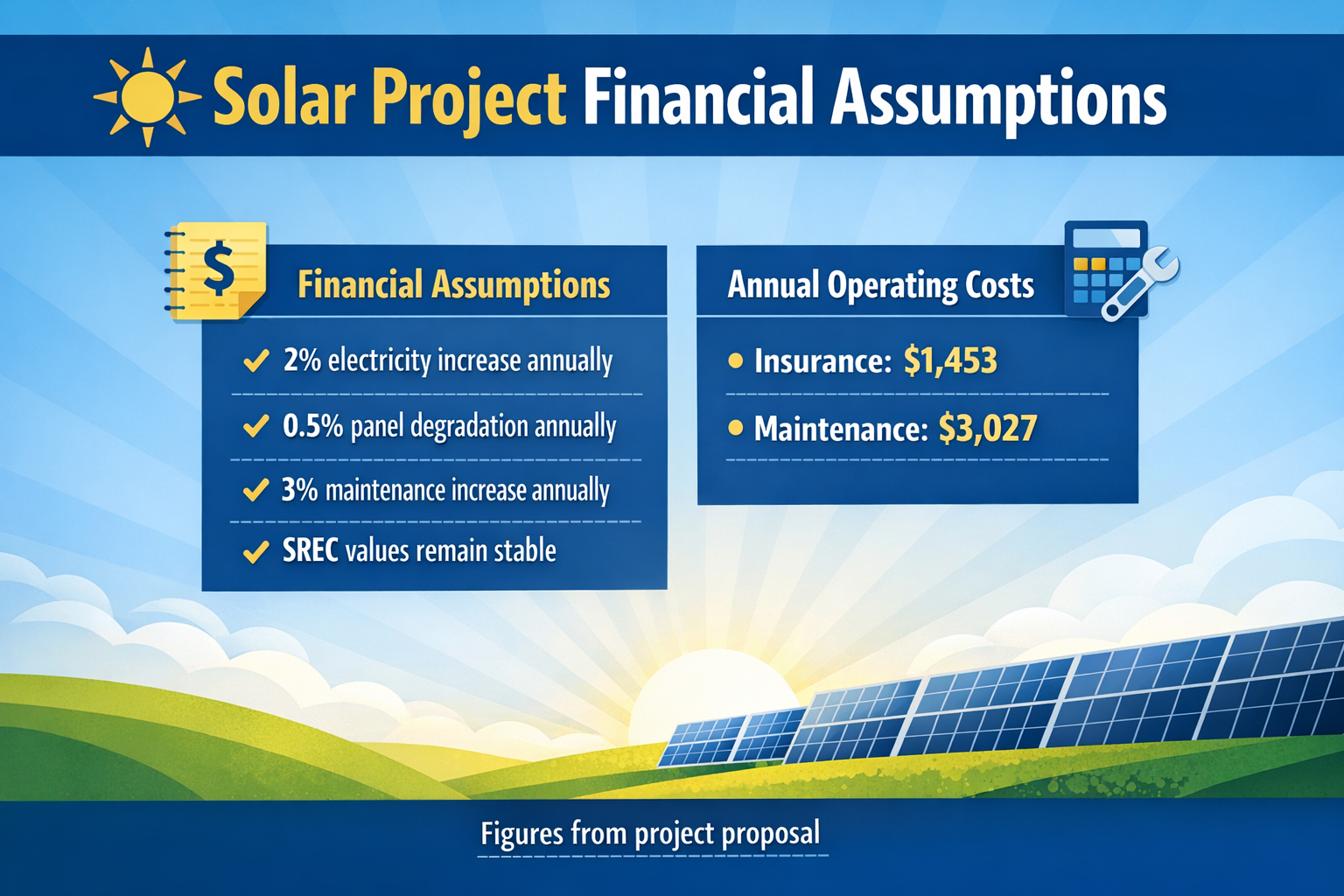
Most modern solar panels are designed to operate for 25 to 30 years. Manufacturers typically guarantee that panels will still produce about 80%-85% of their original output after 25 years. The panels slowly lose efficiency over time — usually around 0.5% per year — but continue producing electricity for decades.
What maintenance do solar systems require?
Solar arrays are generally considered low-maintenance infrastructure. Routine upkeep typically includes periodic inspections, monitoring electrical output, and inverter replacement every 10–15 years. Panels are usually cleaned naturally by rain and snow, although some systems may occasionally be rinsed or inspected if debris accumulates.
Maintenance costs vary, but industry estimates often range between $10 and $20 per kilowatt annually- totaling $3k-$5k annually.
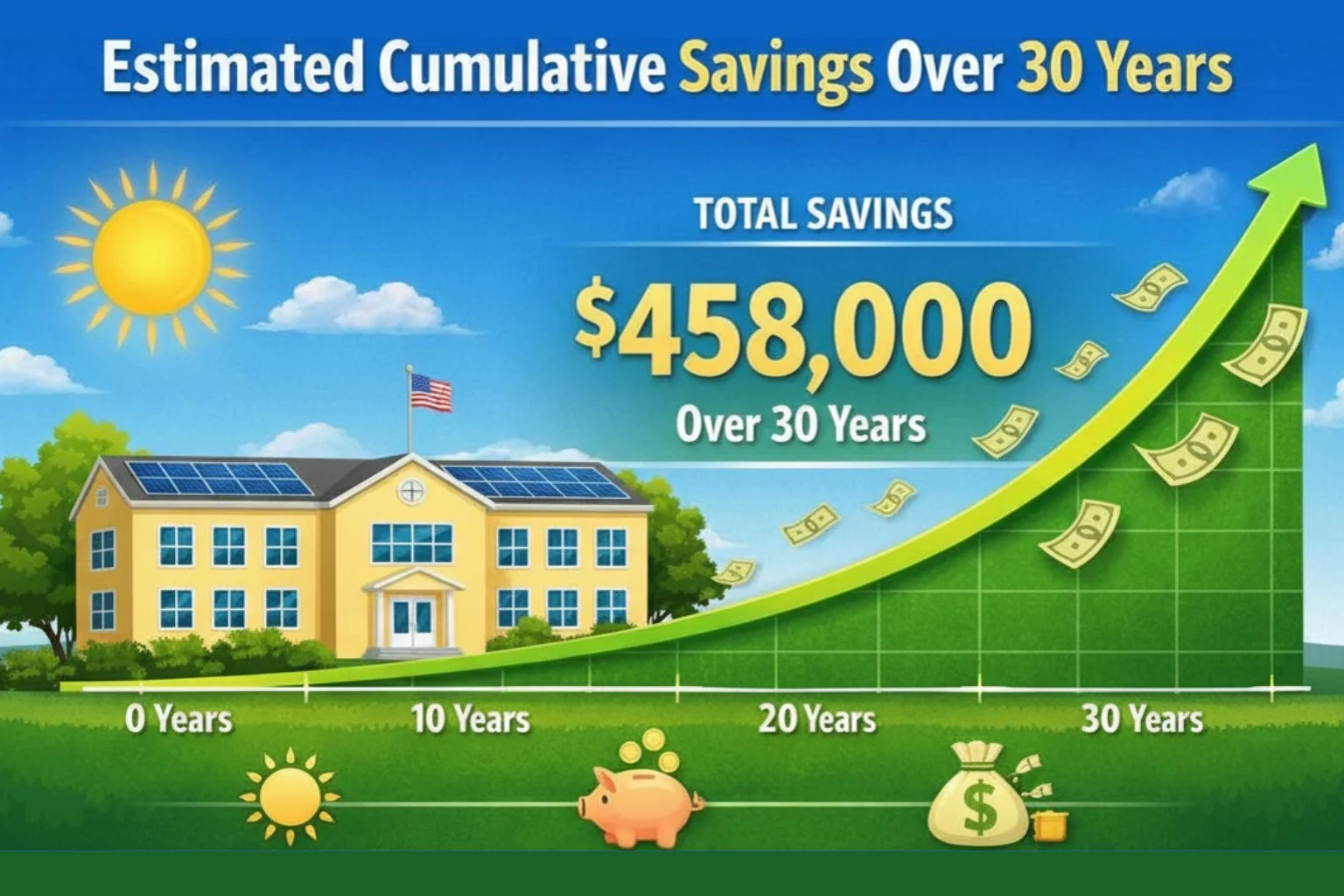
Click for cost savings analysis.
What happens if panels are damaged?
Solar panels are built with tempered glass and designed to withstand hail, snow loads, and strong winds. However, like other outdoor equipment, they can still be damaged during severe storms.
When that happens, repairs or replacement typically fall under a property owner’s insurance coverage. Damaged panels are removed and replaced individually rather than requiring replacement of the entire system.
Can solar panels be recycled?
Solar panel recycling is an emerging industry.
Most panels are made primarily of glass, aluminum frames, silicon cells, and copper wiring. These materials can often be recovered and reused through specialized recycling facilities.
Why incentives matter
Many school solar projects rely on government incentives to make the economics work. Federal energy incentives can cover a large portion of installation costs, reducing the amount that school districts must invest upfront.
Without those incentives, solar projects can take significantly longer to pay for themselves. The current proposal estimates the system will pay for itself in 7.71 years.
Why some schools choose ground-mounted systems
Solar panels can be installed either on rooftops or on the ground.
Ground-mounted systems are often chosen when roofs will need replacement in the near future, buildings cannot support additional weight, or maintenance access is easier at ground level.
Perspectives on Solar in Schools
As with many public infrastructure decisions, school solar projects often generate both support and skepticism.
What supporters say
Supporters of school solar projects often point to the potential for long-term energy savings and reduced reliance on purchased electricity. Because solar panels generate power during the day when schools are in use, some districts see solar as a way to stabilize future utility costs. Advocates also note that solar installations can serve as educational tools, giving students opportunities to learn about energy production, sustainability, and technology.
What critics say
Others raise questions about long-term maintenance costs, panel lifespan, and the financial assumptions used in savings projections. Some residents also ask about how panels would be repaired or replaced if damaged by storms and what the long-term disposal or recycling process would involve.
Local discussion continues
In Geneseo, the proposed middle school solar array remains under consideration, and no final decision has been made. To qualify for federal incentives being considered, the district would need to commit to the project by June and have the system operational by the end of 2027.
As the district evaluates the proposal, community members continue asking questions about costs, benefits, and long-term impacts.
Sources
Geneseo School Board Special Presentations - E-Quantum Consulting - North and South options https://geneseo.schoolboard.net/node/5983
Solar Energy Industries Association (SEIA) – https://www.seia.org
U.S. Department of Energy – Solar Energy Technologies Office – https://www.energy.gov
National Renewable Energy Laboratory (NREL) – https://www.nrel.gov
U.S. Energy Information Administration (EIA) – https://www.eia.gov
U.S. Environmental Protection Agency (EPA) – https://www.epa.gov
International Renewable Energy Agency (IRENA) – https://www.irena.org
U.S. Solar Market Insight Report (SEIA / Wood Mackenzie) – https://seia.org/research-resources/us-solar-market-insight/