By Sarah DeMaranville
Whether you're buying your first home, relocating for work, or deciding where to raise a family, one question usually comes first:
Can I afford to live there?
The answer is more complicated than looking at home prices alone.
Housing is often the largest household expense, but it's only one piece of the financial picture. Household income, mortgage costs, rent, utilities, transportation, taxes, and employment opportunities all influence what it actually costs to live in a community.
To better understand how Geneseo compares with neighboring communities, The Geneseo Current examined data from the U.S. Census Bureau's 2020–2024 American Community Survey.
Housing: Geneseo Costs More Up Front
The biggest difference between Geneseo, Princeton and Kewanee is housing.
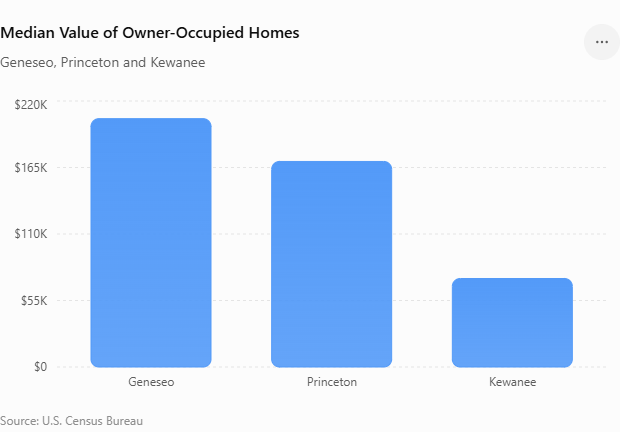
According to the Census Bureau, the median value of an owner-occupied home is:
Geneseo $205,400
Princeton $170,000
Kewanee $73,200
A home in Geneseo is worth nearly three times as much as the typical owner-occupied home in Kewanee.
At first glance, that may make Geneseo seem significantly less affordable.
But economists often view home values as a reflection of something else: demand.
Communities with strong schools, stable employment, desirable neighborhoods, and healthy local economies generally command higher home prices because more people want to live there.
Monthly Mortgage Costs
The Census also estimates what homeowners spend each month.
For homes with a mortgage, the median monthly owner cost is:
Geneseo: $1,688
Kewanee: $1,089
For homeowners without a mortgage, the median monthly housing cost is:
Geneseo: $685
Kewanee: $477
Those figures include expenses such as property taxes, insurance and utilities that are typically included in the Census definition of owner costs.
Renting
Rent follows a similar pattern.
Median monthly gross rent is:
Geneseo: $1,015
Kewanee: $797
That's a difference of more than $2,600 per year for the typical renter.
Princeton generally falls between the two communities on both home values and rental costs.
Higher Costs—But Higher Incomes
Housing tells only half the story.
The other half is income.
Median household income is:
Geneseo $70,147
Princeton $61,900
Kewanee $50,900
In other words, Geneseo households earn roughly 38% more than Kewanee households on average.
Higher incomes help offset higher housing costs.
That's why economists generally evaluate housing affordability rather than simply asking whether homes are expensive.
Homeownership
Another indicator of community stability is homeownership.
According to the Census:
76.3% of Geneseo homes are owner-occupied.
69.2% of Kewanee homes are owner-occupied.
Higher homeownership often corresponds with longer-term residency, greater neighborhood investment, and increased civic participation, although it isn't a measure of quality by itself.
Electricity Costs
Electricity is one area where Geneseo residents appear to have a cost advantage compared with state and national averages.
Geneseo operates its own municipal electric utility. Under the city's 2026 residential rate schedule, customers pay 10.829¢ per kilowatt-hour for the first 500 kWh and 10.294¢ for usage above 500 kWh, plus a $25 monthly basic charge.
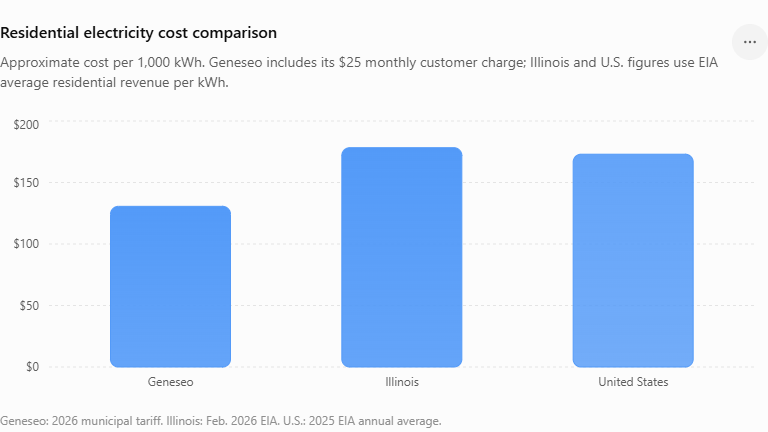
For a household using 1,000 kWh in a month, that translates to approximately $130.62 before applicable taxes, or an effective rate of about 13.06 cents per kWh when the monthly basic charge is included.
For comparison, the most recent finalized annual data from the U.S. Energy Information Administration puts Illinois' 2024 residential average at 15.87¢ per kWh. The national residential average increased to 17.30¢ per kWh in 2025.
More recent monthly data show Illinois residential electricity averaging 17.83¢ per kWh in February 2026, although monthly rates fluctuate and shouldn't be directly compared with a full-year national average.
The comparison isn't perfectly apples-to-apples. Geneseo's figure is calculated from its published rate schedule, while EIA averages represent total residential utility revenue divided by electricity sold and therefore incorporate the various costs customers actually pay. Still, the figures indicate that electricity is one household expense where Geneseo residents generally pay less than broader Illinois and national benchmarks.
It's About More Than Price
If affordability were based solely on home prices, Kewanee would clearly have the advantage.
But lower housing costs don't necessarily mean a community is less expensive overall.
Communities with lower home values often also have lower household incomes, fewer employment opportunities, or slower housing demand.
Geneseo's higher housing costs are accompanied by:
Higher household incomes
Higher educational attainment
Lower poverty
Higher homeownership
Stable population
Those characteristics generally increase demand for housing, which in turn pushes home values higher.
So, Is Geneseo More Expensive?
Yes—but the answer deserves context.
Buying or renting a home in Geneseo will generally cost more than in Kewanee and somewhat more than in Princeton.
However, residents also tend to earn more, and the community has historically maintained stronger home values.
For some buyers, Kewanee's lower home prices may make homeownership easier to achieve.
Others may find Geneseo's combination of schools, employment opportunities, healthcare, and community amenities worth paying more for.
Ultimately, "affordable" isn't just about the purchase price of a house.
It's about what residents earn, what they receive in return, and whether a community offers the quality of life they're looking for.
Sources:
U.S. Census Bureau — American Community Survey —
U.S. Census Bureau QuickFactsU.S. Energy Information Administration (EIA) —
U.S. Energy Information Administration — Electricity DataCity of Geneseo Public Records
Council for Community and Economic Research (C2ER) — C2ER Cost of Living Index
U.S. Bureau of Labor Statistics (BLS) — U.S. Bureau of Labor Statistics
About the State of Geneseo Series
State of Geneseo is an ongoing Geneseo Current series examining the data behind our community. Each installment explores a different aspect of life in Geneseo—from housing and affordability to schools, healthcare, infrastructure, business growth, parks, volunteerism, and local government—to better understand what makes a healthy small town thrive and where opportunities for improvement may exist.