
Henry County officials will consider revised regulations Wednesday governing battery and other energy storage systems in unincorporated areas of the county.
The county's agenda identifies the matter as 26-09 ZO TA, a proposed text amendment involving a revised Appendix D Energy Storage Systems Ordinance covering commercial and private energy storage systems.
The discussion comes as Illinois is moving rapidly to add large-scale electricity storage to its power grid.
What is a battery energy storage system?
Large battery energy storage systems, often referred to as BESS, are designed to store electricity and release it later.
Unlike a power plant that produces electricity from fuel, a battery storage facility charges when electricity is available and can return that electricity to the grid when it is needed.
Illinois law defines an energy storage system covered by its new county-siting requirements as a non-combustion facility with aggregate capacity greater than 1,000 kilowatts that can absorb energy, store it and use it later. The definition includes electrochemical technologies such as batteries.
These facilities can range substantially in size and may include rows of battery enclosures along with electrical equipment, substations, transmission connections, access roads, and other supporting infrastructure.
Illinois is pushing for much more storage
Under the state's Clean and Reliable Grid Affordability Act, Illinois has established a goal of 3,000 megawatts of cumulative energy-storage capacity committed to commercial operation by the end of 2030.
The Illinois Power Agency held its first utility-scale storage procurement this summer with a target of 1,038 megawatts.
On Sept. 1, the Illinois Commerce Commission approved contracts supporting 600 megawatts of new storage projects in Illinois. Of that amount, 520 megawatts came from projects in the MISO territory, which covers much of downstate and western Illinois, while 80 megawatts came from the PJM territory serving the ComEd region.
Additional state procurements are planned as Illinois works toward the 3,000-megawatt target.
That means counties are establishing local rules at the same time a new statewide market for large energy-storage projects is developing.
Counties have limited authority under new state law
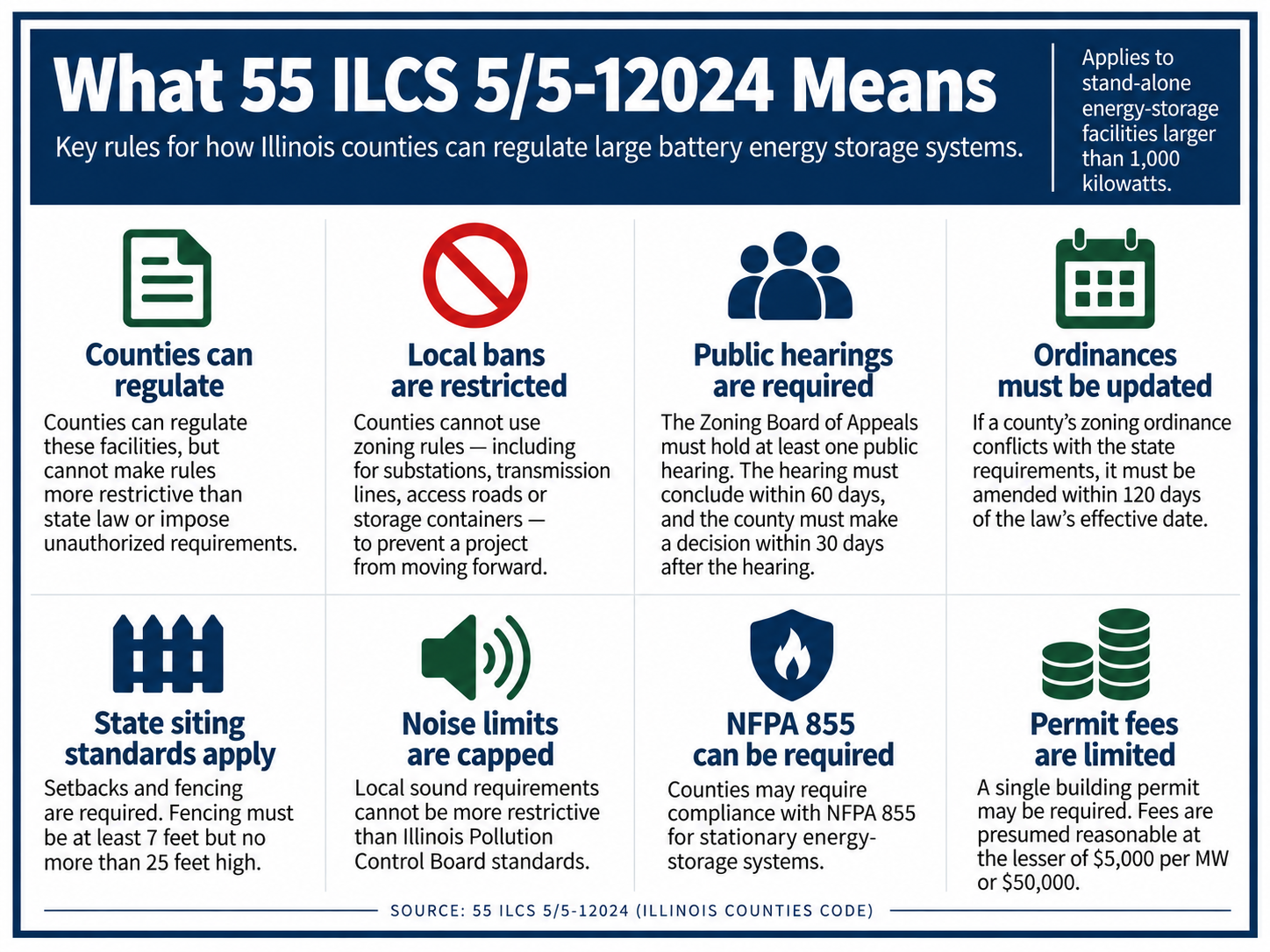
Henry County will not have unlimited discretion in writing those rules. A new section of the Illinois Counties Code establishes statewide parameters for county regulation of large energy storage systems.
Counties with zoning authority may regulate energy-storage facilities in areas outside municipal zoning jurisdiction, but state law says those local requirements cannot be more restrictive than the standards allowed by the statute or impose additional requirements not specified by state law.
The law establishes several specific siting standards:
Battery or other storage enclosures must generally be at least 150 feet from nonparticipating residences and occupied community buildings, including schools, places of worship, libraries, child-care facilities and community centers.
They must generally be at least 50 feet from certain nonparticipating property lines and 50 feet from public road rights-of-way.
Facilities must also be enclosed by fencing at least seven feet high and no more than 25 feet high.
Counties cannot impose noise limits more restrictive than those established by the Illinois Pollution Control Board.
The law also allows counties to require compliance with NFPA 855, a national safety standard governing stationary energy storage systems.
Fire and emergency response among issues to watch
Large lithium-ion battery systems present different emergency-response considerations than conventional buildings or electrical equipment. One concern is thermal runaway, a process in which a battery cell generates heat faster than it can dissipate it, potentially spreading to other cells.
NFPA 855 establishes requirements addressing issues including installation, separation, fire protection and emergency planning for stationary energy-storage systems.
Exactly how Henry County proposes to address fire protection, emergency-response planning and coordination with local fire districts should become clearer when the proposed Appendix D is available.
Other provisions worth watching include decommissioning requirements, financial guarantees, fencing and security, noise, drainage, and the process developers would have to follow to obtain local approval.
State law also sets the approval process
Illinois law requires at least one public hearing before a county grants siting approval or a special-use permit for a qualifying energy-storage facility.
Interested parties must be given an opportunity to present evidence and cross-examine witnesses, subject to reasonable limitations established by the county. Public comment must also be allowed.
The county must generally make its siting or permitting decision within 30 days after the hearing concludes.
Perhaps more significantly, state law says an application that complies with the applicable state requirements, a compliant county zoning ordinance and other state and federal regulations shall be approved.
Counties also cannot permanently or temporarily prohibit qualifying energy-storage systems in agricultural or industrial zoning districts.
The legislation additionally requires counties with existing zoning ordinances that conflict with the new law to amend those ordinances within 120 days of the law taking effect.
Why is Henry County changing its ordinance now?
That remains an unanswered question ahead of Wednesday's meeting. The agenda identifies the matter as a county zoning text amendment rather than an application for a specific energy-storage development.
The Geneseo Current has asked Henry County whether the proposed revision is primarily intended to bring its existing ordinance into compliance with the new state law and whether developers have contacted the county about potential commercial energy-storage projects.
No specific Henry County battery-storage development has been identified in the materials reviewed by The Current.
Wednesday's meeting should provide a clearer picture of how Henry County intends to regulate the emerging industry — and how much authority remains at the local level as Illinois establishes statewide siting standards and encourages development of thousands of megawatts of new energy storage.
The Planning Committee and Zoning Board of Appeals meeting begins at 5:30 p.m. Wednesday, Sept. 23, in Room 102J of the Henry County Courthouse, 307 W. Center St., Cambridge.
Sources
The proposed revised ordinance was not included with the online meeting agenda as of publication. The Geneseo Current has requested a copy from Henry County Zoning and Building Officer Kyle Stromquist, along with information about what prompted the revision and whether the county has received inquiries about potential energy-storage developments.