
On paper, comparing Geneseo to Wheaton, Illinois, might seem like an exercise in mismatched communities.
Wheaton has more than 50,000 residents, sits within the Chicago metropolitan area and has a median household income of approximately $120,000. Geneseo has fewer than 7,000 residents and a median household income of about $70,000.
Yet one economic measure turns that comparison on its head.
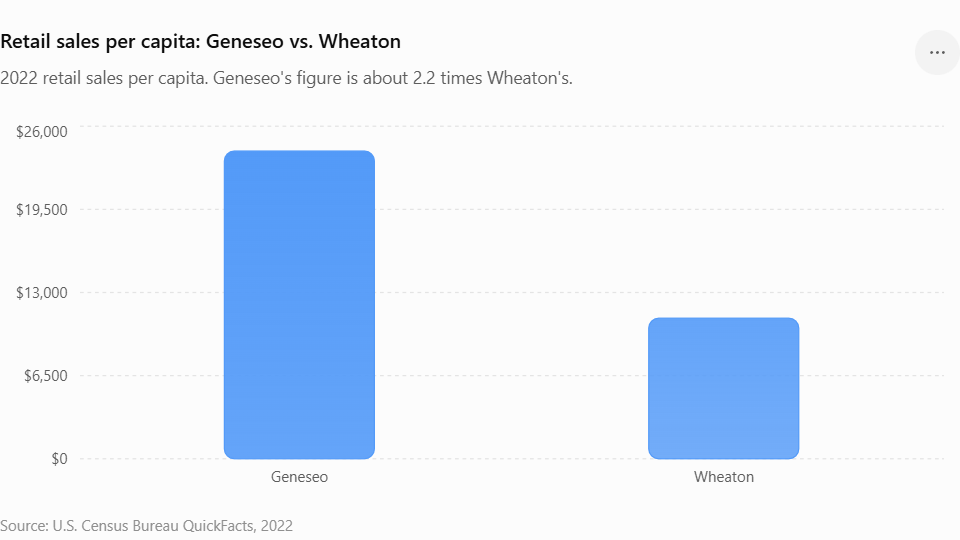
According to the U.S. Census Bureau, Geneseo recorded approximately $157.4 million in retail sales in 2022, or $24,062 in retail sales per capita.
Wheaton generated substantially more retail activity overall — approximately $582.9 million — but its much larger population means its retail sales amounted to only $10,991 per capita.
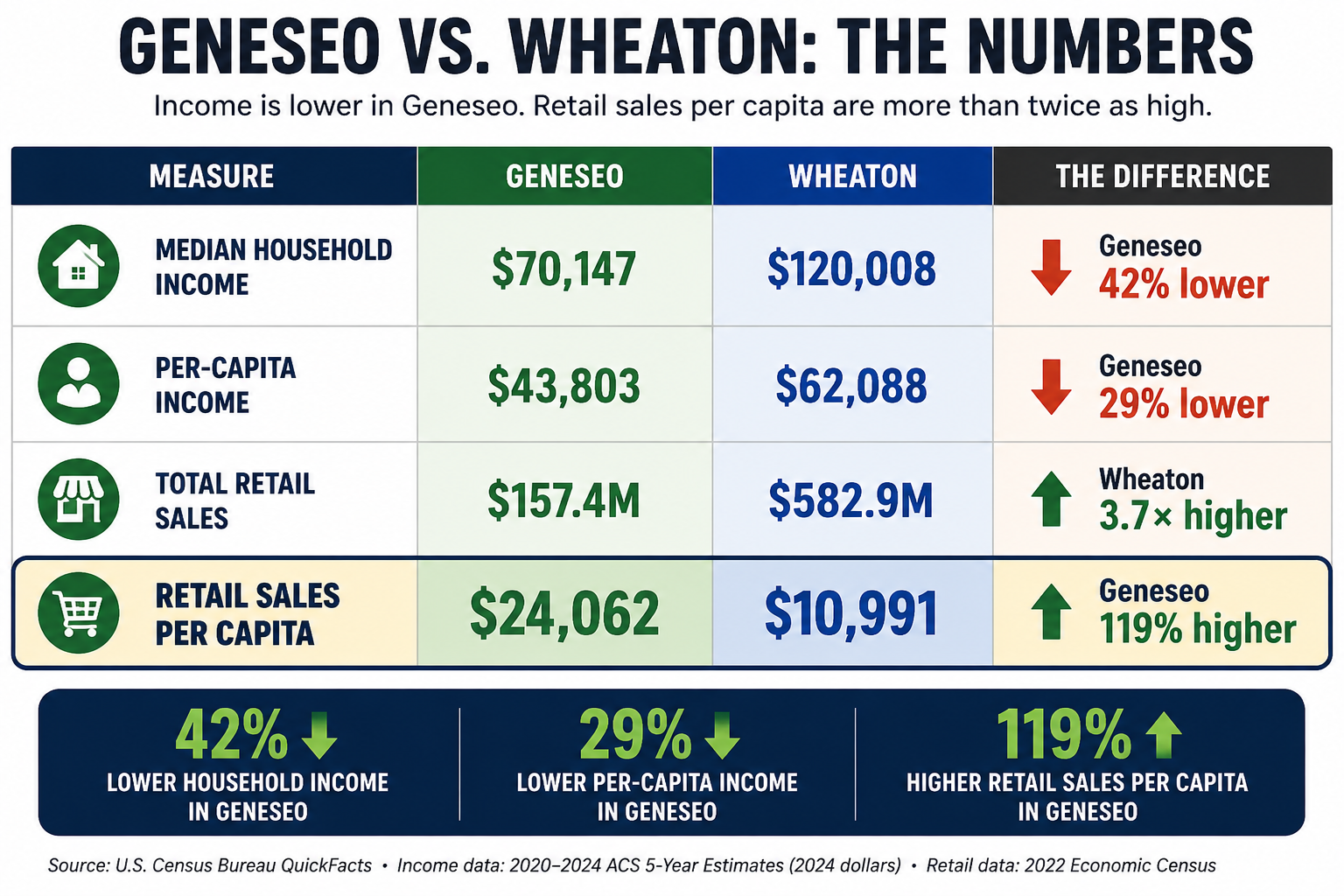
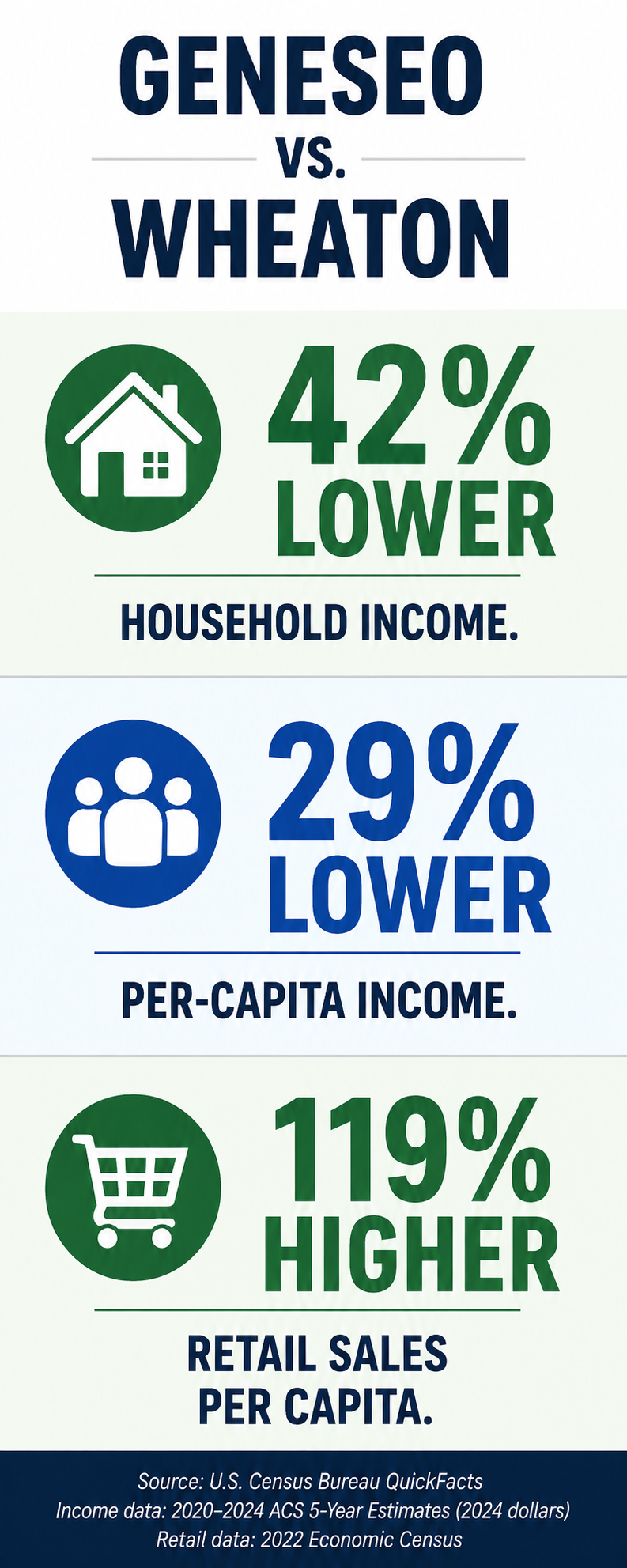
In other words, Geneseo's retail sales per resident were approximately 119% higher than Wheaton's.
For Lindsie Akers, executive director of the Geneseo Chamber of Commerce, the numbers reflect something she believes is already evident in the local business community.
“For a small town, Geneseo really does have an exceptional amount to offer,” Akers said. “When you compare our shopping, dining and services to many other rural communities our size, we’re incredibly fortunate to have the variety and quality we do. I think these numbers reflect what many of us already know — Geneseo punches well above its weight for a community of 6,500 people.”
That doesn't mean the average Geneseo resident went shopping and spent $24,062 in local stores.
It means something potentially much more important about Geneseo's role in the regional economy.
Retail Sales Aren't the Same as Resident Spending
Retail sales per capita can easily be misunderstood.
The Census Bureau figure takes retail sales generated by businesses located within a community and divides those sales by the community's population. It does not identify where the customers making those purchases live.
That distinction is especially important for smaller communities.
A customer from Atkinson, Cambridge, Annawan or elsewhere in the surrounding area who purchases something at a Geneseo retailer contributes to Geneseo's retail sales total—but isn't counted as a Geneseo resident when that total is divided by population.
Travelers and other visitors can do the same.
As a result, unusually high retail sales per capita can be an indication that a community's businesses are attracting spending from beyond its municipal boundaries.
The Census figures alone, however, do not establish where Geneseo's retail customers are coming from. More detailed market and sales-tax data would be needed to measure Geneseo's actual trade area.
A Striking Comparison
The difference becomes more noteworthy when the economic profiles of the two communities are considered.
Wheaton's median household income is approximately $120,008, compared with $70,147 in Geneseo.
Per-capita income is approximately $62,088 in Wheaton and $43,803 in Geneseo.
Wheaton also operates in a much denser market.
Its 2020 population density was approximately 4,768 people per square mile, compared with 1,407 in Geneseo. Wheaton is also part of the much larger suburban Chicago economy.
The City of Wheaton actively promotes downtown redevelopment and business attraction and has used tax increment financing districts as part of its effort to create a downtown offering retail and dining opportunities.
By many conventional measures, Wheaton should have tremendous advantages as a retail market: more residents, greater population density, substantially higher household incomes and access to a massive metropolitan population.
And in total dollars, it does.
Wheaton's $582.9 million in retail sales was about 3.7 times Geneseo's $157.4 million.
But Wheaton has roughly eight times Geneseo's population.
That's what makes the per-capita comparison noteworthy.
Geneseo May Function as More Than a Town of 6,500
The numbers raise a larger question about how Geneseo's economy should be viewed.
Population is one of the first statistics businesses, developers and residents often use when evaluating the size of a local market. For Geneseo, that number can make the potential customer base appear relatively small.
Retail activity suggests the economic footprint may be considerably larger.
Geneseo serves not only its own residents but sits amid a collection of smaller communities and rural areas. It is also located directly along Interstate 80.
It is reasonable to investigate whether those factors contribute to Geneseo's unusually high retail sales per capita, but the Census data by itself cannot establish how much of the difference is attributable to regional shoppers, interstate traffic or other factors.
That's an important distinction.
The data establishes that retail businesses located in Geneseo generate a large amount of sales relative to the city's resident population.
The explanation for that performance requires another layer of analysis.
$24,062 Versus $10,991
The scale of the difference is easier to see when the numbers are placed side by side.
That's approximately $2.19 in Geneseo retail sales for every $1 generated per capita in Wheaton.
Again, this should not be interpreted as Geneseo residents having more purchasing power.
The income statistics show precisely the opposite.
Wheaton's median household earns approximately 71% more than Geneseo's median household.
The more interesting possibility is that Geneseo's retail businesses are serving a market that isn't accurately represented by the number of people who happen to live within the city limits.
Why It Matters for Local Businesses
For someone considering opening or expanding a business in Geneseo, population alone may therefore provide an incomplete picture.
A city of approximately 6,500 residents generating more than $157 million in annual retail sales is different from a city of the same population whose retail activity primarily reflects purchases made by its own residents.
The distinction also matters for existing businesses.
If Geneseo is functioning as a regional shopping and service destination, businesses aren't necessarily competing only for the wallets of Geneseo residents. Their potential customer base includes people who travel into the community for shopping, healthcare, dining, employment, school activities, recreation and other purposes.
There Are Limits to the Comparison
There are also reasons to be cautious about drawing sweeping conclusions from one statistic.
Retail sales can be heavily influenced by the types of businesses located within a municipality. Automobile dealers, grocery stores, building-material retailers and other high-volume businesses can generate substantial sales.
Municipal boundaries matter as well. A major shopping area located just outside one city's boundaries wouldn't appear in that city's retail total even if residents shop there regularly.
Wheaton also exists within a dense network of neighboring suburban communities. Consumers can easily cross municipal boundaries to shop elsewhere, meaning a portion of Wheaton residents' spending inevitably occurs outside Wheaton.
Geneseo and Wheaton therefore represent fundamentally different retail environments.
That's actually what makes the comparison useful.
It demonstrates why population and household income aren't enough to describe a local economy.
A Bigger Picture of Geneseo
The Wheaton comparison shouldn't be interpreted as evidence that Geneseo has a "better" retail economy. The two communities are very different, and retail sales can be influenced by everything from municipal boundaries to the types of businesses located within them.
But the comparison does put Geneseo's numbers into perspective.
A community of roughly 6,500 residents generated more than $157 million in retail sales in 2022 — approximately $24,062 per resident. That level of activity cannot tell us exactly who is spending those dollars or why they are being spent in Geneseo, but it does show that the city's retail activity is substantial relative to its population.
For local businesses and those considering investing here, that's an important distinction. Geneseo's municipal population may be relatively small, but population alone does not fully describe the amount of commerce taking place within the community.
The numbers also reinforce the importance of thinking about Geneseo as more than the people who live within its city limits. Residents of surrounding communities, rural households, commuters and visitors can all contribute to local sales, although the Census data does not allow us to determine how much each group contributes.
What the data does establish is striking enough on its own:
$157 million in annual retail sales in a community of roughly 6,500 people.
Geneseo may be a small city by population.
Its retail economy doesn't necessarily behave like one.
Sources: U.S. Census Bureau QuickFacts; 2020–2024 American Community Survey 5-Year Estimates; 2022 Economic Census, Retail Trade (EC2244BASIC); U.S. Census Bureau Population Estimates Program.