
The closure of Tyson Foods' beef processing plant in Joslin eliminated approximately 2,500 jobs and removed one of the region's largest cattle buyers almost overnight.
But the plant itself remains a significant piece of Rock Island County's economic landscape.
Property records obtained by The Current show that the main Joslin plant property encompasses more than 323 acres, carries a taxable value exceeding $8.2 million and generated nearly $600,000 in property taxes for the 2025 tax year.
The records provide a clearer picture of the property left behind as state officials begin discussions with Tyson about potentially selling or repurposing the facility.
More Than 323 Acres of Industrial Property
Rock Island County property records identify the main plant as parcel 10-14-400-002 at 28424 38th Avenue North in Hillsdale.
The 323.65-acre property is classified as industrial.
The parcel remains legally recorded under IBP Inc., the meatpacking company Tyson acquired in 2001. Tyson Foods Inc. is listed as the current mailing recipient for the property.
For tax year 2025, payable in 2026, the property has a net taxable value of $8,226,359.
The total property-tax bill, including a small drainage assessment, is $597,857.44.
Riverdale Schools Receive Largest Share
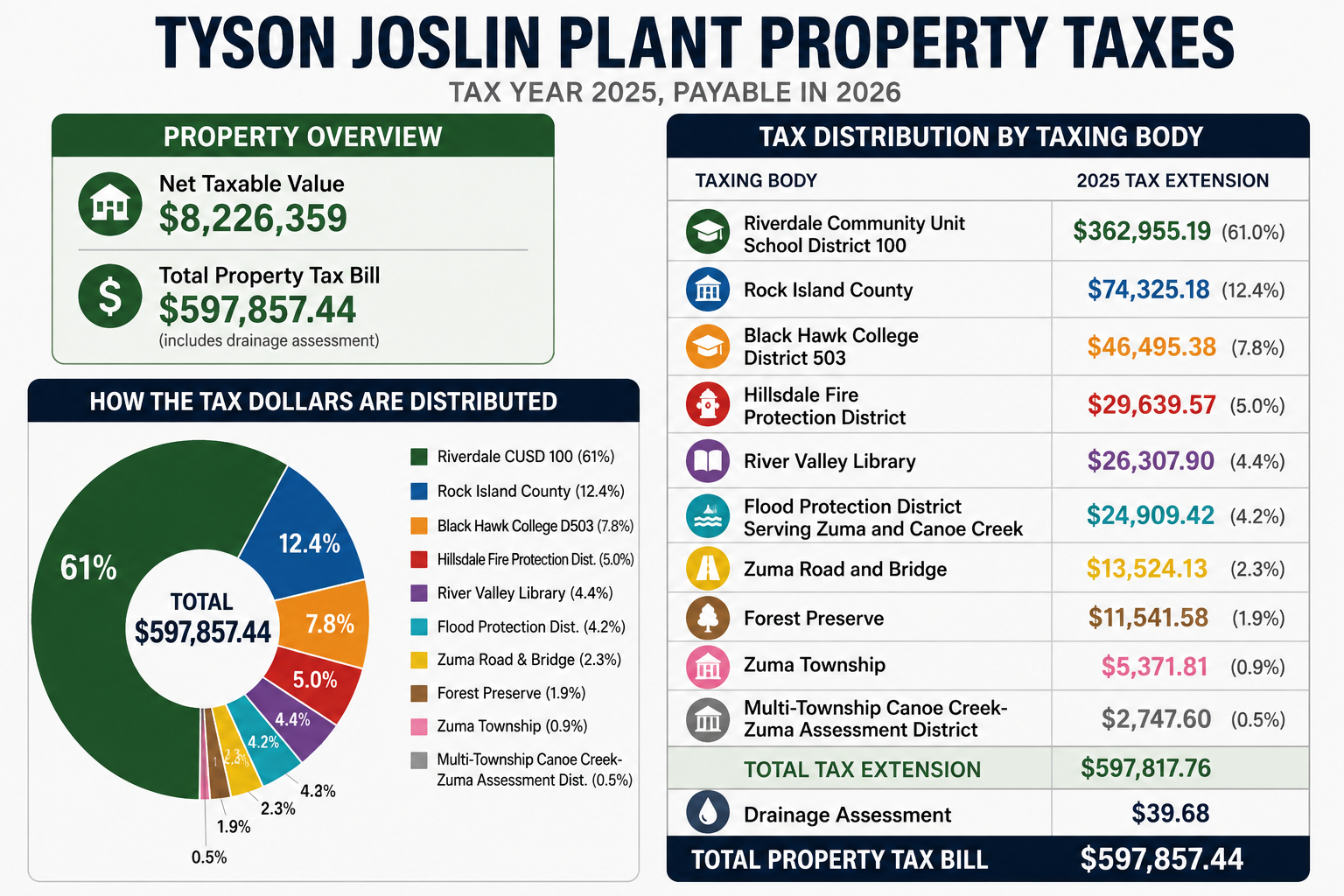
More than half of the property's tax extension goes to Riverdale Community Unit School District 100.
The district's extension from the main plant parcel for the 2025 tax year is $362,955.19 — approximately 61% of the total extension.
Rock Island County receives $74,325.18.
Black Hawk College District 503 receives $46,495.38, while the Hillsdale Fire Protection District receives $29,639.57.
The River Valley Library receives $26,307.90, and the Flood Protection District serving Zuma and Canoe Creek receives $24,909.42.
Smaller portions of the tax bill go to Zuma Road and Bridge at $13,524.13, the Forest Preserve at $11,541.58, Zuma Township at $5,371.81 and the Multi-Township Canoe Creek-Zuma assessment district at $2,747.60.
Together, those taxing bodies account for a property-tax extension of $597,817.76. An additional $39.68 drainage assessment brings the total bill to $597,857.44.
Plant Closed as Tyson Restructures Beef Operations
Tyson abruptly ended operations at the Joslin beef facility Aug. 13 as part of a broader restructuring of its beef business.
The facility employed approximately 2,500 workers and had the capacity to process approximately 3,000 cattle per day.
Tyson also announced that it would close its case-ready beef facility in Eagle Mountain, Utah, and pursue the sale of its beef facility in Pasco, Washington.
The company said it would concentrate its beef processing operations around plants in Dakota City, Nebraska; Holcomb, Kansas; and Amarillo, Texas.
The restructuring comes during a historically tight period for the nation's cattle supply. Tyson has cited the shortage of available cattle and continued losses in its beef business as factors behind changes to its processing network.
State Discussing Future of Joslin Facility
Although Tyson specifically announced plans to pursue a sale of its Pasco facility, the company's Aug. 13 announcement did not similarly announce the Joslin property for sale.
Illinois officials, however, have since acknowledged discussions about the future of the Joslin site.
Gov. JB Pritzker told KWQC on Aug. 19 that the state was talking with Tyson about potentially repurposing or selling the facility.
No purchaser or specific new use for the Joslin property has been publicly announced.
The property itself represents substantially more than an empty industrial building.
The Joslin facility was developed to support a large-scale beef processing operation capable of handling thousands of cattle each day. Federal and state environmental records identify regulated wastewater and other industrial operations associated with the site.
The facility operates under Illinois National Pollutant Discharge Elimination System Permit IL0003913. Federal EPA records also identify the Joslin operation in environmental programs involving air emissions, industrial wastewater, waste management and risk-management requirements.
That existing industrial footprint is part of what remains following Tyson's departure from the facility.
A Significant Property Remains
The closure's most immediate effects continue to be felt by the thousands of workers who lost their jobs and by cattle producers who relied on Joslin as a nearby market.
While Tyson has ended beef production in Joslin, the land, industrial infrastructure and taxable property remain.
With Illinois officials now publicly discussing the possibility of a sale or repurposing of the facility, the future of that 323-acre industrial site represents another chapter in the economic impact of Tyson's departure from the region.