
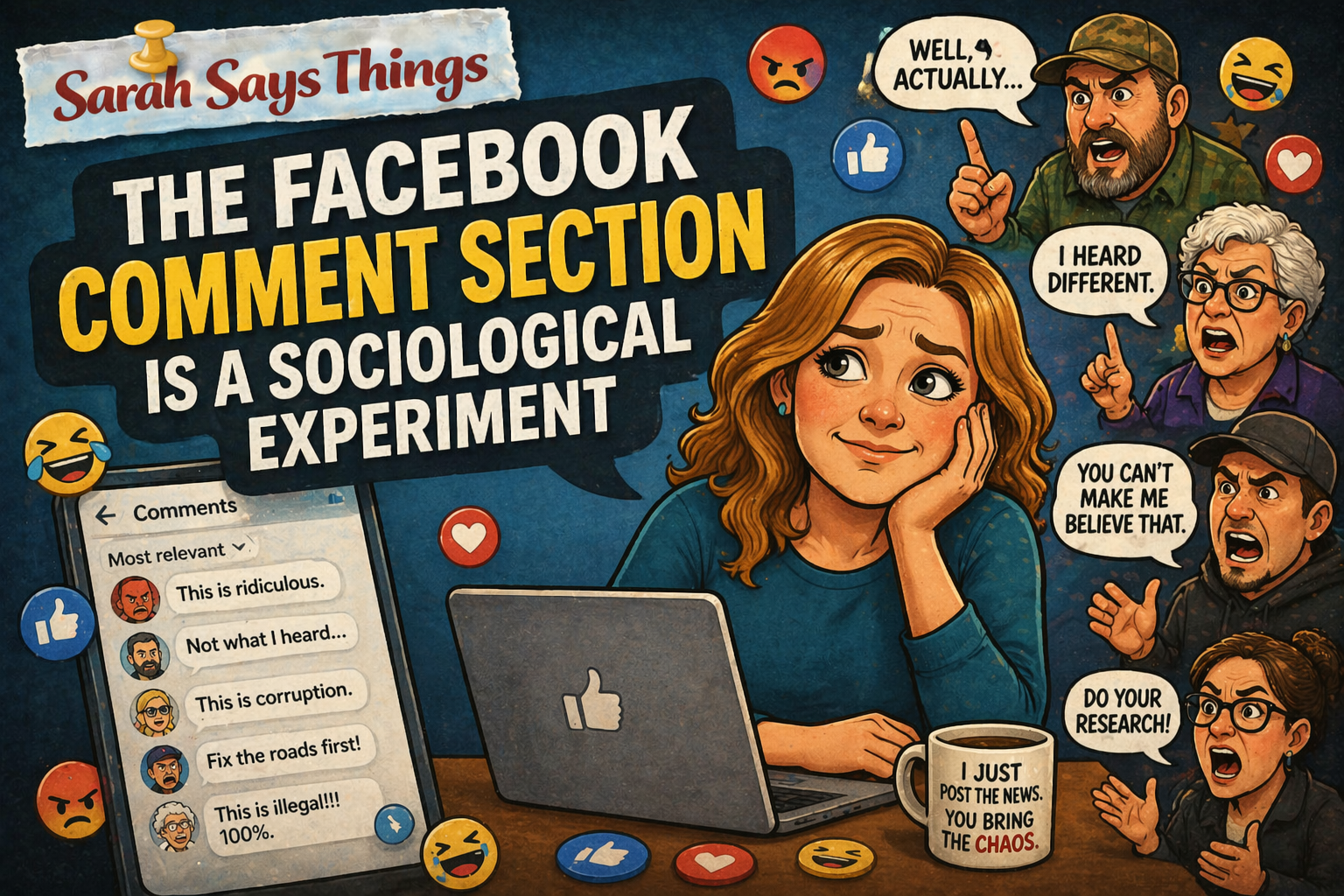
I have come to believe the Facebook comment section is one of the most fascinating social experiments ever conducted. Not intentionally, of course. But it is.
Because nowhere else can you watch the full range of human behavior unfold under a completely normal post about something extremely harmless. For example, imagine someone posts:
“Reminder: The City Council meeting is tonight at 7 p.m.”
A simple piece of information. Neutral. Helpful. Mildly boring. And yet within minutes the comment section will contain the following:
One person asking what time the meeting is.
Someone else announcing they “heard something different” but refusing to elaborate.
A third person vaguely suggesting corruption.
Another person asking why the city doesn’t “fix the roads first,” even though the post had absolutely nothing to do with roads.
And then there’s always one individual who confidently declares the entire situation illegal despite having clearly learned everything they know about municipal law from a YouTube video.
The best part is how quickly people become experts. A post can be about snow removal and within five minutes the comment section contains professional-level analysis from people who have never operated anything more complicated than a microwave.
Suddenly everyone is an infrastructure specialist. “You know what they should do…” This phrase alone has solved approximately zero problems but continues to appear with impressive frequency.
Another fascinating species in the comment section ecosystem is the person who is deeply suspicious of basic information. For example: “The parade starts at 10 a.m.”
Immediately someone replies: “Is that what THEY want us to think?”
Who is they? What is the conspiracy surrounding the parade? Are we suggesting the marching band is involved in a cover-up?
These questions are never answered. But the suspicion remains.
Then there’s the classic internet detective who begins every sentence with: “Well I don’t know all the facts, but…” And then proceeds to deliver a twelve-paragraph analysis based entirely on speculation, vibes, and something their cousin’s neighbor once mentioned at a graduation party.
But my personal favorite is the person who treats every comment section like a courtroom. They arrive with full confidence, a strong opinion, and absolutely no intention of changing their mind. Evidence is irrelevant. Context is unnecessary. The objective is not understanding. The objective is victory.
Meanwhile the original post was just trying to tell people the farmers market moved to Saturday. And somehow we’re now debating property taxes, the school curriculum, and whether the weather forecast is politically motivated.
This is why running a community news page is such a unique experience. You start the day thinking you’re sharing useful information. You end the day watching two people argue about something neither of them actually read.
Which brings us to the most consistent law of the Facebook comment section: The people who are the angriest about a post are often the ones who read the least of it. It’s a remarkable system. Someone will comment with complete outrage, only to later admit they only read the headline. Occasionally not even that. Sometimes just the vibe of the headline.
And yet the confidence level remains extraordinary. If confidence alone were a renewable energy source, Facebook comment sections could power the entire Midwest.
But despite all of this, I actually love it. Because hidden among the chaos are the people who genuinely care about the community. The ones who ask thoughtful questions. The ones who thank volunteers. The ones who show up to events and support local things simply because they want the town to succeed. Those people are the reason the whole experiment works. Everyone else is just… additional entertainment.
And honestly, if you’ve ever watched a Facebook comment section unfold in real time, you know exactly what I mean. It’s not just social media. It’s anthropology.