
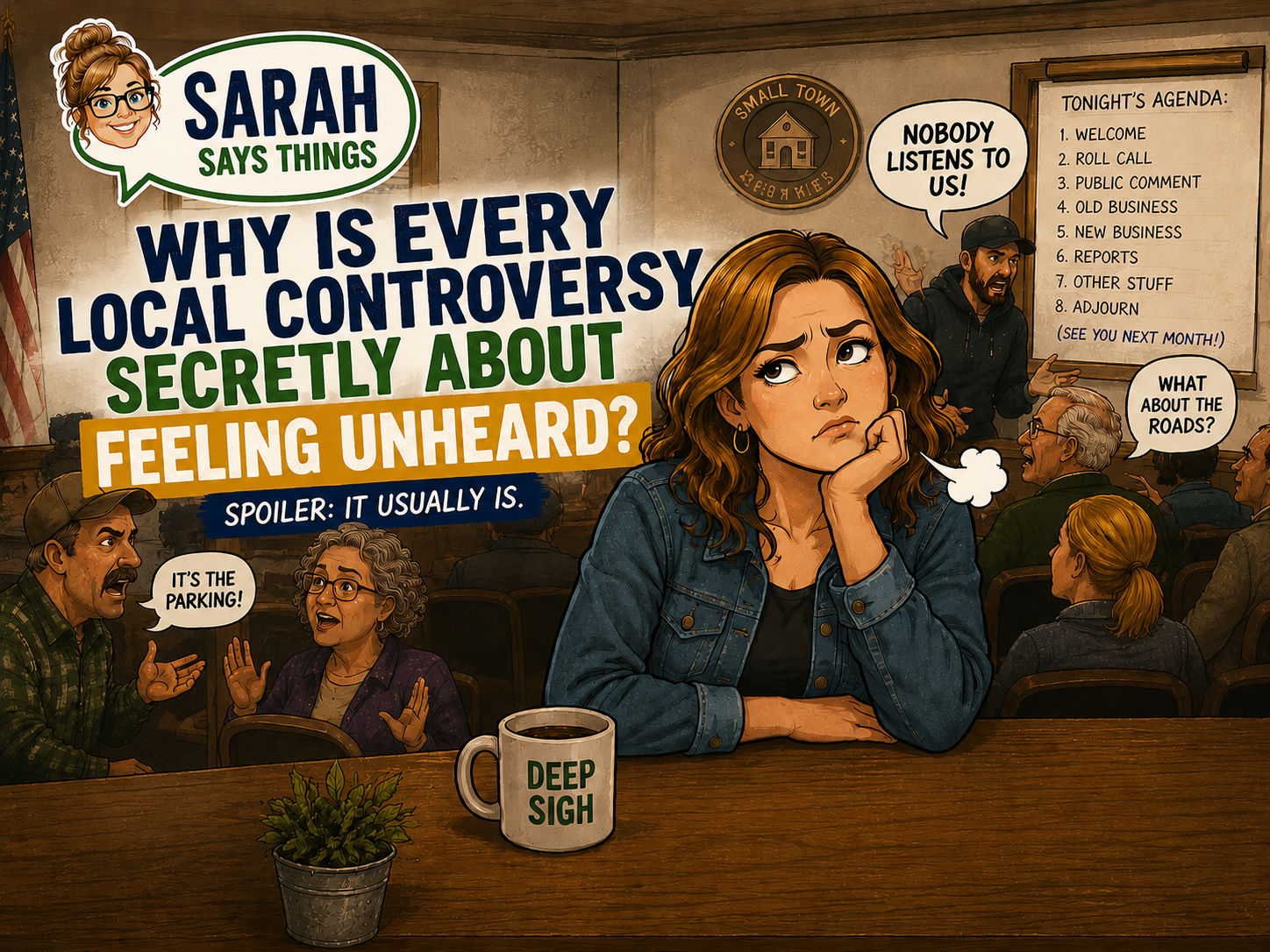
Every local controversy pretends to be about something practical.
Parking.
Taxes.
Bike paths.
Farmers Markets.
Sidewalks.
School policies.
Whether a parade route moved three feet to the left in 1997.
But if you sit through enough public meetings or scroll Facebook long enough, you realize almost none of these fights are actually about the issue itself.
They’re about people wanting acknowledgment— like dehydrated plants reaching for sunlight.
Because most people can survive a decision they dislike.
What they cannot survive is feeling ignored while somebody says: “Thank you for your comment,” before immediately moving to Agenda Item 7B and discussing mulch at the welcome sign.
Small towns make this way worse because accessibility changes expectations.
In larger cities, people assume government is distant and vaguely robotic.
In small towns? People see officials at church and football games, in line at Casey’s, aggressively inspecting cantaloupes at Fareway.
So when residents feel dismissed, it stops feeling political very quickly. Now it feels personal.
Public meetings have quietly transformed from decision-making bodies into emotional support groups with Robert’s Rules of Order.
People don’t just show up wanting outcomes.
They want acknowledgment, transparency, validation, eye contact.. really just some microscopic indication somebody considered their opinion before the PowerPoint was finalized six months ago.
That’s why tiny issues suddenly detonate into 147-comment Facebook wars.
It’s almost never JUST about the issue.
It’s accumulated frustration.
Feeling excluded.
Feeling managed.
Feeling like “public input” means: “We already decided, but please enjoy this ceremonial microphone.”
Now to be fair: some people absolutely ARE unreasonable.
There are citizens who interpret every inconvenience as the collapse of Western civilization.
A new stop sign goes up and suddenly somebody’s posting three paragraphs about constitutional freedom.
But leadership also dramatically underestimates how much tension disappears when people simply feel informed and respected.
Most residents are actually pretty reasonable when treated like adults.
The problem is that many institutions communicate like hostage negotiators reading from legal disclaimers.
And once people decide nobody’s listening?
Congratulations.
Now Facebook becomes Congress.
Everyone becomes a constitutional scholar.
And Karen from down the street is preparing a 19-slide Canva presentation about drainage infrastructure.
People don’t actually lose their minds over parking. Or taxes. Or the Farmers Market. Or school policy.
They lose their minds when they feel like the decision was made before they ever opened their mouth.
That’s the real accelerant in small-town controversy.
Because once people believe the public discussion is mostly ceremonial, every meeting starts feeling less like government and more like community theater with a consent agenda.
And suddenly the issue itself barely matters anymore.
Now it’s about respect. Access. Transparency. Whether ordinary people still have a seat at the table — or just a three-minute timer at the microphone.