
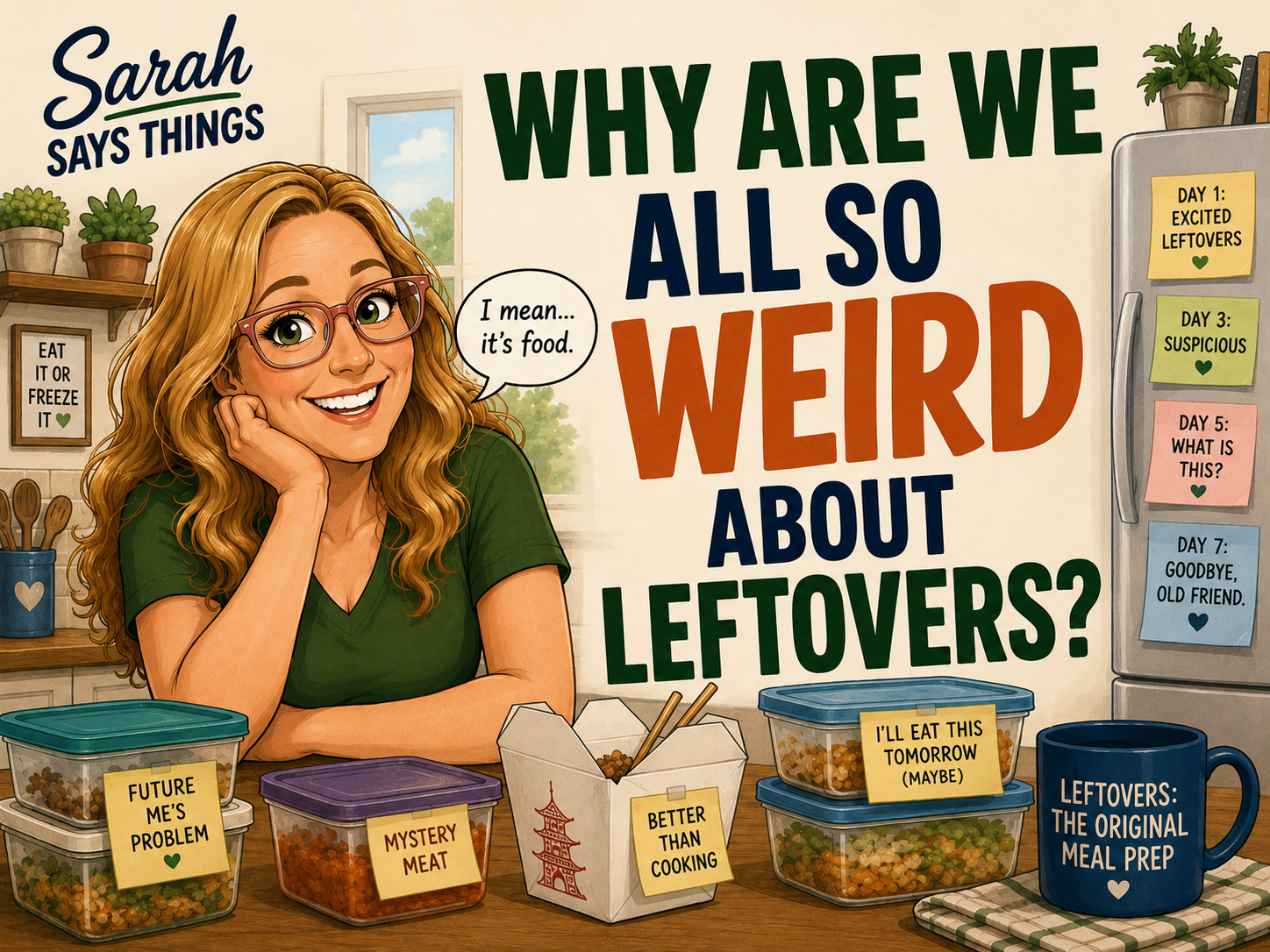
There is no greater personality shift than what happens between Day 1 leftovers and Day 5 leftovers.
Day 1?
We are thriving. We are reheating with intention. Plating it, even. Maybe adding a little garnish like we’re auditioning for Top Chef: Financial Responsibility Edition.
“This is honestly better the next day.” We say this with confidence. With pride. With the full delusion of someone who believes they’ve cracked the code on adulthood.
Day 3?
Now we’re asking questions. Not big questions. Just… quiet, suspicious ones.
“How long has this been in here?”
“Was this from Tuesday… or Monday?”
“Why does it look… wetter?”
We open the container, stare at it like it might explain itself, then close it again. Not because we’ve decided anything—but because we’ve emotionally escalated and need to regroup.
Day 5?
Absolutely not. This is no longer food. This is an artifact.
We don’t even open it. We observe it. From a distance. Like it might release spores if disturbed. At this point, it has a backstory. Possibly a motive.
And here’s the thing—we all have our own completely unscientific, deeply emotional leftover rules.
Some people are “three days, hard stop.” Some people are “smell test, we ride.” Some people will eat week-old pasta like they’re in a survival documentary, and honestly, I’d like to know what they’ve seen in life that made them this fearless.
Because leftovers aren’t about food safety. If it were, we’d all be following the same guidelines. We’d be labeling things. Dating containers. Acting like responsible, well-adjusted adults.
We are not doing that.
We are vibing. We are guessing. We are playing a high-stakes game of “probably fine.”
And the smell test? Completely unreliable.
You ever smell something and go, “That’s… fine?” What does that mean? Fine according to who? Your nose? Your pride? The fact that you refuse to waste $14 worth of chicken?
We’ve all stood there, holding a container, negotiating with ourselves like:
“It doesn’t smell bad.”
“It also doesn’t smell good.”
“But it doesn’t smell bad.”
That is not a standard. That is a gamble. And yet—we proceed. Sometimes.
Because sometimes, the real issue isn’t whether the food is still edible. It’s that we’re suddenly… emotionally disconnected from it.
Day 1: “I chose this.”
Day 5: “I no longer identify with this meal.”
It’s the same pasta. Same chicken. Same stir fry. But something shifts. The relationship is over. The trust is gone. The spark? Absolutely dead and buried.
And instead of eating perfectly good food, we’ll stand in front of a fully stocked fridge and say, “There’s nothing to eat,” while ignoring three containers of food we personally made.
Leftovers are Schrödinger’s dinner. They are both perfectly fine and absolutely unacceptable at the same time, and the only way to find out is to risk your entire evening and possibly your digestive system.
So we don’t.
We close the fridge. We order something new. And we promise ourselves we’ll “eat that tomorrow.”
We will not. Because tomorrow… it’s Day 6.
And Day 6 isn’t dinner. Day 6 is closure.