
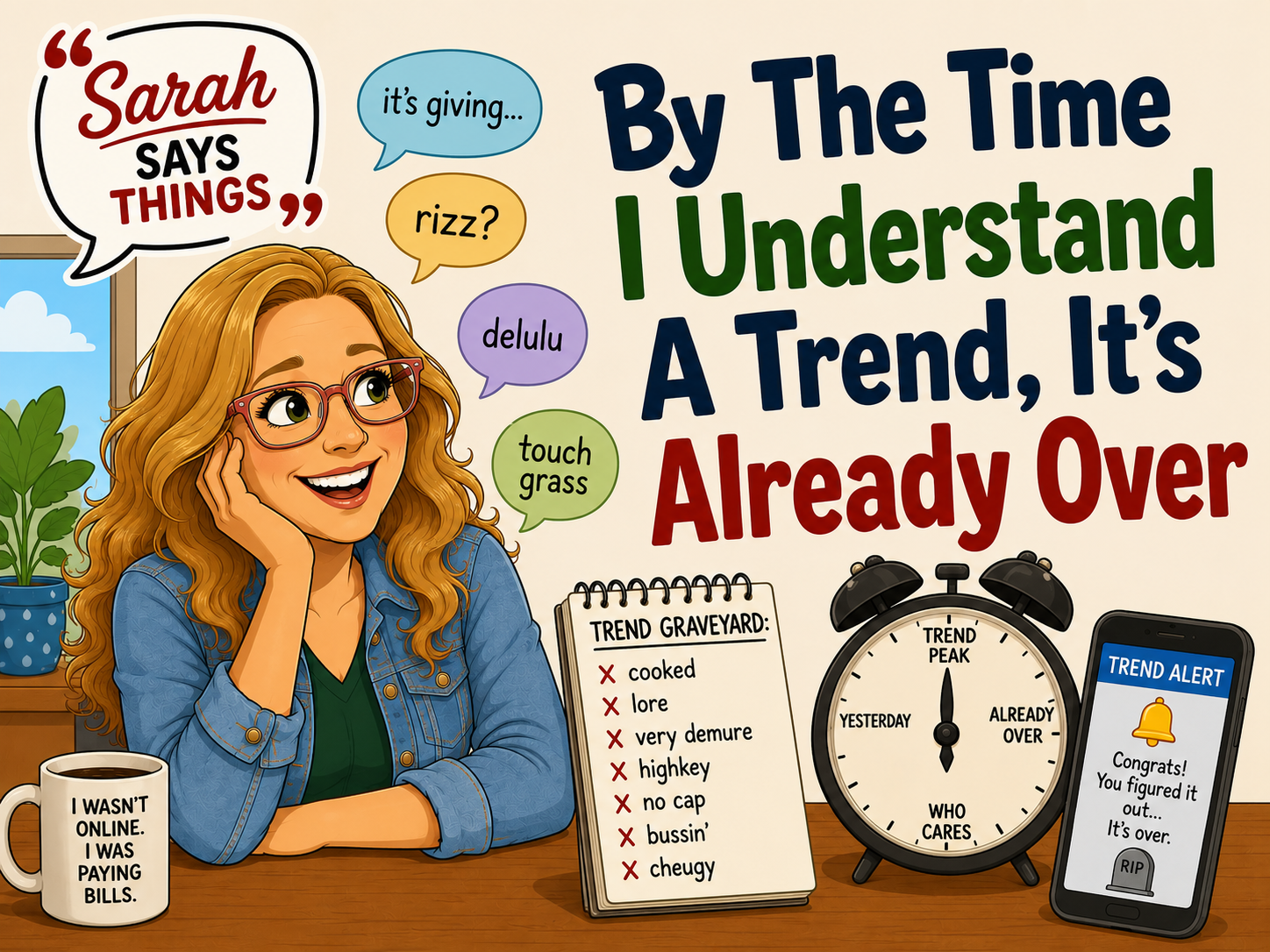
I would like to formally discuss the lifespan of modern trends.
Because from what I can tell, trends now last approximately fourteen minutes. Maybe less.
A trend begins. Teenagers become obsessed. The internet catches fire. Three million people make videos about it. Brands immediately try to capitalize on it.
And by the time I figure out what's happening, everyone under 25 has moved on. I don't even get a chance anymore.
Remember when trends lasted years?
The Macarena had a whole presidency. People spent a decade wearing Livestrong bracelets. Beanie Babies practically ran the economy.
Now trends have the life expectancy of a fruit fly.
Every week I encounter a phrase I've never heard before.
Someone says:
"It's giving..."
Giving what? Nobody knows.
The explanation somehow contains even more unfamiliar words.
But the moment I understand it, teenagers abandon it. I don't know how they know. But they know.
Somewhere there's a secret meeting.
"Sarah figured it out."
"Shut it down."
"Time for a new one."
Even businesses can't keep up anymore. By the time marketing departments approve a social media post, the trend is already being discussed in the past tense. Some poor corporate intern spends two weeks creating content around a viral phrase only to discover the internet has collectively decided it's cringe.
And really, the term "cringe" itself is probably already outdated.
The speed is terrifying. One day everyone's dancing. The next day everyone's lip-syncing. Then everyone's pointing at floating text. Then everyone's making reaction videos to reaction videos reacting to other reaction videos.
At some point the content became self-aware and started reproducing.
The worst part is trying to learn trends from younger people. You ask one simple question.
"What does that mean?"
And they look at you like you've asked them to explain electricity.
"It's just a thing."
Thank you. Very helpful. I've learned nothing.
Then there are the trends I accidentally discover months later.
I'll stumble across one and think:
"That's actually pretty funny."
Only to learn the trend peaked sometime between a Tuesday afternoon and Wednesday morning six months ago.
Apparently I was expected to be online during that specific 18-hour window.
Sorry. I was paying bills.
The younger generation doesn't understand how exhausting this is.
We grew up in an era where information arrived. Now information attacks.
You open your phone to check the weather and suddenly you're expected to understand seventeen new phrases, three celebrity feuds, a dance challenge, a skincare controversy, and why everyone is mad at a penguin.
Nobody even explains the penguin.
You're just expected to know.
At this point I've stopped trying to keep up. If a trend survives longer than a gallon of milk, I'll learn it. Otherwise I'll wait.
Because history suggests that by the time I understand what's happening, society will already be obsessed with something else.
That's fine. I'm beginning to suspect that confusion may actually be the most age-appropriate response to modern culture.