At first glance, a proposed carbon sequestration project near Galva might not seem like something Geneseo residents need to follow. After all, the project isn't located in Geneseo, and most of the activity would take place at Big River Resources' ethanol plant just outside Galva. But the decisions being made over the next year could affect all of Henry County.
The Henry County Board recently approved a one-year moratorium on new carbon sequestration projects while officials gather more information, review emergency preparedness, and determine whether additional local safeguards are needed. Those discussions involve countywide emergency planning, taxpayer-funded public safety resources, agriculture, economic development, and regulations that could shape future projects across the county.
That's why The Geneseo Current is launching a three-part series explaining what the Big River–Lapis project is, why it's being debated, and what it could mean for our region. In Part 1, we'll answer the most basic question: What exactly is this project?
What is carbon capture?
To understand the project, it helps to start with how ethanol is made.
At the Big River Resources ethanol plant near Galva, corn is processed into ethanol fuel. During fermentation, yeast converts sugars into alcohol—and in the process, naturally produces carbon dioxide (CO₂).
Traditionally, that carbon dioxide is released into the atmosphere.
Carbon capture changes that.
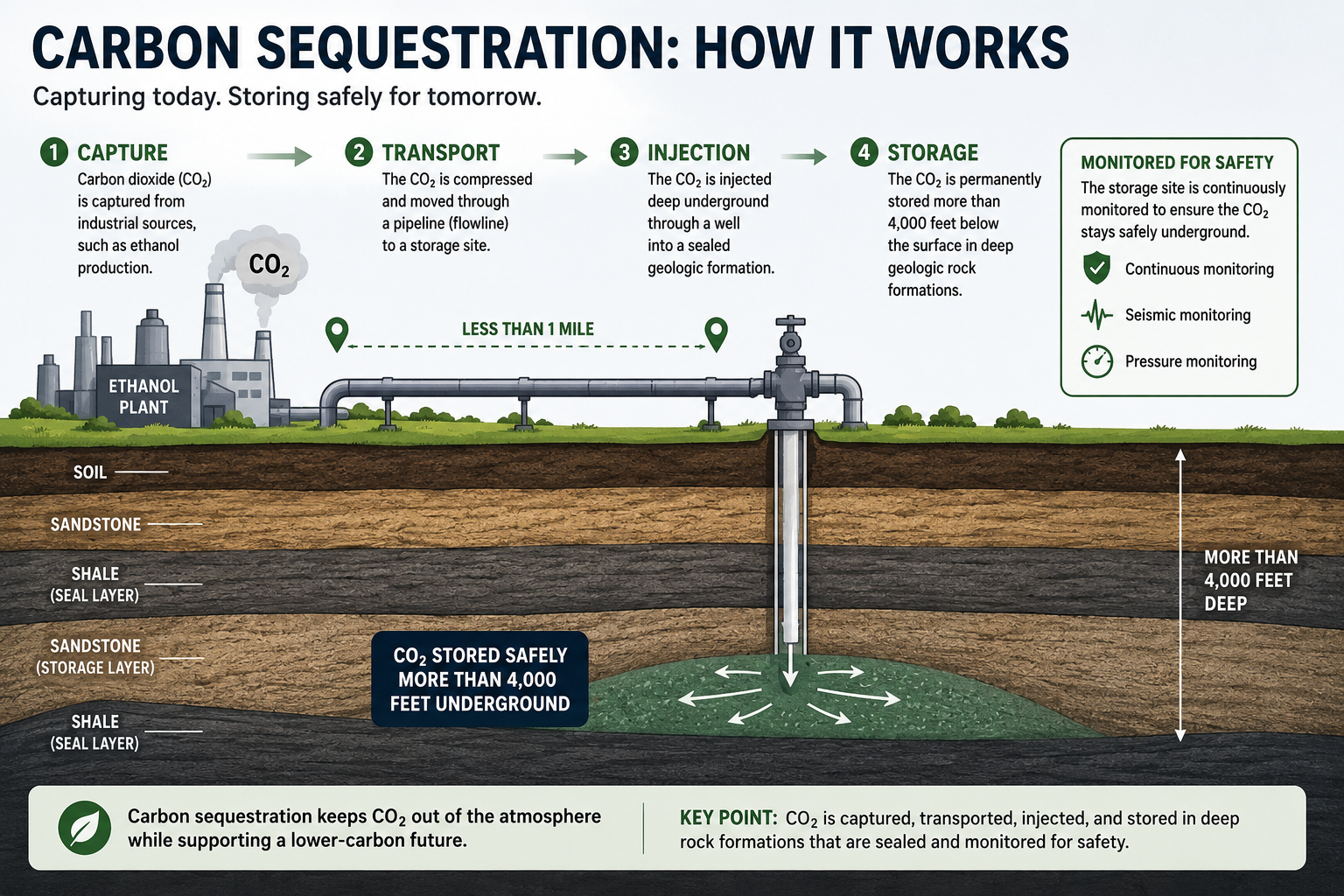
Instead of venting the CO₂, specialized equipment captures it, removes impurities, compresses it into a dense fluid, and prepares it for transportation and storage.
The goal is to prevent those emissions from entering the atmosphere.
What is carbon sequestration?
Capturing carbon dioxide is only half of the process.
Carbon sequestration refers to permanently storing that captured CO₂ deep underground.
The compressed carbon dioxide is injected thousands of feet below the surface into porous rock formations capped by impermeable layers of rock that are intended to keep it trapped over the long term.
Supporters describe the process as similar to storing natural gas underground, while opponents raise questions about long-term monitoring and safety.
What is being proposed near Galva?
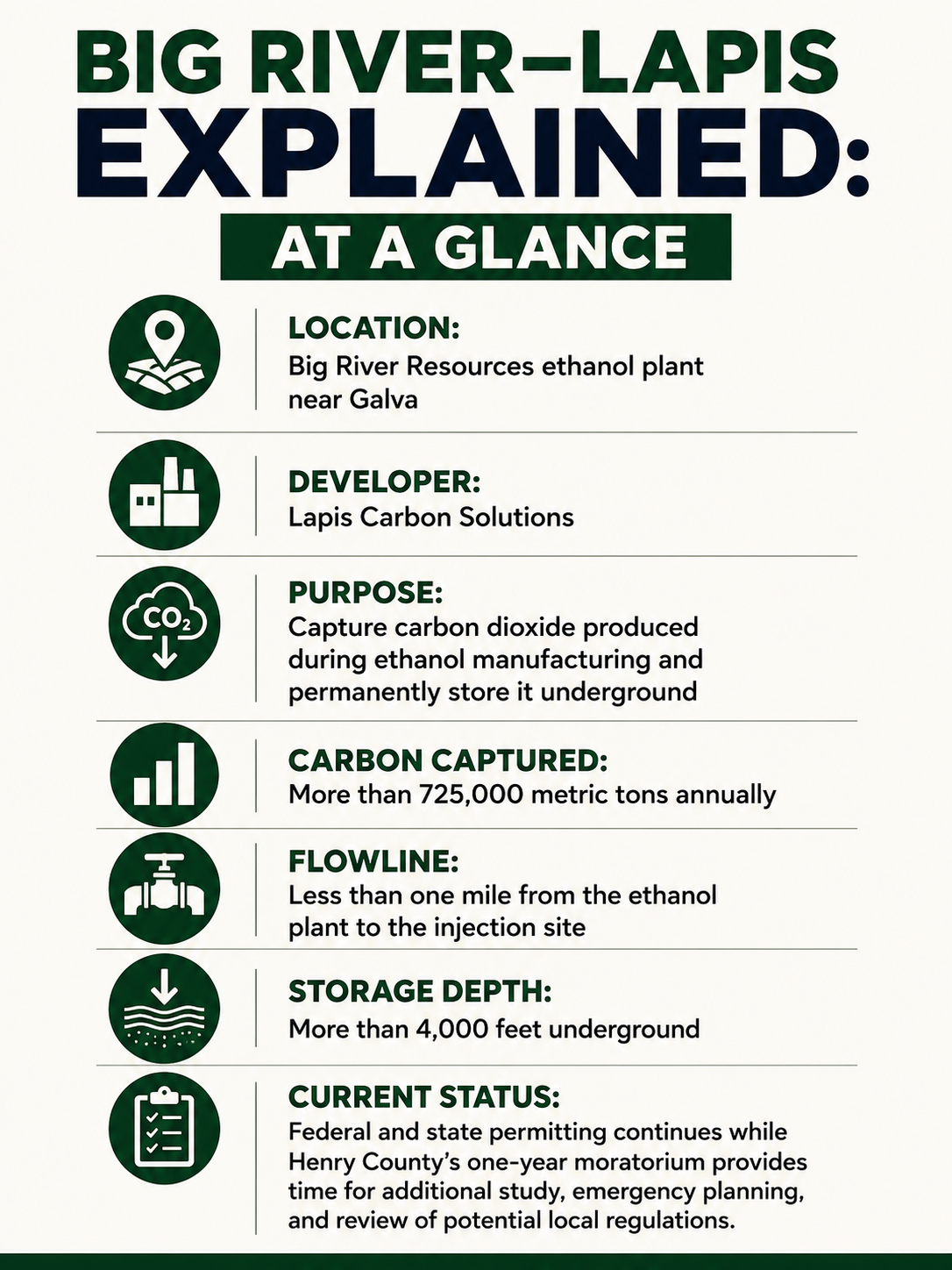
The proposed project is a partnership between Big River Resources, which operates the ethanol plant near Galva, and Lapis Carbon Solutions, a company that develops carbon capture and storage projects.
According to the companies, the project would:
Capture more than 725,000 metric tons of carbon dioxide each year from ethanol production.
Compress the CO₂ and transport it through a flowline less than one mile long.
Inject it more than 4,000 feet underground into geologic formations suitable for permanent storage.
Continuously monitor the storage site under federal and state regulations.
Unlike some carbon capture proposals that involve hundreds of miles of interstate pipeline, Project Big River is designed as a near-plant project, with the storage site located adjacent to the ethanol facility.
Lapis has also stated it does not anticipate using eminent domain for the project's short flowline.
Why build a project like this?
The primary reason is to reduce the carbon intensity of ethanol.
Many fuel markets and government programs place a value on fuels with lower greenhouse gas emissions. By capturing and storing carbon dioxide that would otherwise be released into the atmosphere, ethanol producers may qualify for incentives and improve the competitiveness of their product.
Supporters say projects like this can help Illinois ethanol plants remain competitive while supporting local jobs and markets for corn producers.
Where would the carbon dioxide go?
One of the most common misconceptions is that carbon dioxide would be stored in tanks or warehouses.
Instead, it would be injected into deep underground rock formations that have held fluids for millions of years.
These formations are located thousands of feet below drinking water aquifers and are selected based on extensive geologic studies.
Before injection can begin, the project must receive a federal Class VI Underground Injection Control permit, one of the most rigorous permitting processes overseen by the U.S. Environmental Protection Agency. Illinois also recently adopted additional state regulations governing carbon sequestration projects.
Why is Henry County talking about it now?
Although the project is located near Galva, it has become a countywide discussion because county officials want to better understand the technology before additional projects move forward.
Earlier this month, the Henry County Board approved a one-year moratorium on new carbon sequestration projects and new data center developments.
County leaders have said the temporary pause is intended to give officials time to:
Review technical information.
Develop emergency response plans.
Study public safety considerations.
Evaluate whether additional local regulations are needed.
The moratorium is not a permanent ban on carbon sequestration, nor does it automatically stop the existing Big River–Lapis proposal. Instead, county officials describe it as an opportunity to gather information before making future decisions.
Why should Geneseo residents care?
Even though the project is centered near Galva, the discussions extend beyond one community.
County emergency planning, mutual aid between first responders, economic development, agriculture, and county regulations all have implications that reach across Henry County. Big River Resources is also an important regional purchaser of corn, meaning decisions affecting the plant can have ripple effects throughout the local agricultural economy.
Perhaps most importantly, these decisions are being made by elected officials who represent residents throughout Henry County—not just Galva.
Understanding the project helps residents better evaluate the conversations taking place at County Board meetings and the decisions their representatives will make over the coming months.
Coming Next: Part 2
In Part 2, we'll take a closer look at safety and emergency planning.
Editor's Note: This is the first installment in a three-part educational series designed to explain the proposed Big River–Lapis carbon sequestration project. The purpose of this series is to provide factual information about the proposal, the science behind carbon sequestration, and the issues being discussed by local officials so readers can better understand the ongoing public conversation.