Real or artificial? It's a familiar holiday debate, but when the Christmas tree stands in the middle of downtown and is purchased with public funds, the discussion involves more than personal preference.
A few years after Geneseo invested $36,178 in a commercial-grade artificial Christmas tree, the purchase continues to generate discussion. Some residents miss the tradition of a living tree, while others question whether the artificial replacement was worth the expense.
But the comparison involves more than the purchase price. Real trees require annual transportation, installation and removal, while an artificial tree spreads its initial cost across multiple holiday seasons.
The decision also involves practical considerations, including the health of Geneseo's former downtown tree, the challenges of growing a replacement and the role the display plays in the community's holiday celebrations.
Why Not Just Plant Another Tree?
Geneseo's former living Christmas tree was a longtime downtown landmark, serving as the centerpiece of holiday celebrations for generations.
Its removal followed an assessment by an independent arborist who determined the tree was in poor health and at significant risk of failure.
During a November 8 appearance on WGRG's Let's Talk Geneseo, then-Chamber Executive Director Zach Sullivan explained why planting another tree at the same location presented challenges.
"It's going to take a long time for something new like that to grow in an area on State Street that's not very good for growing trees," Sullivan said.
He noted that other downtown trees had required replacement over the years because of difficult growing conditions.
Planting a new tree would therefore require years of growth, with no guarantee it would thrive in that location.
The artificial tree offered an immediate replacement without depending on the long-term survival of another living tree.
What Would a Real Christmas Tree Cost Each Year?
Another alternative would be to bring in a large real Christmas tree annually.
Even if the tree itself were donated, transporting and installing a 30-foot evergreen would involve recurring expenses.
Each year, the tree would need to be cut down, loaded, transported downtown, lifted into position, secured, decorated and eventually removed.
For a community the size of Geneseo, a preliminary budgeting estimate places those annual expenses at approximately $6,000 to $8,000, depending on labor, equipment, transportation distance and donated services.
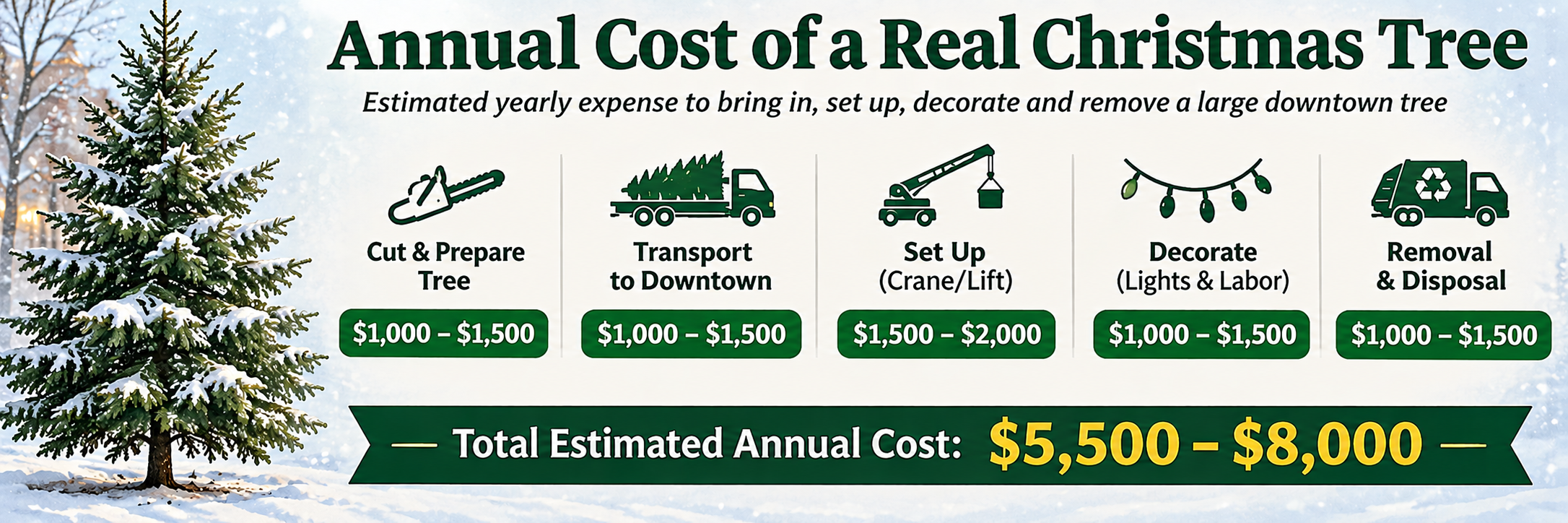
These figures are estimates rather than documented Geneseo expenditures, but they illustrate why a donated tree is not necessarily a cost-free option.
What Other Communities Spend on Christmas Trees
Other communities provide useful comparisons for both approaches.
In 2025, Washington, Illinois, approved a 26-foot artificial tree for approximately $29,339, including a shipping allowance. The community also considered a 30-foot version priced at approximately $39,379.
Real trees can carry substantial costs as well.
Mount Prospect, Illinois, reported spending approximately $2,200 annually just to harvest a donated 30- to 35-foot Christmas tree, before decorating, maintaining and removing it.
For a larger-scale example, Healdsburg, California, reported approximately $30,585 in costs for a real Christmas tree in 2026, including the tree itself, transportation, crane installation and removal assistance.
These examples are not direct equivalents to Geneseo's project. Tree sizes, labor arrangements, equipment needs and donated services vary by community. However, they demonstrate the range of expenses associated with municipal Christmas displays.
Designed for Repeated Use
Geneseo's artificial tree was purchased as a long-term investment rather than a one-season decoration.
City officials explained that the commercial-grade structure would be assembled in four sections using municipal equipment and employees from the Public Works and Electric departments.
The existing four-foot topper from the former living tree was also being reused.
Officials described the new tree as a heavy-duty structure designed to withstand outdoor conditions and serve the community for years.
The city also installed a concrete pad and electrical service at the location, creating infrastructure that could support future holiday displays and other downtown activities.
Those improvements represent additional project expenses, although their costs are not included in the tree's $36,178 purchase price.
The financial benefit of reusing the artificial tree will ultimately depend on its lifespan and the city's actual annual expenses for installation, maintenance, storage and eventual replacement.
More Than a Christmas Decoration
The downtown Christmas tree also serves a purpose beyond its seasonal appearance.
Geneseo's Christmas Walk, which reportedly attracts more than 10,000 visitors annually, brings people downtown for shopping, dining and community activities.
The tree is one element of the holiday atmosphere that helps make the event a recognizable local tradition.
During his November 8 interview, Sullivan described the new tree as part of the continued evolution of the Christmas Walk, which began as the Victorian Walk in 1986.
"And this new tree is going to be another step of that evolution of the event over 40 years, and I can't wait for people to see it," Sullivan said.
He acknowledged that replacing the former living tree would be an adjustment but expressed optimism about the new display.
"I think it's going to be marvelous. It's going to be an adjustment and a change."
The tree's contribution to tourism and downtown business activity is difficult to quantify independently. Nevertheless, its role as a centerpiece of one of Geneseo's signature events is part of the broader discussion about the investment.
Evaluating the Long-Term Value
The decision to spend public funds on an artificial Christmas tree is a legitimate subject for discussion, particularly when communities face competing financial priorities.
A real tree may involve a smaller initial expense, especially when the tree or related services are donated. But securing and installing a replacement every year creates recurring costs.
An artificial tree requires a larger upfront investment, with the potential to spread that expense across many seasons.
For perspective, the $36,178 purchase price works out to approximately $3,618 per year over 10 seasons, or $2,412 per year over 15 seasons. Those figures reflect only the initial purchase and do not include installation, maintenance, storage, site improvements or eventual replacement.
Whether Geneseo's artificial tree ultimately proves less expensive than bringing in a real tree annually will depend on its useful life and documented operating costs.
The broader question is not simply what the city spent on a Christmas tree, but what it will cost to maintain a downtown holiday centerpiece over time — and how that investment contributes to a tradition that brings residents and visitors together.