
by Sarah DeMaranville
Geneseo Current
District enrollment has fallen about 11% since 2018, while Geneseo administrators work to align staffing with enrollment and maintain educational programs amid rising costs.
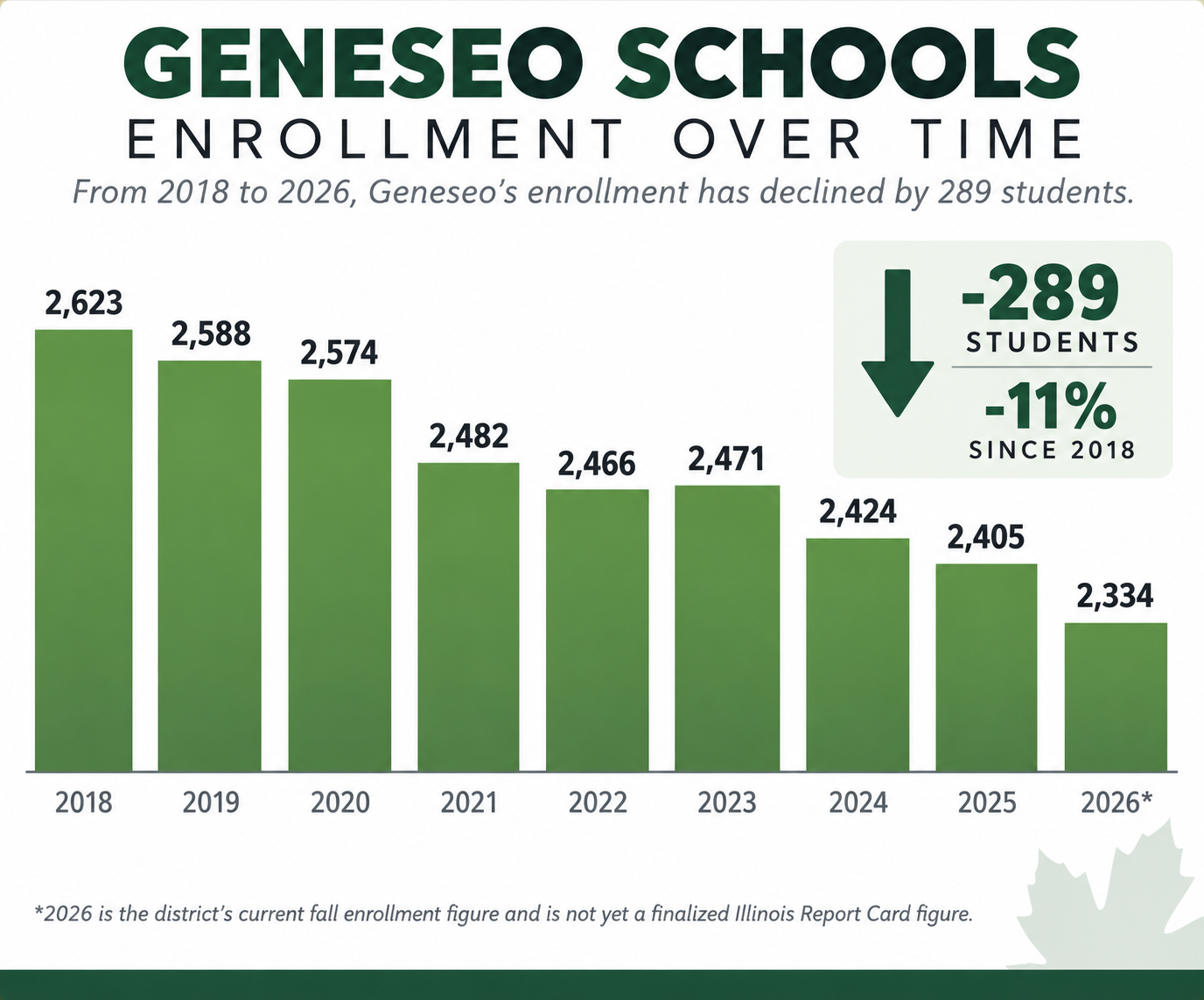
Nearly 300 fewer students attend Geneseo schools today than eight years ago, and the decline is already playing a role in how the district plans its staffing and finances.
Geneseo Community Unit School District 228 reported 2,334 students this fall, compared with 2,623 in 2018. That's a decline of 289 students, or about 11%.
The trend has been persistent. Enrollment declined in seven of the eight year-to-year comparisons since 2018, with a five-student increase in 2023 the only interruption.
Why does that matter?
A district with 11% fewer students doesn't automatically become 11% less expensive to operate. Buildings still have to be maintained, buses still travel routes throughout the district, and staffing and other expenses don't necessarily decline at the same pace as enrollment.
A classroom with 20 students requires a teacher just as a classroom with 23 does. Buildings still require utilities, maintenance and insurance, while transportation, technology and support services remain necessary.
Staffing is already being adjusted
District officials have publicly discussed the need to align staffing with enrollment as part of maintaining long-term financial stability.
The district has reduced staffing by three full-time-equivalent positions and one contractor. Long-range financial projections also assume seven additional full-time-equivalent positions will be absorbed through attrition between fiscal years 2028 and 2030.
District administrators have stressed that reducing staffing as enrollment declines should not come at the expense of students. During the district’s FY27 budget discussions, Assistant Superintendent and Chief School Business Official Tim Gronski emphasized minimizing the impact on student learning and maintaining the services and educational programs available to students. The FY27 budget maintains all current educational programs even as the district adjusts staffing and works to address its longer-term financial position.
Meanwhile, other costs are increasing.
Geneseo's fiscal year 2027 budget included approximately $37.65 million in operating expenditures, up 5.72%, and projected a $975,805 Education Fund deficit. Health insurance costs were projected to increase approximately 29%.
Declining enrollment isn't solely responsible for those financial pressures. District officials have identified aligning staffing with enrollment as part of their strategy for improving long-term financial sustainability.
Despite those financial pressures, district figures show Geneseo's per-student spending remained below both regional and statewide averages in 2024.
What about state funding?
Enrollment is one factor in Illinois' Evidence-Based Funding formula, but fewer students don't translate directly into an equivalent reduction in state funding.
The formula considers enrollment, student demographics, local resources and numerous cost factors. Illinois' Base Funding Minimum also provides districts some protection against losing previously received state funding.
So an 11% enrollment decline does not mean Geneseo receives 11% less state funding.
The larger issue is whether the district can adjust expenses as the number of students it serves changes.
Fewer students don't necessarily mean fewer needs
Enrollment is only one measure of the resources a district may need. District figures also show the percentage of students classified as low-income increased from 17.18% to 29.29% over the same time.
That's why the loss of 289 students matters. Geneseo is serving 11% fewer students than it did eight years ago, but many of the costs of operating its schools remain. The challenge for the district is adjusting staffing and spending as enrollment changes while maintaining the educational programs and services available to students.