
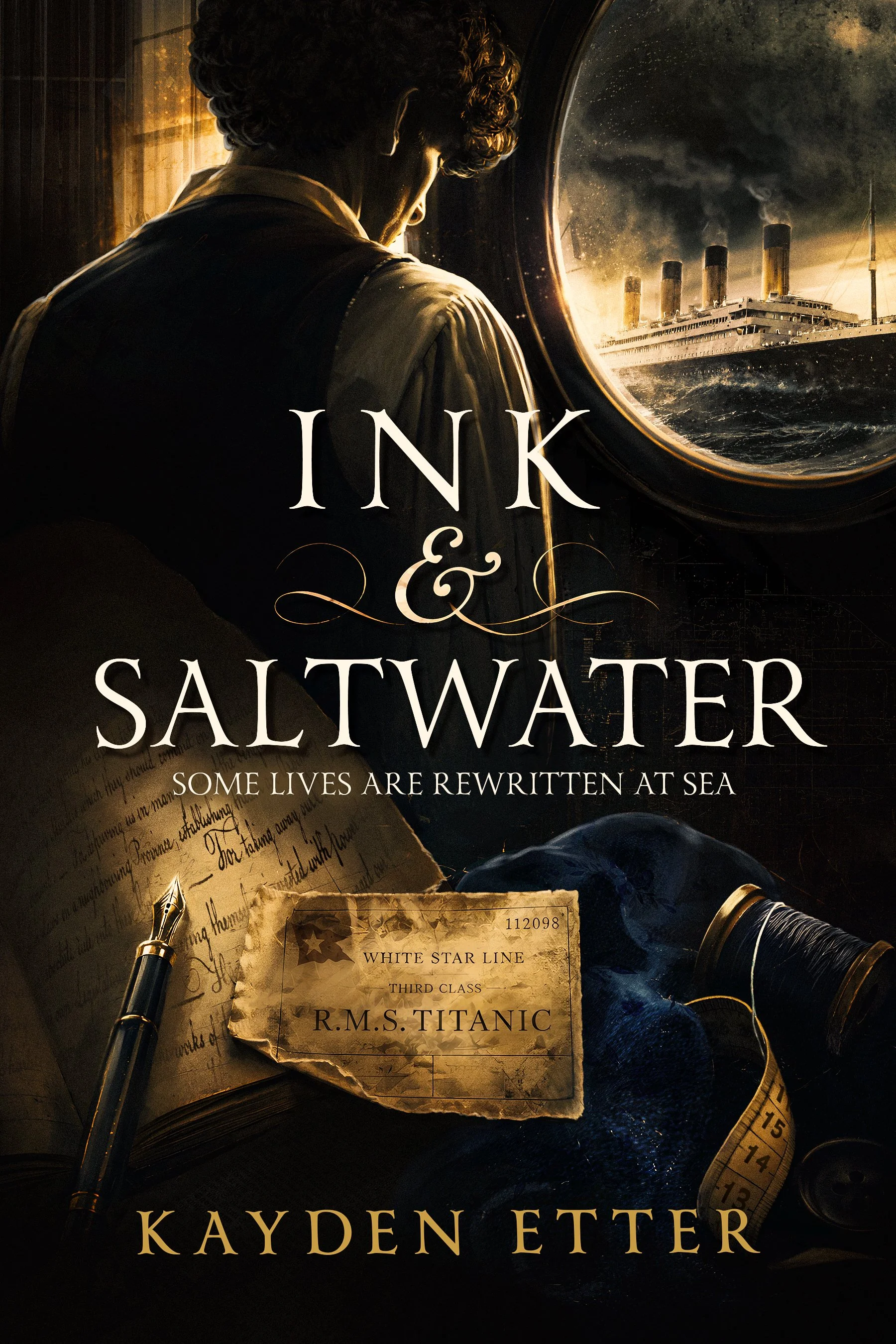
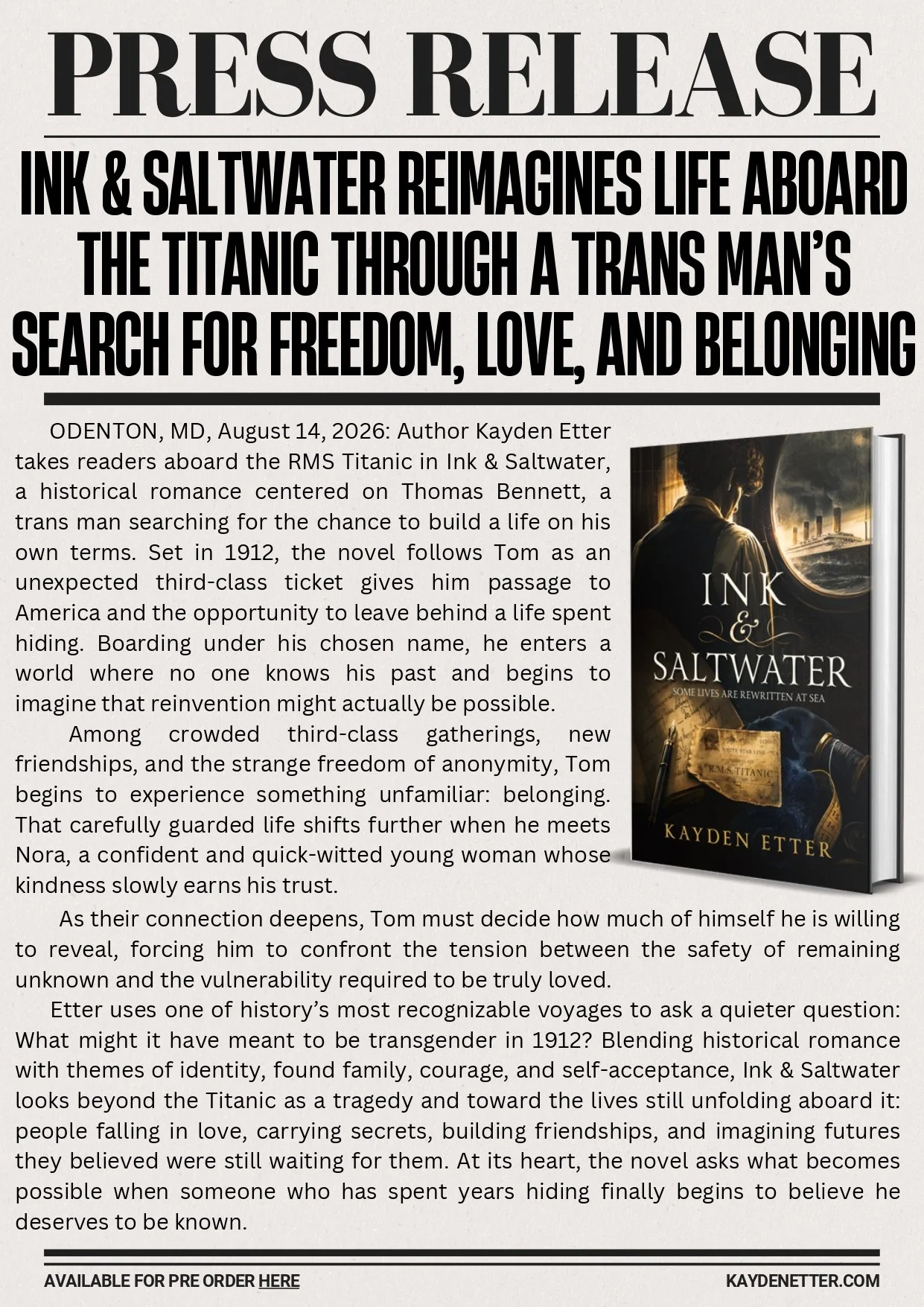
Ink & Saltwater takes one of history’s most familiar tragedies and tells a much more personal story within it.
Set aboard the Titanic, Kayden Etter’s novel follows Thomas Bennett, a 21-year-old trans man from Southampton who sees an unexpected ticket to America as an opportunity for a new beginning. What follows is less about the famous ship itself and more about relationships, possibility, and the freedom that comes with being known on your own terms.
For Etter, the book also marks a milestone that stretches all the way back to Geneseo. What follows is less about the famous ship itself and more about relationships, possibility and the freedom that can come with being known on your own terms.
“Geneseo is home for me,” Etter said. “I grew up there, started preschool there, and graduated from Geneseo High School in 2015.”
Etter remained in the area until around 2020 or 2021 before eventually moving to Maryland.
“So much of who I became happened in Geneseo, long before ‘author’ was something I ever imagined I would get to put after my name,” he said. “There is something pretty surreal about writing my first novel years later and now getting to share it with the community that knew me when I was just a kid trying to figure out what the hell I was going to do with my life.”
Finding a Different Story Aboard the Titanic
Etter said his fascination with the Titanic goes back as far as he can remember. While the ship and scale of the disaster initially captured his attention, over time he became more interested in the stories history didn't preserve.
“The ‘lost’ ones,” Etter said. “The people whose names might appear once in a passenger list or historical record, but whose thoughts, relationships, fears, hopes, and dreams disappeared with time.”
That curiosity eventually led him to consider another group whose stories are often difficult to find in the historical record.
“Queer people were there. Trans people were there. But what might that life actually have looked like in 1912?” Etter said. “That was where Thomas began.”
Etter was particularly conscious of creating a character who belonged in that historical period rather than applying a modern understanding of identity to someone living more than a century ago.
“I didn’t want to write a modern trans character wearing Edwardian clothes,” he said. “I wanted to imagine someone who understood something fundamental about himself even if the world around him didn’t have the same language we have today.”
That required extensive research. Etter drew from books, photographs, documentaries, passenger records, firsthand accounts and other historical sources. His research covered everything from third-class life aboard the Titanic to clothing, social expectations, gender roles and the practical realities Thomas would have faced.
“There are things history can tell us with certainty, and there are places where fiction has to admit, ‘We don’t know, but this life was possible,’” Etter said. “I tried to approach those spaces with as much research, imagination, and humility as I could.”
A Geneseo Influence
Etter also credits a Geneseo High School teacher with encouraging his writing years before Ink & Saltwater existed.
“There is one teacher from Geneseo I still think about all these years later: Mr. Tesmond, my high school English teacher,” Etter said.
For an essay assignment, Etter wrote something deeply personal and came out to Tesmond. When the essay was returned, the teacher had included a handwritten note encouraging him to consider publishing it.
“Of course, I did absolutely nothing with that suggestion because fear won that particular battle,” Etter said. “But I kept writing.”
Looking back, Etter said the experience showed him that something honest and vulnerable he had written might deserve an audience beyond the classroom.
Those same ideas continue to appear in his work.
“Identity. Belonging. Courage. The things we hide. The terrifying act of letting someone know us anyway,” he said.
Geneseo also helped shape another recurring idea in Ink & Saltwater: what it means to call somewhere home.
“Is home where you grew up? Is it where people know your name? Is it where you are understood? Can you love where you came from and still need to leave it in order to figure out who you are?” Etter said. “Those questions show up throughout Ink & Saltwater.”
A Familiar History From a New Perspective
Those themes are also what make the novel work.
Etter doesn't need to create suspense around the fate of the Titanic. Readers already know the history. Instead, seemingly ordinary moments—new friendships, humor, uncertainty and an unexpected connection with fellow passenger Nora—carry additional weight because readers know something the characters don't.
The result is a character-driven historical novel that uses an enormous historical event as the backdrop for a much smaller examination of identity and belonging.
For Etter, however, Thomas is intended to be more than what he represents.
“More than anything, I hope readers remember Tom as a person before they remember him as representation,” he said. “I hope they remember his friendships, his fear, his humor, the people he loves, the mistakes he makes, and the moments where he begins to understand that being known doesn’t always have to be dangerous.”
Etter said there is a larger idea beneath the novel—that queer and transgender people existed throughout history, including during periods when their lives were rarely documented.
“But I never wanted Tom to exist simply to prove that point,” he said. “I wanted him to laugh, fall in love, screw things up, hope for things, get angry, be scared, and take up space. I wanted him to be human.”
That may also be the best way to approach Ink & Saltwater. Readers fascinated by the Titanic will find a familiar historical setting from an uncommon perspective, while those drawn to character-driven historical fiction will find a story concerned less with a famous ship than with the people whose individual lives unfolded aboard it.
“If readers finish the book thinking about the people history never fully recorded, I’ll be grateful,” Etter said. “But if they also think about their own lives, the versions of themselves they’ve had to become, and the people who made them feel safe enough to be fully known, then the story did exactly what I hoped it would do.”
Ink & Saltwater will be released on September 4. The book is available to pre-order on Amazon and Barnes & Noble.