
by Sarah DeMaranville
Geneseo Current
A piano can sit untouched for months and still gradually fall out of tune.
Unlike many other musical instruments, an acoustic piano contains hundreds of strings under considerable tension, along with thousands of moving parts that must work together to produce the proper sound.
Temperature changes, humidity fluctuations, and ordinary aging can all affect how a piano sounds and responds.
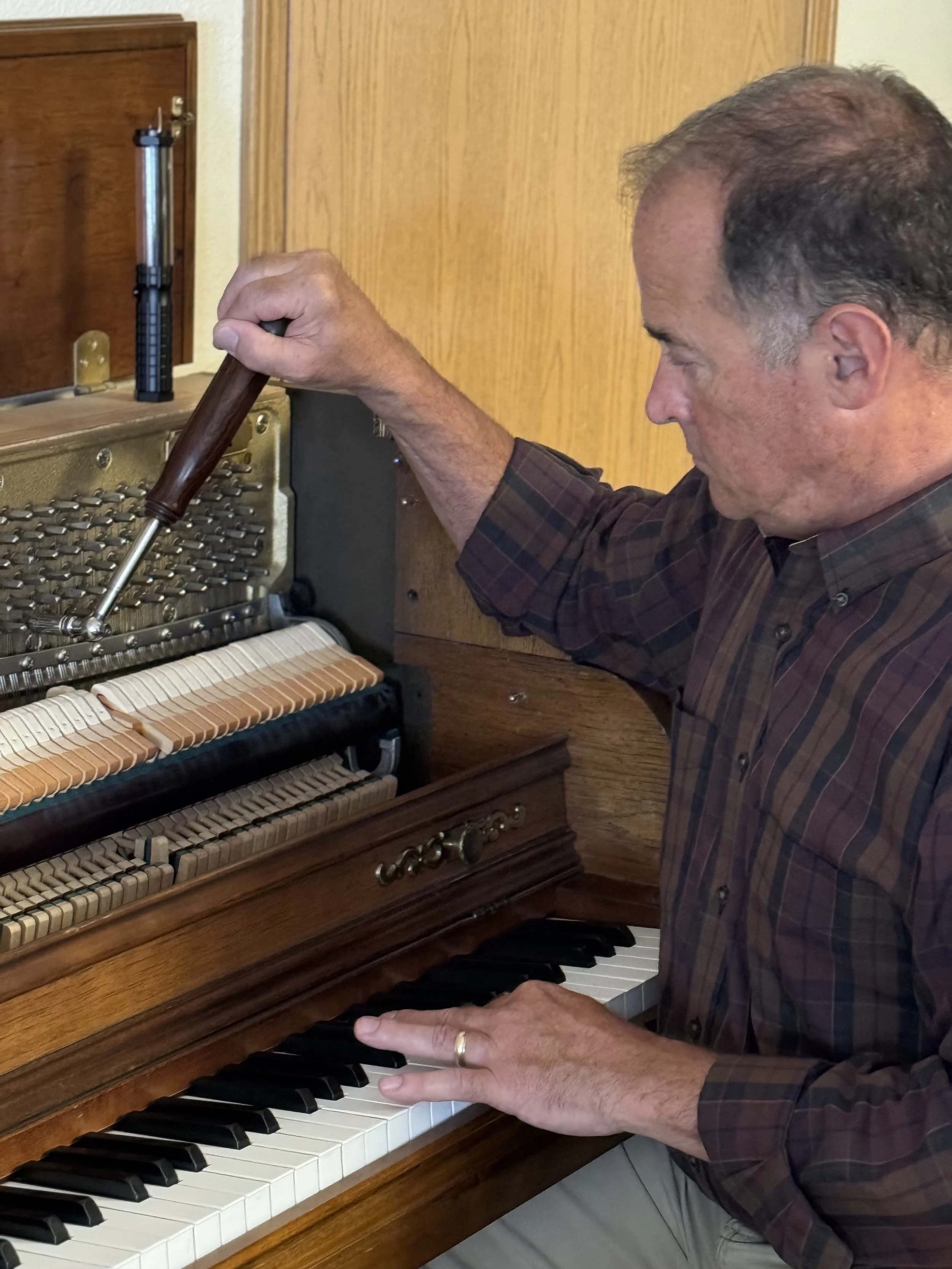
Steve Scherer of SS Piano Services tunes a piano. Contributed photo
For piano owners in Geneseo and throughout the Midwest, regular maintenance is an important part of protecting an instrument that can last for generations.
Steve Scherer, owner of Geneseo-based SS Piano Service and a former Geneseo High School band director, explains what happens during a piano tuning, how often maintenance is needed, and when an older instrument may require more extensive repairs.
What Happens During a Piano Tuning?
For many piano owners, tuning is something that happens periodically without much thought about the work involved.
But the process is considerably more complicated than adjusting a few notes.
Scherer begins a typical appointment by removing portions of the piano's case to expose its internal components, including the hammers, strings, and tuning pins.
He inspects the instrument for damaged or missing parts and checks for objects that may have fallen inside.
Pencils, coins, playing cards, and even small pieces of jewelry can interfere with the piano's mechanical operation.
Next, he uses an electronic device to evaluate how far the instrument has drifted from standard concert pitch, commonly identified as A440.
This refers to the A above middle C vibrating at 440 cycles per second, a widely used tuning reference.
He then establishes the proper relationships among the notes, a process known as setting the temperament, before carefully adjusting the individual strings.
Although a standard piano has 88 keys, most keys activate two or three strings simultaneously.
That means a typical piano contains approximately 230 strings, each requiring individual attention.
The entire process generally takes a couple of hours.
Piano Tuning vs. Piano Regulation: What's the Difference?
One distinction Scherer emphasizes is the difference between tuning a piano and regulating it.
Piano tuning adjusts the tension of the strings so they produce the correct pitches.
Piano regulation addresses the mechanical components connecting the keys to the hammers that strike the strings.
Each note can require nine to twelve separate mechanical adjustments to ensure the instrument responds properly.
Minor adjustments may be completed during a routine tuning appointment, but full regulation is a much more extensive process that can take many hours.
It is generally most beneficial for pianists who are particularly sensitive to how an instrument feels and responds, or for pianos whose mechanical components have fallen significantly out of adjustment.
A piano can be properly tuned but still feel difficult or inconsistent to play if its action needs regulation.
Understanding that difference can help owners determine what kind of service their instrument needs.
How Often Should a Piano Be Tuned?
Scherer recommends having an acoustic piano tuned at least once a year, even if it isn't played regularly.
People who play frequently may benefit from tuning every six months.
Illinois' changing seasons create particular challenges for acoustic instruments.
Temperature and humidity fluctuations cause wooden and metal components to expand and contract, which can affect string tension and tuning stability.
Scherer recommends maintaining a relative humidity level of approximately 45% around the instrument.
Keeping indoor conditions consistent can help protect the piano and reduce the effects of seasonal changes.
Regular tuning also helps maintain the instrument at the pitch and tuning relationships for which it was designed.
And while routine maintenance is important, Scherer believes one of the best things an owner can do is actually use the instrument.
"What is best for a piano, is for it to be played often," he said.
Can an Old Piano Be Restored?
Not every piano Scherer encounters is in good condition.
Some instruments have gone years without maintenance, leaving them severely out of tune or suffering from loose tuning pins, broken strings, and mechanical problems.
In certain cases, those instruments can be brought back into playable condition.
Scherer has worked on pianos requiring replacement strings, adjustments to loose tuning pins, and extensive tuning corrections.
When a piano is significantly out of tune, the process may require two passes.
The first is a preliminary tuning that brings the instrument closer to the proper pitch. The second is a more precise tuning after the strings and other components have adjusted to the changes in tension.
But not every instrument can be economically repaired.
Cracked or separating wooden components, moisture damage, mold, rusted strings, and damage caused by mice can create problems that are difficult or expensive to correct.
In some cases, the cost of repairing or replacing deteriorated components exceeds the value of the piano.
Moisture is particularly damaging because it can affect both the wood and metal components.
Even when rusted strings remain intact, their sound quality can deteriorate.
Scherer's work involves not only tuning instruments but also evaluating their condition and determining what repairs may be practical.
Why Midwest Weather Matters
For piano owners in Illinois and Iowa, seasonal weather changes are an important consideration.
Acoustic pianos contain substantial amounts of wood, including the soundboard, bridges, and other structural components.
Changes in indoor humidity can cause these materials to expand and contract.
During humid summer months, wood can absorb moisture and swell. During dry winter months, it can release moisture and shrink.
These changes can affect the tension of the strings and cause the instrument to drift out of tune.

The effects can occur even when a piano is rarely played.
Maintaining consistent indoor humidity and scheduling regular tunings can help reduce the effects of seasonal changes.
When Is a Piano Beyond Repair?
Pianos are durable instruments, but they are not indestructible.
Scherer has encountered instruments with significant deterioration caused by moisture, rust, damaged wooden components, and even mice.
While broken strings and some mechanical problems can be repaired, extensive structural damage may make restoration financially impractical.
The decision often comes down to the condition and value of the instrument compared with the cost of repairs.
An older piano isn't necessarily beyond saving simply because it hasn't been tuned in years.
However, an inspection by a qualified piano technician can help determine whether tuning, repairs, or more extensive restoration would be appropriate.
Finding Piano Tuning Services in Geneseo
Scherer provides piano tuning and maintenance through SS Piano Service, based in Geneseo, Illinois.
His service area generally includes communities within a 50-mile radius or approximately 75 driving miles, with some established customers located farther away.
For appointments more than 30 miles from Geneseo, he typically coordinates multiple tunings in the same area to help distribute travel expenses.
For local piano owners, regular service can help maintain sound quality, identify mechanical problems, and protect the long-term condition of the instrument.
Whether a piano is played daily or only occasionally, Scherer's advice is straightforward: have it tuned regularly, protect it from extreme humidity changes, and keep making music.