
by Sarah DeMaranville
Geneseo Current
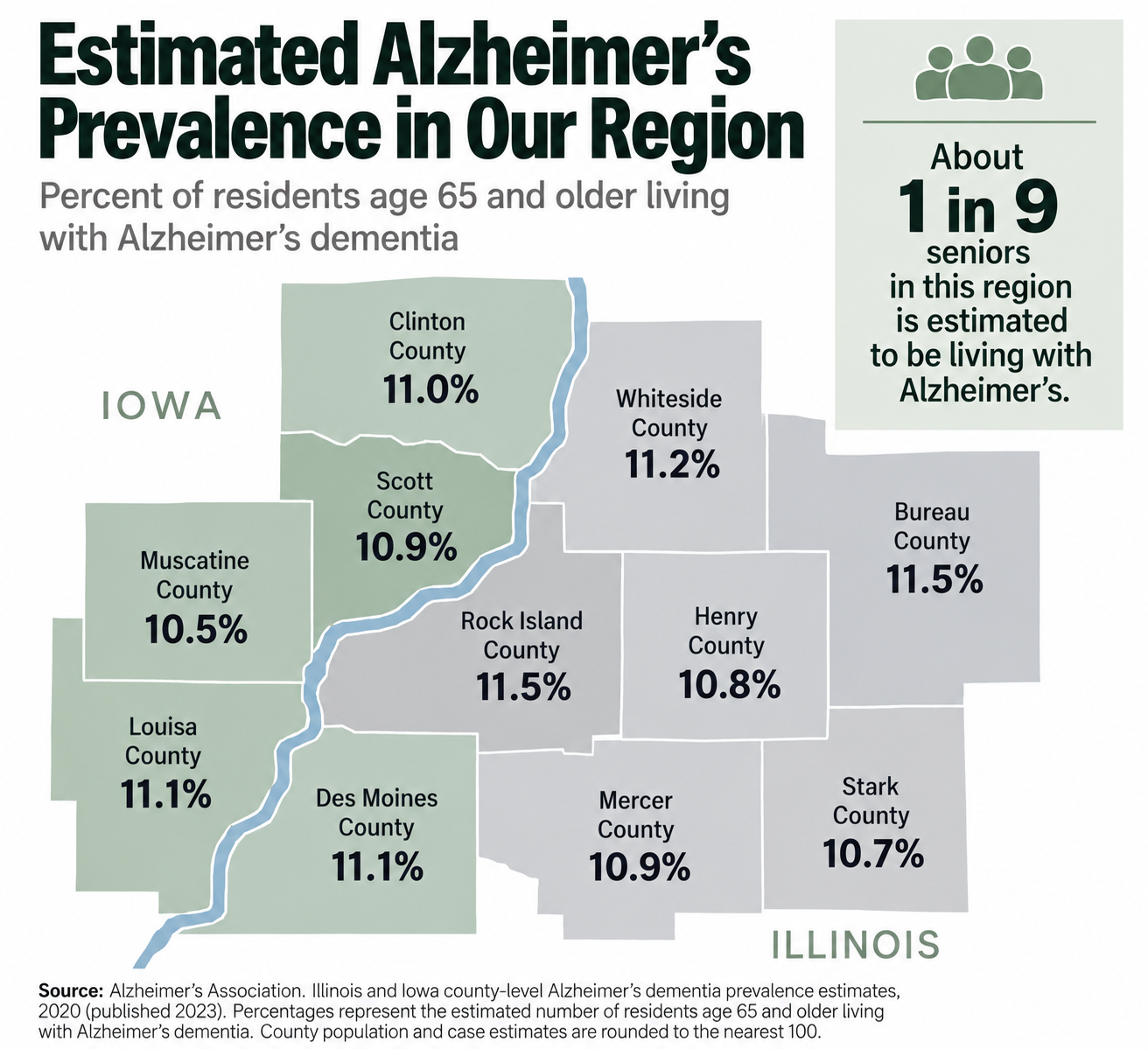
An estimated 1,100 Henry County residents age 65 and older are living with Alzheimer’s dementia — about one in every nine seniors in the county — according to county-level prevalence data from the Alzheimer’s Association.
The Alzheimer’s Association estimates Henry County has approximately 10,400 residents age 65 and older and 1,100 Alzheimer’s dementia cases, producing an estimated prevalence rate of 10.8%.
That means roughly one out of every nine Henry County residents age 65 and older was estimated to be living with Alzheimer’s dementia.
Rural Communities Face Additional Challenges
For rural communities like Henry County, Alzheimer's presents challenges that extend beyond the number of people living with the disease.
"People living in rural communities face real barriers to Alzheimer's diagnosis and care," said Matt Eaton of the Alzheimer's Association.
Eaton explained that rural residents tend to be older on average and experience higher rates of certain health conditions associated with dementia risk, including hypertension, diabetes, and obesity.
Access to specialized medical care can also be more difficult.
"Rural areas have fewer neurologists and memory care specialists nearby, which can delay diagnosis and limit access to newer treatments and biomarker testing that require specialized care," Eaton said.
Those barriers can leave families traveling farther for appointments, waiting longer for specialized evaluations, or relying more heavily on primary care providers.
Nationally, 71% of rural primary care physicians report shortages of dementia specialists, according to the Alzheimer's Association.
Alzheimer's Is Already a Major Issue in Illinois
The Alzheimer's Association estimates 250,600 Illinois residents age 65 and older are living with Alzheimer's, representing approximately 12% of Illinoisans in that age group.
Nationally, an estimated 7.4 million Americans age 65 and older are living with Alzheimer's in 2026, or about one in nine older Americans. Nearly three-quarters — 74% — are age 75 or older.
The number is expected to increase substantially as the population ages. The Alzheimer's Association projects that the number of Americans age 65 and older living with Alzheimer's could reach 13.8 million by 2060, barring medical breakthroughs that prevent or cure the disease.
The Impact Extends Far Beyond Patients
Alzheimer's and other dementias also create significant demands on family caregivers.
In Illinois, approximately 465,000 unpaid caregivers provide an estimated 668 million hours of dementia care annually.
The Alzheimer's Association estimates the economic value of that unpaid care at approximately $16.7 billion.
Those figures illustrate how Alzheimer's affects not only patients but also families, workplaces, long-term care facilities, and communities.
Illinois will also need additional health care workers to meet growing demand. The Association estimates the state will need 27.7% more geriatricians by 2050 and 14.8% more home health and personal care aides by 2032.
For rural counties, recruiting and retaining those professionals may present additional challenges.
New Blood Tests Could Improve Rural Diagnosis
Although Alzheimer's remains incurable, advances in diagnostic testing and treatment are changing how physicians identify and manage the disease.
Eaton highlighted newly FDA-cleared blood-based biomarker tests as a potentially significant development for rural patients. According to Eaton, the FDA has cleared four blood-based biomarker tests for Alzheimer's in people showing signs of cognitive decline. These tests can help physicians identify biological indicators associated with Alzheimer's without immediately requiring some of the more specialized diagnostic procedures traditionally used.
Research presented at the 2026 Alzheimer's Association International Conference found that primary care clinicians' diagnostic accuracy increased from 65% to 93% after reviewing blood test results, according to information provided by Eaton.
The Association said the improvement brought primary care diagnostic accuracy close to the approximately 90% accuracy reported among specialists.
Alzheimer's Association President and CEO Joanne Pike described the new diagnostic tools as "making an accurate diagnosis and the treatment and care management options that can follow, more accessible."
Eaton emphasized the potential benefits for communities with limited access to specialized medical care.
"For a county with limited access to neurologists and memory care specialists, the ability to get an accurate first read from a primary care visit is a meaningful step toward earlier diagnosis and faster access to treatment and care planning," Eaton said.
However, the Association emphasizes that blood-based biomarker tests should be used alongside established clinical guidelines and a physician's judgment, rather than as stand-alone screening tools.
The tests also do not eliminate the need for specialized evaluations or treatment monitoring when appropriate.
Why Some Communities Are Affected More Than Others
Age remains the greatest known risk factor for Alzheimer's, but researchers continue to examine the roles of genetics, cardiovascular health, and other health, lifestyle, social, and environmental factors.
Significant racial disparities also remain.
According to the Alzheimer's Association, older Black Americans are approximately twice as likely to have Alzheimer's or another dementia as older White Americans. Older Hispanic Americans are approximately 1.5 times as likely.
The Association's findings also highlight the importance of addressing chronic health conditions and improving access to preventive care, diagnosis, and ongoing support.
Resources Available to Henry County Families
Despite the challenges of accessing specialized care in rural communities, Eaton said Henry County residents and their families can use the Alzheimer's Association's Illinois Chapter services.
Available resources include the organization's free, 24-hour Helpline, virtual caregiver support groups, virtual care consultations, community education programs, and an online Community Resource Finder.
The Helpline connects individuals and caregivers with information about Alzheimer's disease, caregiving strategies, available services, and support options.
Residents can contact the Alzheimer's Association at 800-272-3900 or visit alz.org.
Preparing for the Future
As the number of Americans living with Alzheimer's increases, communities will face growing demands for medical services, transportation, caregiver support, and long-term care.
"For a rural county, that growth strains an already thin caregiving and health care workforce and increases demand for local support services, transportation to specialists and long-term care capacity," Eaton said.
For Henry County, the challenge involves not only ensuring that residents can receive timely diagnoses but also supporting families throughout the progression of the disease.
Illinois' 2026–2029 Alzheimer's Disease State Plan identifies advances in biomarkers and diagnostic testing as important developments in improving identification and treatment.
Eaton emphasized that new diagnostic tools offer opportunities to reduce longstanding disparities in access to Alzheimer's care.
For rural communities, the ability to begin an accurate diagnostic evaluation through a local primary care provider could represent an important step toward earlier treatment, better care planning, and additional support for families.
Sources
Alzheimer’s Association — Illinois County-Level Alzheimer’s Dementia Prevalence Data: Illinois county-by-county prevalence data
Alzheimer’s Association — 2026 Alzheimer’s Disease Facts and Figures: 2026 Alzheimer’s Disease Facts and Figures
Alzheimer’s Association — Illinois Facts and Figures:
Illinois Alzheimer’s Facts and FiguresIllinois Department of Public Health — 2026–2029 Alzheimer’s Disease State Plan:
Illinois Alzheimer’s Disease State Plan 2026–2029Email interview with Matt Eaton, Vice President of Field Marketing and Communications, Alzheimer's Association, October 2026.