
Rock Valley Physical Therapy will host a free joint replacement surgery education event November 4 in Geneseo, featuring orthopedic surgeon Dr. Ryan Pizinger.
Read moreThe Henry & Stark County Health Department and First Choice Healthcare Note National Lead Poisoning Prevention Week, October 25-31
October 25–31, 2026, is Lead Poison Prevention Week. Learn how to protect children from lead exposure through education, blood lead testing, and home safety measures, with First Choice Healthcare.
Read moreHenry & Stark County Health Departments & First Choice Healthcare Offer Halloween Safety Tips
The Henry and Stark County Health Departments and First Choice Healthcare share Halloween safety tips for families, including illness prevention, hand hygiene, and precautions against falls and traffic accidents.
Read moreHammond-Henry Hospital, Geneseo Police IMPACT Partnership Earns State Innovation Award
Hammond-Henry Hospital and Geneseo Police Department’s IMPACT partnership earns a 2026 ICAHN Innovation Award for its collaborative approach to mental health crisis response and community support.
Read moreThe Well Studio Opens in Geneseo
Devon Schaaf opened The Well Studio in Geneseo to offer restorative stretching and stress management in a calming space designed to help people slow down, breathe and reset.
Read moreThe Henry & Stark County Health Departments & First Choice Healthcare Note International Infection Prevention Week, October 19-25
Henry and Stark County Health Departments recognize Infection Prevention Week, October 19–25, with tips for preventing illness and information on flu and COVID-19 vaccinations available at First Choice Healthcare Clinics in Kewanee and Toulon.
Read moreHenry & Stark County Health Departments & First Choice Healthcare Note National Health Education Week, October 19-23, 2026
The Henry and Stark County Health Departments recognize National Health Education Week, October 19–23, highlighting the importance of preventive care, healthy lifestyles, and community partnerships in reducing chronic disease.
Read moreHenry & Stark County Health Departments Are Conducting Community Health Needs Assessment Surveys
The Henry and Stark County Health Departments are seeking residents’ input through a confidential, 10-minute community health survey to identify local health needs and guide future public health priorities.
Read moreAn Estimated 1,100 Henry County Seniors Are Living With Alzheimer's Disease
An estimated 1,100 Henry County residents age 65 and older are living with Alzheimer’s dementia — about one in every nine seniors in the county — according to county-level prevalence data from the Alzheimer’s Association.
Read moreHenry & Stark County Health Department & First Choice Healthcare Note October-National Breast Cancer Awareness Month!
Henry and Stark County Health Department recognizes Breast Cancer Awareness Month 2026, sharing screening recommendations, cancer statistics, and local women's health services in Kewanee and Toulon.
Read moreGet Covered Illinois Health Insurance Navigators At Upcoming Events
Get Covered Illinois Health Insurance Navigators will offer free enrollment assistance at October events in Kewanee, Geneseo, and Colona, helping residents explore coverage options and financial assistance.
Read moreWomen's Health Luncheon and Mini Breast Cancer Expo Oct. 22
Hammond-Henry Hospital will host a Women’s Health Luncheon and Mini Breast Cancer Expo on Oct. 22, featuring health information and local resources.
Read moreMen's Health Series Program is Oct 7 at Hammond-Henry
Hammond-Henry Hospital will host a Men’s Health Series program on Oct. 7, offering information and resources focused on men’s health and wellness.
Read moreTerminally Ill Illinoisans Have a New End-of-Life Option — But Access May Vary Locally
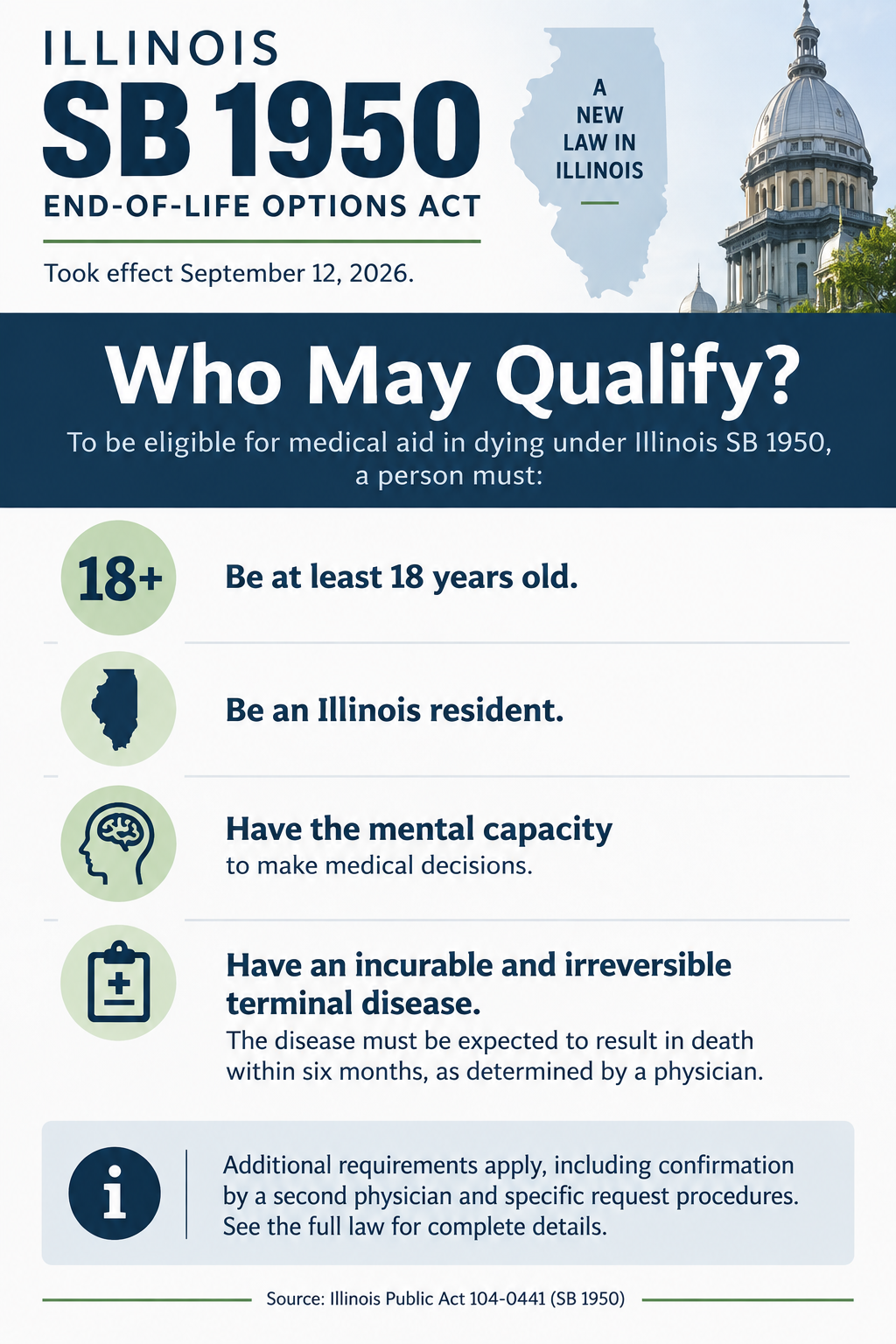
A new Illinois law allowing some terminally ill adults to obtain medication to end their lives took effect Sept. 12.
But whether Geneseo-area patients can access that option through their current health care provider may vary.
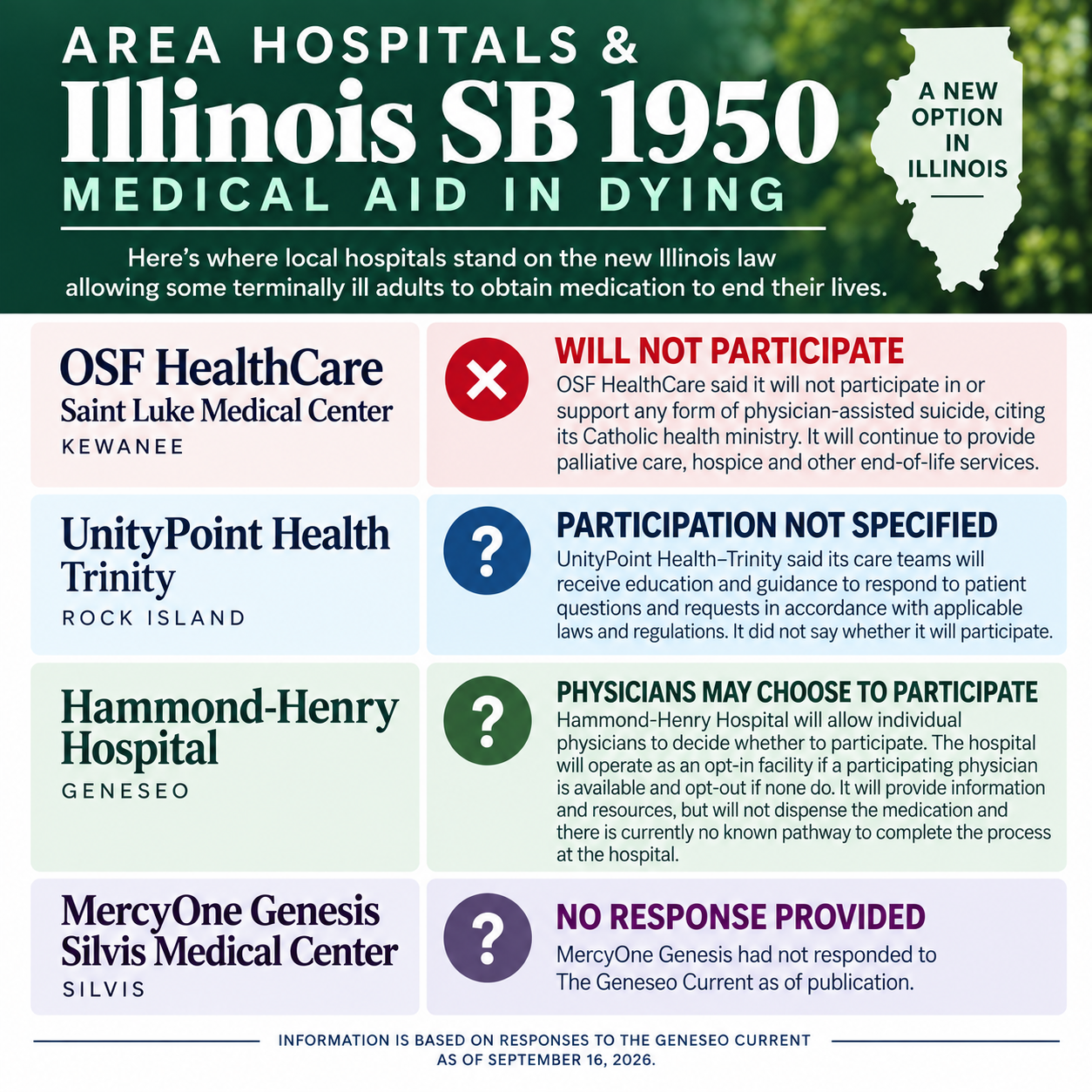
Hammond-Henry Hospital says it will allow individual physicians to decide whether to participate in medical aid in dying and will operate as an “opt-in” facility if it has a participating physician.
OSF HealthCare told The Geneseo Current it will not participate, citing its Catholic health ministry. UnityPoint Health–Trinity did not say whether it will participate, but said its care teams will receive guidance on responding to patient questions and requests.
The End-of-Life Options for Terminally Ill Patients Act, also known as Deb’s Law, applies to mentally capable adult Illinois residents with a terminal illness and a prognosis of less than six months to live.
The diagnosis and prognosis must be confirmed by an attending and consulting physician. Patients must make two oral requests and a written request, and the request cannot be made by a family member, guardian, health care proxy or other surrogate decision-maker. The patient must be able to self-administer the medication.
Hammond-Henry will allow physicians to choose whether to participate
Hammond-Henry Hospital CEO Wyatt Brieser told The Geneseo Current that the hospital's participation will depend on whether any of its physicians choose to participate.
“The Board of Directors and Administration recognize that Medical Aid In Dying (MAID) is a deeply personal issue involving ethical, professional, and community considerations,” Brieser said.
Under Hammond-Henry's policy, individual physicians may choose to participate or abstain, consistent with the law, hospital policy and their professional judgment. No physician will be required to participate.
“The hospital will operate as an opt-in facility only if a physician plans to participate and opt-out if there are no participating physicians,” Brieser said.
That means Hammond-Henry's participation status could change over time depending on whether it has a physician willing to participate.
Regardless of that status, Brieser said the hospital will provide information to patients, families, clinicians and staff.
Hammond-Henry will not dispense the medication
Even if Hammond-Henry has a participating physician, the hospital's role would be limited.
According to Brieser, patients could meet with a participating attending or consulting physician to discuss and consider medical aid in dying.
Hammond-Henry does not operate an outpatient pharmacy and will not stock or dispense the medications used in the process, Brieser said.
If the hospital does not have a participating physician, patients would be directed to resources through the Illinois Department of Public Health.
“At this time, Hammond-Henry Hospital is not aware of any pharmacies that are participating in stocking or dispensing the medications necessary for MAID,” Brieser said. “Therefore, there is currently no known pathway to complete this option at the time of this response.”
That distinction is important: Hammond-Henry is not categorically opting out of medical aid in dying, but its policy does not mean a patient can currently complete the entire process through the hospital.
Brieser said education, resources and auditing processes are in place to help the hospital comply with the new law and its own policies.
OSF will not participate
OSF HealthCare, which operates OSF HealthCare Saint Luke Medical Center in Kewanee and other facilities in the region, said its Catholic identity prevents it from participating.
“OSF HealthCare is saddened that SB 1950 is now law in Illinois. As a Catholic health ministry, OSF is guided by honoring the dignity of every human person and we will not participate in or support any form of physician-assisted suicide,” OSF said in a statement provided to The Current.
OSF said it will continue providing palliative care, hospice, pain management, emotional support and spiritual care. Patients who want to pursue medical aid in dying can transfer their records and seek care elsewhere.
“We will continue to provide robust palliative care, hospice care, pain management, emotional support, and spiritual care to patients and families, ensuring that no one feels alone or without options during their most vulnerable moments,” OSF said. “As is current process, decisional patients can transfer their records and seek interventions elsewhere and are able to self-refer outside of OSF.”
UnityPoint does not specify whether it will participate
UnityPoint Health–Trinity did not say whether medical aid in dying will be available through its physicians or facilities.
“UnityPoint Health is committed to ensuring our care teams have the education and guidance needed to respond to patients and their caregivers when they have questions and requests, in accordance with applicable laws and regulations,” a UnityPoint Health–Trinity spokesperson said.
The health system added that its focus remains on “delivering compassionate, patient-centered care and supporting patients and families throughout their health care journey.”
The Geneseo Current also contacted Genesis but had not received a response as of publication.
What happens if a provider doesn't participate?
Illinois law does not require physicians or health care organizations to participate in medical aid in dying. The law specifically states that a health care entity has no duty to participate and allows organizations to prohibit aid-in-dying care while their professionals are working for the organization.
IDPH also says physicians are not required to provide aid-in-dying care. If a patient transfers to another provider, however, the patient's medical records must be provided in a timely manner.
Hammond-Henry said patients who ask about medical aid in dying will receive information about their end-of-life options. If the hospital has no participating physician, it can direct patients to IDPH and other outside resources.
For Geneseo-area patients, the responses from the three health systems illustrate how differently the new law may work from one provider to another: OSF has chosen not to participate; Hammond-Henry has established a framework that allows individual physicians to participate but says there is currently no known pathway to complete the process; and UnityPoint has not publicly specified whether it will participate.
The practical availability of medical aid in dying locally may therefore depend not only on whether a patient qualifies under state law, but also on whether participating physicians and pharmacies are available.

Hammond-Henry Navigates a Difficult Reality Facing Rural Hospitals
For many people, a hospital's finances seem simple: either it's making money or it isn't. The reality—especially for rural hospitals—is far more complicated.
Read moreCyclospora Cases Reported in Illinois; No Henry County Cases Identified at This Time
As concerns grow over an increase in cyclospora cases across the United States, local health officials say there is currently no evidence of cases in Henry County.
The Geneseo Current contacted the Henry & Stark County Health Department to determine whether the recent increase in illnesses has had any local impact.
"We have yet to hear of any outbreaks in our area," said RaeAnn Tucker-Marshall of the Henry & Stark County Health Department. "If we do, we would put out an alert."
Tucker-Marshall said the best way to prevent infection is by following the same food safety practices already recommended for everyday meal preparation, including frequent handwashing and properly washing or cooking fresh produce. The Illinois Department of Public Health offers similar guidance in its public education materials and seasonal health advisory.
Illinois Cases Continue to Rise
Illinois is among 17 states reporting cases of cyclosporiasis this year, although the Centers for Disease Control and Prevention (CDC) has not released county-level case information.
According to the CDC, 145 people in 17 states contracted cyclosporiasis in the United States between May 1 and June 16, 2026. Another 45 travel-related cases have also been reported.
Twenty people have been hospitalized, but no deaths have been reported.
Health officials stress there is currently no evidence of a single nationwide outbreak linked to one food item or supplier. Instead, investigators are examining several smaller clusters while continuing to search for possible sources.
Because many people recover without seeking medical care—or are never specifically tested for Cyclospora—the actual number of illnesses is likely higher than reported.
What Is Cyclospora?
Cyclospora is an intestinal illness caused by the microscopic parasite Cyclospora cayetanensis. People typically become infected after consuming contaminated food or water.
Previous outbreaks in the United States have often been linked to imported fresh produce such as raspberries, basil, cilantro, lettuce and snow peas, although investigators have not identified a common source in the current investigations. The parasite does not typically spread directly from person to person.
Symptoms to Watch For
Symptoms usually begin about one week after exposure but may appear anywhere from two days to more than two weeks later.
Common symptoms include:
Frequent watery diarrhea
Stomach cramps
Bloating and gas
Nausea
Loss of appetite
Weight loss
Fatigue
Some people also experience vomiting, body aches or a low-grade fever.
Without treatment, symptoms can last several weeks and may disappear before returning. Most healthy people recover, although some require treatment with prescription antibiotics.
Older Adults Face Greater Risks
Older adults and people with weakened immune systems are at greater risk because prolonged diarrhea can lead to dehydration and other complications.
Potential complications include:
Kidney injury
Electrolyte imbalances
Weakness
Dizziness and falls
Worsening of existing medical conditions
People experiencing prolonged diarrhea, severe abdominal pain, persistent vomiting, blood in the stool or signs of dehydration should seek medical attention.
Because Cyclospora is not routinely included in all stool testing, patients with ongoing diarrhea should ask their healthcare provider whether specific Cyclospora testing is appropriate. Illinois health officials have also reminded providers that multiple stool samples may sometimes be needed because a single negative test does not necessarily rule out infection.
Simple Prevention Steps
Although investigators have not identified the source of the current illnesses, health officials emphasize that routine food safety practices remain the best defense.
The Illinois Department of Public Health recommends:
Wash your hands with soap and water before and after handling fresh produce and after using the restroom.
Wash fruits and vegetables thoroughly under running water.
Scrub firm produce such as melons with a produce brush.
Remove bruised or damaged portions before eating.
Refrigerate cut fruits and vegetables within two hours.
Store produce separately from raw meat and seafood.
The Henry & Stark County Health Department says it will continue monitoring for any local cases and would notify the public if an outbreak were identified.
The Geneseo Current will continue following updates from the Henry & Stark County Health Department, Hammond-Henry Hospital, the Illinois Department of Public Health and the CDC.
Sources: Centers for Disease Control and Prevention (CDC); Illinois Department of Public Health; Henry & Stark County Health Department; AARP; Mayo Clinic; local reporting by The Geneseo Current.
Henry & Stark County Health Department & First Choice Healthcare Note National Immunization Awareness Month
Henry & Stark County Health Department & First Choice Healthcare Note National Immunization Awareness Month
Read moreHealth Department & First Choice Healthcare Note Summer Sun Safety Measures
Health Department & First Choice Healthcare Note Summer Sun Safety Measures”
Read moreHealth Department Notes World No-Tobacco Day, May 31, 2023
Health Department Notes World No-Tobacco Day, May 31, 2023
Read moreHealth Department & First Choice Healthcare Clinics Celebrate National Women's Health Week, May 14-20, 2023
Health Department & First Choice Healthcare Clinics Celebrate National Women's Health Week, May 14-20, 2023
Read more