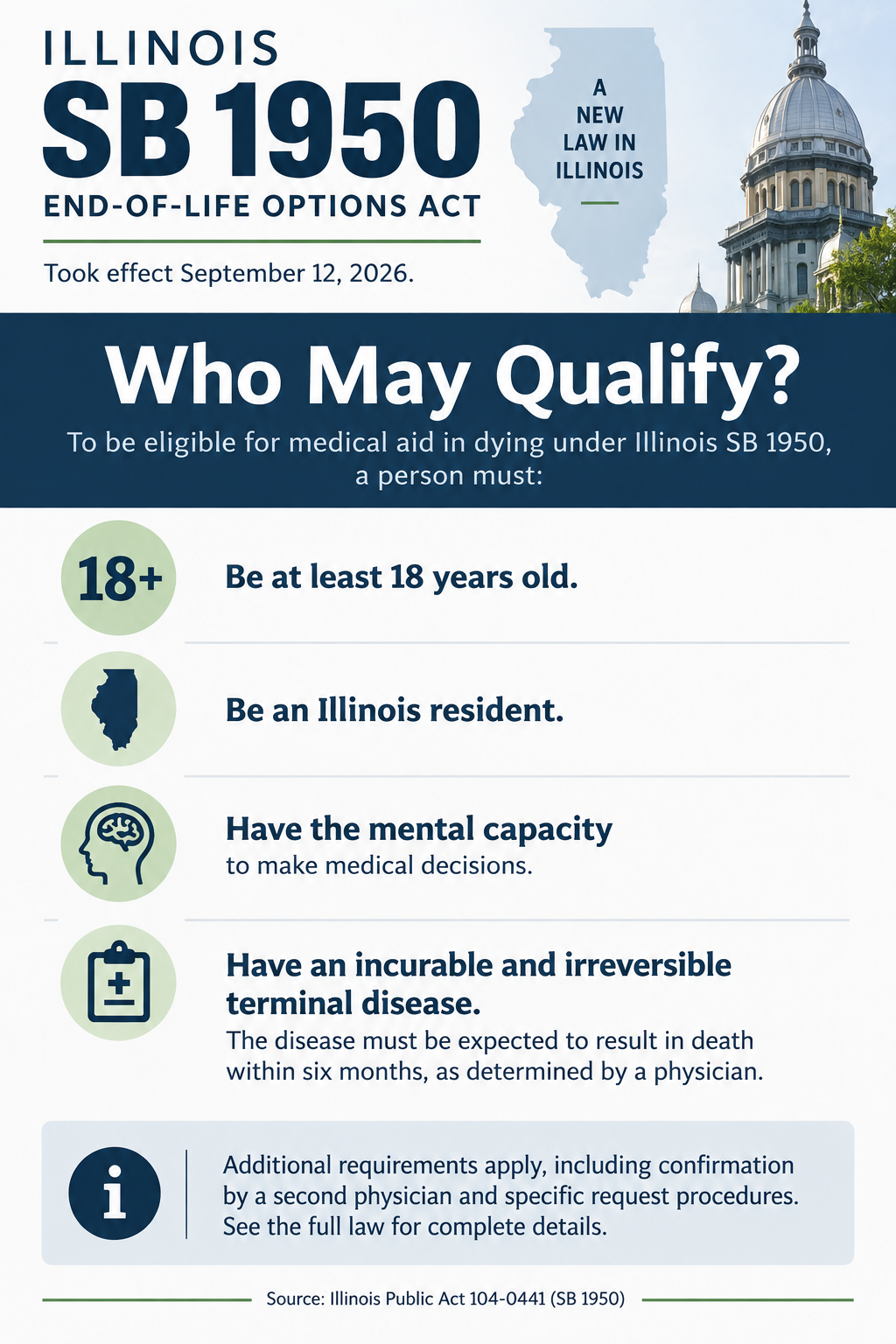
A new Illinois law allowing some terminally ill adults to obtain medication to end their lives took effect Sept. 12.
But whether Geneseo-area patients can access that option through their current health care provider may vary.
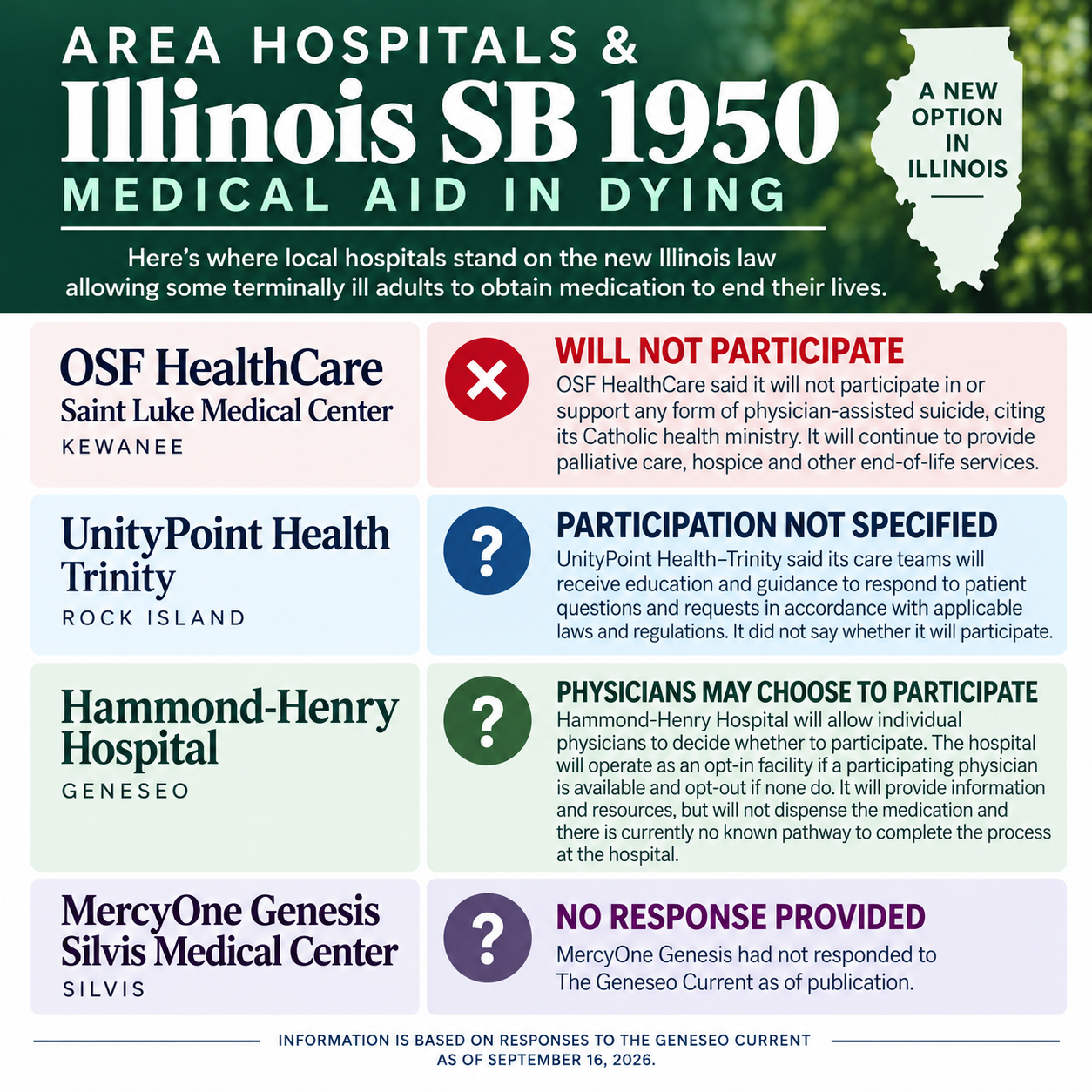
Hammond-Henry Hospital says it will allow individual physicians to decide whether to participate in medical aid in dying and will operate as an “opt-in” facility if it has a participating physician.
OSF HealthCare told The Geneseo Current it will not participate, citing its Catholic health ministry. UnityPoint Health–Trinity did not say whether it will participate, but said its care teams will receive guidance on responding to patient questions and requests.
The End-of-Life Options for Terminally Ill Patients Act, also known as Deb’s Law, applies to mentally capable adult Illinois residents with a terminal illness and a prognosis of less than six months to live.
The diagnosis and prognosis must be confirmed by an attending and consulting physician. Patients must make two oral requests and a written request, and the request cannot be made by a family member, guardian, health care proxy or other surrogate decision-maker. The patient must be able to self-administer the medication.
Hammond-Henry will allow physicians to choose whether to participate
Hammond-Henry Hospital CEO Wyatt Brieser told The Geneseo Current that the hospital's participation will depend on whether any of its physicians choose to participate.
“The Board of Directors and Administration recognize that Medical Aid In Dying (MAID) is a deeply personal issue involving ethical, professional, and community considerations,” Brieser said.
Under Hammond-Henry's policy, individual physicians may choose to participate or abstain, consistent with the law, hospital policy and their professional judgment. No physician will be required to participate.
“The hospital will operate as an opt-in facility only if a physician plans to participate and opt-out if there are no participating physicians,” Brieser said.
That means Hammond-Henry's participation status could change over time depending on whether it has a physician willing to participate.
Regardless of that status, Brieser said the hospital will provide information to patients, families, clinicians and staff.
Hammond-Henry will not dispense the medication
Even if Hammond-Henry has a participating physician, the hospital's role would be limited.
According to Brieser, patients could meet with a participating attending or consulting physician to discuss and consider medical aid in dying.
Hammond-Henry does not operate an outpatient pharmacy and will not stock or dispense the medications used in the process, Brieser said.
If the hospital does not have a participating physician, patients would be directed to resources through the Illinois Department of Public Health.
“At this time, Hammond-Henry Hospital is not aware of any pharmacies that are participating in stocking or dispensing the medications necessary for MAID,” Brieser said. “Therefore, there is currently no known pathway to complete this option at the time of this response.”
That distinction is important: Hammond-Henry is not categorically opting out of medical aid in dying, but its policy does not mean a patient can currently complete the entire process through the hospital.
Brieser said education, resources and auditing processes are in place to help the hospital comply with the new law and its own policies.
OSF will not participate
OSF HealthCare, which operates OSF HealthCare Saint Luke Medical Center in Kewanee and other facilities in the region, said its Catholic identity prevents it from participating.
“OSF HealthCare is saddened that SB 1950 is now law in Illinois. As a Catholic health ministry, OSF is guided by honoring the dignity of every human person and we will not participate in or support any form of physician-assisted suicide,” OSF said in a statement provided to The Current.
OSF said it will continue providing palliative care, hospice, pain management, emotional support and spiritual care. Patients who want to pursue medical aid in dying can transfer their records and seek care elsewhere.
“We will continue to provide robust palliative care, hospice care, pain management, emotional support, and spiritual care to patients and families, ensuring that no one feels alone or without options during their most vulnerable moments,” OSF said. “As is current process, decisional patients can transfer their records and seek interventions elsewhere and are able to self-refer outside of OSF.”
UnityPoint does not specify whether it will participate
UnityPoint Health–Trinity did not say whether medical aid in dying will be available through its physicians or facilities.
“UnityPoint Health is committed to ensuring our care teams have the education and guidance needed to respond to patients and their caregivers when they have questions and requests, in accordance with applicable laws and regulations,” a UnityPoint Health–Trinity spokesperson said.
The health system added that its focus remains on “delivering compassionate, patient-centered care and supporting patients and families throughout their health care journey.”
The Geneseo Current also contacted Genesis but had not received a response as of publication.
What happens if a provider doesn't participate?
Illinois law does not require physicians or health care organizations to participate in medical aid in dying. The law specifically states that a health care entity has no duty to participate and allows organizations to prohibit aid-in-dying care while their professionals are working for the organization.
IDPH also says physicians are not required to provide aid-in-dying care. If a patient transfers to another provider, however, the patient's medical records must be provided in a timely manner.
Hammond-Henry said patients who ask about medical aid in dying will receive information about their end-of-life options. If the hospital has no participating physician, it can direct patients to IDPH and other outside resources.
For Geneseo-area patients, the responses from the three health systems illustrate how differently the new law may work from one provider to another: OSF has chosen not to participate; Hammond-Henry has established a framework that allows individual physicians to participate but says there is currently no known pathway to complete the process; and UnityPoint has not publicly specified whether it will participate.
The practical availability of medical aid in dying locally may therefore depend not only on whether a patient qualifies under state law, but also on whether participating physicians and pharmacies are available.