Inside the Rules Communities Are Using to Rein In Data Center Impacts

As Henry County studies data centers during its temporary moratorium, it is not the only local government examining how existing zoning rules apply to a type of development that can bring unusually large demands for electricity, water and supporting infrastructure.

Communities in Illinois, Iowa, Virginia, Georgia and elsewhere have adopted data-center-specific ordinances or revised existing zoning codes. Their approaches differ, but the ordinances provide examples of the issues local governments have chosen to address before or during the approval of a project.

Henry County's Planning and Development Committee considered a resolution for a temporary moratorium on new data centers in June. The moratorium gives the county time to study the issue before new projects move through the zoning process.

No single ordinance provides a standard model. Local authority also varies by state. However, existing ordinances show several recurring areas of regulation: where data centers may locate, water use, noise, setbacks, utilities, roads, emergency planning, environmental studies and what happens when a facility eventually closes.

Linn County Requires Water Study and Agreements

One of the closest regional examples is Linn County, Iowa.

In February 2026, the Linn County Board of Supervisors approved an ordinance establishing separate zoning rules for small and large data centers in unincorporated portions of the county.

The ordinance addresses building setbacks, noise, traffic and road impacts, emergency planning and site-plan review. Large-scale projects face additional requirements.

Before a large data center can proceed, the developer must complete a water study describing the project's water source, anticipated consumption, cooling method, efficiency measures, reliability and potential effects on existing groundwater and surface-water users.

The developer must also enter into a water-use agreement with Linn County. That agreement addresses monitoring, reporting, information sharing and procedures that could apply during droughts, emergencies or other periods of constrained water supply.

Linn County also requires an economic development agreement for a large-scale data center. The agreement establishes any incentives the project will receive and contributions associated with the development. County documents state that it must include a community fund that can support infrastructure, public services, environmental protection and workforce development. It may also include measures addressing nearby property values.

The county subsequently placed an 18-month moratorium on new applications to rezone property for large-scale data centers beginning July 1, 2026.

County officials said the additional review would consider cumulative effects involving public infrastructure, water, electrical infrastructure, emergency response, transportation and long-range land-use planning.

An Illinois Community Requires Special-Use Approval

Troy, Illinois, provides an example from within the state.

Under Troy's ordinance, data centers are permitted only in the city's I-2 General Industry zoning district and require a special-use permit.

The review includes the project's relationship to surrounding and planned land uses, building design, parking, traffic, road capacity, utility demand, site access, signage and environmental effects. The applicant must provide confirmation from utility providers that adequate facilities are available and submit a noise study.

Troy also establishes specific operating noise limits.

Stationary noise adjacent to residential land uses cannot exceed 60 decibels during the day or 55 decibels at night. The limit adjacent to nonresidential uses is 70 decibels.

The ordinance further reduces permissible levels when sound contains discrete tones or impulsive characteristics. It requires an existing ambient-noise study and allows post-construction testing to determine whether an operating facility complies with the limits.

Those provisions demonstrate one distinction found in some data-center ordinances: rather than relying entirely on a general noise ordinance, the regulations establish standards specifically for the facility.

Albemarle County Uses Setbacks and Cooling Requirements

Albemarle County, Virginia, regulates the physical location and operation of data centers through measurable standards.

Existing regulations require data-center buildings and associated equipment — including generators, HVAC systems and battery backup equipment — to be at least 200 feet from property lines and 500 feet from the county's Rural Areas zoning district.

Data centers must use public water and sewer. If water is used for cooling, the system must be closed-loop or use recycled water.

Generator testing is another regulated activity.

Routine generator maintenance is limited to weekdays between 10 a.m. and 4 p.m. Generators must use enclosures that limit sound to 70 dBA measured 23 feet from the generator, while the facility remains subject to the county's overall property-line noise requirements.

The county has also studied additional requirements involving landscaping, equipment screening, building appearance and post-construction noise testing. Its draft standards included three staggered rows of evergreen trees in certain locations and requirements intended to break up the appearance of large building facades.

Albemarle's experience also illustrates that local regulatory authority differs by state. The county states that Virginia law allows it to regulate matters such as zoning districts, setbacks, building size, height, noise and landscaping, but does not give it zoning authority to regulate a data center based on factors such as energy consumption or customers served.

Jones County Requires 100 Acres and a Decommissioning Bond

Jones County, Georgia, adopted detailed data-center regulations in January 2026.

A data center is not permitted as a matter of right in any zoning district. It requires conditional-use approval in the county's M-2 district.

The regulations establish a minimum site size of 100 acres. Buildings and equipment generally must be at least 200 feet from property lines, while structures generating noise are subject to a 400-foot setback.

The county establishes noise limits of 55 dBA during the day and 45 dBA at night at property lines. Generator testing is restricted to one weekday test period per week between 11 a.m. and 1 p.m.

Applications must include sound modeling.

Water requirements are also specific.

Jones County requires closed-loop cooling or equivalent technology designed to minimize water consumption. Non-closed-loop and evaporative cooling systems are prohibited.

Data centers must use a public water supply, and wells cannot be drilled or operated to supply the facility.

Applicants must also submit a traffic-impact study and a baseline environmental-impact study addressing potential effects involving air quality, water, energy generation, noise, lighting, traffic, natural resources and archaeological or cultural resources.

Planning for the End of a Facility

Jones County's ordinance addresses an issue that occurs potentially decades after a zoning application is approved: decommissioning.

A building-permit application must contain a decommissioning plan describing how electronic equipment and other materials will be managed, recycled or disposed of.

The requirement applies not only when the entire facility closes but also to electronic waste generated through future equipment replacement and technological upgrades.

The developer must provide financial security, such as a bond or letter of credit, sufficient to cover the county's estimated cost of decommissioning the facility.

Wastewater is addressed separately. Data centers must connect to a publicly owned sewer system. Where public sewer is unavailable, the ordinance prohibits on-site wastewater treatment and disposal systems.

Applicants must estimate wastewater volumes and explain the treatment and disposal of process wastewater, including flows associated with cooling and water-treatment systems.

Different Ordinances Address Different Stages of Development

The ordinances reviewed do not regulate data centers identically.

Some focus heavily on the initial land-use decision. Troy requires special-use approval and evaluates compatibility, traffic, utilities and noise before a project is approved.

Others establish detailed operating standards. Albemarle regulates setbacks, cooling systems and generator testing, while Jones County establishes property-line noise limits and cooling requirements.

Linn County adds another layer by requiring agreements governing water use and economic development in addition to ordinary zoning requirements.

Jones County extends regulation to the end of the facility's useful life through a decommissioning plan and financial surety requirement.

Together, the ordinances identify several questions local governments have addressed when developing data-center regulations:

  • Where can a data center be located?

  • Is it permitted by right or does each project require discretionary approval?

  • How far must buildings, generators and cooling equipment be located from neighboring properties?

  • What noise levels are allowed during daytime and nighttime hours?

  • Is sound modeling required before construction and testing required afterward?

  • Where can the facility obtain water?

  • What cooling technologies are permitted?

  • How is water consumption measured and reported?

  • Can groundwater be used?

  • What utility-capacity information must be supplied before approval?

  • What road and traffic studies are required?

  • What emergency planning is required?

  • What environmental information must an applicant provide?

  • What landscaping or screening is required?

  • Are development incentives and community contributions addressed through a separate agreement?

  • What happens when equipment is replaced or a facility permanently closes?

  • Is the developer required to provide financial security for eventual decommissioning?

For Henry County, the examples provide a record of the subjects other local governments have chosen to address as they developed regulations for a land use that may not have been specifically contemplated when their existing zoning codes were written.


Source Documents


The Future of Data Centers in Henry County, Part 3

What Henry County Needs to Decide

For the past two weeks, we've explored why data centers are being built at an unprecedented pace and examined the potential benefits and concerns they bring to the communities that host them.

Now the focus shifts to Henry County.

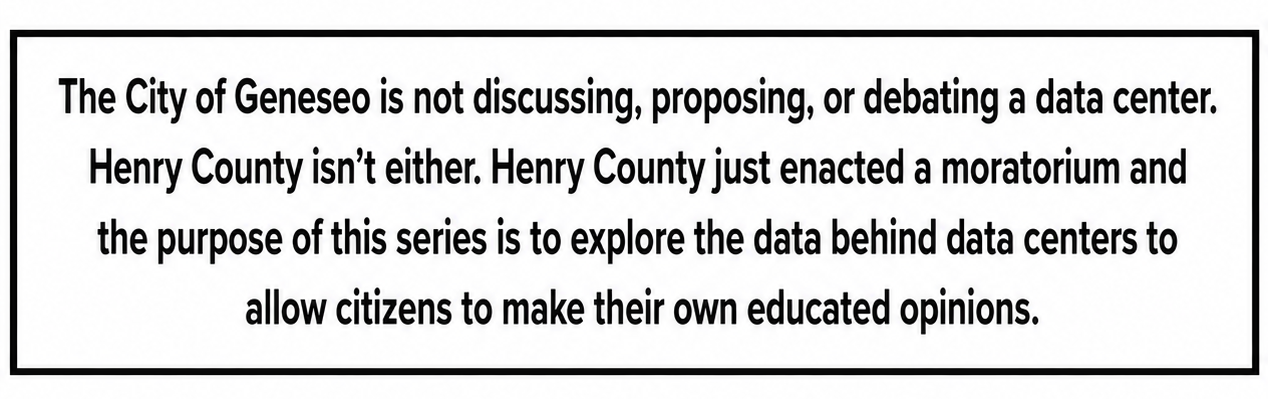
In June, the Henry County Board approved a 12-month moratorium on new data center projects. The decision wasn't intended to stop development permanently. Instead, county leaders chose to pause, gather information, and determine whether Henry County's current regulations are sufficient—or whether new rules should be in place before a proposal ever reaches the County Board.

A Pause to Plan

Data centers are unlike most developments the county has considered in the past.

A new subdivision, manufacturing facility, or retail business each presents its own challenges. But modern data centers bring unique questions involving electricity, water, technology infrastructure, emergency response, and long-term land use.

Rather than waiting until an application arrives, county officials have opted to establish expectations in advance.

The goal is simple: create a fair, transparent process that protects the public while giving developers a clear understanding of the county's requirements.

Where Should They Be Allowed?

One of the first decisions the county may need to make is where data centers could be built. Space needs range from 15-30 acres for a small facility, 30-150 acres for an average data center, and up to 150-500+ acres for “hyperscale” centers.

Throughout the Henry County moratorium, the board will be considering questions like:

  • Should they be limited to industrially zoned property?

  • Should they be located near existing electrical, utility, or stormwater infrastructure?

  • Should productive farmland receive additional protections?

  • Should minimum setbacks be required from homes, schools, parks, or other sensitive areas? Will any additional landscaping/ screening be required?

  • Are safeguards in place to protect farmland and our rural character?

The answers will shape not only whether a project is approved, but where one could realistically be proposed.

How Much Power Is Too Much?

Modern data centers consume large amounts of power, and future facilities are expected to require even more as technology needs continues to expand.

Issues that are not properly addressed upfront can cause increased electricity bills:

  • need for new substations, transmission lines, or equipment

  • higher capacity requirements

  • stranded (abandoned) projects

  • increased wholesale prices due to increased demand

  • local grid updates

Addressing these issues prior to approval may involve:

  • an infrastructure payment agreement

  • a utility cost-impact study

  • separate utility rates so the data center pays its fair share (also known as a separate large-load rate treatment)

  • exit and stranded cost protections

  • agreed-upon expansion triggers

  • public reporting and accountability measures

  • third-party regulator reviews

While utilities ultimately determine whether power can be supplied, the county may require developers to document those plans before a project moves forward.

How Will Water Be Managed?

Not every data center uses the same cooling technology. Some rely primarily on outside air. Others use water-based cooling systems. Still others use hybrid designs that reduce water consumption while maintaining efficient operation. Water consumption ranges from as much as 5 million gallons daily to nearly zero, depending on the cooling system and the size of the facility.

Before considering a project, the county may want developers to identify:

  • Acceptable cooling systems

  • Estimated daily water use

  • The source of the water

  • Potential impacts on nearby water systems

  • Plans for drought conditions

  • Wastewater management

  • Maximum annual withdrawal and consumption caps

  • Water usage and monitoring measures

What About Noise?

Unlike factories, data centers typically don't produce smoke or heavy truck traffic. They do, however, operate 24 hours a day. Cooling equipment, transformers, ventilation systems, and backup generators all create sound.

Many communities establish measurable noise standards instead of relying on subjective descriptions like "too loud."

Possible standards could address:

  • Maximum daytime noise

  • Maximum nighttime noise

  • Property-line measurements

  • Generator testing schedules

  • Required sound barriers or landscaping

  • Quieter equipment

  • Noise monitoring, complaint, and response plans

Clear standards provide certainty for both residents and developers.

Emergency Preparedness

Data centers contain sophisticated electrical equipment, backup power systems, batteries, and fire suppression systems.

Although these facilities are designed with multiple layers of safety, local emergency responders still need to have the tools and training to respond appropriately to potential emergencies.

County officials may ask:

  • What specialized training would responders need?

  • Would additional equipment be necessary?

  • How would emergency access be maintained?

  • What information should fire departments receive before construction?

These discussions often occur long before a building permit is issued.

Roads and Infrastructure

A project of this size could affect roads, utilities, and other public infrastructure. Construction may require heavy equipment and frequent deliveries. Electrical service may require upgrades. Fiber-optic connections may need expansion.

One important question is who pays for those improvements. Many communities negotiate development agreements that clearly assign responsibility before construction begins.

County officials may formalize expectations regarding:

  • road repairs for wear and tear caused by construction traffic

  • upgrades to roads, bridges, and intersections

  • traffic control, signage, and safety measures

  • dust control and cleanup

  • construction hours

Air Pollution

Data centers rely on backup generators to keep critical systems running during outages. When these generators run or are tested, they emit pollution, including:

  • nitrogen oxides

  • particulate matter

  • carbon monoxide

  • volatile organic compounds (VOCs)

  • carbon dioxide

  • other toxins including formaldehyde, benzene, and others

Limiting those pollutants or outlining expectations requires policies outlining:

  • generator testing schedules

  • generator maintenance runs

  • fuel used in generators

  • location relative to prevailing winds and nearby homes, schools, businesses

  • stack height and dispersion modeling

Data center generators are regulated as stationery engines under the Clean Air Act.

Weighing the Choice

Supporters often point to the economic impact of data centers, while opponents often question whether those benefits justify the project's size and infrastructure needs.

Rather than relying on estimates or assumptions, the moratorium allows Henry County the opportunity to evaluate measurable information, including:

  • Expected property tax revenue

  • Potential tax incentives

  • Construction investment

  • Temporary construction jobs

  • Permanent employment

  • Local purchasing commitments

  • Infrastructure contributions

  • Long-term maintenance obligations

Looking beyond the headline investment number allows decision-makers to understand a project's overall impact on the community.

Should Henry County Create New Rules?

One of the biggest questions during the moratorium is whether the county's existing zoning regulations are enough.

Many communities have concluded that data centers deserve their own standards because of their unique infrastructure needs.

A future ordinance could address issues such as:

  • Appropriate zoning districts

  • Minimum lot size

  • Building height

  • Setbacks

  • Landscaping and screening

  • Noise limits

  • Water reporting

  • Utility documentation

  • Emergency response planning

  • Road-use agreements

  • Environmental requirements

  • Financial guarantees

  • Decommissioning plans if a facility eventually closes

The purpose of those standards wouldn't necessarily be to encourage or discourage development. Their purpose would be to ensure every proposal is evaluated using clear, consistent, and transparent criteria.

Looking Beyond One Project

The decisions Henry County makes during this moratorium could shape how the county evaluates technology-related development for decades.

Strong regulations provide clarity for residents, developers, and elected officials alike. Poorly defined regulations can create uncertainty for everyone involved.

The coming months give Henry County an opportunity to ask difficult questions before difficult decisions have to be made.

Next in the series: How would a data center proposal actually move from concept to construction? In the final installment, we'll walk through the decision-making process, the roles of local, state, and utility partners, and how residents can participate as plans take shape.

Sources:

What Is a Moratorium? Henry County Board Chair Explains Why Officials Hit Pause on Carbon Sequestration and Data Centers

When the Henry County Board voted to approve one-year moratoriums on new carbon dioxide (CO₂) sequestration projects and new data center developments, some residents questioned what a moratorium actually means—and whether it signals opposition to the projects themselves.

According to Henry County Board Chair Kippy Breeden, the answer is no.

Instead, she says the temporary pause is intended to give county officials time to gather additional information, develop emergency response plans and ensure appropriate safeguards are in place before any future proposals move forward.

What is a moratorium?

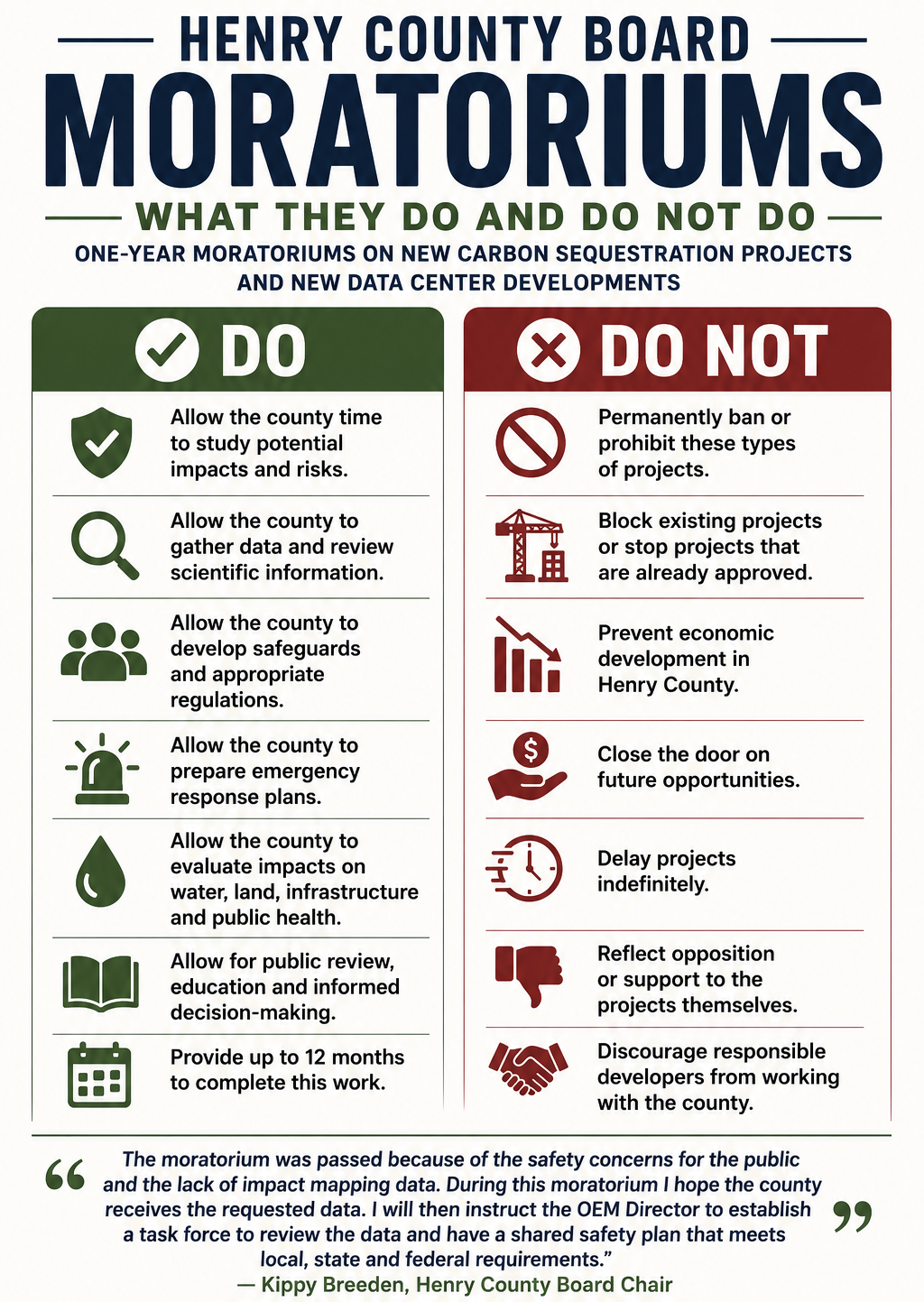
A moratorium is a temporary suspension of certain activities while additional study, planning or regulations are completed.

In Henry County's case, the resolutions temporarily pause the acceptance, approval, recommendation, endorsement or support of new carbon sequestration projects and new data center developments for up to 12 months—or until the County Board takes further action.

The moratoriums do not permanently prohibit either type of development.

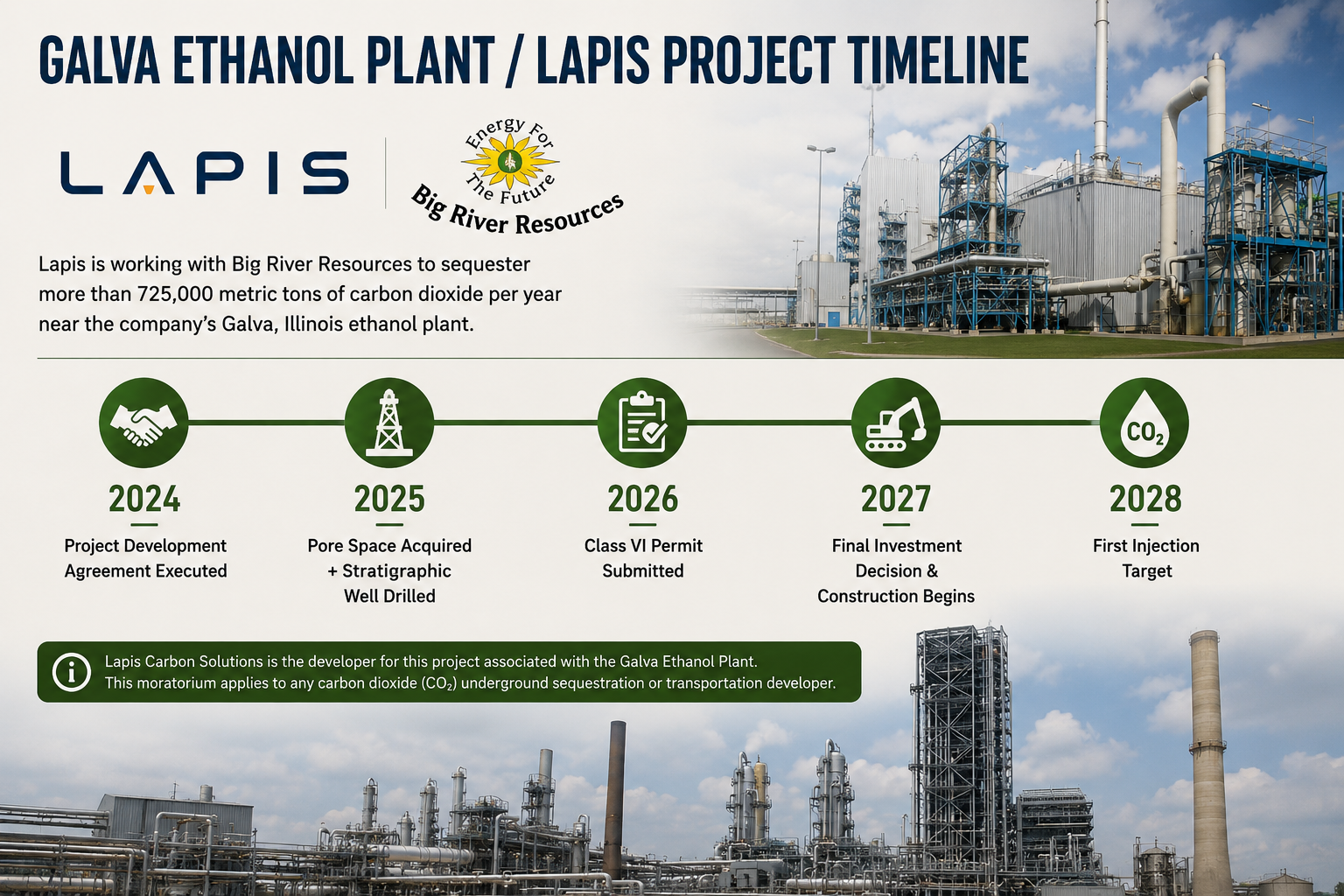
The current discussion in Henry County has centered largely around a proposed carbon dioxide sequestration project associated with Big River Resources' ethanol plant in Galva. Lapis Carbon Solutions is the developer pursuing that project. However, Board Chair Kippy Breeden emphasized that the moratorium is not directed at Lapis specifically. Instead, it applies broadly to any future carbon dioxide underground sequestration or CO₂ transportation project proposed within Henry County during the moratorium period.

Why did the Board approve the moratorium?

Breeden said two primary concerns drove the Board's decision.

"The moratorium was passed because of the safety concerns for the public and the lack of impact mapping data."

During previous Planning & Development Committee meetings, officials cited concerns including emergency response preparedness, groundwater protection, infrastructure impacts, agricultural land preservation and the need to better understand the potential effects of both carbon sequestration projects and large-scale data centers.

What happens during the pause?

Breeden said county officials intend to use the next year to gather additional information and prepare for the possibility of future projects.

"During this moratorium I hope the county receives the requested data. I will then instruct the OEM (Office of Emergency Management) Director to establish a task force to review the data and have a shared safety plan that meets local, state and federal requirements."

She said the task force would work alongside the Henry County Planning & Development Committee to review technical information and help develop emergency response plans should future projects be proposed.

Does the moratorium stop economic development?

Some residents have expressed concern that temporarily pausing new projects could discourage investment in Henry County.

Breeden said she does not believe the one-year moratorium should have that effect.

"The County Board and County officials have had several meetings with the developer and they understood our process and the 12-month moratorium should not impede the perceived economic advantage."

What happens next?

Breeden said the county's focus during the moratorium will be education and planning.

"The next steps are that the OEM Director will work with his task force and the Planning and Development County Board Committee to inform and educate us all on the overall parameters of the project."

Any future decisions regarding carbon sequestration projects or data center developments would occur after the moratorium expires or if the County Board chooses to take action sooner.

For now, the temporary moratorium allows county officials additional time to evaluate scientific research, review technical data, consider emergency preparedness needs and determine whether additional local regulations should be adopted before new projects move forward.

Sources:

  • Henry County Planning & Development Committee Minutes, June 9, 2026.

  • Henry County Planning & Development Committee agenda packet, including draft moratorium resolutions.

  • Henry County Board meeting, June 18, 2026.

  • Email interview with Henry County Board Chair Kippy Breeden, July 16, 2026.

  • Lapis Carbon Solutions, “Project Big River”

Henry County Board Approves One-Year Moratoriums on New Carbon Sequestration Projects and Data Centers

Henry County has approved 12-month moratoriums on new carbon dioxide sequestration projects and new data centers, temporarily pausing future proposals while county officials research potential impacts on public safety, farmland, water resources, infrastructure, and local regulations. The action follows public input and gives the county time to evaluate whether additional safeguards should be adopted before new projects move forward.

Read more