
Over the past two installments of this series, we've explained how the proposed Big River–Lapis project would work and why Henry County officials are spending significant time discussing emergency planning and public safety.
That leaves one important question:
Why is carbon sequestration so controversial?
Unlike many public issues, this debate isn't simply between people who support economic development and people who oppose it.
Many of those involved—including elected officials, farmers, business leaders, emergency responders, environmental advocates, and nearby residents—agree on several basic goals: protecting public safety, supporting the local economy, and making informed decisions.
Where they differ is how they weigh the potential benefits against the potential risks.
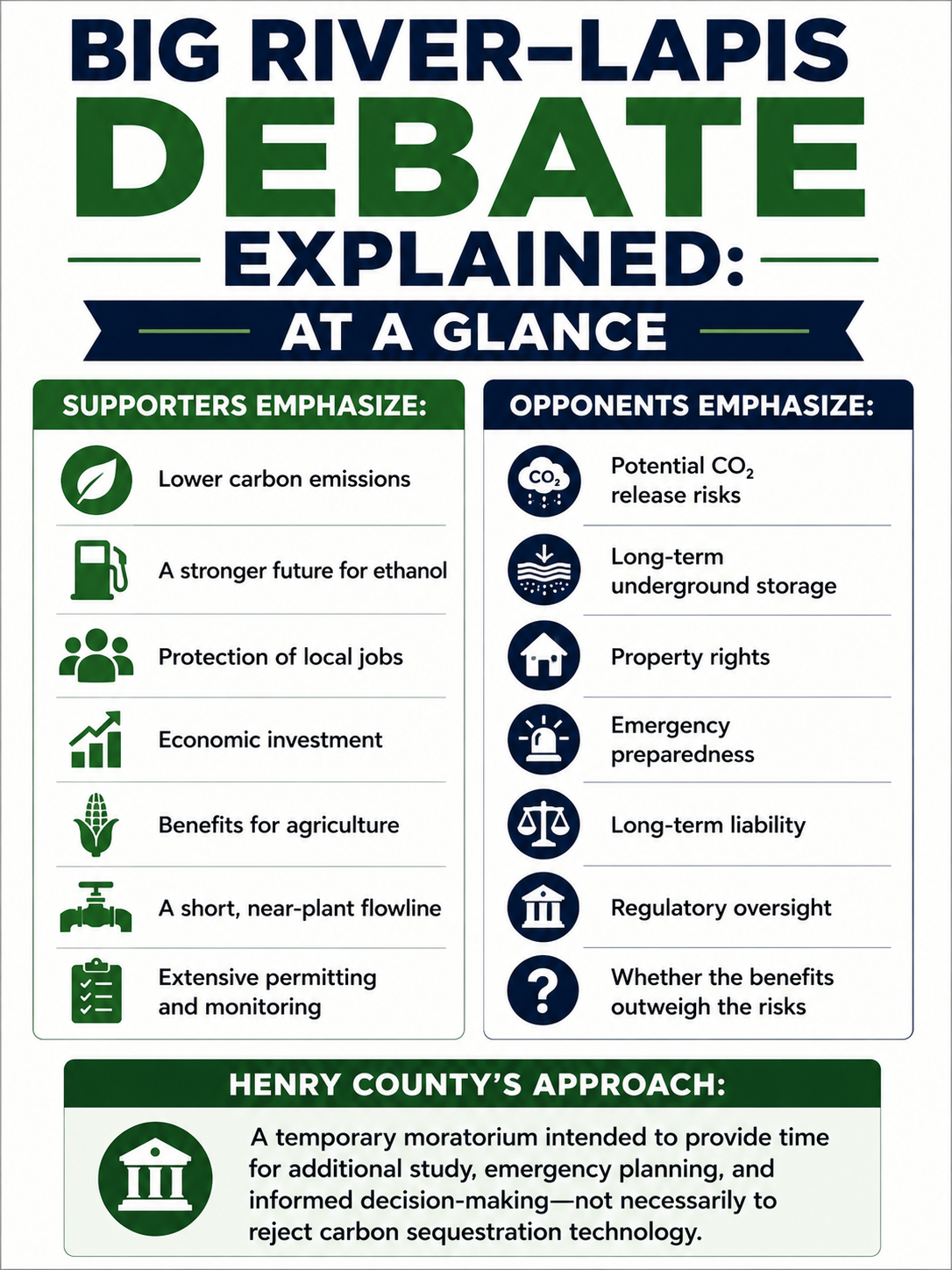
Why supporters favor the project
Supporters believe carbon sequestration can help both the local economy and the future of ethanol production.
Lower carbon emissions
Capturing carbon dioxide before it enters the atmosphere reduces the greenhouse gas emissions associated with ethanol production.
Supporters view carbon capture as one tool for lowering industrial emissions while allowing existing facilities to continue operating.
Keeping ethanol competitive
Fuel markets increasingly reward products with lower carbon intensity.
Supporters argue that reducing the carbon footprint of ethanol helps Illinois producers compete in those markets and positions the industry for long-term success.
Protecting local jobs
Big River Resources is a significant employer in the region.
Supporters say projects like this help ensure facilities remain economically viable, supporting both existing jobs and future employment opportunities.
Supporting agriculture
Illinois is one of the nation's leading corn-producing states.
A strong ethanol industry creates demand for locally grown corn, which supporters say benefits farmers, grain elevators, transportation companies, equipment dealers, and other agriculture-related businesses.
Attracting investment
Supporters believe carbon capture projects represent new private investment in rural communities.
Construction activity, engineering services, and long-term operation can generate additional economic activity.
A different type of project
Supporters also emphasize that Project Big River is not a long interstate pipeline.
Instead, it is designed as a near-plant project, with a flowline of less than one mile connecting the ethanol plant directly to the underground injection site.
They argue this substantially changes the project's risk profile compared to regional carbon dioxide pipeline networks.
Extensive permitting and monitoring
Before carbon injection could begin, the project must satisfy extensive federal and state permitting requirements.
Supporters point to ongoing geological studies, well construction standards, groundwater protections, pressure monitoring, financial assurance requirements, and long-term monitoring as evidence that multiple safeguards already exist.
Why opponents remain concerned
Opponents don't necessarily oppose every carbon capture project.
Many simply believe unanswered questions remain.
Carbon dioxide releases
The primary concern involves the possibility—however unlikely—of a significant carbon dioxide release.
Because CO₂ can displace oxygen, opponents want to better understand potential public safety impacts before projects move forward.
Long-term underground storage
Some residents question whether carbon dioxide can safely remain underground for decades or centuries.
While supporters point to extensive geological research, opponents say they would like more information about long-term monitoring and responsibility.
Property rights
Although Lapis has stated it does not anticipate using eminent domain for Project Big River's short flowline, some landowners remain concerned about how future carbon capture projects could affect property rights if additional infrastructure were proposed elsewhere.
Emergency preparedness
Many residents have asked whether local emergency responders have the training, equipment, and resources needed to respond to a carbon dioxide incident.
Those questions became more common following the 2020 Satartia, Mississippi pipeline rupture.
Long-term liability
Questions have also been raised about who would remain responsible for monitoring and maintaining underground storage sites years—or even decades—after injection ends.
Residents have asked who would bear responsibility if problems were ever identified in the future.
Government oversight
Some opponents believe additional local regulations may be necessary beyond existing federal and state permitting requirements.
Others believe current regulations are sufficient.
That difference of opinion has become one of the central questions facing county officials.
Do the benefits outweigh the risks?
Ultimately, much of the debate comes down to balancing potential economic benefits against potential public safety concerns.
Supporters believe the benefits justify moving forward under existing regulations.
Opponents believe additional study and local safeguards are appropriate before approving similar projects.
Why did Henry County approve a moratorium?
The County Board has repeatedly emphasized that the one-year moratorium should not be viewed as a permanent prohibition on carbon sequestration.
Instead, officials have described it as an opportunity to better understand the issue before additional projects move forward.
County leaders have said they want time to:
Gather additional technical information.
Develop comprehensive emergency response plans.
Review public safety considerations.
Study whether additional county regulations are appropriate.
Better understand how future projects could affect Henry County.
County Board Chair Kippy Breeden has said the Board's intent is to make informed decisions—not to reject the technology outright.
Whether additional county regulations are ultimately adopted remains to be seen.
What happens next?
The proposed Big River–Lapis project continues moving through the federal and state permitting process.
Meanwhile, Henry County officials are expected to continue reviewing technical information, coordinating with emergency management officials, and discussing whether additional local safeguards should be considered before the moratorium expires.
The conversations taking place over the next year may shape not only this project, but how Henry County approaches similar proposals in the future.
A final thought
Carbon sequestration is a complicated topic.
It combines agriculture, manufacturing, geology, engineering, environmental policy, emergency management, economics, and public safety.
Reasonable people can—and do—reach different conclusions about whether projects like Big River should move forward.
As the public discussion continues, understanding both the potential opportunities and the concerns allows residents to evaluate the project based on facts rather than assumptions.
That is ultimately the purpose of this series.