
by Sarah DeMaranville
Geneseo Current
Henry County's proposed rules for large-scale battery storage have not been adopted by the County Board, County Administrator Erin Knackstedt confirmed to The Geneseo Current this week.
The proposal — labeled Appendix D of the county zoning ordinance — is expected to go before the Planning and Development Committee for discussion and possible approval. If it clears committee, it would move to the full County Board in October for a final adoption vote.
The 13-page proposal, obtained by The Current through a Freedom of Information Act request, would create the county's first dedicated rules for battery energy storage systems: facilities over 1,000 kilowatts that store electricity for later sale to the grid.
What the proposal would require
In plain English, the ordinance would:
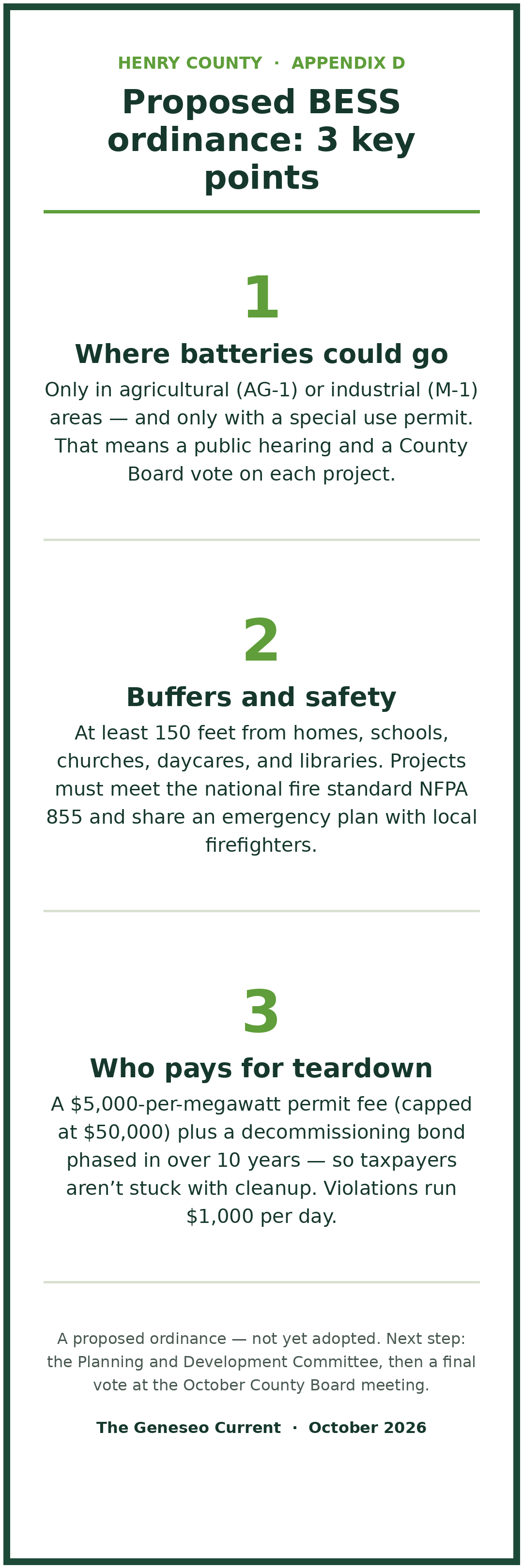
Limit where batteries can go. Storage facilities would be allowed only in agricultural (AG-1) or industrial (M-1) zoning districts — and only with a special use permit, which means a public hearing and a board vote on each individual project.
Set distance buffers. Facilities would have to sit at least 150 feet from homes, schools, churches, daycares, and libraries, and 50 feet from property lines and public road rights-of-way.
Require fire-safety compliance. Projects would have to meet the National Fire Protection Association's battery-storage standard (NFPA 855), carry an emergency operations plan shared with local fire departments, and offer training to first responders.
Protect farmland drainage. Developers would file a farmland drainage plan, restore surface and underground drainage after construction, and compensate landowners for crop losses caused by drainage damage.
Put money behind teardown. A permit fee of $5,000 per megawatt (capped at $50,000) plus a decommissioning bond phased in over 10 years — so the cost of removing an abandoned facility doesn't fall on taxpayers. A facility that sits idle for 12 months would count as abandoned.
Penalize violations. Noncompliance could draw fines of $1,000 per violation per day and, in serious cases, revocation of the permit.
The road to adoption
According to Knackstedt, the path is a two-step process:
Planning and Development Committee — discussion and a vote on whether to recommend the ordinance. The next meeting is October 13 at 4:30 in room 303C at the Henry County Courthouse.
Full County Board — if the committee approves, the board votes on final adoption at its October 22 meeting.
Why this is on the table now
In June, the county adopted a 12-month moratorium on data centers. Battery storage is a separate technology — batteries store electricity; data centers consume large amounts of it — but the two are often discussed together because both involve the electric grid and large-scale energy infrastructure. The Current has not found evidence linking a specific battery-storage proposal to a data center project in Henry County.
The county's zoning code already contains a solar energy ordinance (Appendix C, cited in a solar application filed in June). Appendix D would extend that structure to energy storage.
What to watch
The committee agenda has not been posted yet. The Current will follow the ordinance through the committee vote and the board's final decision, and will publish the meeting dates once agendas are available.