
Public schools in Illinois and Iowa share many of the same responsibilities, from educating students and maintaining buildings to paying teachers and providing transportation. But the two states use different systems to determine how much funding school districts receive.
Both rely on a combination of state funding, local property taxes and federal assistance. The biggest difference is how state aid is calculated.
Illinois uses an evidence-based formula designed to direct additional funding toward districts furthest from their estimated financial needs. Iowa relies primarily on a statewide per-pupil funding formula, with additional funding for certain student needs and programs.
Those differences affect how school districts develop budgets, respond to enrollment changes, and depend on local taxpayers.
Illinois: Funding Based on Each District's Needs
Illinois adopted its Evidence-Based Funding formula in 2017, replacing a system that relied heavily on a standard foundation funding level.
Under the current formula, the Illinois State Board of Education calculates an adequacy target for each district. This represents the estimated resources needed to provide students with an education based on the district's circumstances.
The calculation incorporates 34 cost factors, including staffing, student needs, and other educational expenses.
The state then compares that target with the financial resources available to the district, including its local revenue capacity.
Districts with the largest gaps between available resources and their adequacy targets receive priority when additional state funding is distributed.
Illinois places districts into four funding tiers. Those furthest from adequate funding generally receive the largest shares of new funding, while districts at or above their targets receive relatively small shares.
The system also includes a Base Funding Minimum intended to protect districts from losing previously established formula funding.
Why property taxes still matter in Illinois
Although the formula was designed to reduce funding disparities, local property taxes remain a major source of school revenue.
Communities with substantial taxable property wealth can generate more revenue at a given tax rate than communities with smaller tax bases.
The evidence-based formula attempts to account for those differences when allocating state money, but it does not eliminate them.
According to a July 2026 analysis by Capitol News Illinois, local revenue accounted for more than two-thirds of Illinois school funding in the data examined, with property taxes providing the largest local source.
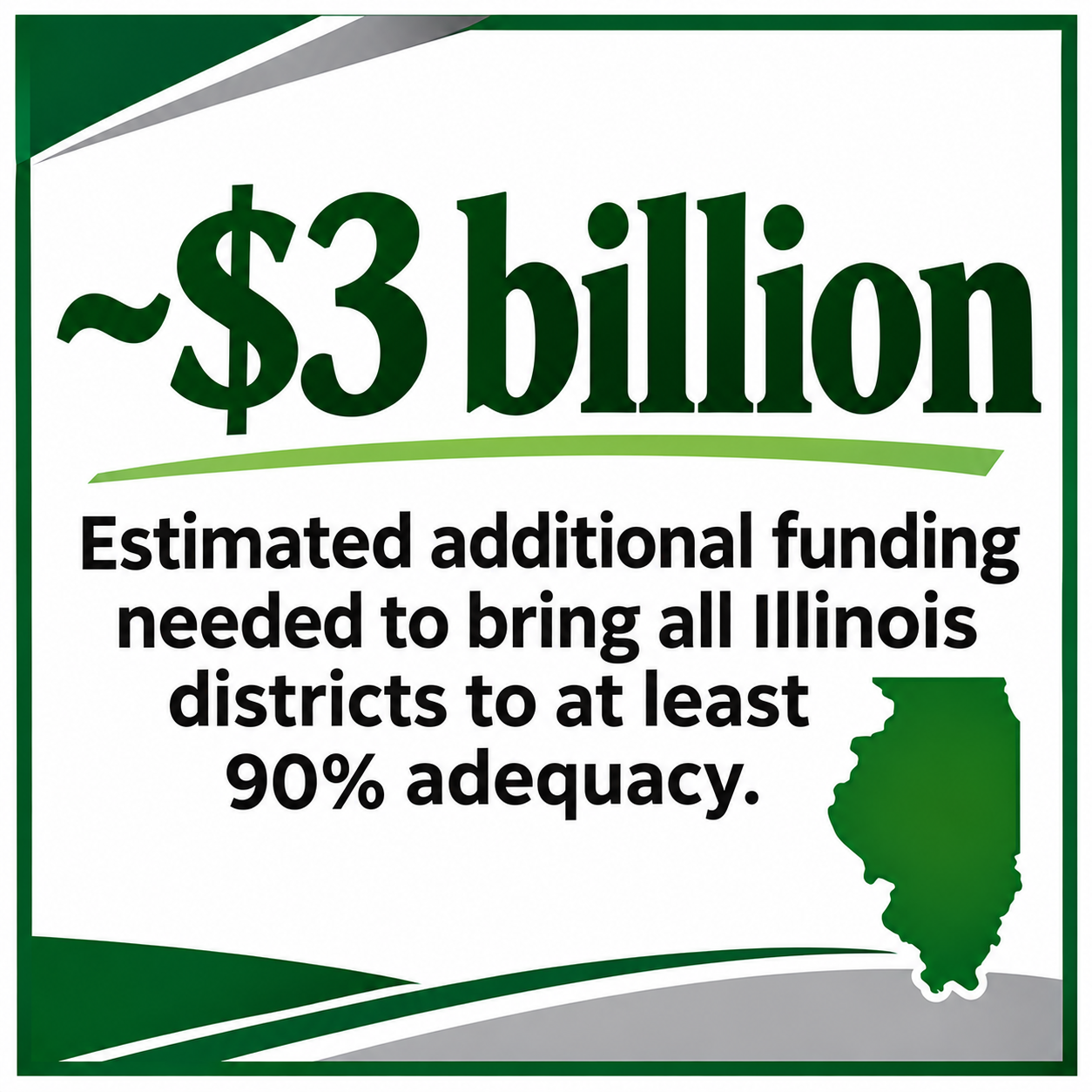
The same analysis found that 537 of Illinois' 850 school districts, approximately 63%, remained below 90% of their calculated adequacy targets in fiscal year 2026. ISBE estimated it would take about $3 billion more to bring every district to at least 90% of adequacy.
The state has increased funding since adopting the formula, but many districts continue to operate below the resources estimated to meet their needs.
Iowa: Funding Based Primarily on Students
Iowa uses a school foundation formula that begins with a statewide cost-per-pupil calculation.
Each year, state lawmakers establish the growth rate for this funding amount, commonly called Supplemental State Aid.
The formula combines state assistance with property tax revenue to support each district's authorized educational spending.
Student enrollment plays a central role in determining how much funding a district can receive. Additional weighting and funding provisions account for certain student populations, services, and programs.
Unlike Illinois' district-specific adequacy targets, Iowa's regular program funding begins with a common statewide per-pupil amount.
For the fiscal year beginning July 1, 2026, Iowa lawmakers approved a 2% increase in per-pupil funding. The legislation also included budget-guarantee assistance for qualifying districts and changes to enrollment calculations, including a second enrollment count date of Jan. 15, with the two counts averaged to set budget enrollment — a change that takes effect for budget years beginning on or after July 1, 2027.
How property taxes work in Iowa
Iowa also relies on property taxes, but its foundation formula establishes a more standardized structure for calculating local contributions.
For the 2026–27 school year, the uniform school foundation levy is $5.40 per $1,000 of taxable property valuation.
Additional property tax levies help finance the remaining authorized budget and certain other district expenses.
School districts may also collect taxes for specific purposes, including facilities, equipment, insurance, and debt payments.
Iowa's system does not eliminate differences in property tax rates among districts. Local taxable valuation, authorized spending, and additional levies all influence what residents pay.
Legislation enacted in May 2026 will gradually reduce the uniform foundation levy to $5.10 in fiscal year 2028 and $4.90 beginning in fiscal year 2029. Those reductions are not yet in effect for the 2026–27 school year.
How Much Funding Comes From Each Source?
The difference between the two states becomes clearer when examining where school revenue originates.
According to National Center for Education Statistics data compiled by USAFacts, Illinois schools receive a substantially larger share of their funding from local sources, while Iowa schools receive a majority from the state.
The same data show that Illinois schools received approximately $26,100 per student in total revenue, compared with $17,400 in Iowa during the 2023–24 school year.
That represents a difference of approximately $8,700 per student.
However, those figures measure total revenue from all sources, not just state formula payments or classroom spending. They do not account for every difference in district costs, student needs, or how money is used.
What Happens When Enrollment Declines?
Enrollment is important in both states, but the formulas respond differently.
In Iowa, student counts are central to determining a district's regular program funding. A district experiencing declining enrollment can face a reduction in its authorized budget even when expenses such as building maintenance, transportation, and staffing do not decline proportionately.
Iowa provides budget-guarantee assistance for qualifying districts. Under the 2026 funding legislation, 199 districts were expected to qualify for approximately $42.9 million in assistance.
Illinois also incorporates enrollment into its funding calculations, but its Base Funding Minimum generally protects districts from reductions in previously established evidence-based formula funding.
That protection does not guarantee that a district's total revenue will remain unchanged. Local taxes, federal grants, and other revenue sources can still fluctuate.
How Do the States Pay for School Buildings?
Both states distinguish between funding daily educational operations and financing major construction projects.
In Illinois, school districts can use local property taxes, borrowing, and available state assistance to finance buildings and improvements. Debt payments and capital projects may require separate funding decisions.
Iowa has an additional dedicated funding source known as SAVE, or Secure an Advanced Vision for Education.
SAVE distributes statewide sales tax revenue for school infrastructure needs and certain property tax relief purposes. Eligible expenses include school construction, remodeling, repairs, and other facilities projects.
Iowa districts also use property tax levies and voter-approved bonds for capital improvements.
What Does This Mean for Local Taxpayers?
For residents of Geneseo and neighboring Iowa communities, the distinction helps explain why school budgets and property tax discussions can look different across the Mississippi River.
In Illinois, a district's funding depends partly on how the state evaluates its educational needs and available local resources. Even with state assistance, property taxes remain essential to operating many school districts.
In Iowa, state lawmakers' annual decisions about per-pupil funding growth directly influence how much regular program funding districts can receive. Property taxes still contribute, but the state supplies a larger share of total school revenue.
Neither system removes financial pressures from local school boards.
Illinois districts must balance their available resources against district-specific adequacy targets, while Iowa districts must manage expenses within a formula closely tied to enrollment and legislatively established funding increases.
Both states also face the challenge of financing educational services and facilities when costs rise faster than available revenue.
Ultimately, the central distinction is how the states determine where additional money goes. Illinois emphasizes the gap between a district's estimated needs and available resources. Iowa emphasizes a statewide per-pupil funding calculation, supplemented by additional funding provisions.
Understanding that difference provides important context when evaluating school budgets, state funding announcements and local property tax proposals.