
Parents sometimes hear that curriculum is a local decision. And that is true — but only up to a point.
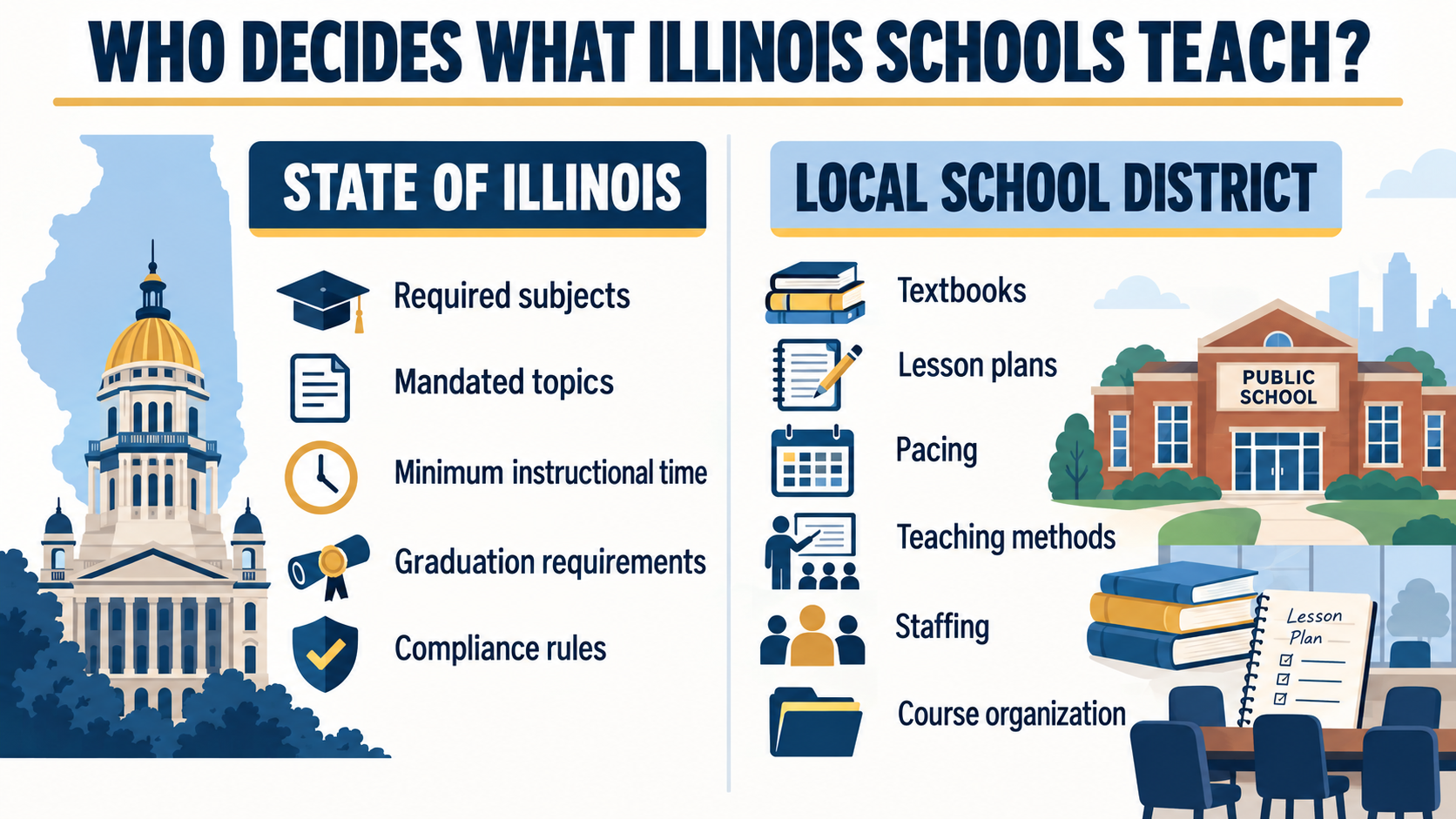
Illinois school boards, administrators and teachers make thousands of local decisions about textbooks, lesson plans, course sequences, and instructional methods. But the state establishes a significant framework underneath those decisions, including subjects schools must offer, topics students must study and, in some cases, exactly how much instructional time must be devoted to them.
The Illinois State Board of Education's 2025-26 Illinois Instructional Mandates identifies the areas of study required under the Illinois School Code and Illinois Administrative Code. Schools are also advised to review those requirements annually and before a Regional Office of Education compliance review.
And the list goes considerably beyond reading, writing, math and science.
The basics are still the basics
At the broadest level, Illinois law identifies the fundamental purposes of public education as instruction in language arts, mathematics, biological and physical sciences, social sciences, fine arts, and physical development and health. State rules require districts to make instruction in those fundamental areas available to students.
That leaves plenty of room for local control. For example, Illinois requires elementary schools to provide coordinated instruction in science, but generally leaves the amount of instructional time to the local school board. High schools must likewise include science in their course offerings.
The same basic structure applies in areas such as music. Schools must offer it, but local boards determine the time allotted.
Language arts must be provided in elementary schools and included in high school curricula. Illinois additionally directs school boards to promote at least 60 minutes of daily reading opportunities for K-3 students who are reading at least one grade level below their current grade.
So "the state requires it" does not necessarily mean Springfield hands every teacher a daily lesson plan. Often the state establishes the subject or content requirement while districts decide how to put it into practice.
Then there are the mandates
This is where Illinois curriculum becomes much more complicated.
ISBE's current checklist includes more than three dozen instructional categories, ranging from traditional subjects to very specific topics.
Schools are required in various grades to address areas including abduction education, American government and patriotism, steroid abuse prevention, Asian American history, Black history, career education, civics, computer literacy, conservation, consumer education, cursive writing, disability history, drug education, health, Holocaust and genocide education, internet safety, media literacy, Native American history, sexual abuse prevention, teen dating violence, violence prevention and women's history, among others.
Some mandates are very broad. Every public school, for instance, must provide students instruction about recognizing and avoiding abduction.
Others are much more detailed. Illinois schools must teach drug and substance abuse education across K-12. Grades 6-12 must include instruction about fentanyl, and students in Grades 9-12 must actually be assessed on the required fentanyl instruction.
History comes with specific requirements
A district cannot simply say that it offers "social studies" and leave the content entirely open-ended. Illinois requires public elementary and high schools to provide instruction in specific historical subjects.
That includes a unit on Black history, including pre-enslavement history, slavery and the civil rights movement. It includes Asian American history, including Asian American history in Illinois and the Midwest and contributions to civil rights.
Illinois also requires Holocaust education and an additional unit examining other genocides, including Native American genocide in North America, the Armenian Genocide, the Ukrainian Famine-Genocide, and more recent atrocities including Cambodia, Bosnia, Rwanda and Sudan.
Schools must also provide instruction on disability history, people with disabilities, and the disability rights movement, although local school boards determine the minimum instructional time.
Beginning with the 2026-27 school year, Illinois is also requiring every public school to provide climate-change instruction addressing environmental and ecological impacts and evaluating possible solutions.
Civics is unusually specific
Illinois' civics requirements provide a good example of where the state goes beyond simply requiring a subject.
Every public elementary school must provide at least one semester of civics in sixth, seventh, or eighth grade. That instruction must include current societal issues, service learning, simulations of democratic processes, and instruction on voting.
High school students must also complete a semester of civics focused on government institutions, current and controversial issues, service learning, and simulations of the democratic process.
Illinois additionally requires instruction in American patriotism, representative government, the U.S. and Illinois constitutions, and proper use and display of the American flag.
In Grades 7 and 8, the equivalent of at least one hour per school week must be devoted to those subjects. A similar requirement applies during high school, and students cannot graduate without satisfactorily passing an examination covering the required government subjects.
Some requirements specify actual instructional time
Many mandates leave scheduling to local school boards. Others do not.
Health education, for example, must be part of the regular instructional program at every grade from K-6. Students must then receive the equivalent of at least one semester — 18 weeks — during middle or junior high school and another semester during high school.
Required health topics include nutrition, family-life responsibilities, disease prevention, sexual-abuse prevention, mental health, dental health, cancer education, and consent education. Secondary schools must also include CPR and AED training.
Consumer education has another unusually specific rule: high school students must receive the equivalent of 50 minutes per day for nine weeks, and the superintendent must maintain evidence showing that each student received adequate instruction before completing Grade 12.
Driver education has its own minimums: at least 30 clock hours of classroom instruction and six hours of individual behind-the-wheel instruction for the course described by state law.
Internet safety must currently be taught at least once every school year in Grades 3-12.
Who checks whether schools are doing it?
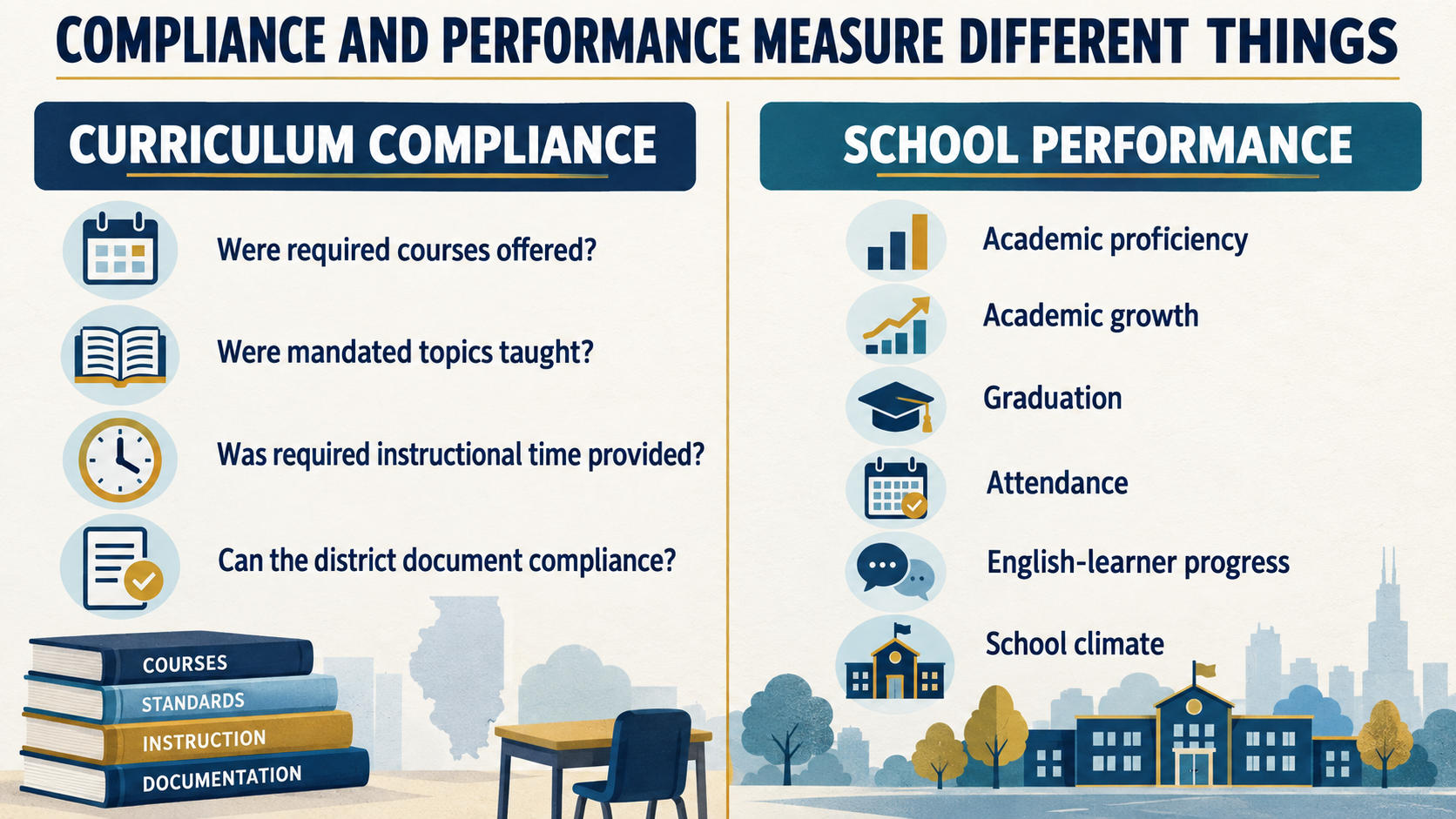
There are really two different accountability systems, and they answer different questions.
The first is compliance: Is the district following state education law?
ISBE specifically recommends that schools review the instructional-mandate document annually and before a Regional Office of Education Compliance Review Visit. The guide is designed so districts can identify themselves, review every mandate and even document the method used to deliver the instruction.
In several areas of the School Code, regional superintendents are expressly directed to monitor district compliance with curricular requirements during compliance visits and recommend improvements where necessary.
That is different from asking whether students actually learned the material.
The second accountability system measures results
Illinois also measures school performance through its statewide accountability system.
State law authorizes ISBE to establish student-performance standards, use state assessment results and assign annual school-improvement designations.
Illinois is implementing a redesigned accountability system for the 2026 Report Card. Under that framework, schools are evaluated through a profile incorporating academic proficiency, academic growth and — for high schools — graduation, along with measures including English learner progress, consistent attendance and school climate.
That creates an important distinction.
A school could theoretically be compliant with curriculum requirements but perform poorly academically.
It could have the required courses, teach the mandated units and document compliance, while students still struggle on state assessments.
Conversely, strong test scores do not by themselves prove that every legally mandated instructional topic was taught.
One system asks, essentially, "Are you doing what state law requires?"
The other asks, "What results are students producing?"
Local control still matters — a lot
The sheer number of mandates can make Illinois education sound entirely state-controlled. It isn't.
Local boards still make consequential decisions about curriculum materials, textbooks, pacing, staffing, course organization, and how numerous mandates are integrated into existing classes.
For internet safety, for instance, the local board determines the scope and duration of the required unit. For disability history, the board determines the minimum instructional time. For science and music, the state requires the instructional offering while leaving time allocation to the district.
That's probably the clearest way to understand Illinois curriculum:
Springfield establishes the floor. Local school districts build much of the house above it.
And because new mandates continue to be enacted, that floor isn't static. Public Act 104-0391 made multiple changes for the 2025-26 school year, prompting ISBE to tell districts to review the requirements again "with fresh eyes" to make sure their curricula comply with current law.
For parents wondering what their local school is supposed to teach, the answer therefore isn't contained in one textbook, one curriculum map or even one school-board policy.
It begins with Illinois law.
Sources:
Illinois Instructional Mandates — 2025–26 School Year (ISBE PDF)
Illinois School Code — Article 27 and related curriculum provisions
105 ILCS 5/27-260 — Environmental and climate-change education
ISBE 2025 Report Card: School Improvement and Accountability
Illinois School Code — Regional superintendent responsibilities and school inspections