Artificial intelligence is already changing how students learn, how teachers prepare lessons and how schools operate. Now, the Illinois State Board of Education is giving school districts a framework for deciding how that technology should — and shouldn't — be used.
ISBE released its statewide artificial intelligence guidance July 9 in response to Public Act 104-0399. Importantly, the guidance does not require Illinois schools to use AI, prohibit its use or establish a single statewide classroom policy. Instead, ISBE says decisions should be made locally, based on each district's needs, capacity and community priorities.
For parents and students, the guidance offers a first look at the questions Illinois schools will increasingly have to answer as tools such as ChatGPT and other forms of generative AI become commonplace.
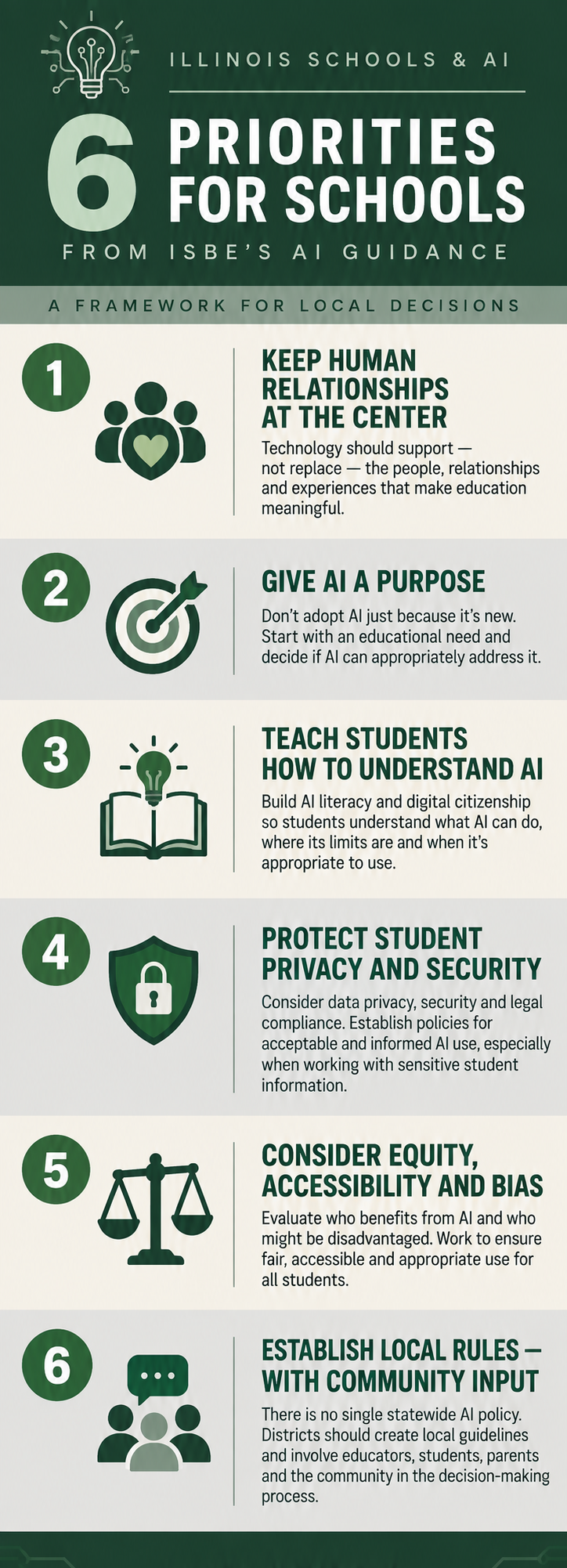
While ISBE formally organizes its guidance around four core tenets, its recommendations can be understood through six major components.
1. Keep human relationships at the center
ISBE's first principle is also one of its clearest: technology should not replace the relationships at the heart of education.
Teaching and learning, according to the guidance, are shaped by human relationships and by the individual experiences, interests and strengths students bring into school. AI should be a tool that assists that process rather than substitutes for it.
That principle applies to teachers as well.
AI may help educators develop instructional materials, plan lessons or find new ways to engage students, but ISBE says decisions about how the technology is used should remain grounded in professional judgment and human oversight.
In other words, the goal isn't to turn over teaching to an algorithm.
2. Give AI a purpose
The state is also cautioning districts against adopting AI simply because it is new or readily available.
One of ISBE's four core tenets describes artificial intelligence as a means to inform teaching and learning rather than an end in itself.
That means districts should begin by identifying an educational need and then determine whether AI can appropriately address it — rather than purchasing an AI product and figuring out what to do with it afterward.
ISBE says effective AI use should be deliberate, sensitive to the context in which it is being used and ultimately determined at the local level.
3. Teach students how to understand AI
Keeping AI out of classrooms entirely isn't the direction ISBE is recommending either.
The state recognizes that artificial intelligence is becoming part of students' everyday lives and future workplaces. Schools therefore have a role in helping students understand both what AI can do and where its limitations lie.
That includes digital citizenship and AI literacy.
It also means the conversation about students and AI is broader than academic dishonesty.
Depending on the assignment and the rules established by a teacher or district, AI could potentially be used to brainstorm, explain a concept, provide feedback or assist learning. In another situation, having AI complete the work could defeat the purpose of the assignment entirely.
Clear expectations will become increasingly important as schools distinguish between using AI as a learning tool and using AI instead of learning.
4. Protect student privacy and security
Some of the biggest questions surrounding AI in schools have little to do with cheating.
They involve data.
ISBE says districts need to consider data privacy, security and legal compliance and establish policies governing acceptable and informed AI use.
That becomes particularly important when teachers or administrators are working with information about individual students.
Earlier this year, for example, ISBE specifically reminded school districts about their responsibilities when using AI in the development of Individualized Education Programs. The agency advised districts to review or revise internal AI policies and procedures to avoid violating the rights of students with IEPs.
The larger message is straightforward: using AI does not eliminate a school's existing obligations to protect student information or comply with education law.
5. Consider equity, accessibility and bias
ISBE is also asking schools to evaluate who benefits from AI — and who might be disadvantaged by it.
The guidance specifically identifies equity, accessibility and bias mitigation among the issues districts should consider when implementing AI.
AI could potentially help remove barriers for some students or provide new ways to access educational material. At the same time, AI systems can produce inaccurate or biased results, and students may have different levels of access to AI technology outside of school.
Those differences matter if teachers begin incorporating AI into assignments or if districts rely on AI-powered products to make recommendations affecting students.
The state's framework therefore asks districts to consider not simply whether a tool works, but whether its use is fair, accessible and appropriate for the students it is intended to serve.
6. Establish local rules — with community input
Perhaps the biggest takeaway from ISBE's guidance is what the state didn't decide.
There isn't one Illinois rule governing student use of ChatGPT. There isn't one statewide definition determining when AI assistance becomes cheating. And ISBE isn't selecting one AI platform that every school must use.
Those decisions remain largely local.
ISBE recommends that districts establish policies covering governance, procurement, acceptable use, privacy, security and other AI-related issues. It also encourages schools to involve educators, students, parents and caregivers and other community stakeholders in deciding why and how AI will be used.
The state specifically recommends building agreement among staff, families and the community about the purpose of AI before selecting tools and determining how implementation will be monitored.
That puts a significant amount of responsibility on local school boards.
What happens next in Geneseo?
For Geneseo Community Unit School District 228, the next step will be translating the state's broad guidance into a local policy.
Geneseo school officials are now waiting for model policy language addressing artificial intelligence through PRESS, the Policy Reference Education Subscription Service offered by the Illinois Association of School Boards. Once that guidance is available, the district expects to review the proposed language and will likely bring a local policy to the Board of Education for consideration.
Dr. Laura Delgado said the forthcoming policy will build on the framework recently released by the Illinois State Board of Education:
“[The ISBE guidance] provides a strong framework for safely evaluating this technology in our schools. In accordance with their direction, our district will begin developing a localized AI policy that enhances learning while keeping human relationships at the center of instruction.”
Developing that local policy will require Geneseo to answer some of the practical questions ISBE intentionally left to individual districts: What AI tools can students use? When is AI assistance appropriate? What constitutes academic dishonesty? How can teachers use AI? What student information can be entered into an AI system? And what safeguards should be in place before a new AI product is introduced?
Those decisions can also be measured against the six major considerations in ISBE's framework: keeping people at the center, giving AI an educational purpose, building student AI literacy, protecting student information, considering equity and bias, and establishing clear local governance.
And the state's guidance is not intended to be the final word on artificial intelligence in schools. ISBE says additional role-specific guidance, resources and no-cost professional learning opportunities will be developed during the 2026–27 school year.
For Geneseo, the next step will be determining what local rules are appropriate for artificial intelligence in its schools. The district's eventual policy could address student and staff use, academic integrity, privacy and security, approved tools and oversight.
ISBE's guidance does not prescribe what those local decisions should be. Instead, it provides a framework for districts to consider the educational purpose of AI, its potential benefits and limitations, student privacy, equity, accessibility and the role of educators and families.
Once the PRESS Policy recommendation arrives, the Geneseo Board of Education will have an opportunity to consider those issues and determine how — or whether — different uses of AI fit within the district's classrooms and operations.
Sources
Illinois State Board of Education — Artificial Intelligence Guidance
https://www.isbe.net/aiguidanceIllinois State Board of Education — AI Guidance Quick Start FAQ
https://www.isbe.net/Pages/AI-Guidance-FAQ.aspxIllinois State Board of Education — Statewide AI Guidance announcement
https://www.isbe.net/Lists/News/DispForm.aspx?ID=1593Illinois State Board of Education — Superintendent's Weekly Message, Feb. 18, 2026, including guidance concerning AI and IEPs
https://www.isbe.net/Documents_Superintendent_Weekly_Message/Weekly-Message-20260218.pdfIllinois Association of School Boards — PRESS: Policy Reference Education Subscription Service
https://www.iasb.com/services/policy-services/press-policy-reference-education-subscription-servDr. Laura Delgado, Geneseo Schools Superintendent — Emailed statement. 3 Sept 2026.