
Illinois residents will face new statewide rules for electric bicycles, scooters and other small electric vehicles beginning Jan. 1, 2027.
Gov. JB Pritzker signed Senate Bill 3484 on Aug. 26, creating age requirements, speed restrictions and operating rules for what the state calls “electric micromobility devices.” The legislation is now Public Act 104-0854.
The law covers more than traditional e-bikes. It also addresses high-powered electric bikes sometimes marketed as e-motos, along with electric scooters, skateboards and unicycles.
For most adults who own conventional e-bikes, the most significant changes involve where the bikes may be ridden. Families with younger riders, however, will also need to pay close attention to the law’s new minimum-age requirements.
New Age Requirements
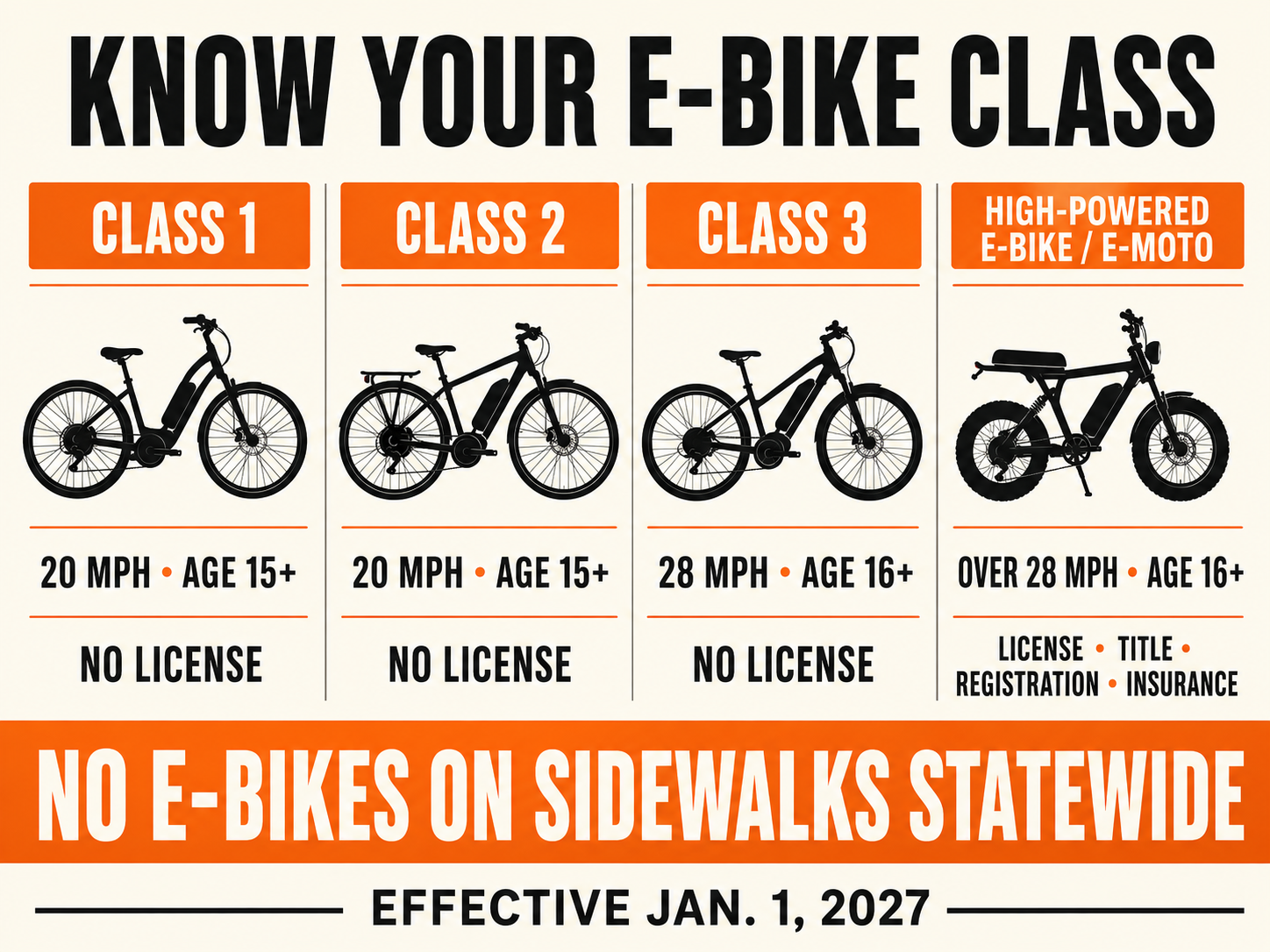
Illinois will retain its existing three-class system for conventional e-bikes:
A Class 1 e-bike provides assistance only while the rider is pedaling and stops assisting at 20 mph.
A Class 2 e-bike can propel the bicycle without pedaling but stops providing power at 20 mph.
A Class 3 e-bike provides assistance while the rider is pedaling and stops assisting at 28 mph.
Beginning Jan. 1, riders must be at least 15 years old to operate Class 1 or Class 2 e-bikes. Riders must be at least 16 to operate Class 3 e-bikes.
The Class 1 and Class 2 limits represent a significant change. Illinois currently has no statewide minimum age for those two categories, while the minimum age for Class 3 riders is already 16.
All electric-scooter riders will also have to be at least 16.
The legislation includes an additional passenger restriction. A rider younger than 18 generally may not carry a passenger on a low-speed electric or gas-powered bicycle unless the passenger is the rider’s sibling, stepsibling, child or stepchild.
E-Bikes Will Be Prohibited on Sidewalks
The law prohibits e-bikes and electric scooters from being operated on sidewalks statewide.
Conventional Class 1, Class 2 and Class 3 e-bikes may generally be used on streets and in bike lanes. They may also be permitted on bike paths and trails, although the Illinois Department of Natural Resources, park districts, forest preserve districts, conservation districts and transit districts retain authority to regulate e-bike use on property under their control.
That distinction could matter on locally managed recreational trails: being legal under the Illinois Vehicle Code does not necessarily guarantee that every class of e-bike will be permitted on every trail.
Electric scooters, skateboards and unicycles may be operated on roads with speed limits of 35 mph or less. They may be used along roads with higher speed limits only when a bike lane is available, and they may not be operated on highways.
Battery-powered toy vehicles intended for young children are treated separately and are expected to remain on sidewalks and paths.
Faster Devices Will Be Treated More Like Motorcycles
The law draws an important line at 28 mph and 750 watts.
Traditional Class 1, Class 2 and Class 3 e-bikes—with working pedals, motors of no more than 750 watts and assisted speeds no higher than 28 mph—will not require a driver’s license, title, registration or liability insurance.
But higher-powered electric bikes and e-motos will be treated as motor-driven cycles. Riders must be at least 16 and will need a valid driver’s license, registration and insurance. Qualifying vehicles will also be subject to titling requirements, although the legislation provides different title treatment for some devices purchased before the law takes effect.
Those higher-powered vehicles must be operated on roadways rather than sidewalks, bike lanes or bicycle paths.
The distinction is likely to affect devices that look like bicycles but perform more like mopeds or motorcycles. Some are sold online as e-bikes despite having motors considerably more powerful than 750 watts or being capable of speeds well above 28 mph.
For consumers, the advertised name of the product will matter less than its actual motor rating and speed capability.
Speed Is Limited Even When a Device Can Go Faster
Electric scooters, skateboards and unicycles may not be operated faster than 28 mph on public roads, bike lanes or paths, even if the device is mechanically capable of reaching a higher speed.
High-speed e-bikes and e-motos are placed in the motor-driven-cycle category instead. That subjects their operators to licensing and vehicle requirements that do not apply to conventional e-bikes.
Violations may result in fines, and police may confiscate or impound devices in some circumstances. Riders will also remain subject to other applicable traffic laws.
Why Illinois Changed the Law
Supporters said Illinois law had not kept pace with increasingly fast and powerful electric vehicles.
Before the legislation, the state had no comprehensive classification for some electric devices capable of exceeding 28 mph. State officials say certain models can reach 50 mph or more, despite being marketed or perceived as bicycles.
The Secretary of State’s office also cited a national increase in injuries involving micromobility devices. According to the office, related injuries and fatalities rose 300% from 2019 through 2022. Several serious or fatal Illinois crashes involving teenage riders also occurred during the summer of 2026.
The legislation passed the Illinois House 84-16. The Senate initially approved the bill 55-0 and later voted 48-7 to accept the House amendment containing the final micromobility provisions.
The Secretary of State plans to conduct a public-awareness campaign, update driver-education materials and provide guidance to law-enforcement agencies, schools, municipalities, riders and retailers before implementation.
Geneseo City Council to Discuss E-Bikes
The issue will also receive local attention before the statewide law takes effect.
The Geneseo City Council is scheduled to discuss e-bikes during its Sept. 22 Committee of the Whole meeting.
Committee of the Whole meetings are generally used for discussion and direction rather than final action. Any specific local changes would require subsequent City Council action.
What Owners and Parents Should Check
Before the law takes effect, Illinois e-bike owners should locate the manufacturer’s label or specifications and determine:
Whether the bike is Class 1, Class 2 or Class 3
Its motor’s rated wattage
The maximum speed at which the motor provides assistance
Whether it has fully operable pedals
Whether a younger rider meets the new minimum-age requirement
Whether the device will require a license, registration, title or insurance
Whether the agency managing a particular trail permits that type of e-bike
The practical dividing line is straightforward: conventional e-bikes that remain within the three-class, 750-watt system continue to be treated largely like bicycles. Devices that exceed those limits may legally be considered motor-driven cycles—regardless of what the manufacturer or seller calls them.