
When an Illinois school district announces a budget deficit, approves a construction project or discusses issuing bonds, residents may wonder how those decisions fit together.
How can a district have money available for building improvements while reporting a shortage in its operating budget? Why can't money designated for one expense simply be used to cover another?
The answer lies in how Illinois requires school districts to manage their finances.
Unlike a household checking account, a school district's budget is divided into separate funds, each established for specific financial purposes.
Illinois school districts use nine major funds to account for revenue and expenditures. Some support everyday operations, while others are designated for transportation, construction, debt payments or other obligations.
Understanding these distinctions is essential when evaluating a school district's financial condition.
The Nine Major School District Funds
1. Educational Fund — Fund 10
The Educational Fund is generally the largest and most significant part of a school district's operating budget.
It pays for classroom instruction and many of the expenses associated with educating students, including teacher salaries, instructional materials, technology, educational programs and administrative services.
The fund also covers expenditures that are not specifically assigned to another fund.
When school officials discuss financial pressure caused by salaries, benefits, instructional costs or educational programming, the Educational Fund is often central to that discussion.
A deficit in this fund means its expenditures exceed its revenues for the period. It does not necessarily mean the district has run out of cash, but recurring deficits can reduce its available reserves.
2. Operations and Maintenance Fund — Fund 20
The Operations and Maintenance Fund pays for the upkeep and operation of school buildings and grounds.
Typical expenses include utilities, custodial services, building maintenance, repairs and certain improvements.
For example, repairing a heating system or maintaining school facilities may be paid from this fund.
A district can have a surplus in Operations and Maintenance while experiencing a deficit in its Educational Fund. Those balances are reported separately because the funds serve different purposes.
3. Debt Service Fund — Fund 30
The Debt Service Fund, sometimes called the Bond and Interest Fund, accounts for payments on qualifying district debt.
When a school district issues bonds to finance a major project, it generally must repay the borrowed principal plus interest over time.
The Debt Service Fund accounts for those payments.
This distinction matters because money used to repay bonds is not automatically available to pay teachers or cover other operating expenses.
A district may have sufficient revenue to make scheduled bond payments while facing financial challenges elsewhere in its budget.
4. Transportation Fund — Fund 40
The Transportation Fund pays for student transportation services.
Expenses can include bus drivers, fuel, vehicle maintenance, transportation contracts and other eligible transportation costs.
Transportation funding can be particularly important for districts serving large geographic areas, where students must travel considerable distances to attend school.
A transportation deficit means the fund's expenses exceed its revenues during the budget period. The district must account for that shortfall through available balances or other legally permitted financial measures.
5. Municipal Retirement and Social Security Fund — Fund 50
School districts have financial obligations associated with employee retirement and payroll taxes.
This fund accounts for employer contributions to the Illinois Municipal Retirement Fund, commonly known as IMRF, along with applicable Social Security and Medicare contributions.
IMRF generally covers eligible nonteaching employees, such as certain support and administrative staff.
Teachers' Retirement System obligations are accounted for differently and should not be confused with IMRF.
These expenses are employment-related, but they are tracked separately from many instructional salary expenses.
6. Capital Projects Fund — Fund 60
The Capital Projects Fund accounts for money designated for major construction and other qualifying capital projects.
It can include proceeds from bond issues and other financing sources used for building construction, renovations or substantial improvements.
For example, if a district borrows money to construct an addition to a school, the proceeds may be accounted for in the Capital Projects Fund.
This creates an important distinction between money available for a specific building project and money available for daily operations.
A district may have millions of dollars in a capital project account without having the legal authority to use those funds to cover an operating deficit.
7. Working Cash Fund — Fund 70
The Working Cash Fund helps districts manage cash flow.
School districts do not necessarily receive revenue at the same time they must pay their bills. Property tax distributions, for example, may arrive at different points throughout the year.
Working Cash can provide temporary financial support when an eligible operating fund needs cash before anticipated revenue arrives.
Under applicable Illinois law, districts can make interfund loans and certain transfers involving Working Cash.
However, these transactions are subject to legal requirements and are not all interchangeable.
Working Cash is not an unlimited emergency account that can automatically be spent on any district expense.
If a district uses working cash to cover a recurring operating shortfall, that action does not resolve the underlying difference between ongoing revenues and expenses.
8. Tort Immunity and Judgment Fund — Fund 80
The Tort Fund accounts for certain liability-related expenses authorized under Illinois law.
These may include liability insurance, qualifying claims and judgments, workers' compensation and certain risk-management expenses.
The fund helps districts account for legal and insurance obligations separately from classroom and building expenses.
Its revenue is subject to restrictions governing eligible expenditures.
9. Fire Prevention and Safety Fund — Fund 90
The Fire Prevention and Safety Fund—formally known as Fire Prevention, Safety, Energy Conservation, Handicapped Accessibility, and School Security Purposes Fund—supports qualifying school facility improvements involving safety, fire prevention, environmental concerns, energy conservation and security.
Projects may include work needed to address applicable building or safety requirements.
Not every renovation or building improvement automatically qualifies for this fund. Certain projects require specific approvals, certifications or other statutory procedures.
This fund is another example of money that may be available for a designated facilities project but not for unrelated operating expenses.
These nine funds are identified in the Illinois State Board of Education's accounting framework and the Illinois Association of School Boards' school finance guidance.
A School District's Budget Is Not One Big Bank Account
Consider a hypothetical Illinois school district with the following financial picture:
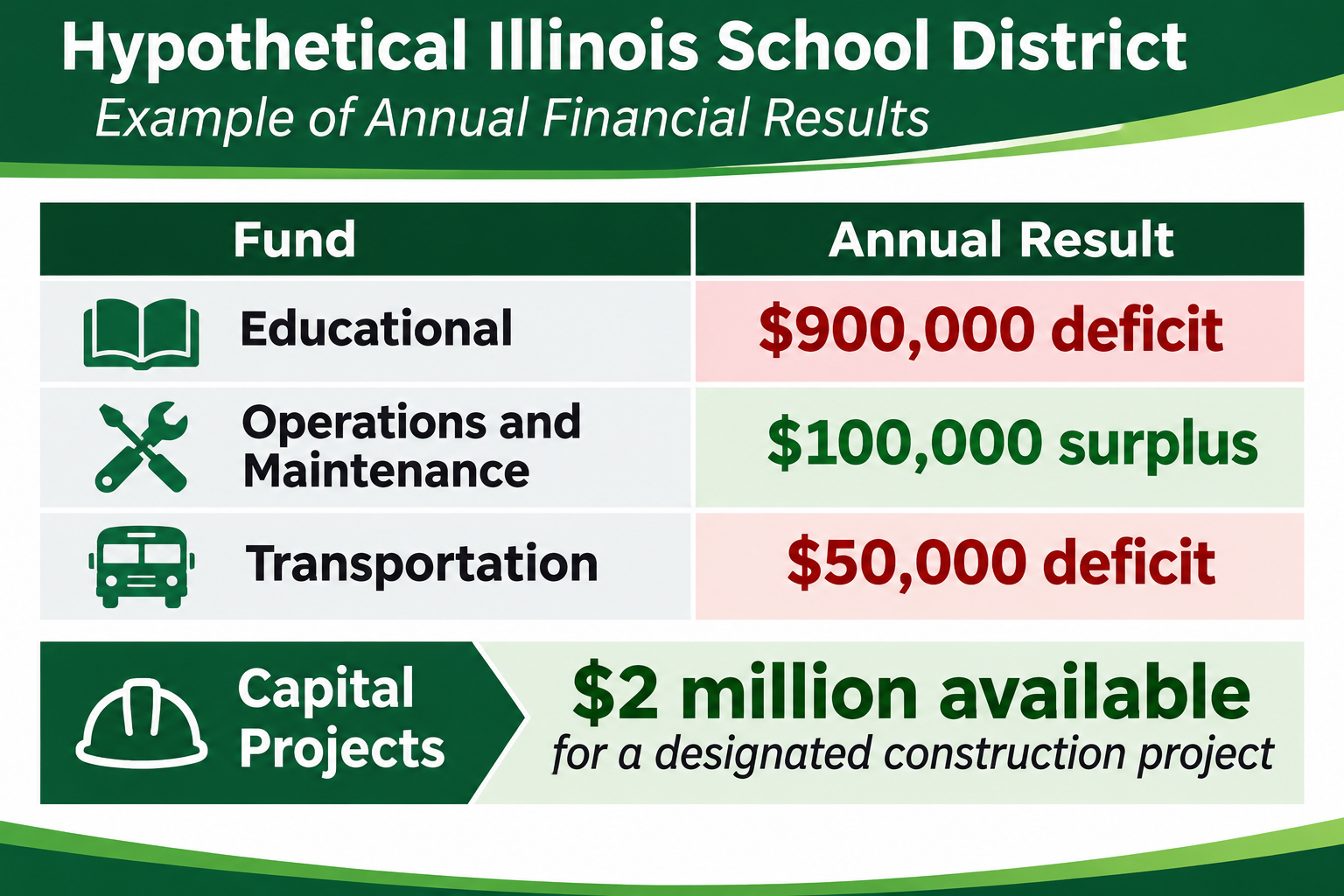
At first glance, residents might conclude that the district has more than enough money to eliminate its operating deficits.
But the $2 million in the Capital Projects Fund may be legally restricted to construction expenses. It cannot simply be redirected to cover teacher salaries.
The Operations and Maintenance surplus also does not automatically cancel the Educational Fund deficit.
Illinois law permits certain transfers between funds, but the rules depend on the funds involved, the source of the money and the purpose of the transaction. Some transfers require public notice, hearings or other procedures.
The figures above are illustrative, not figures from Geneseo CUSD 228.
Where Does the Money in Each Fund Come From?
District funds can receive money from several sources, depending on the fund and applicable restrictions.
Property taxes are one source. A school district's property tax levy can include separate amounts for education, operations and maintenance, transportation, debt service and other authorized purposes.
State funding is another major source. Illinois' Evidence-Based Funding formula provides money based on district needs and available resources.
Importantly, Evidence-Based Funding is generally an unrestricted source of revenue, although certain amounts associated with English learners, special education and low-income students have additional requirements.
Federal funding can also support school district programs, but many federal grants are restricted to particular activities or student populations.
For example, money awarded for an eligible special education program cannot automatically be used for an unrelated building project.
These restrictions help explain why a district's total revenue does not necessarily represent money that can be spent wherever officials choose.
What Is the Difference Between a Fund Balance and a Surplus?
Two terms frequently appear in school financial reports: fund balance and surplus.
They are not the same thing.
A fund's annual surplus occurs when its revenues exceed its expenditures and other financing uses for the period, after accounting for applicable transfers and adjustments.
A fund's balance represents its accumulated financial position at a particular point in time.
Consider a district that begins the year with a $3 million Educational Fund balance.
If it spends $500,000 more than it receives during the year, its balance could decline to approximately $2.5 million, assuming no other changes.
The district would have an annual deficit but still possess a positive fund balance.
That distinction is important because a deficit does not necessarily mean a district cannot pay its bills.
However, repeatedly using reserves to cover operating expenses can eventually create financial difficulties.
Why Does Working Cash Generate So Much Discussion?
Working Cash is one of the more complicated parts of Illinois school finance.
A district may maintain Working Cash to address temporary differences between when bills must be paid and when revenues arrive.
Districts can also issue working cash bonds under applicable Illinois law.
Those bonds provide money upfront, but they create debt that must be repaid.
This is why discussions about working cash bonds require a distinction between short-term liquidity and long-term financial stability.
Borrowing can provide cash when it is needed. It does not, by itself, create recurring revenue to support recurring expenses.
Likewise, transferring money between funds may change where resources are available without changing the district's overall financial position.
How Can Residents Evaluate a School District's Finances?
Rather than looking only at the total budget or the district's combined cash balance, residents can examine several questions:
Which funds are reporting annual deficits or surpluses?
How much money remains in each fund at the end of the fiscal year?
Which balances are restricted for particular purposes?
Are operating expenses increasing faster than recurring revenues?
Is the district using reserves or borrowing to support ongoing operations?
Are proposed transfers temporary cash-flow measures or permanent reallocations?
How much outstanding debt does the district have, and when must it be repaid?
These questions provide a clearer understanding of financial conditions than a single districtwide dollar amount.
Illinois also monitors school district finances through its annual Financial Profile system.
The state's 2026 report, based on fiscal year 2025 data, classified 698 districts in Financial Recognition, 111 in Financial Review, 27 in Early Warning and 14 in Financial Watch.
Those classifications consider multiple indicators of financial condition rather than simply whether a district has a deficit in one fund.
Why Understanding the Funds Matters
School district financial decisions often involve more than whether money is available.
They also involve where that money originated, what it was intended to support and whether the law permits it to be used for another purpose.
A district can have substantial construction funding while experiencing pressure in its Educational Fund. It can maintain a healthy debt payment account while drawing down operating reserves. And it can report an annual deficit without being immediately unable to meet its obligations.
None of those situations, viewed alone, tells the complete financial story.
For taxpayers, parents and community members, understanding the different funds provides a foundation for evaluating school budgets, proposed tax levies, bond issues and spending decisions.
The important question is not simply how much money a school district has. It is how much money is available in each fund, what that money can legally be used for and whether the district's ongoing revenues can support its ongoing expenses.
Sources: Illinois State Board of Education, Illinois Administrative Code Part 100, and Illinois Association of School Boards, Understanding School Finance. This article explains statewide accounting rules; individual district budgets and legal restrictions may vary.