
A Look at Geneseo District 228's Student Fees — and What It Costs to Attend From Outside the District
By Sarah DeMaranville
As Geneseo families register students for another school year, one familiar expense appears along with the forms, schedules and school supply lists: the annual registration fee.
For the 2026–27 school year, Geneseo Community Unit School District #228 charges $126 for students in kindergarten through eighth grade and $138 for high school students.
The fees increased by $3 from last year, when they were $123 and $135, respectively.
But what exactly does a school registration fee pay for?
And what happens financially when a student who doesn't live within District 228 attends Geneseo schools?
The answers provide an interesting look at two very different pieces of school finance: registration fees and non-resident tuition.
What Does the Registration Fee Pay For?
Perhaps the biggest misconception about school registration fees is that the money is attached to a particular expense.
It isn't.
According to Tim Gronski, Assistant Superintendent and Chief School Business Official for Geneseo CUSD #228, registration fees are not earmarked for any particular line item.
Instead, Gronski said, registration fees are deposited into the district's general fund.
That means it would be inaccurate to say a family's $126 or $138 specifically purchases textbooks, Chromebooks, classroom supplies or another particular item. The money becomes part of the district's broader pool of operating revenue.
How Much Could Registration Fees Generate?
With thousands of students each paying more than $100, the fees add up.
Using approximately 2,600 students as a rough enrollment figure and the district's 2026–27 registration rates, The Current estimates the district could bill approximately $340,000 annually in general registration fees.
The calculation doesn't account for students who qualify for fee waivers, unpaid fees, enrollment changes or other adjustments.
Still, roughly $340,000 provides a useful sense of scale.
What Does $340,000 Realistically Pay For?
In a household or small-business budget, $340,000 is substantial.
In the context of an entire school district, it's considerably smaller.
District 228's tentative FY2027 budget projects approximately $37.65 million in operating expenditures.
Against that amount, approximately $340,000 in gross registration fees would represent about 0.9% of annual operating expenditures.
Put another way, more than 99% of the district's operating expenditures must be supported by other revenue sources.
There's another way to visualize it.
At $37.65 million annually, district operating expenditures average approximately $103,000 per calendar day.
An entire year's estimated gross registration fees would therefore equal roughly three-and-a-third days of district-wide operating expenditures.
That doesn't mean registration fees literally pay for three days of school.
Because Gronski confirmed that registration revenue goes into the general fund, there isn't a particular program, employee or expense that can accurately be assigned to those dollars.
The comparison simply illustrates the scale.
Registration Isn't the Only Fee
The annual registration charge isn't necessarily the only school fee a family may encounter.
For 2026–27, the district's approved fee schedule includes several additional charges for particular activities and services.
At Geneseo High School, the one-time participation fee covering all activities is $40, up from $35. Behind-the-wheel driver's education remains $150.
Other high school charges include:
Replacement hallway or P.E. padlock: $10
First-semester parking tag: $35
Third-quarter parking: $25
Fourth-quarter parking: $15
Musical instrument repair fee for students using a district-owned instrument: $50
At Geneseo Middle School, the participation fee increased from $30 to $35. The district-owned musical instrument repair fee remains $50, while replacement hallway and P.E. padlocks remain $10.
Those charges are separate from the $126 or $138 general registration fee.
Registration Fees Aren't the Cost of an Education
The registration fee is also very different from what it costs to educate a student.
District 228 reports FY2025 operating expenditures of $13,264 per pupil.
A $126 K–8 registration fee represents about 0.95% of that amount.
A $138 high school registration fee represents about 1.04%.
Those aren't directly comparable accounting measures, but the numbers provide useful perspective: a registration fee represents only a small fraction of the resources involved in educating a student.
For families who live within District 228, the remainder isn't presented as an individual tuition bill. Public education is supported through local, state and federal revenue.
For students living outside the district, however, the financial situation can be very different.
What Does It Cost to Attend Geneseo Schools From Outside the District?
Gronski confirmed to The Current that District 228's non-resident tuition rate for the school year is $11,880 per student.
According to Gronski, the per-capita tuition rate is determined by the district's auditors.
That produces a striking comparison:
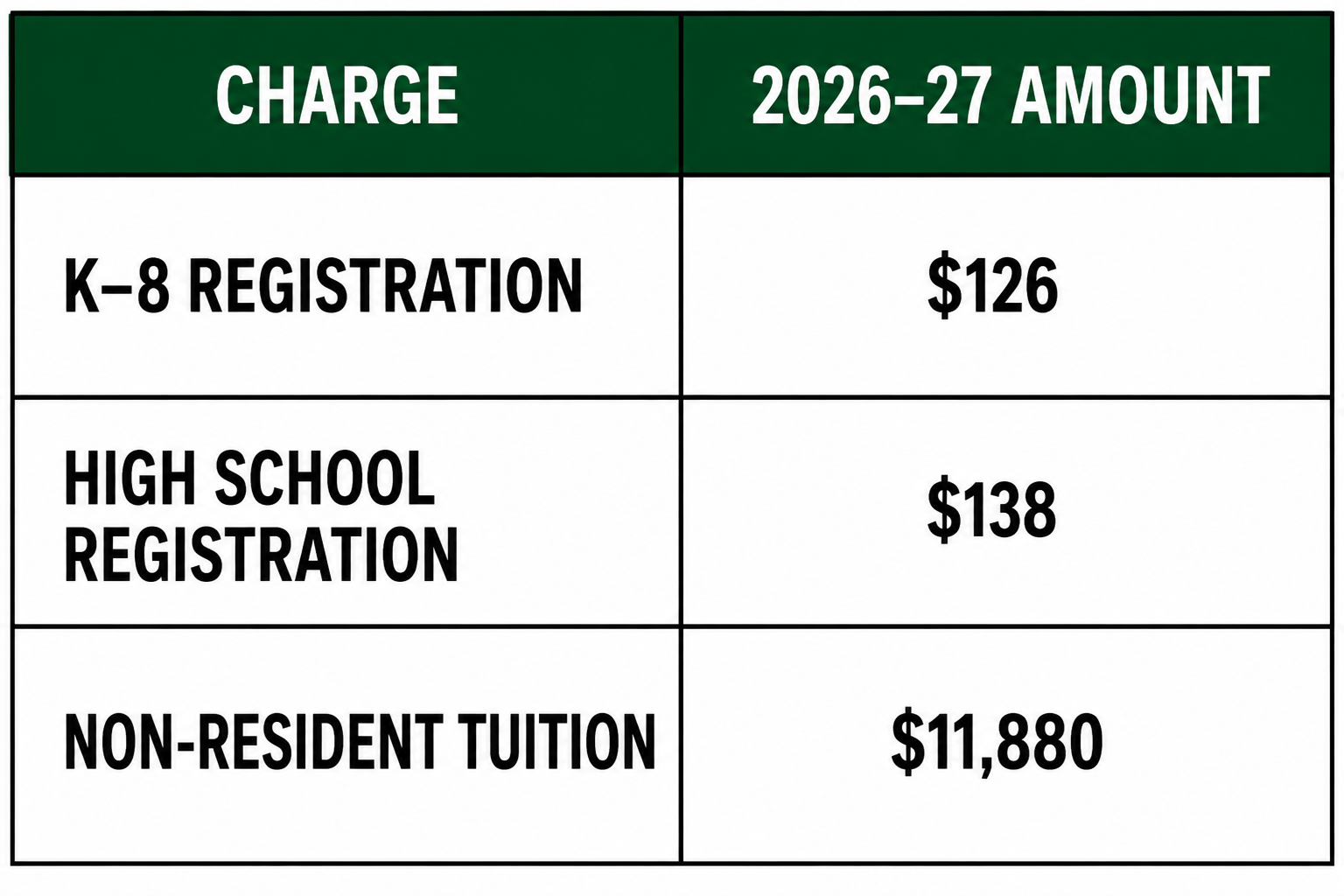
The in-district registration fee equals about 1.16% of the $11,880 non-resident tuition rate.
The two charges serve different purposes, so this isn't a direct comparison of equivalent expenses. It does, however, illustrate the difference between a relatively small student fee and the much larger financial calculation involved when a non-resident student attends the district.
Why Does Residency Make Such a Difference?
Public education doesn't operate like most services families purchase. Parents living within District 228 don't receive a bill each year representing the full cost of educating each child. Instead, public education is collectively financed.
Property owners within District 228 contribute to the local tax base whether they have three children enrolled in school, one child enrolled or no children attending district schools at all. Local revenues are combined with state and federal funding and other district revenue to operate the schools.
A student residing outside District 228 presents a different financial situation because that student's residence is outside the local tax base supporting the district.
Illinois law allows districts to charge tuition for non-resident students under applicable circumstances and establishes rules governing those charges.
For Geneseo, the district's current non-resident tuition rate is $11,880.
A Small Fee in a Much Larger System
Registration is one of the more visible pieces of school finance because it's one of the expenses families pay directly. Across approximately 2,600 students, those fees could theoretically produce somewhere around $340,000 in gross revenue before waivers and other adjustments.
That's meaningful revenue. But against approximately $37.65 million in projected operating expenditures, it represents less than 1%.
And according to Gronski, those registration dollars aren't designated for a particular textbook, computer, classroom supply or other expense. They simply become part of the district's general fund.
The contrast with the district's $11,880 non-resident tuition rate provides perhaps the clearest perspective.
The registration fee families see each year helps support the school district. It just doesn't come close to representing what it costs to provide the education their child receives.
Sources
Geneseo CUSD #228 —
Geneseo CUSD #228 financial and fee informationGeneseo CUSD #228 —
Geneseo CUSD #228 registration informationGeneseo CUSD #228 Board of Education —
District 228 Board materials on 2026–27 student feesIllinois General Assembly — 105 ILCS 5/10-20.12a.
Illinois School Code — Tuition for Non-Resident PupilsEmail from Tim Gronski, Assistant Superintendent and Chief School Business Official, Geneseo CUSD #228 — August 11, 2026.