
How Will Henry County Decide?
Over the past three weeks, we've explored why the demand for data centers has grown so rapidly, examined the potential benefits and concerns they present, and looked at the questions Henry County hopes to answer during its one-year moratorium.
If a company eventually proposes building a data center in Henry County, one question will remain:
How will the decision actually be made?
The answer is through a public process involving multiple boards, agencies, technical experts, utility providers and, ultimately, the residents of Henry County.
A project of this size would not be approved in a single meeting, nor would it be decided by one elected official.
Instead, it would likely move through months of review, public discussion, and technical evaluation.
Public Input Starts Before the Vote
One of the biggest misconceptions about local government is that public participation happens only after a decision has already been made. In reality, public input is most valuable before elected officials cast their votes.
Residents often know local conditions better than anyone else. They understand traffic patterns, drainage issues, nearby neighborhoods, agricultural concerns, emergency response capabilities, and the history of previous developments.
Just as importantly, they often ask questions government officials or developers may not have considered.
A strong public process doesn't guarantee everyone will agree with the outcome. It does help ensure decisions are made with the best available information.
The Role of the Planning & Development Committee
The Henry County Planning & Development Committee would likely be one of the first groups to review a proposed project. Its responsibility isn't simply to decide whether members personally support or oppose a development.
Instead, the committee examines whether the proposal complies with county ordinances and whether additional conditions or recommendations should be considered before forwarding the project to the full County Board.
Committee members may review issues such as:
Zoning compatibility
Site location
Land use
Infrastructure
Utility availability
Environmental considerations
Public comments
Proposed conditions of approval
The committee's recommendation helps shape the discussion but does not necessarily determine the final outcome.
The Role of the County Board
Ultimately, significant land-use decisions rest with the Henry County Board.
Board members must balance many competing priorities, including:
Economic development
Property rights
Agriculture
Infrastructure
Public safety
Long-term planning
Fiscal responsibility
Community concerns
Board members are responsible not only for today's residents but also for decisions that may affect the county for decades.
Their vote represents the final local policy decision after technical reviews and public input have been considered.
Who Else May Be Involved?
A project of this size would likely involve far more than county government.
Depending on the proposal, reviews or approvals could involve:
Electric Utility Providers
Determining whether sufficient electrical capacity exists.
Evaluating substations and transmission needs.
Planning infrastructure improvements.
Water Providers
Reviewing water availability.
Determining service capacity.
Evaluating impacts on existing customers.
Henry County Office of Emergency Management
Reviewing emergency response plans.
Coordinating with fire protection districts.
Identifying specialized training needs.
Fire Protection Districts
Evaluating fire suppression systems.
Reviewing emergency access.
Planning response procedures.
Illinois Environmental Protection Agency (if applicable)
Reviewing permits related to environmental regulations.
Evaluating wastewater or other regulated activities when required.
Illinois Department of Transportation (if applicable)
Reviewing access to state highways if necessary.
Other state or federal agencies may also become involved depending on the size, location and specific features of a proposed project.
What Does a Zoning Hearing Look Like?
For many residents, a zoning hearing may be unfamiliar.
While every hearing is different, the process generally follows a structured format.
It often includes:
Staff presentation summarizing the proposal.
The developer presents the project.
Questions from committee or commission members.
Public comments from supporters, opponents, and neighboring property owners.
Additional questions from officials.
Deliberation.
A recommendation or vote.
The purpose of the hearing is not simply to count supporters and opponents.
It is to create a public record, gather facts and allow decision-makers to evaluate testimony before making a recommendation.
Questions Worth Asking
Public meetings are often most productive when residents focus on information rather than positions.
Instead of asking only, "Should we allow a data center?" residents may find it more helpful to ask:
About Infrastructure
Can the electrical grid support the project?
Will roads require improvements?
Who pays for those improvements?
About Water
How much water will be used?
What type of cooling system is proposed?
Could nearby users be affected?
About the Economy
How many permanent jobs are expected?
What tax revenue is projected?
Are tax incentives being requested?
What local businesses could benefit?
About Community Impact
How will noise be measured?
What landscaping or screening is planned?
How will neighboring properties be protected?
About the Future
What happens if ownership changes?
What happens if the facility closes?
Who is responsible for removing equipment or restoring the property?
Questions like these move the conversation beyond opinions and toward informed decision-making.
If a Proposal Is Approved
Approval would not necessarily mean construction begins the next day.
Developers may still need to:
Finalize engineering plans.
Obtain permits.
Complete utility agreements.
Meet conditions established by the county.
Coordinate with contractors.
Begin infrastructure improvements.
Construction itself could take months or even years, depending on the project's size.
Throughout that process, developers would generally remain responsible for complying with local ordinances, permit requirements and any conditions attached to the approval.
If a Proposal Is Denied
A denial does not necessarily end the conversation forever.
Depending on the circumstances, a developer might:
Revise the proposal.
Select another location.
Wait until county regulations change.
Appeal through legal processes if permitted under applicable law.
Likewise, the county could continue refining its ordinances as technology and community priorities evolve.
Local land-use planning is an ongoing process, not a one-time decision.
An Informed Community Makes Better Decisions
Throughout this series, one message has remained consistent.
The discussion about data centers should not begin with "yes" or "no."
It should begin with information.
Henry County's moratorium provides time to understand an industry that is expanding rapidly across the country, to develop thoughtful local regulations and to ensure that if a proposal ever arrives, it will be evaluated through a transparent public process.
Whether Henry County eventually welcomes a data center or decides another path is best, residents deserve a process that is open, informed and grounded in facts.
Editor's Note
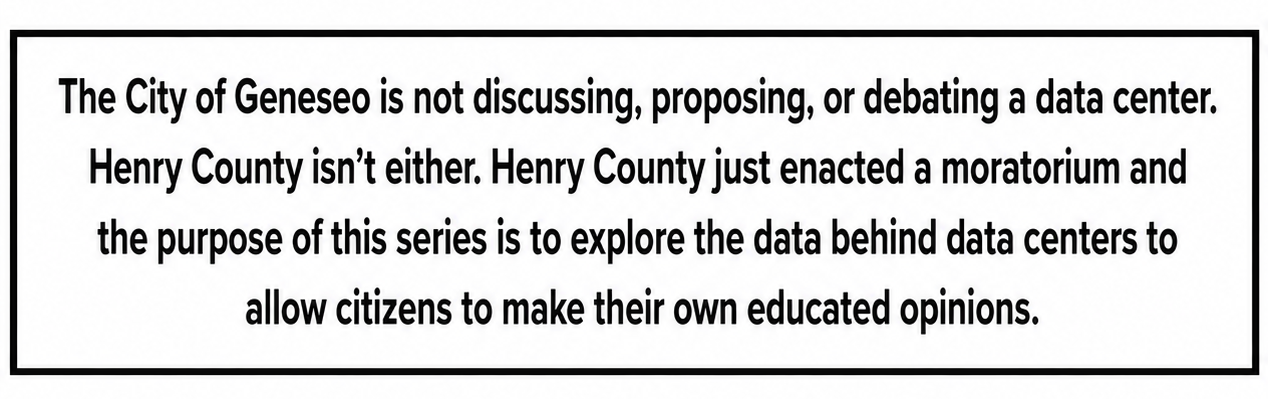
This four-part series was created to explain one of the fastest-growing industries in the world and how it could intersect with Henry County in the years ahead. It was not intended to advocate for or against data centers, but to provide readers with the background needed to participate in an informed public conversation if a proposal is ever brought before the county.
Additional resources on both sides of the issues
Lawrence Berkeley National Laboratory- Center of Expertise for Data Center Energy
Roosevelt Institute- AI’s Physical Footprint: The Environmental Consequences of Super Data Centers
Coalition for Responsible Data Center Development- Data Center Opposition Report
US Department of Energy- Cooling Water Efficiency Opportunities for Federal Data Centers