
By Claudia Loucks
Geneseo Current
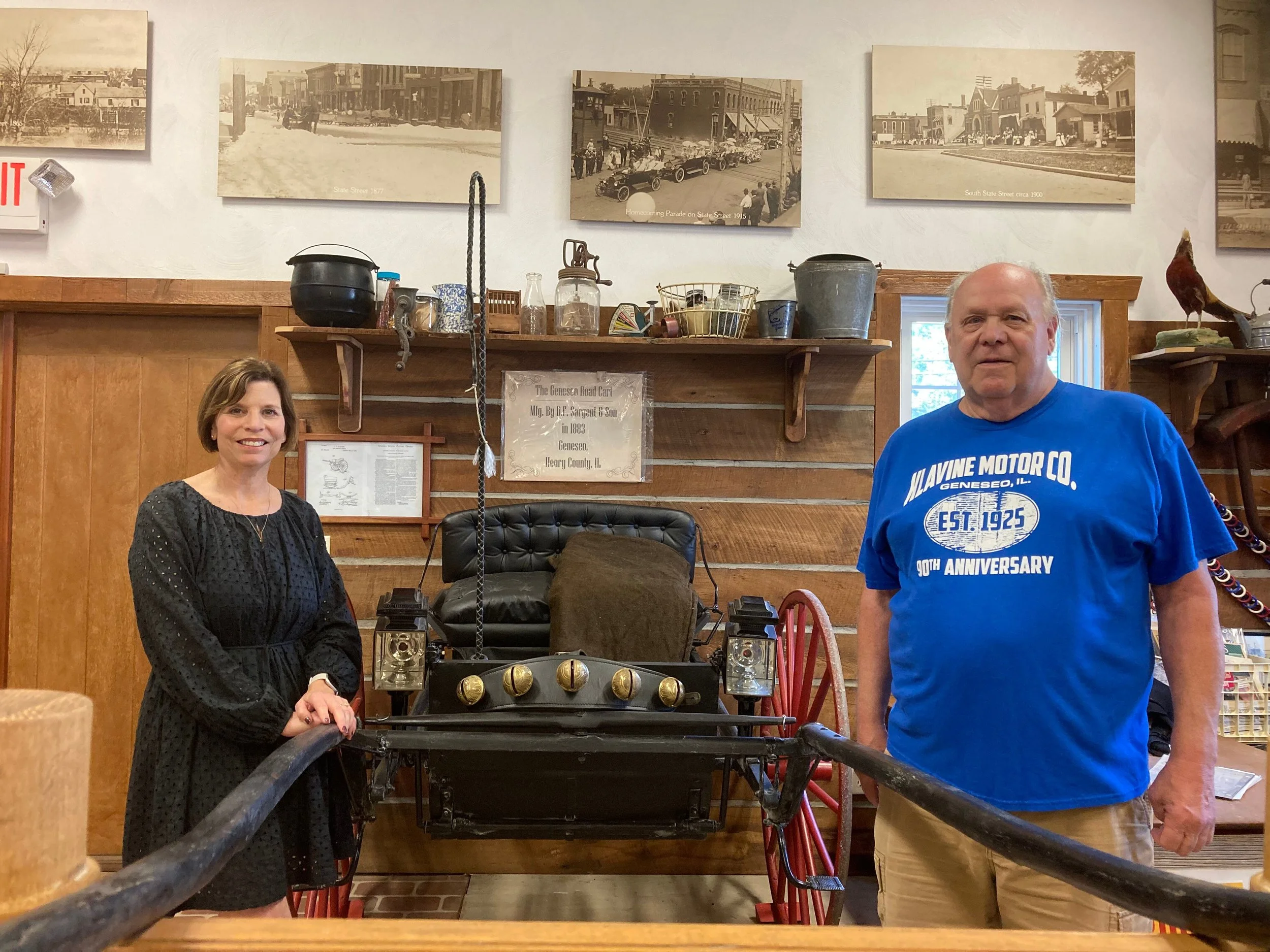
Melanie Rice, director/curator of the Geneseo Historical Museum, and Dan Klavine, are shown by the Geneseo Road Cart, donated to the museum by Klavine, of Klavine Motors in Geneseo. Photo by Claudia Loucks
The Geneseo Road Cart, once considered one of the finest horse-drawn vehicles of its time, has made its way from its long-time home at Klavine Motor Co., across Center St., to its new destination in the Geneseo Historical Museum Carriage House, located in back of the museum.
Earlier this year, the two-wheeled road cart was donated by Dan Klavine to the museum, and will be on display from 10 a.m. to 2 p.m. on Saturday, Sept. 12, during the Trains, Planes, & Automobiles celebration in Geneseo.
Melanie Rice, director/curator of the Geneseo Museum, provided history of the “The Geneseo Road Cart: A Little Cart that Traveled the World.”
In the late 1800’s, Geneseo was the home to a manufacturing business whose products traveled far beyond the streets and prairies of Henry County. The Geneseo Road Cart, manufactured by D.F. Sargent & Son, and later A.F. Sargent & Company, became one of the community’s notable contributions to the world of transportation.
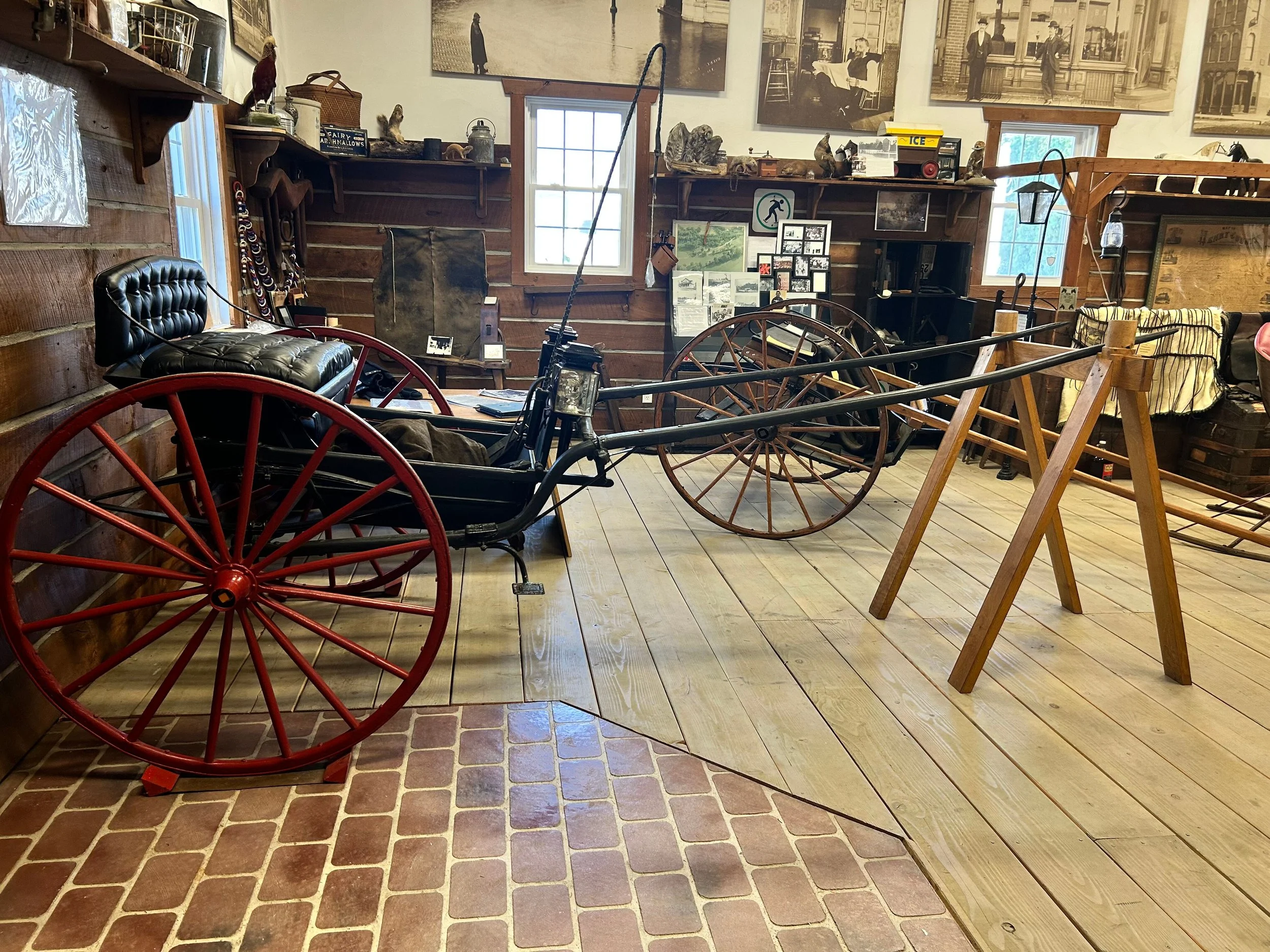
Step back to 1872, when D.F. Sargent and his son began manufacturing the Maple City Road Cart. In 1883, the company changed to producing the Geneseo Road Cart, a joint product of A.F. Sargent and F.D. Carrell. The cart was associated with Robert Farrell of Geneseo, who is credited in the historical information with inventing the famous two-wheeled vehicle. Its slogan proudly proclaimed it was “known around the world.”
And the business was anything but small. The Sargents produced approximately 800 road crats each year with 14 employees. In 1882 alone, the company sold $775,000 worth of manufactured merchandise.
The road carts were shipped throughout western and southern United States and were exported to Africa, Prussia, and possibly Russia.
For a buyer in 1882, owning a Geneseo-made road cart offered a comfortable way to travel across the dirt roads and prairie landscapes of the day. Prices ranged from $60 to $150, depending on the style and features.
The No. 3 Road Cart, advertised in 1883–84, was available with either a wide or narrow track and a low-drop shaft. Buyers could choose either style of box, while fenders were optional at an additional cost of $3. The base price was $60, making it the least expensive cart offered by Sargent & Son.
The road cart’s design made it especially popular among physicians. More than 2,000 carts were sold to doctors, in part because of the cart’s smooth ride and its design for a single passenger. A clever hidden compartment beneath the seat provided storage space—an ideal place for a physician to carry a doctor’s bag while making house calls.
FROM THE AMERICAN HOUSE TO A CARRIAGE FACTORY
The story of the Sargent business is also tied to an important Geneseo building.
The building now associated with Klavine Motor Company began its life in 1854 as the American House, a boarding house for seminary students. Over the years, the building served many purposes. It became a private school, a hotel and boarding house, and even temporary housing for families arriving in Geneseo during the growth of the community around the Civil War. Later, the public schools used it for overflow classrooms.
In 1888, the building was moved to 119 South Center Street. It was then occupied by Sargent & Company and later A.F. Sargent & Company, where the famous two-wheeled road carts were manufactured. After the cart and buggy business ended, the building was used as a buggy upholstery business before eventually becoming associated with Klavine Motors.
One surviving example helps bring the history to life.
In 2006, the late Roy Joe Klavine purchased and refurbished a No. 3 Road Cart from a woman in Wisconsin. Her grandfather had purchased the cart in the late 1800s, and remarkably, the original brass identification plate was still attached.
The plate reads:
“Geneseo Road Cart DF Sargent and Son Geneseo Il”
That small brass plate provides a direct connection between a surviving artifact and Geneseo’s manufacturing past.
A PIECE OF GENESEO HISTORY
Today, it is easy to look at a two-wheeled road cart and see simply an old-fashioned vehicle.

But the Geneseo Road Cart represents much more. It tells the story of local invention, craftsmanship, entrepreneurship and manufacturing during a period when Geneseo was growing and businesses were reaching customers far beyond the community.
From Geneseo’s prairie roads to destinations across the United States and even overseas, the Sargent road cart carried the name of Geneseo with it.
A small two-wheeled cart made in a small Illinois community had, indeed, become “known around the world.”