
by Sarah DeMaranville
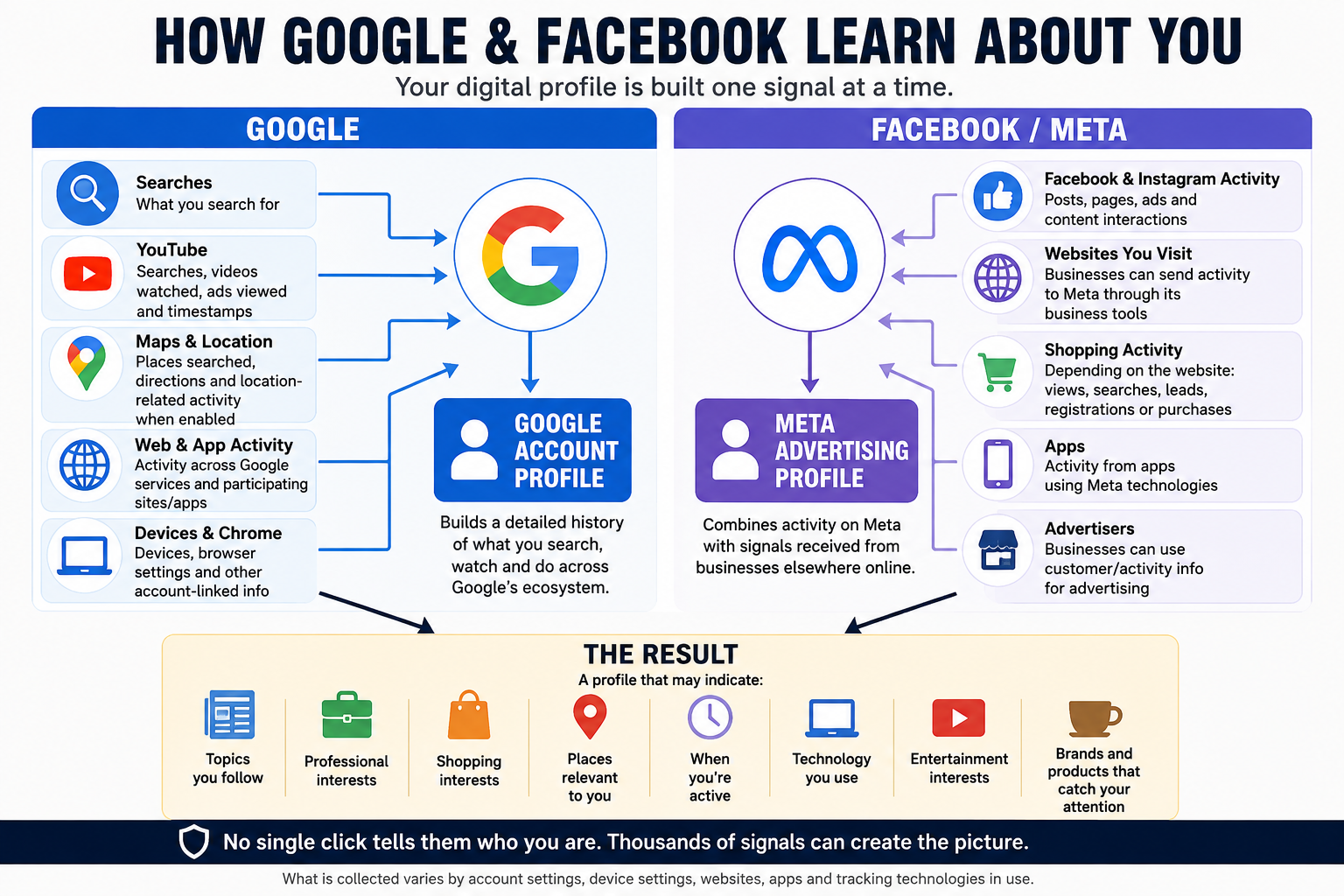
Most of us understand that Google remembers our searches and Facebook uses our activity to show us advertisements.
What is harder to appreciate is what happens when years of those individual pieces of information are assembled in one place.
So I downloaded my data.
The files I received from Google and Facebook contained thousands of records documenting searches, videos, advertising activity, websites, interests, devices and other information associated with my accounts.
Individually, many of the records seem mundane.
Together, they create something much more revealing: a surprisingly detailed picture of a person.
And Facebook's files went considerably further than simply listing things I might be interested in.
Google Looks More Like a Timeline
Of the two platforms, Google's data felt more like a history of what I had actually done.
My YouTube history, for example, contains individual searches and videos along with dates and exact timestamps.
One record shows that I watched a City of Geneseo City Council meeting in July 2026. The file also explains why Google retained the activity: my YouTube watch-history setting was enabled.
The records stretch back years.
They include local-government and school-related material, videos connected with The Geneseo Current, website and marketing tutorials and other topics. A Squarespace-related video I watched in May 2024, for example, remained in the history more than two years later.
Google also retained searches for phrases such as "city of geneseo" and "geneseo current," complete with timestamps.
That's an important distinction.
Google doesn't simply know that local government might be relevant to me. It can retain a chronological record showing that I intentionally searched for it, when I searched for it and what I subsequently watched.
Over time, those individual actions can reveal patterns.
Someone looking at enough of the history could reasonably conclude that I frequently research Geneseo, follow local government, work with websites and digital publishing, use marketing technology and consume a variety of other information and entertainment.
But even that conclusion needs a qualifier.
A search does not necessarily represent a personal interest.
In my case, much of what I search for is related to my work. Someone analyzing only the data might see repeated searches about city government and conclude that municipal government is a personal hobby.
The context changes the meaning.
Google has the activity. It doesn't necessarily have the explanation.
Google Also Remembers Advertising Activity
Another portion of the Google download contained activity explicitly labeled "From Google Ads."
Those records included websites and services encountered through Google's advertising system and timestamps associated with the activity.
Some involved software, marketing services and technology. Others had little apparent connection to anything I would describe as an interest.
That's another important distinction when interpreting these files.
Seeing an advertisement isn't the same thing as liking a product.
Clicking something isn't necessarily an endorsement.
Searching for something doesn't mean you own it.
But advertising systems don't need every individual signal to be perfectly meaningful. They can work with enormous numbers of signals accumulated over time.
Facebook's File Looks Different
Facebook's data felt less like a diary and more like an advertising profile.
One file explicitly described the information as interests based on Facebook activity and other actions used to help show relevant ads.
The categories covered a remarkably broad range of subjects.
They included news, journalism, local news, marketing, small business, social media, artificial intelligence, photography, coffee, restaurants, clothing, home improvement, entertainment, pets, travel, and numerous brands and products.
Again, some are accurate. Some are questionable. Some may simply reflect something I clicked once.
But another Facebook file revealed something even more significant.
Facebook Has Demographics — and Advertising Categories
Some of the demographic information Facebook has about me isn't mysterious at all.
I gave it to Facebook.
My profile-information file contains my exact birthday, gender, current city, hometown, marital status, education history and employment history. It also contains previous-name information, email addresses and an Instagram screen name.
That's worth separating from information Facebook determines through tracking.
If I tell Facebook my birthday, Facebook hasn't secretly discovered my birthday.
But another file in the download was titled "Other categories used to reach you."
Facebook describes these as categories associated with a person based on activity and information provided through Meta technologies.
That's where things get much more interesting.
My file included categories identifying me as:
a parent;
a parent of teenagers;
a parent of adult children ages 18–26;
a commuter;
a frequent traveler;
an "Engaged Shopper";
someone in management;
a Facebook Page administrator;
a new Page administrator; and
a Travel & Tourism Page administrator (wrong!)
It also placed me into household-income advertising categories. That does not mean Facebook's file says what my household earns, but it has data comparing my income to that of other users.
Facebook Knows Something About the Technology I Use, Too
The same advertising-category file identified technology associated with my account.
It included Chrome, Apple iOS devices, mobile devices, smartphones and tablets, tablets specifically, Wi-Fi usage and mobile-network or device users.
There were even categories for a "Potential mobile network or device change" and a "Recent mobile network or device change."
In other words, an advertising system doesn't necessarily just consider who you are or what you're interested in. The device in your hand can become another advertising signal.
Then It Gets Strangely Specific
Some of the categories were almost comically precise.
Facebook's file included:
"Friends of Men with a Birthday in 0-7 days."
"Friends of Women with a Birthday in 7-30 days."
"Friends of Soccer fans."
"Friends of those who live abroad."
There were also categories for friends of people with birthdays coming within a week or a month.
Think about what that means.
Advertising doesn't have to be based exclusively on something about you.
Characteristics of your social network can also make you useful to an advertiser.
A company selling birthday gifts doesn't necessarily need to know that your birthday is approaching.
It may be useful to know that one of your friends has a birthday approaching.
Facebook Can Receive Information When You Leave Facebook
Perhaps the most surprising part of the Facebook download was the section dealing with activity outside Meta's own platforms.
My file contained businesses and organizations whose websites or services had transmitted activity associated with my account back to Meta.
The list included companies and services ranging from Squarespace, Canva, Adobe, Constant Contact, Buffer, Zapier and Wave to Zillow, Airbnb, DoorDash, Instacart, Hy-Vee and Casey's.
That doesn't mean Facebook received everything I did on those websites.
Depending on how a company's Meta integration is configured, the information transmitted could involve events such as visiting a page, viewing content, searching, registering, submitting a lead or making a purchase.
But the basic point is significant:
You don't necessarily have to be using Facebook for a business to send information to Facebook.
That makes Meta's view of a person potentially much broader than activity occurring inside Facebook or Instagram.
Advertisers Can Bring Their Own Information
Another file explains yet another way someone can enter Facebook's advertising system.
Meta says advertisers can choose audiences using lists of information or interactions with their websites, apps or stores. Meta can then attempt to match that information with a person's profile.
My download contained an enormous list of advertisers associated with this part of Meta's advertising system.
That doesn't mean every company on the list uploaded my name or possesses a detailed file about me.
There are multiple ways an advertiser can end up associated with an account.
But it demonstrates that the flow of information isn't simply:
You → Facebook.
It can also be:
You → Business → Facebook.
And:
Business customer information → Facebook → possible account match.
Even Turning Off Some Ad Targeting Doesn't End Everything
My export also contained the advertising preferences Facebook had recorded for my account.
It showed that I had opted out of using interests to target advertisements and opted out of targeting based on religious and political views.
But the same record showed that the user-level third-party-data opt-out was false.
Another setting showed that I was not opted out of Meta using activity on its apps for advertisements shown on other apps and websites.
The lesson isn't that privacy controls do nothing.
It's that "personalized advertising" isn't necessarily one switch.
Different information, advertising systems and settings can operate separately.
Thousands of Small Signals Become a Profile
None of these records by itself is especially remarkable.
Facebook knowing that I use an iPhone isn't shocking.
Google knowing that I watched a City Council meeting isn't alarming by itself.
Facebook categorizing me as an engaged shopper isn't particularly consequential.
A website reporting a page visit to Meta might seem insignificant.
But combine all of it.
A platform can potentially know or categorize things related to your age, gender, location, relationship status, education, employment, family structure, approximate socioeconomic geography, devices, travel habits, shopping behavior, professional interests, entertainment interests, websites visited and advertisements encountered.
It can know when some activities occurred.
It can receive signals from companies outside its own websites.
It can connect information advertisers already possess with an account.
And it can continually add new signals.
That's where the scale becomes difficult to comprehend.
But the Profile Isn't Necessarily You
There is another important lesson buried in these files.
Data can be extraordinarily detailed and still be wrong.
Someone can research a medical condition without having it.
A journalist can repeatedly research a politician without supporting that politician.
A parent can watch a video because a child handed over the phone.
Someone can click an advertisement accidentally.
A business owner can spend months researching products he or she would never personally purchase.
The platforms can observe behavior extremely well.
Understanding why someone behaved that way is much harder.
That's the distinction I found most interesting after looking through the files.
Google had something resembling my timeline.
Facebook had something resembling my marketing profile.
Neither necessarily had the context behind every action.
But given enough searches, clicks, videos, website visits, purchases, devices, locations, profile information and advertising signals, they don't need every conclusion to be perfect.
They can still construct a remarkably detailed approximation.
We spend years telling these systems who we are — sometimes intentionally, sometimes without realizing it — one search, one click, one video and one website visit at a time.