When Tyson Foods announced Aug. 13 that it would end operations at its Joslin beef-processing facility, attention immediately turned to workers, cattle producers and the broader economic impact.
Another question will eventually have to be answered:
What happens to the property itself?
There is no publicly announced plan to turn the Tyson site into a data center, and Tyson has not announced a specific future use for the property.
But as communities across the country debate where large data centers should be built, existing and former industrial properties are increasingly part of the conversation.
The U.S. Environmental Protection Agency has specifically identified large brownfield and Superfund properties with existing infrastructure and industrial zoning as potential candidates for data-center redevelopment. That does not mean the Tyson property itself is classified as a brownfield. Rather, the federal guidance illustrates a broader redevelopment strategy: putting new industrial uses on previously developed land instead of starting with undeveloped property.
On paper, several characteristics of the Joslin property make that question worth examining.
First, it's in Rock Island County
Although the plant is closely associated with Geneseo and its closure has major implications for Henry County, the main Joslin facility is located near Hillsdale in Rock Island County.
That distinction matters because Henry County currently has a temporary moratorium on new data-center developments.
The Henry County Board approved the moratorium June 18 for up to 12 months, or until the board takes further action, while officials study issues including groundwater, agricultural land, infrastructure, emergency response and potential local regulations.
A project at the Joslin property would therefore not fall under Henry County's moratorium.
A large industrial site already exists
Rock Island County property records identify the primary plant parcel at 28424 38th Avenue North near Hillsdale as approximately 323.65 acres and classify it as industrial.
For the 2025 tax year, payable in 2026, that parcel carried a net taxable value of approximately $8.23 million and a total property-tax bill of $597,857.44.
The plant occupies more than one parcel, so the 323-acre figure should not necessarily be interpreted as the entire Tyson property. But the primary parcel alone represents a substantial industrial footprint.
That matters because large data-center campuses can require significant acreage for computing buildings, electrical substations, cooling systems, backup power equipment, stormwater infrastructure and future expansion.
The Tyson property also differs fundamentally from a proposal beginning on undeveloped farmland: a major industrial operation has already existed there for decades, and roads and utility infrastructure already serve the site.
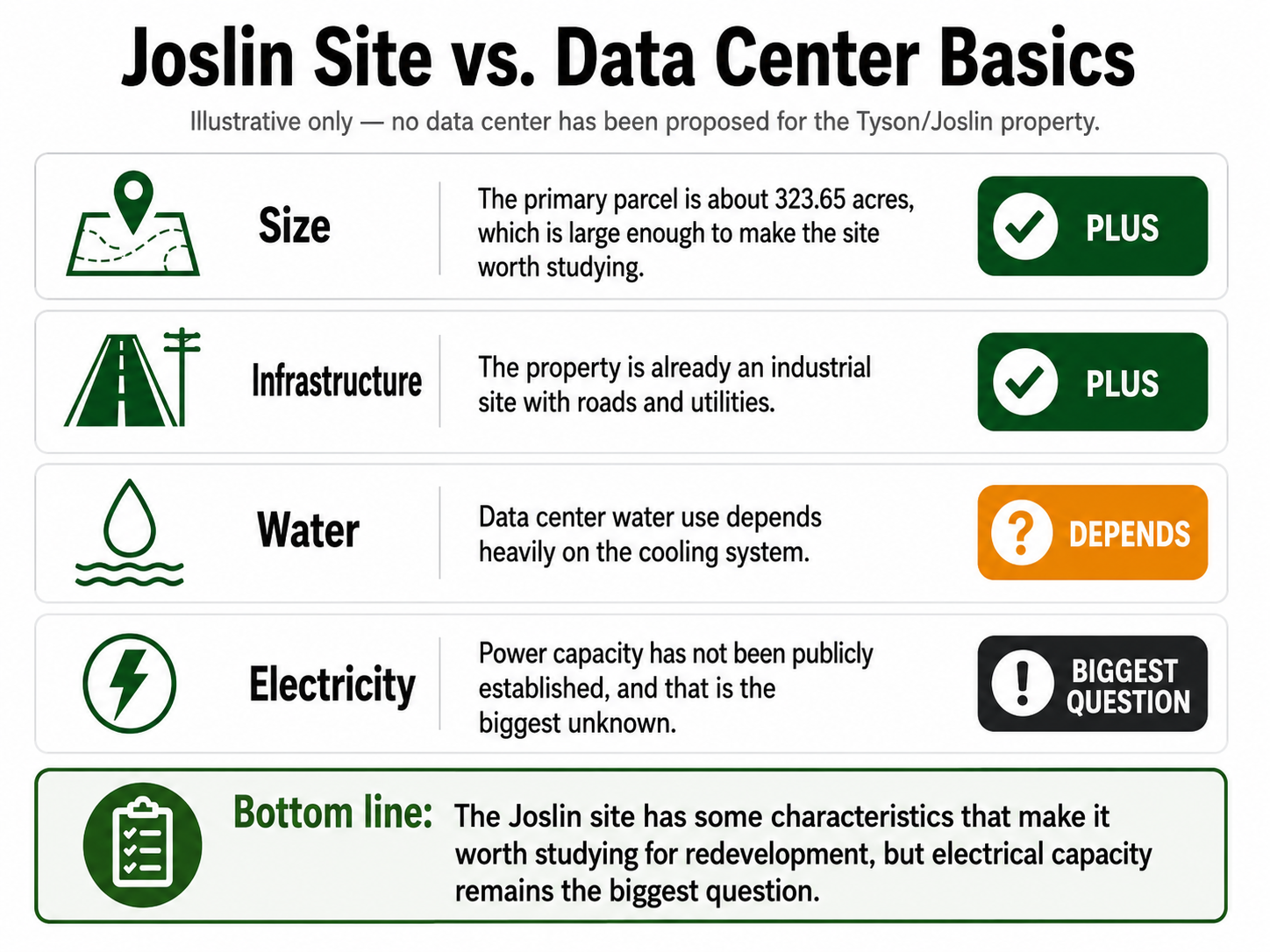
That does not mean the existing infrastructure is sufficient for a data center. Capacity would have to be evaluated separately.
What about water?
Illinois EPA records show the Joslin facility discharged an average of about 3.17 million gallons per day, or roughly 1.16 billion gallons per year. That represents wastewater discharge, not Tyson's total water consumption.
Data-center water use varies dramatically depending on size and cooling technology.
The Electric Power Research Institute estimates that a 150-megawatt hyperscale data center could consume approximately 120 million gallons of water annually in one representative cooling scenario.
For comparison, Tyson's documented wastewater discharge was about 1.16 billion gallons annually. The figures aren't directly comparable — one measures discharge and the other consumption — but they provide useful context.
A data center would not automatically bring unprecedented water demand to the property. Any proposal would need to disclose its water source, expected use and cooling system before a meaningful comparison could be made.
Electricity may be the bigger question
For a modern data center, electricity could ultimately matter more than acreage or existing water infrastructure.
Large data-center campuses can require hundreds of megawatts — and in some cases more than a gigawatt — of electricity.
Tyson's operation of a major industrial facility does not establish that the Joslin site has anything approaching the electrical capacity required for a hyperscale data center.
Available transmission capacity, nearby substations, possible utility upgrades, generation resources and redundant power connections would all have to be evaluated.
The buildings may matter less than the property
Redeveloping the Tyson site as a data center would not necessarily mean putting computer servers inside the existing meat-processing buildings.
Modern data centers are highly specialized facilities designed around power distribution, cooling, networking, security and redundancy.
Depending on the condition and configuration of the Tyson property, a developer could potentially reuse some roads, utility corridors, water or wastewater infrastructure, electrical infrastructure or other improvements while demolishing or replacing major portions of the existing plant.
In that scenario, the value of the property could be less about the existing buildings and more about its acreage, industrial history, existing infrastructure and location.
Taxes and jobs would look different
The primary 323.65-acre Tyson parcel generated about $597,857 in property taxes for 2025.
More than $362,000 went to Riverdale Community Unit School District 100.
A large data center could bring hundreds of millions or even billions of dollars in investment. But its tax impact would depend on the property's assessed value, ownership and available incentives.
Illinois has offered tax incentives for qualifying data centers. However, the Illinois Department of Commerce and Economic Opportunity stopped accepting new applications for the program July 1, 2026. Existing approved projects may continue receiving benefits, but a new project at Joslin should not be assumed to qualify.
Jobs would also look different.
Tyson employed about 2,500 people at Joslin. A data center could create many construction jobs, but it would likely need far fewer permanent workers. The U.S. Department of Energy says individual data centers may employ only a few to a few dozen permanent workers, while larger campuses can employ hundreds.
A data center could still bring significant investment, construction work and tax revenue, but it would not replace Tyson's thousands of production jobs.
Why the Tyson site is worth discussing
Perhaps the strongest argument for at least examining a property like Tyson is what would not have to happen.
Hundreds of acres of undeveloped farmland would not necessarily have to be converted to a new industrial use.
The primary parcel is already classified as industrial. A major industrial facility has operated there for decades. Roads and utilities already serve the property.
EPA's own data-center redevelopment guidance identifies large previously developed properties with existing infrastructure and industrial zoning as characteristics worth examining when determining whether a site could support a data center.
Those advantages do not answer the important questions.
Electricity capacity would still have to be established.
Water supply and cooling technology would have to be disclosed.
Noise from cooling equipment and backup generators would have to be evaluated.
Emergency-response requirements, environmental conditions, stormwater management, transmission upgrades and the project's tax treatment would all have to be examined.
And the community would still have to decide whether such a project represented the best future use of one of the region's most significant industrial properties.
There is currently no public evidence that Tyson Foods, Rock Island County or a data-center developer is pursuing a data center at Joslin.
So the question today is not whether a data center is coming.
It is whether, if this region eventually decides it wants data-center development, redeveloping an existing industrial property like the Tyson site would make more sense than converting hundreds of acres of farmland.
Sources
U.S. Environmental Protection Agency — Reuse Considerations for Data Centers on Brownfield Sites
U.S. Environmental Protection Agency — Guidance on the Redevelopment of Superfund and Brownfield Sites as AI Data Centers
U.S. Environmental Protection Agency — Tyson Fresh Meats Inc., Joslin facility records and effluent-guidelines documents
Electric Power Research Institute — Water Usage in Data Centers
Illinois Department of Commerce and Economic Opportunity — Data Center Investment Tax Exemptions and Credits
U.S. Department of Energy — Data Center Resource Hub and data-center redevelopment materials
Rock Island County property records
Rock Island County Zoning & Building Safety
Rock Island County Unified Zoning Ordinance
Henry County Board and Planning & Development Committee records
Tyson Foods — Aug. 13, 2026 network restructuring announcement