
Henry County farms produce more than $500 million in agricultural products, but much of the food sold locally comes from elsewhere. Here’s why.
Read moreEarly Voting Underway in Henry County for Nov. 3 Midterm Election
Early voting is underway in Henry County for the Nov. 3, 2026 midterm election. Find key dates for early voting, vote-by-mail applications, voter registration, and Election Day.
Read more‘Lil’ Leaf Cheerleaders Perform at GHS-Galesburg Football Game
By Claudia Loucks
Geneseo Current
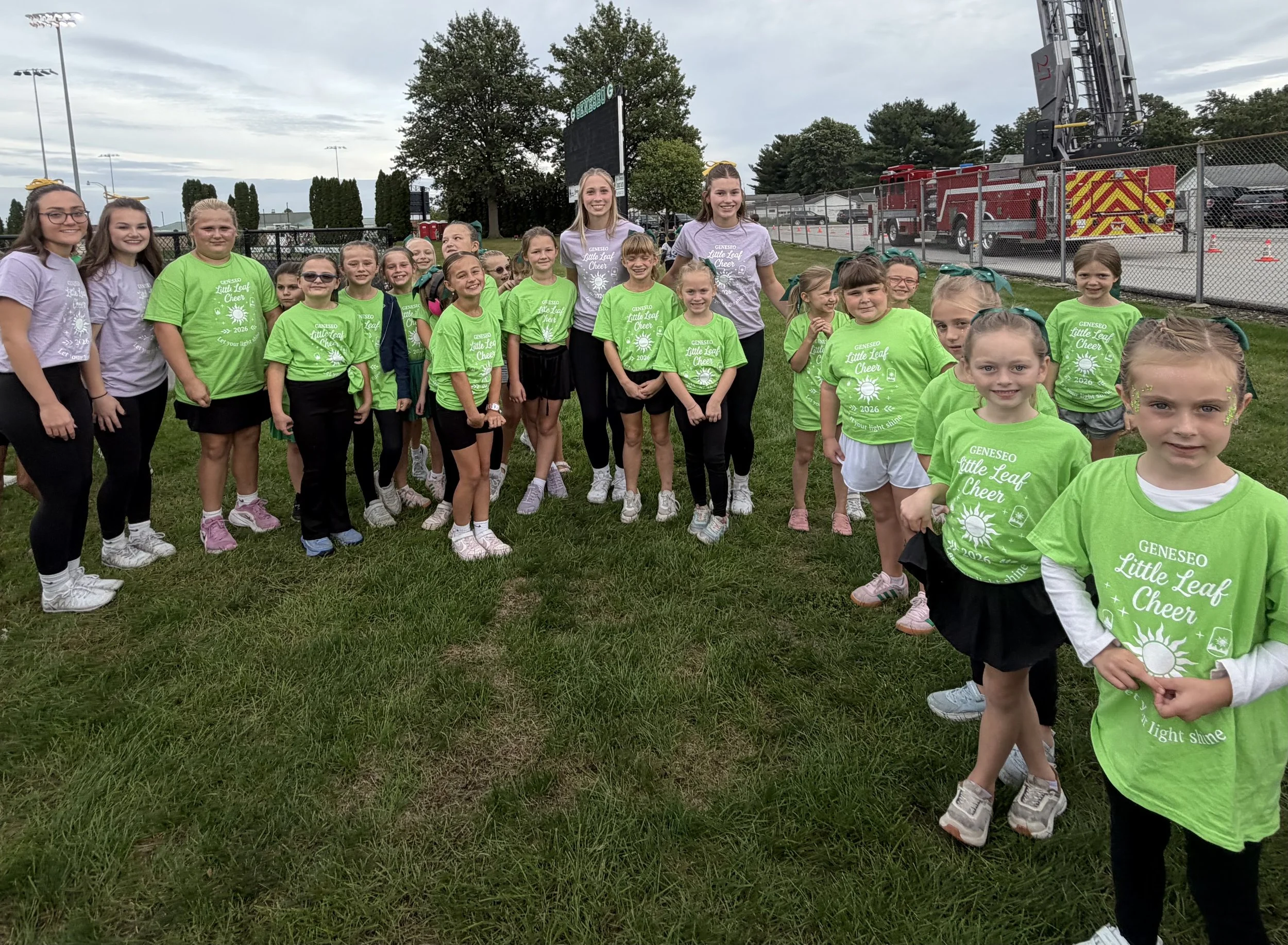
There were 116 “Lil” Leaf Cheerleaders, in kindergarten through fifth grade, who entertained football fans with the chants they learned at a recent “Lil” Leaf Cheer Clinic. Their performance was held Friday night in conjunction with the Green Machine’s football games against Galesburg, when Geneseo dominated the night with both junior varsity and varsity wins. The theme of the performance by the “Lil” Leaf cheerleaders was “Rapunzel-Let Your Light Shine.”


Pastor Murphy Honored on 10th Anniversary at First Baptist
Rev. David Murphy and his wife, Michelle, were honored by First Baptist Church in Geneseo as Murphy marked 10 years of serving the congregation.
Read moreCan Schools Discipline Students for What They Do Outside School?
by Sarah DeMaranville
The Geneseo Current
Social media, group chats and weekend conflicts can spill into the classroom — but schools’ authority has limits.
A social media post made from a student’s bedroom. A text sent on a Saturday night. An argument at a private gathering. A group chat that erupts over the weekend.
None of this may happen inside a school building.
But by Monday morning, screenshots may be circulating, students may be confronting one another, and administrators may be hearing from concerned parents.
So when does something that happens outside school become a school concern?
There is no single rule. Public schools have responsibilities involving student safety, access to education, and school operations. Students also retain constitutional rights when they are away from school.
When off-campus activity reaches school
Something that happens away from school can become relevant to administrators when it begins affecting what happens at school.
That could include threats, confrontations, absences, interruptions to instruction, or interference with a student's ability to participate in school. Officials may also consider whether students or employees were targeted or whether an athletic team, school organization, account, or device was involved.
Safety concerns are among the clearest examples. Threats against students or employees, information about possible weapons or planned violence, or other credible concerns may require a school response even when the original communication occurred elsewhere.
That response could include a safety assessment, contacting parents, student support, or law enforcement. But responding to a safety concern and disciplining a student for the underlying speech are separate questions.
Bullying can cross into school
Illinois law also addresses cyberbullying, including electronic communication that affects students.
Beginning with the 2026-27 school year, Illinois' definition of cyberbullying includes certain unauthorized digital replicas, sometimes broadly described as deepfakes, when their distribution produces effects covered by the state's bullying law.
But not every rude comment, online disagreement or argument between students qualifies as bullying.
Schools must consider the circumstances, applicable law and district policies.
What counts as disruption?
The U.S. Supreme Court has long recognized that public-school students have First Amendment rights.
In the 1969 case Tinker v. Des Moines Independent Community School District, the Court also recognized that schools may regulate student expression in certain circumstances involving substantial disruption of schoolwork or interference with the rights of others.
That makes what actually happens at school important.
Did classes have to be interrupted? Did students confront one another? Did someone stay home because of safety concerns? Did the incident interfere with a school activity?
Simply being offensive, unpopular, or upsetting does not automatically establish the kind of disruption that allows a public school to restrict otherwise protected speech.
The Supreme Court addressed off-campus social media
The Supreme Court considered the issue more directly in 2021 in Mahanoy Area School District v. B.L.
The case involved a student who posted vulgar comments about her school and cheerleading team on Snapchat while away from school on a weekend. The school suspended her from the junior varsity cheerleading squad.
The Supreme Court ruled in the student's favor.
But the Court did not say schools can never address off-campus speech. Instead, it emphasized that schools generally have less authority over students when they are away from campus and outside school supervision.
The Court also identified circumstances where schools can retain an important interest, including serious bullying or harassment, threats against students or teachers, violations involving schoolwork or online school activities, and breaches of school security.
Geneseo district points to existing policies
Asked how Geneseo CUSD #228 approaches student conduct outside school, Superintendent Dr. Laura Delgado referred The Geneseo Current to existing district policies and student-parent handbooks.
“At this time, the district has no specific comment regarding your questions,” Delgado said. “Instead, we refer you to our existing Board policies and student-parent handbooks, which outline the applicable expectations, procedures, and responsibilities related to student conduct, safety, technology use, bullying and harassment, extracurricular activities, and other relevant matters.”
Delgado said individual circumstances matter.
“Every situation is unique and must be considered based on its individual facts and circumstances. When concerns arise, we commit to thoughtfully and carefully reviewing the circumstances, considering student well-being, safety, educational access, school operations, and the applicable policies and legal requirements.”
What parents and students should know
An incident happening outside school does not automatically put it beyond a school's concern. But something affecting school also does not automatically give administrators unrestricted authority to discipline students for off-campus conduct.
When a situation spills into school, families can preserve complete messages, screenshots, dates, and other context. Immediate safety concerns should be reported promptly.
If discipline is being considered, families can ask which district policy applies, what connection the school believes exists between the conduct and school, and what complaint or appeal procedures are available.
Ultimately, the circumstances matter: what happened, where it happened, who was affected, what happened at school as a result, which policies and laws apply, and what response the school proposes.
Richmond Hill Players Drama Opens Oct. 1
Richmond Hill Players opens Donald Margulies’ drama Collected Stories Oct. 1 at the Richmond Hill Barn Theatre in Geneseo.
Read moreGeneseo Council Moves Forward With US 6 Project & Oakwood Bridge Grant
Geneseo City Council members moved several major items forward Tuesday, including the 2027 US 6 improvement project, another attempt to secure funding for the Oakwood pedestrian bridge and continued development of new e-bike and e-scooter regulations.
Read moreWhat Will Winter Look Like in Geneseo? Forecasters See El Niño Playing a Major Role
by sarah demaranville
the geneseo current
NOAA says El Niño has a greater than 90% chance of becoming very strong this winter, while long-range forecasts differ on exactly what that will mean for Illinois
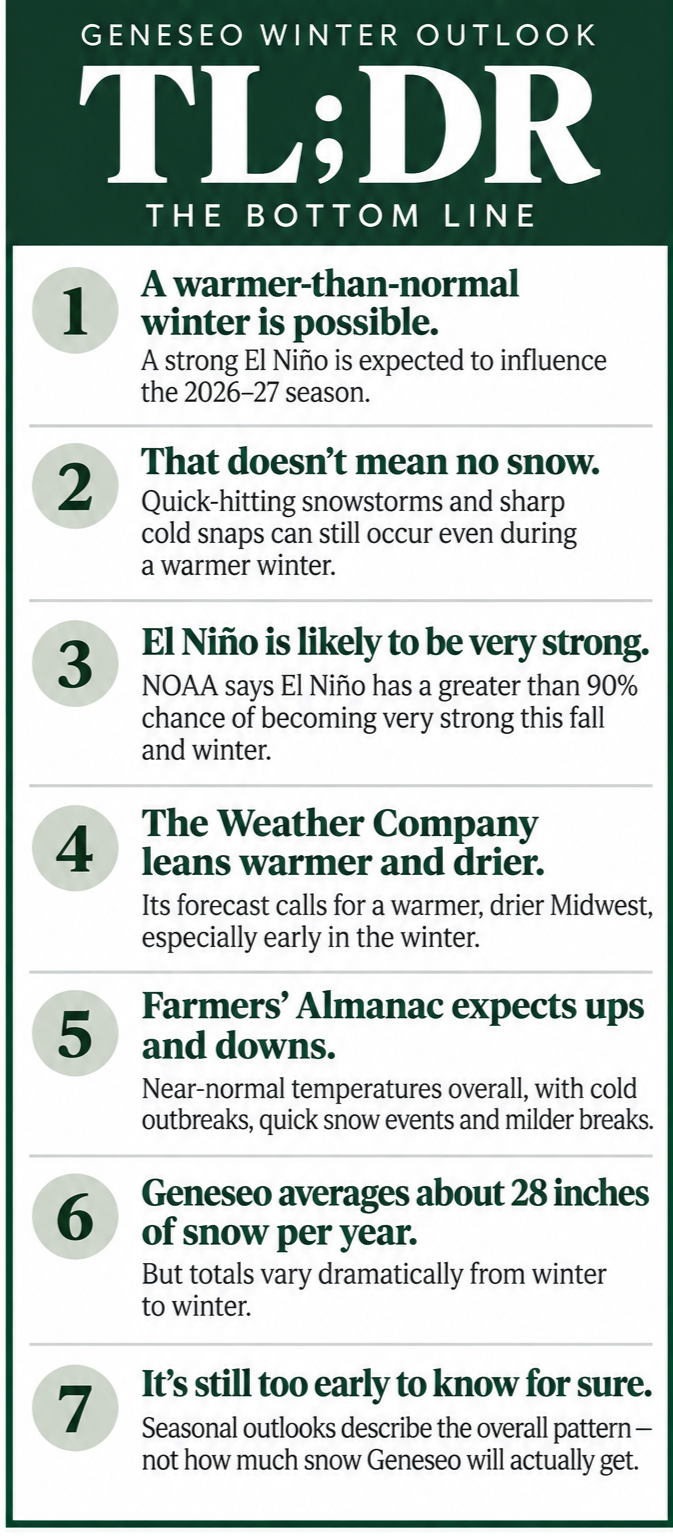
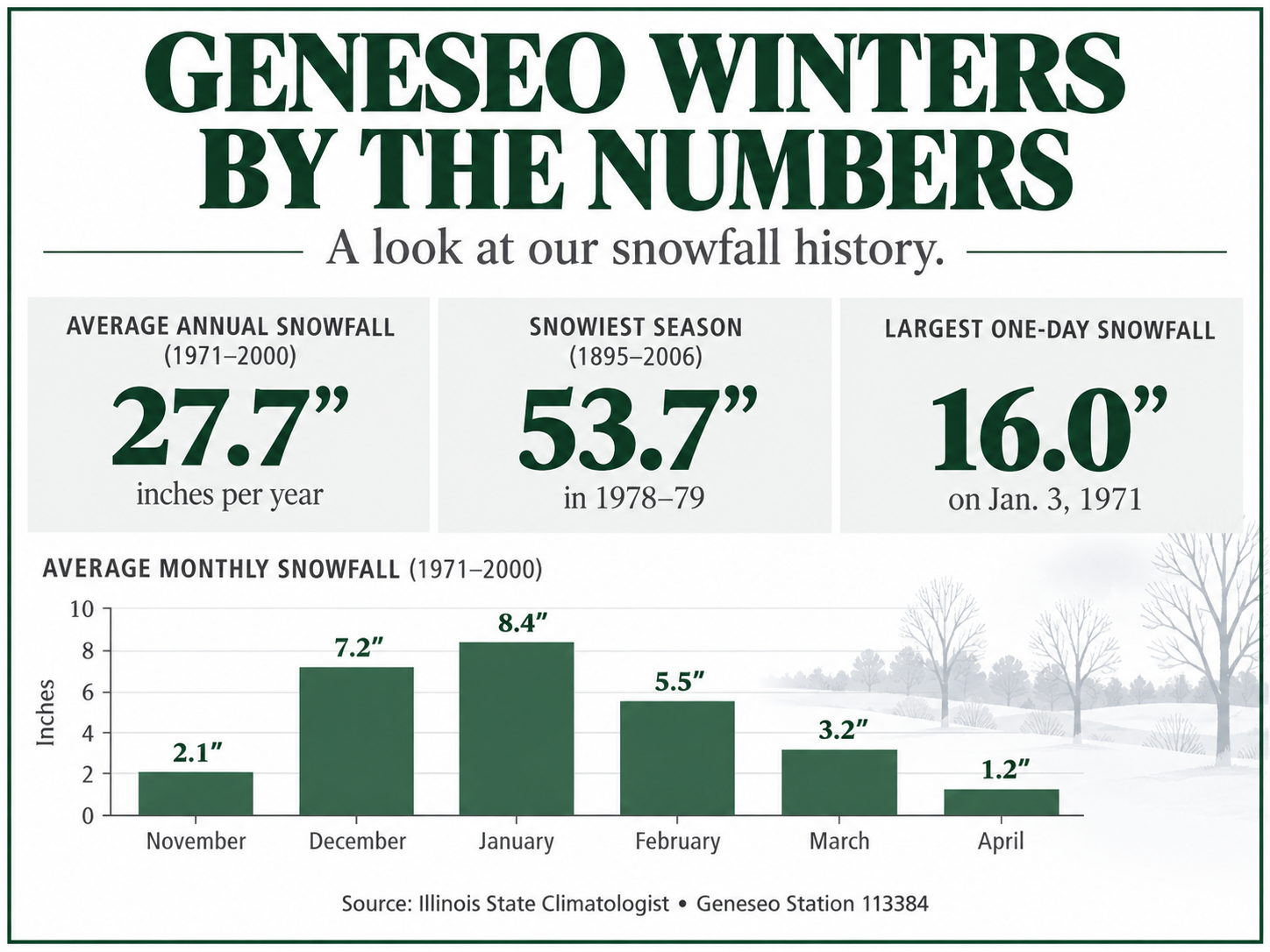
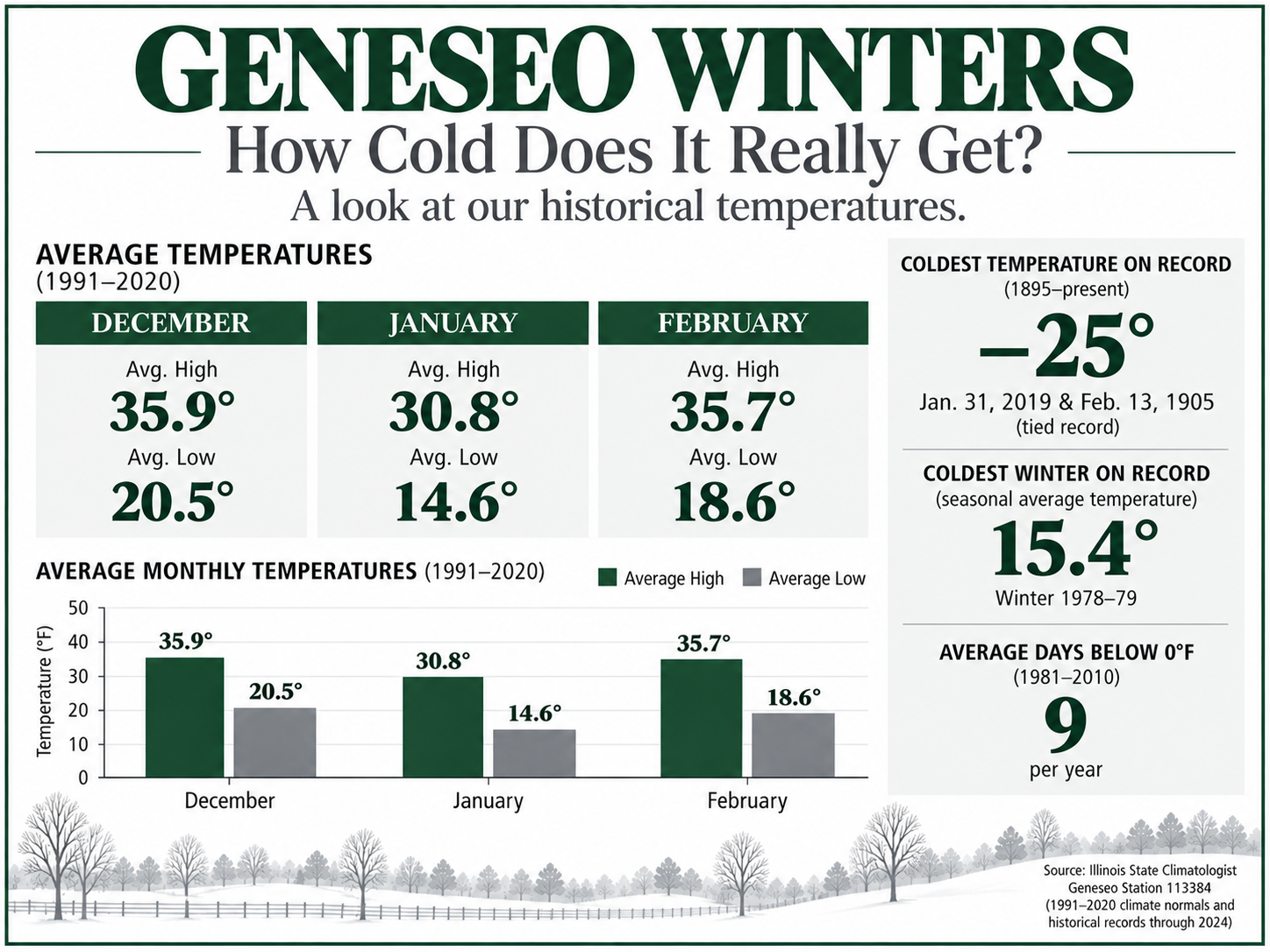
It is still too early to know how many inches of snow Geneseo will see this winter or when the season's biggest storm might arrive, but several long-range winter outlooks are now available — and they share one important feature.
El Niño is expected to have a major influence on the winter of 2026–27.
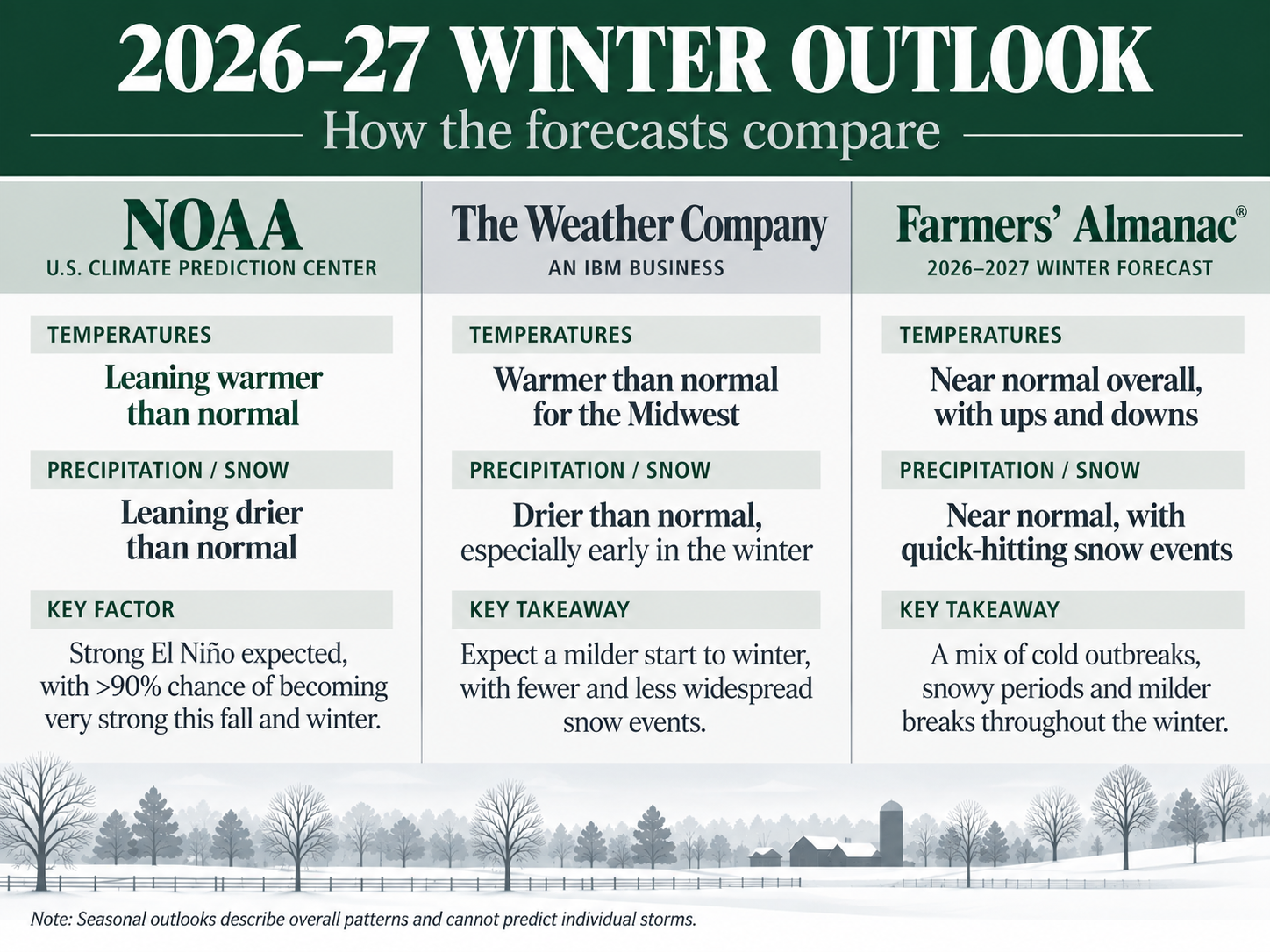
The National Oceanic and Atmospheric Administration, The Weather Company and the Farmers’ Almanac have all released information about the coming winter. Their forecasts don't agree on every detail for the Midwest, but the developing El Niño provides a common thread.
For western Illinois, the current outlooks generally leave room for snow and sharp cold spells while suggesting that persistent cold and snow throughout the entire winter may be less likely.
NOAA: El Niño could reach historic strength
The most significant development comes from NOAA's Climate Prediction Center.
In its Sept. 10 update, NOAA reported that El Niño is strengthening and has a greater than 90% chance of becoming a very strong event during fall and winter 2026–27.
NOAA goes even further. The agency currently estimates a 75% chance that El Niño reaches a level during October through December that would exceed the strength of previous events in records dating to 1950, based on the Relative Oceanic Niño Index used by the Climate Prediction Center.
That doesn't mean a record-breaking winter is coming to Illinois.
El Niño describes a large-scale warming of waters in the tropical Pacific Ocean. That warming can alter atmospheric circulation and shift weather patterns thousands of miles away.
Historically, strong El Niño winters tend to favor a more active southern storm track while portions of the northern United States experience relatively warmer and drier conditions.
NOAA stresses that those historical tendencies are probabilities, not guarantees. Even an unusually strong El Niño does not determine the weather in a particular community or prevent periods of snow and severe cold.
NOAA's seasonal outlook leans warmer
NOAA's Climate Prediction Center is already publishing its long-range outlooks extending through the winter months.
Unlike a conventional weather forecast, NOAA's seasonal products don't attempt to predict the temperature or snowfall on a particular day months in advance. Instead, they estimate whether temperatures and precipitation over a three-month period are more likely to finish above, below or near their historical averages.
The agency says El Niño is playing an important role in those long-range forecasts. Its August seasonal discussion already favored above-normal temperatures across the Great Lakes during the fall and noted a tilt toward below-normal precipitation there. NOAA's outlooks now extend through December-January-February and beyond.
That distinction is important: NOAA is not predicting that Geneseo will have a snowless or warm winter. Seasonal averages can conceal considerable variation, including individual snowstorms and short periods of bitter cold.
The Weather Channel expects a warmer, drier Midwest
The Weather Channel's winter forecast, released Sept. 11, is more specific about how it expects the developing El Niño to affect the Midwest.
Its December-through-February outlook calls for a warmer and drier winter from the Midwest into portions of the northern Rockies and Pacific Northwest.
December stands out.
The Weather Channel expects an unusually warm beginning to winter in the Midwest and Great Lakes, with some of the largest departures from average temperatures occurring in this part of the country.
Above-average temperatures are expected to continue across much of the northern half of the country in January.
By February, the forecast allows colder air to become more established across northern portions of the country. Even then, however, the Midwest and Great Lakes are expected to trend warmer than average.
The reason again comes back largely to El Niño.
A strong El Niño typically strengthens the southern branch of the jet stream, increasing storm activity across the southern United States while leaving portions of the northern United States relatively warmer and drier.
That could limit overall snowfall opportunities in the Midwest, but it certainly doesn't eliminate them.
Farmers’ Almanac sees more ups and downs
The Farmers’ Almanac paints a somewhat different picture for Illinois.
Its 2026–27 forecast places Illinois in its Great Lakes and Midwest region and predicts temperatures averaging near normal overall, rather than the warmer winter forecast by The Weather Channel.
But “near normal” doesn't mean consistently moderate.
The Almanac expects fast-moving clipper systems, sudden cold snaps, snow squalls, blustery winds and brief periods of bitter cold. Those conditions are expected to be interrupted frequently by milder weather.
For places such as Chicago and Indianapolis, the publication specifically anticipates quick-moving systems capable of producing brief accumulating snow rather than prolonged snowstorms.
Geneseo isn't in one of the primary Great Lakes lake-effect snowbelts, so that portion of the Almanac's forecast is less applicable locally.
The Almanac also anticipates frequent cycles of thawing and freezing across the central United States, potentially producing rapidly changing road and field conditions.
The forecasts aren't as contradictory as they first appear
A warmer-than-average winter does not mean there won't be cold weather, and a drier-than-average winter does not mean there won't be significant snowstorms.
That's one reason long-range winter predictions can sound contradictory.
The Weather Channel sees the entire winter averaging warmer and drier across the Midwest.
The Farmers’ Almanac sees temperatures closer to normal overall, with pronounced swings between cold and mild periods.
NOAA provides probabilities rather than a specific narrative for Geneseo, while emphasizing that an exceptionally strong El Niño could increase the likelihood of weather patterns historically associated with the phenomenon.
All three leave plenty of opportunity for individual winter storms.
A week of bitter cold can occur during an otherwise warmer-than-average winter. Likewise, one major snowstorm can produce a substantial portion of a community's seasonal snowfall even during a relatively dry winter.
Why NOAA's forecast is different from the Almanac
There is also an important difference in how these forecasts are produced.
NOAA's Climate Prediction Center uses observations of the atmosphere and oceans, multiple climate models, historical patterns and large-scale climate signals such as El Niño to develop probabilistic seasonal outlooks.
The Farmers’ Almanac uses a proprietary forecasting method that it says incorporates natural cycles, solar activity, lunar influences and historical weather patterns. The publication says those calculations are now supplemented by modern meteorological information, satellite observations, computer modeling and analysis of large-scale atmospheric and ocean patterns. Its complete formula is not publicly disclosed.
The Weather Channel relies on modern meteorological models, climate patterns and professional meteorological analysis for its seasonal outlook.
For that reason, the three products shouldn't necessarily be treated as three equivalent scientific forecasts. NOAA's outlook provides the federal government's official climate forecast, while the Farmers’ Almanac offers its own proprietary long-range prediction.
What does all of this mean for Geneseo?
For now, perhaps the most useful conclusion is that there isn't strong evidence pointing toward an exceptionally snowy or relentlessly cold winter in western Illinois.
The Weather Channel leans warmer and drier for the Midwest. The Farmers’ Almanac expects something closer to normal temperatures but with quick snow events, cold outbreaks and frequent warmer breaks.
Meanwhile, NOAA has identified the much larger weather story that could influence both: an El Niño that is already strengthening and has a greater than 90% chance of becoming very strong this fall and winter.
Exactly how that translates to Geneseo won't become clear until much closer to individual weather events.
Seasonal forecasting can provide clues about the background pattern months in advance. It cannot tell residents whether there will be six inches of snow on a Tuesday in January.
So far, though, the signals point more toward a changeable winter — potentially warmer and somewhat drier overall, but still capable of delivering quick snowstorms and sharp blasts of Midwestern cold.
Sources
NOAA Climate Prediction Center seasonal outlooks
The Weather Company 2026–27 winter outlook
Farmers’ Almanac 2026–27 winter forecast
Henry County to Consider New Rules for Battery Energy Storage Systems
County officials will take up revised regulations Wednesday as Illinois begins a major expansion of utility-scale energy storage — but a new state law limits how restrictive local rules can be.
Read moreResidents Back Oakwood Pedestrian Bridge at Monday Meeting
Residents attending a Monday informational meeting expressed support for the proposed pedestrian crossing, as Geneseo prepares another attempt at state funding that could reduce the city's share of the $392,010 project to about $71,000.
Read moreTerminally Ill Illinoisans Have a New End-of-Life Option — But Access May Vary Locally
A new Illinois law allowing some terminally ill adults to obtain medication to end their lives took effect Sept. 12.
But whether Geneseo-area patients can access that option through their current health care provider may vary.
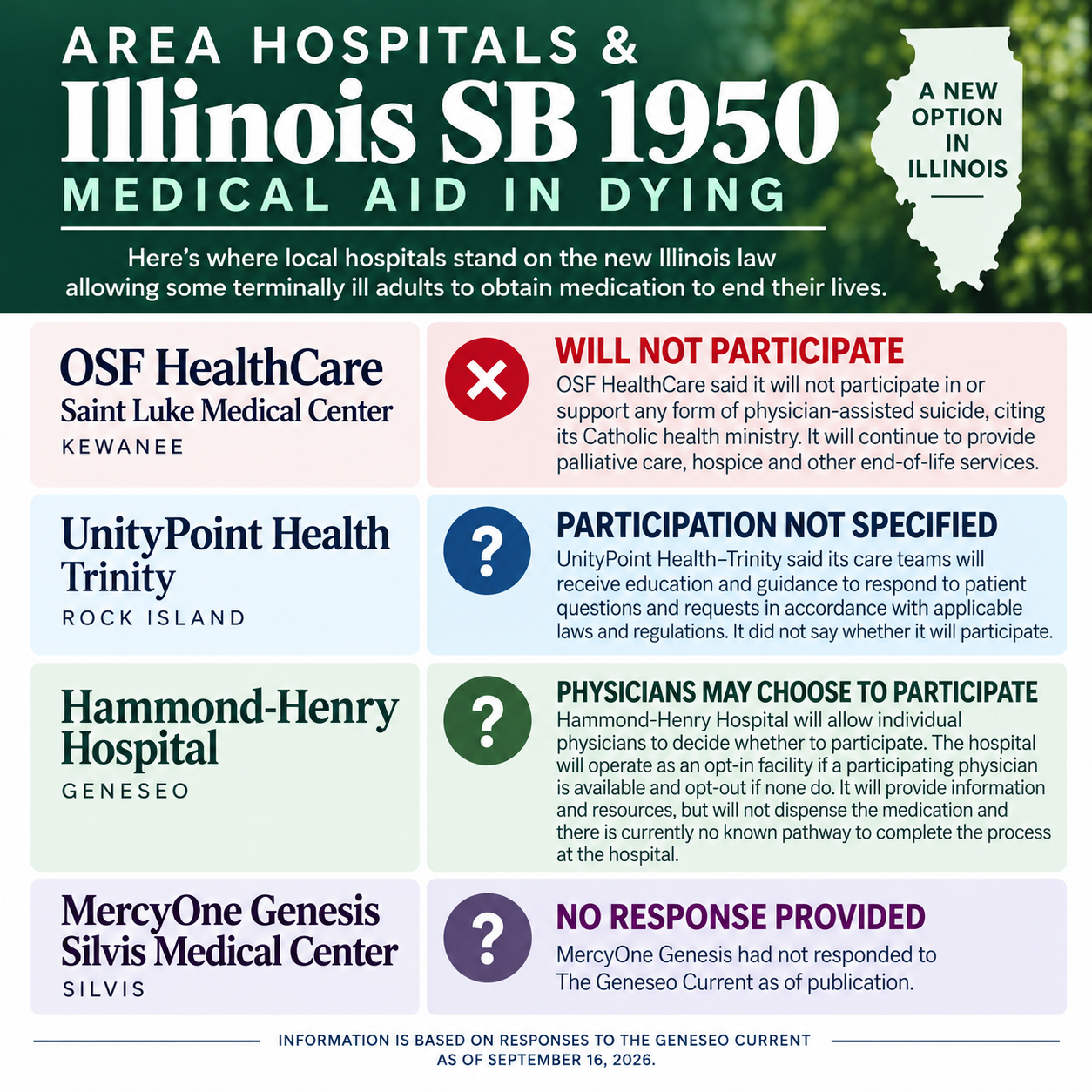
Hammond-Henry Hospital says it will allow individual physicians to decide whether to participate in medical aid in dying and will operate as an “opt-in” facility if it has a participating physician.
OSF HealthCare told The Geneseo Current it will not participate, citing its Catholic health ministry. UnityPoint Health–Trinity did not say whether it will participate, but said its care teams will receive guidance on responding to patient questions and requests.
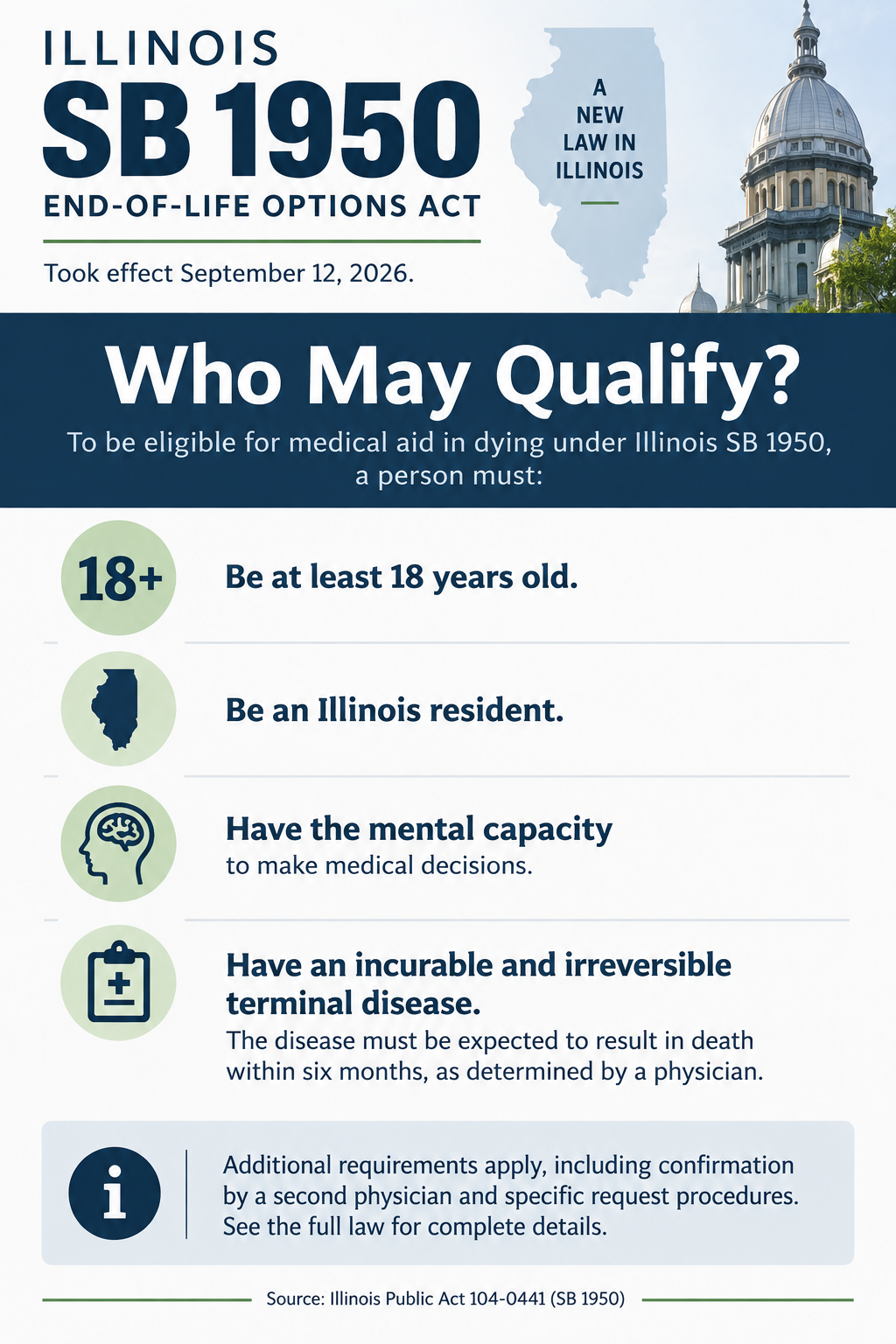
The End-of-Life Options for Terminally Ill Patients Act, also known as Deb’s Law, applies to mentally capable adult Illinois residents with a terminal illness and a prognosis of less than six months to live.
The diagnosis and prognosis must be confirmed by an attending and consulting physician. Patients must make two oral requests and a written request, and the request cannot be made by a family member, guardian, health care proxy or other surrogate decision-maker. The patient must be able to self-administer the medication.
Hammond-Henry will allow physicians to choose whether to participate
Hammond-Henry Hospital CEO Wyatt Brieser told The Geneseo Current that the hospital's participation will depend on whether any of its physicians choose to participate.
“The Board of Directors and Administration recognize that Medical Aid In Dying (MAID) is a deeply personal issue involving ethical, professional, and community considerations,” Brieser said.
Under Hammond-Henry's policy, individual physicians may choose to participate or abstain, consistent with the law, hospital policy and their professional judgment. No physician will be required to participate.
“The hospital will operate as an opt-in facility only if a physician plans to participate and opt-out if there are no participating physicians,” Brieser said.
That means Hammond-Henry's participation status could change over time depending on whether it has a physician willing to participate.
Regardless of that status, Brieser said the hospital will provide information to patients, families, clinicians and staff.
Hammond-Henry will not dispense the medication
Even if Hammond-Henry has a participating physician, the hospital's role would be limited.
According to Brieser, patients could meet with a participating attending or consulting physician to discuss and consider medical aid in dying.
Hammond-Henry does not operate an outpatient pharmacy and will not stock or dispense the medications used in the process, Brieser said.
If the hospital does not have a participating physician, patients would be directed to resources through the Illinois Department of Public Health.
“At this time, Hammond-Henry Hospital is not aware of any pharmacies that are participating in stocking or dispensing the medications necessary for MAID,” Brieser said. “Therefore, there is currently no known pathway to complete this option at the time of this response.”
That distinction is important: Hammond-Henry is not categorically opting out of medical aid in dying, but its policy does not mean a patient can currently complete the entire process through the hospital.
Brieser said education, resources and auditing processes are in place to help the hospital comply with the new law and its own policies.
OSF will not participate
OSF HealthCare, which operates OSF HealthCare Saint Luke Medical Center in Kewanee and other facilities in the region, said its Catholic identity prevents it from participating.
“OSF HealthCare is saddened that SB 1950 is now law in Illinois. As a Catholic health ministry, OSF is guided by honoring the dignity of every human person and we will not participate in or support any form of physician-assisted suicide,” OSF said in a statement provided to The Current.
OSF said it will continue providing palliative care, hospice, pain management, emotional support and spiritual care. Patients who want to pursue medical aid in dying can transfer their records and seek care elsewhere.
“We will continue to provide robust palliative care, hospice care, pain management, emotional support, and spiritual care to patients and families, ensuring that no one feels alone or without options during their most vulnerable moments,” OSF said. “As is current process, decisional patients can transfer their records and seek interventions elsewhere and are able to self-refer outside of OSF.”
UnityPoint does not specify whether it will participate
UnityPoint Health–Trinity did not say whether medical aid in dying will be available through its physicians or facilities.
“UnityPoint Health is committed to ensuring our care teams have the education and guidance needed to respond to patients and their caregivers when they have questions and requests, in accordance with applicable laws and regulations,” a UnityPoint Health–Trinity spokesperson said.
The health system added that its focus remains on “delivering compassionate, patient-centered care and supporting patients and families throughout their health care journey.”
The Geneseo Current also contacted Genesis but had not received a response as of publication.
What happens if a provider doesn't participate?
Illinois law does not require physicians or health care organizations to participate in medical aid in dying. The law specifically states that a health care entity has no duty to participate and allows organizations to prohibit aid-in-dying care while their professionals are working for the organization.
IDPH also says physicians are not required to provide aid-in-dying care. If a patient transfers to another provider, however, the patient's medical records must be provided in a timely manner.
Hammond-Henry said patients who ask about medical aid in dying will receive information about their end-of-life options. If the hospital has no participating physician, it can direct patients to IDPH and other outside resources.
For Geneseo-area patients, the responses from the three health systems illustrate how differently the new law may work from one provider to another: OSF has chosen not to participate; Hammond-Henry has established a framework that allows individual physicians to participate but says there is currently no known pathway to complete the process; and UnityPoint has not publicly specified whether it will participate.
The practical availability of medical aid in dying locally may therefore depend not only on whether a patient qualifies under state law, but also on whether participating physicians and pharmacies are available.

Stumphy’s Returning to Its Roots with Move to Former Captain’s Table in Moline
Stumphy’s Restaurant & Bar is returning to its roots with plans to move into the former Captain’s Table location in Moline, bringing the restaurant back to the Quad Cities.
Read moreHarvest Fest Weekend Brings Music, Raffles and Family Activities to Geneseo
Geneseo’s Harvest Fest weekend features student band and choir performances, the Maple Leaf Classic, raffles, a silent auction, food and family activities.
Read moreIgnite Begins Oct. 7 at Kingswood Geneseo Church
Kingswood Geneseo Church’s Ignite program begins Oct. 7, offering Wednesday afternoon programming for children in kindergarten through fifth grade.
Read moreKingswood Hosts Garage Sale Silent Auction to Benefit Operation Christmas Child
Kingswood Church will host a garage sale and silent auction Oct. 2–3 to benefit Operation Christmas Child, supporting its annual shoebox gift ministry.
Read more$8 Million US 6 Project, E-Bike Rules and Oakwood Bridge on Geneseo Council Agenda
Tuesday’s meetings will include a new grant application for the Oakwood pedestrian bridge, a first look at proposed rules for e-bikes and e-scooters, and planning for a major 2027 IDOT project along West Main Street.
Geneseo City Council members will have a full slate of infrastructure and planning issues before them Tuesday, Sept. 22, with discussions ranging from the city's long-term capital needs to new regulations for electric bicycles and scooters.
The Committee of the Whole meeting begins at 6 p.m. in Council Chambers at City Hall. A Special City Council meeting is also scheduled Tuesday and includes action on the Oakwood Landing pedestrian bridge grant application and the sale of surplus Electric Department equipment.
Oakwood pedestrian bridge returns to council
The city is preparing to make another attempt at securing Illinois Transportation Enhancement Program (ITEP) funding for the proposed pedestrian bridge over Geneseo Creek near Oakwood Avenue.
The Historic Landing Area and Pedestrian Crossing Project was introduced in 2022. Geneseo previously applied for ITEP funding during the 2022 and 2024 application cycles but was not selected. The beautification and historical landing portion of the project was completed in March 2024 with local grant support, while the pedestrian bridge remained unfinished.
Since the previous applications, the city authorized preliminary engineering for the bridge. Plans have also undergone revisions requested by the Illinois Department of Natural Resources, including raising the structure completely out of the floodway. According to the meeting materials, those modifications have been made and final IDNR approval is pending.
IMEG Engineering now estimates the project at $392,010. Plans call for a 90-foot-long, six-foot-wide pedestrian bridge over Geneseo Creek.
The city is working with Bi-State Regional Commission on another ITEP application, due in early October. According to city documents, an award could cover between 50% and 80% of eligible construction costs, with award announcements expected in April 2027. The Geneseo Foundation has also confirmed that its previously pledged $125,000 grant remains available for the project.
The Special City Council agenda calls for a vote on Resolution R-26-17 supporting the city's grant application. If the city does not receive ITEP funding, council members would be asked in 2027 to decide whether to proceed using local funding along with the Foundation contribution.
Council gets look at 2027 capital planning
Council members will also review the city's capital planning and Waterworth modeling for 2027.
The extensive capital improvement plan looks several years into the future and covers needs across city departments. The documents are planning materials rather than authorization Tuesday night for every individual project listed.
Among the items identified for 2027 are $200,000 for miscellaneous City Hall building repairs and $40,000 for other administration equipment and IT work.
The Parks Department plan includes $60,000 for City Park band shelter and bathroom improvements. Proposed work includes a new roof, LED lighting, bathroom renovations, interior painting, and an epoxy floor. The city notes that the bathrooms have not been operational for many years and indicates that grant funding would be pursued.
Street projects identified for 2027 include $150,000 for the annual street overlay program and $135,000 for concrete patching on Chicago Street between Main and Exchange streets. A $225,000 equipment replacement is also included.
The capital plan extends well beyond those examples and includes projects and equipment needs across city operations.
New rules proposed for e-bikes and e-scooters
One of Tuesday's discussions could eventually affect residents who use e-bikes, electric scooters, electric skateboards, and similar devices.
The city is considering changes to Chapter 36 of its municipal code in response to new Illinois regulations scheduled to take effect Jan. 1, 2027. No ordinance is scheduled for passage Tuesday. The draft is being presented for council review and discussion and is expected to be refined with the city attorney.
The proposal divides low-speed electric bicycles into three classes. Class 1 and Class 2 e-bikes would have maximum assisted speeds of 20 mph, while Class 3 bikes could provide pedal assistance up to 28 mph. Electric scooters, electric skateboards and electric unicycles are included under electric micromobility devices. Higher-powered devices exceeding 750 watts or 28 mph would be treated as motor-driven cycles and subject to licensing, registration, titling and insurance requirements.
The draft also includes age restrictions. Operators of Class 1 and Class 2 e-bikes would need to be at least 15 to use them on public streets, paths or trails. Class 3 e-bike and electric micromobility device operators would need to be at least 16. Children's battery-powered electric toys would be exempt from those age provisions.
Another significant provision would prohibit Class 1, 2 and 3 e-bikes, electric scooters and other covered micromobility devices from being operated on public sidewalks within Geneseo.
Lower-speed devices could instead operate on public roads with posted speed limits of 35 mph or less, designated bicycle lanes and multi-use trails, subject to rules including yielding to pedestrians. Higher-powered motor-driven cycles would not be permitted on sidewalks, bike paths, multi-use trails or bike lanes.
The proposed ordinance also contains fines, potential police impoundment, and provisions addressing parental responsibility when minors violate the rules.
Major US 6 project planned for 2027
Council members will also review an agreement with the Illinois Department of Transportation for a substantial improvement project along US 6/West Main Street.
The project would extend from approximately 0.1 mile west of Dilenbeck Drive east to South Oakwood Avenue and include pavement patching, milling and hot-mix asphalt resurfacing, ADA sidewalk improvements, traffic signal upgrades, parking improvements and utility adjustments.
IDOT would serve as the lead agency, handling surveying, necessary land acquisition, engineering design, bidding, and construction inspection.
The project is currently scheduled for the November letting, with construction expected to span the 2027 construction season. The documents list a Nov. 24, 2027 completion date, plus 10 days the following spring for remaining landscaping and punch-list work.
The estimated overall project cost is $8.05 million, including engineering. Federal funding is estimated at approximately $6.35 million, the state's share at approximately $1.56 million, and Geneseo's share at approximately $134,637.
The city's share includes costs associated with traffic signals, utility adjustments, and parking improvements. The project also includes resurfacing two parking lanes along the south side of West Main Street between Main and Center streets and resurfacing the parking lot at Geneseo City Park.
The Committee of the Whole agenda calls for moving the IDOT agreement and associated resolutions forward for final City Council review and approval.
Four transformers could be sold
The Special City Council will also consider declaring four Electric Department transformers surplus property.
According to the resolution, the transformers are no longer needed by Geneseo's electric utility following its voltage conversion project. The city proposes selling them to the City of Mascoutah for $20 per KVA.
Residents have two opportunities for public comment
Residents who want to address council members can do so during designated public-comment periods.
Near the beginning of the Committee of the Whole meeting, the council accepts comments specifically concerning items on the night's agenda. Each speaker may provide input for up to three minutes. City rules specify that the period is intended for council members to listen to public feedback and is not an interactive question-and-answer session.
A second public-comment period is scheduled near the end of the meeting for all other items, with the same three-minute limit.
The Committee of the Whole meeting begins at 6 p.m. Tuesday, Sept. 22, in Council Chambers at Geneseo City Hall. The meeting can also be watched through the City's YouTube livestream.


Geneseo Home Sales Up Nearly 15% This Year as Median Price Climbs
More homes are selling in Geneseo in 2026, while the year-to-date median sale price has increased 23%.
Geneseo's housing market has recorded more home sales through the first eight months of 2026 than during the same period last year, even as prices have moved considerably higher.
Through August, 78 single-family detached homes had closed in Geneseo, up 14.7% from 68 during the first eight months of 2025, according to an August Local Market Update provided by the Quad City Area Board of Realtors using data from Midwest Real Estate Data LLC.
The year-to-date median sale price reached $239,950, compared with $194,750 at the same point last year — an increase of 23.2%.
The average sale price increased 19.2%, from $231,696 to $276,201.
More homes are entering the Geneseo market
The increase in sales has been accompanied by an increase in homes coming onto the market.
Geneseo recorded 102 new single-family detached listings through August, up 17.2% from 87 during the same period last year.
Pending sales increased even faster, rising 18.8% from 69 to 82.
Inventory was also higher at the end of August. There were 22 single-family detached homes for sale, compared with 18 in August 2025, an increase of 22.2%.
The combination is notable: Geneseo has had more homes listed for sale this year, but it has also recorded more pending and completed sales.
August alone tells a different price story
The year-to-date numbers are particularly useful because a single month's results can fluctuate significantly in a relatively small housing market.
That can be seen in August.
Ten detached homes closed in Geneseo during the month, compared with nine in August 2025. But the median sale price was $251,450 — down 19.5% from the unusually high $312,500 median recorded in August 2025.
At the same time, the average August sale price jumped 65.7%, from $257,144 to $425,990.
Having the median fall sharply while the average rises sharply is a good example of why small-market monthly statistics need context. A relatively small number of unusually expensive sales can pull an average higher without representing what happened to the price of a typical home.
Year-to-date figures therefore provide a broader picture: Geneseo's detached-home median is up 23.2%, while its average price is up 19.2%.
Homes sold quickly in August
Homes that closed during August also moved considerably faster than those that closed during the same month last year.
Cumulative days on market until sale fell from 27 days in August 2025 to 15 days this August, a 44.4% decline.
Year to date, however, the pattern is reversed. Homes sold through August had spent 36 days on the market compared with 24 days through August 2025.
August sellers also received 100% of their original listing price, compared with 96% in August 2025.
Year to date, sellers have received 97.4% of their original asking price, virtually unchanged from 97.5% last year. Those calculations do not account for seller concessions.
Henry County shows higher prices but fewer sales
The broader Henry County market has followed a somewhat different trajectory.
Through August, 263 detached homes had closed countywide, down 9.3% from 290 during the first eight months of 2025.
Pending sales were down 7%, while new listings were nearly flat, increasing from 348 to 351.
Prices, however, were higher.
The countywide year-to-date median sale price increased 14.1%, from $157,750 to $180,000, while the average increased 14.3% to $193,726.
Inventory also expanded. Henry County had 82 detached homes for sale in August, up 28.1% from 64 a year earlier. Months of inventory increased from 1.7 to 2.3.
August itself was slower than a year ago, with 37 closed sales compared with 41 in August 2025. The month's median price, however, increased 17.1% to $202,500.
Geneseo outperforming county sales trend
The contrast between Geneseo and Henry County is one of the clearest findings.
Through the first eight months of the year, Geneseo detached-home sales increased 14.7%, while Henry County sales overall declined 9.3%. Geneseo's year-to-date median price increased 23.2%, compared with a 14.1% increase countywide.
Both markets have also accumulated more homes for sale.
For buyers, that means there are more properties available than there were last August. For sellers, the numbers show that higher inventory has not prevented Geneseo from recording more sales or higher year-to-date prices.
The August reports were provided to The Geneseo Current by LuAnn Lavine of RE/MAX Concepts and originate from the Quad City Area Board of Realtors' Local Market Update using Midwest Real Estate Data LLC data. The reports were current as of Sept. 14.
Geneseo Chamber Lunch & Learn to introduce businesses to EOS tools
The Geneseo Chamber of Commerce will host an Oct. 15 Lunch & Learn introducing local business leaders to practical EOS tools for setting priorities, aligning teams and improving execution.
Read moreA First Look at the October Current Scene
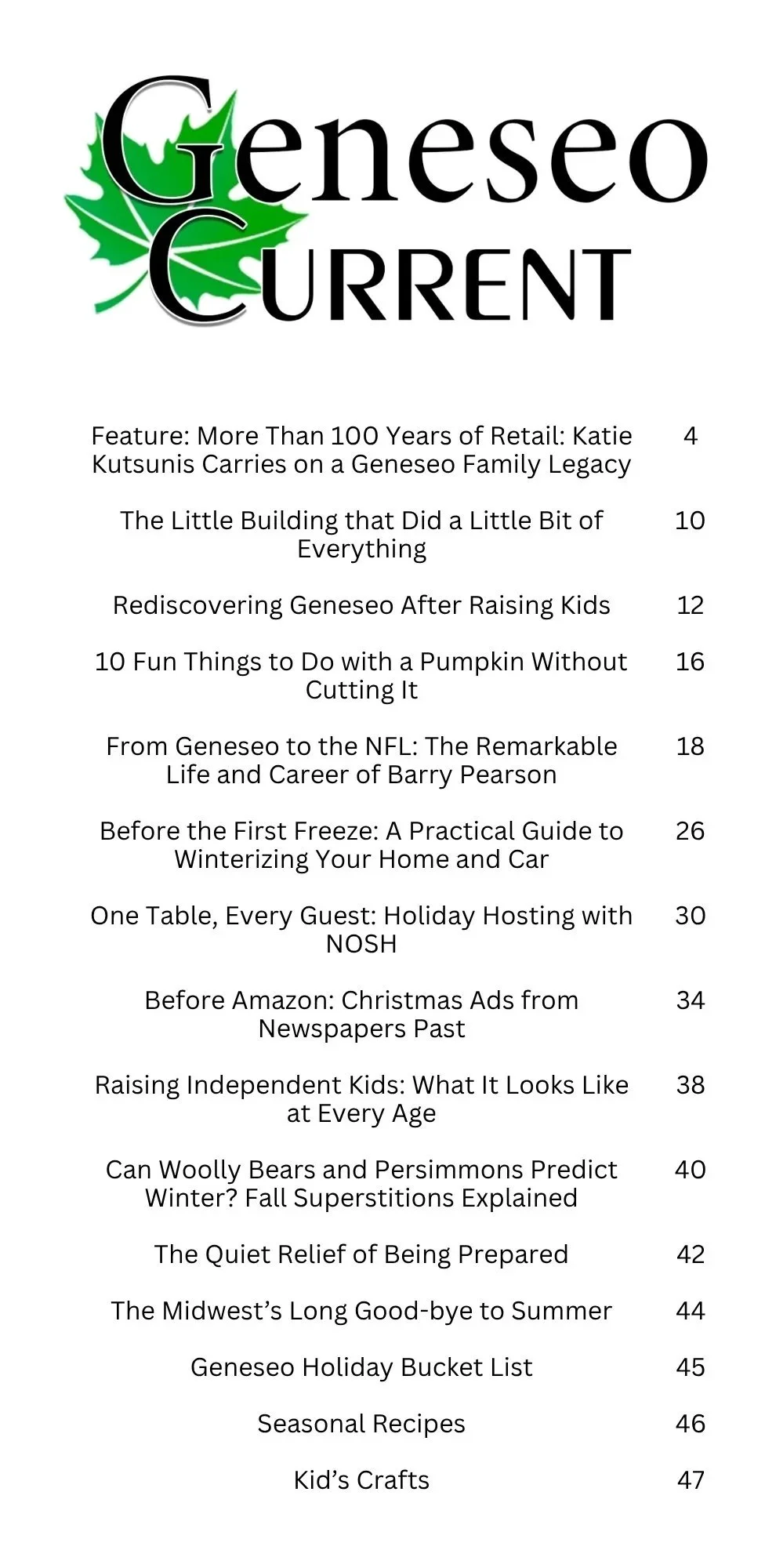
The October issue of Current Scene is coming soon, with 48 pages of local stories, fall ideas, Geneseo history and practical seasonal reads.
Our feature story looks at more than 100 years of retail through “Katie Kutsunis Carries on a Geneseo Family Legacy.” We’ll also tell the story of “The Little Building That Did a Little Bit of Everything” and remember longtime Geneseo standout Barry Pearson, whose remarkable football career took him all the way to the NFL.
There’s plenty for fall, too: 10 things to do with a pumpkin without cutting it, winterizing your home and car, fall superstitions explained, seasonal recipes and kids’ crafts.
And as the holidays approach, we’re getting an early start with historic Christmas ads from Geneseo newspapers, holiday hosting with NOSH and our Geneseo Holiday Bucket List.
You’ll also find thoughtful features on rediscovering Geneseo after raising kids, raising independent kids at every age, and saying one last Midwestern goodbye to summer.
🍁 History. Home. Family. Football. Fall. And the holidays just around the corner.
The October Current Scene is coming soon.
Geneseo Rotary Joins Regional Effort to Raise $10,000 for Polio Eradication
Geneseo Rotary will join a regional World Polio Day walk Oct. 24, helping the Quad Cities raise $10,000 to support global polio eradication efforts.
Read more