
One of the biggest reasons the Henry County Board approved a one-year moratorium on new carbon sequestration projects, however, wasn't about how the technology works: It was about public safety.
County officials have repeatedly said they want more time to understand potential risks, develop emergency response plans, and ensure first responders are prepared before additional projects move forward.
So what exactly are those risks?
Carbon dioxide can be dangerous
One of the biggest misconceptions is that carbon dioxide (CO₂) is toxic like chlorine or ammonia. It isn't.
CO₂ is a naturally occurring gas. Humans exhale it every time they breathe, and plants use it during photosynthesis.
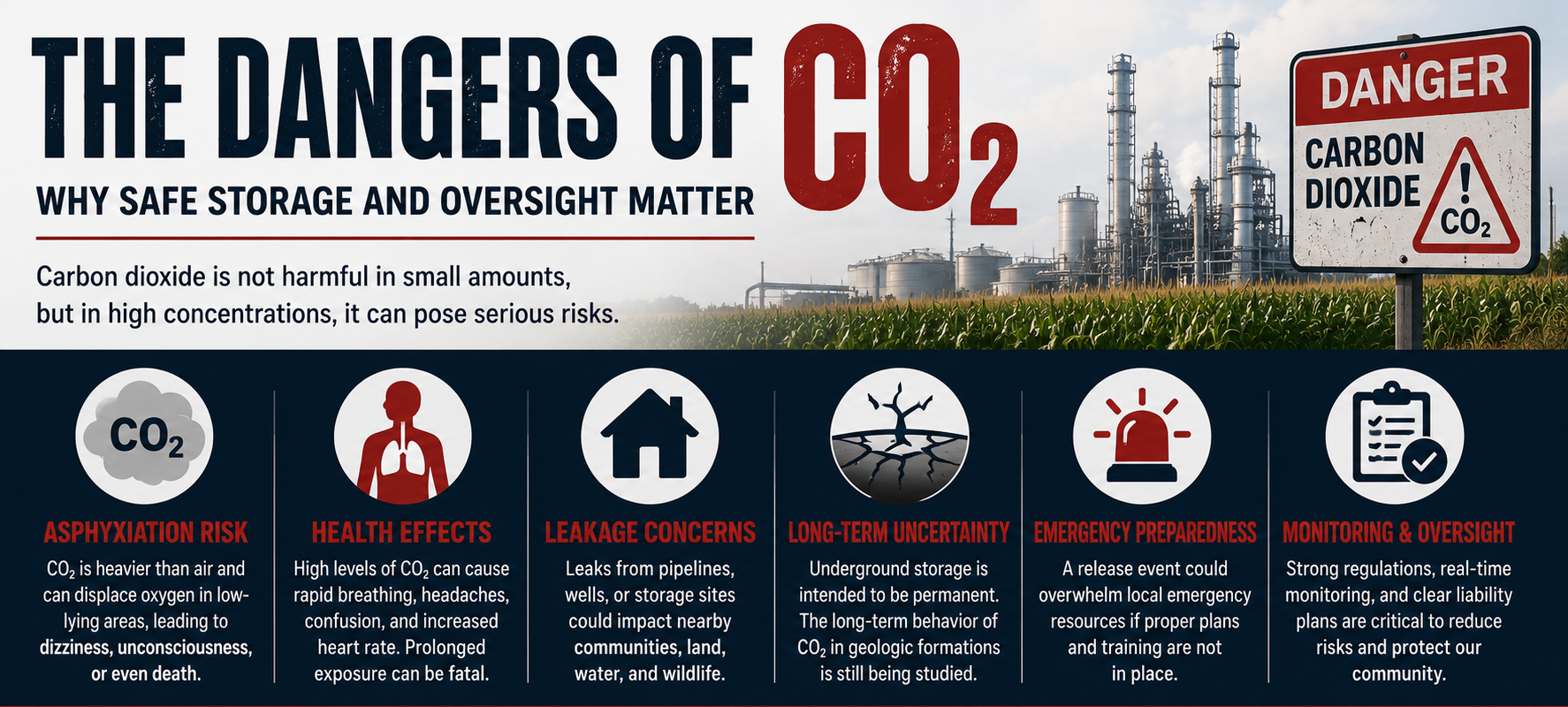
The danger comes when large amounts of carbon dioxide displace oxygen. That makes CO₂ an asphyxiant.
Instead of poisoning the body, it reduces the amount of oxygen available to breathe. When oxygen levels become too low, the brain and other organs can no longer function normally.
Why carbon dioxide behaves differently than natural gas
Many people compare carbon dioxide pipelines to natural gas pipelines, but the gases behave very differently.
Natural gas is lighter than air. So when it’s released outdoors, it generally rises and disperses into the atmosphere.
Carbon dioxide, on the other hand, is about 1½ times heavier than air.
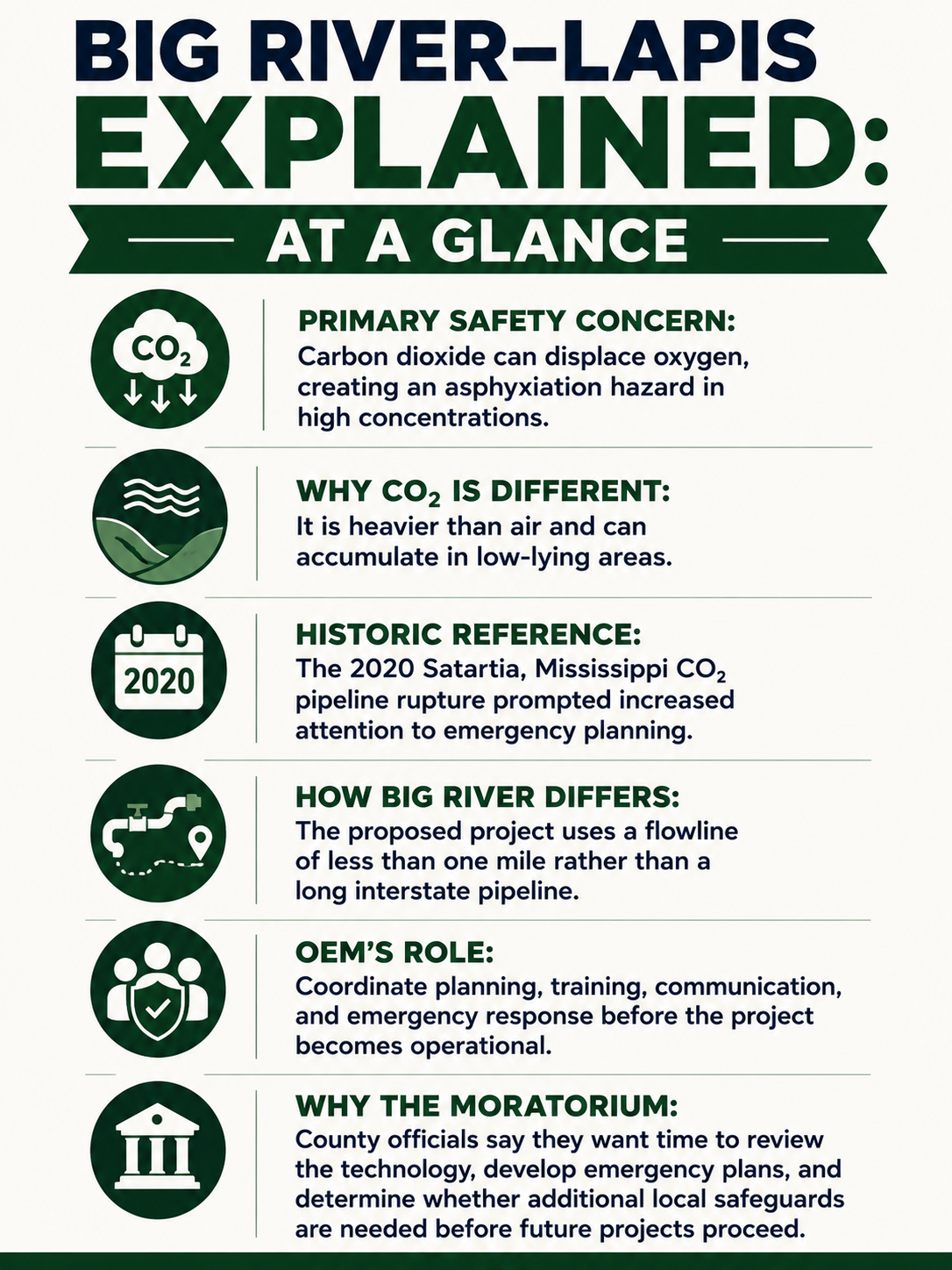
So when CO₂ is released in large quantities, it tends to sink and collect in low-lying areas such as:
Ditches
Creek beds
Culverts
Basements
Low spots in fields
Depressions in the landscape
Weather conditions can also affect how long the gas remains concentrated before dispersing.
Because carbon dioxide is colorless and odorless, people may have no warning that oxygen levels are dropping.
What happens if someone is exposed?
The effects depend on both the concentration of carbon dioxide and the length of exposure.
Early symptoms may include:
Headache
Dizziness
Shortness of breath
Confusion
Increased heart rate
As oxygen levels continue to fall, symptoms can progress rapidly to:
Difficulty walking
Impaired judgment
Loss of consciousness
Suffocation due to oxygen deprivation
Unlike smoke or natural gas, there may be no visible cloud or odor alerting someone to the danger. Animals can also be affected.
Can carbon dioxide stop vehicles?
Yes, a concentrated cloud of cardon dioxide can stall a vehicle. Internal combustion engines require oxygen to burn fuel.
If a vehicle enters an area where oxygen has been displaced by highly concentrated carbon dioxide, the engine may stall because combustion cannot continue.
This possibility is one reason emergency planners study carbon dioxide releases differently than many other industrial incidents.
A stalled emergency vehicle could delay rescue efforts if responders entered an area with elevated CO₂ concentrations before conditions were fully assessed.
The incident that changed the conversation
Much of today's discussion about carbon dioxide safety references a single event.
On February 22, 2020, a carbon dioxide pipeline ruptured near Satartia, Mississippi. The release created a dense cloud of carbon dioxide that settled into low-lying terrain.
Residents reported difficulty breathing, confusion, dizziness, and loss of consciousness. Some people became disoriented while attempting to drive away.
According to investigations by the Pipeline and Hazardous Materials Safety Administration (PHMSA), dozens of people were treated by emergency responders, and approximately 45 people were transported to hospitals. Several vehicles reportedly stalled after entering the oxygen-deficient area because their engines could no longer sustain combustion.
The incident prompted additional scrutiny of carbon dioxide transportation and emergency response planning across the country.
How is the Big River project different?
While Satartia is often cited during discussions about carbon dioxide safety, the proposed Big River–Lapis project differs in several important ways.
The Mississippi incident involved a long interstate carbon dioxide pipeline transporting CO₂ across multiple states.
Project Big River would instead use a flowline of less than one mile connecting the Big River Resources ethanol plant directly to a nearby underground injection site.
Because the transportation distance is significantly shorter, supporters argue the project presents a different risk profile than a regional pipeline network.
That doesn't eliminate risk, but it changes the types of scenarios emergency planners evaluate.
Why is Henry County's Office of Emergency Management involved?
Emergency management is responsible for much more than tornadoes and floods.
Henry County's Office of Emergency Management (OEM) coordinates planning for hazardous materials incidents, industrial accidents, transportation emergencies, severe weather, and other events that could require a coordinated multi-agency response.
Even if the likelihood of a carbon dioxide release is considered low, OEM's role is to prepare for the possibility.
County officials have said they want emergency plans in place before any project becomes operational—not afterward.
What kinds of plans are being discussed?
According to Lapis Carbon Solutions, emergency planning includes coordination with Henry County OEM, local fire departments, and other responding agencies.
Planning may include:
Identifying potential release scenarios.
Modeling how carbon dioxide could move under different weather conditions.
Developing notification procedures.
Coordinating evacuation routes if necessary.
Establishing communication between agencies.
Conducting emergency response exercises.
Reviewing specialized equipment needs.
The company has also said it intends to share carbon dioxide dispersion modeling as part of the planning process.
What would first responders train for?
Responding to a carbon dioxide incident differs from responding to a fire.
Training could include:
Recognizing symptoms of oxygen-deficient environments.
Using atmospheric gas monitoring equipment.
Establishing exclusion zones.
Identifying areas where CO₂ may accumulate.
Coordinating rescues without exposing responders to unnecessary risk.
Communicating protective actions to the public.
Working within the county's Incident Command System alongside fire, EMS, law enforcement, and emergency management.
The goal is to ensure responders know how to safely assess conditions before entering an affected area.
Why did the County Board approve a moratorium?
County officials have emphasized that the one-year moratorium is not a permanent ban on carbon sequestration.
Instead, they have said the additional time will allow Henry County to:
Better understand the technology.
Review emergency preparedness.
Evaluate public safety considerations.
Gather technical information.
Determine whether additional local regulations are appropriate.
Supporters of the moratorium say it gives the county time to prepare before additional projects move forward.
Supporters of the project argue that planning and permitting requirements are already extensive and that the Big River proposal's short flowline makes it fundamentally different from large interstate pipeline systems.
Those differing viewpoints are at the center of the ongoing public discussion.
Coming Next: Part 3
In the final installment of this series, we'll examine the debate surrounding Project Big River—why supporters believe it could strengthen the region's agricultural economy, why critics remain concerned about safety and long-term impacts, and how Henry County officials may balance those competing perspectives as the project moves through the permitting process.