
Illinois parents have certain rights when allegations of sexual misconduct involve adults working with students. Those protections extend beyond traditional classroom teachers in some circumstances, potentially including coaches, extracurricular advisors, contractors, and individuals acting on behalf of a school district.
Faith’s Law was enacted to strengthen student protections, establish clearer professional boundaries, improve hiring practices, and ensure that families receive important information when allegations of sexual misconduct arise.
However, the law does not apply identically to every adult involved in school activities. Understanding those distinctions is important for parents who want to know what protections exist, what schools are required to disclose, and how concerns should be addressed.
What Is Faith’s Law?
Faith’s Law is named after Faith Colson, who experienced sexual abuse by a teacher while attending an Illinois high school. Her experience helped inspire legislation aimed at preventing sexual misconduct in educational settings and strengthening accountability.
The legislation established additional requirements for Illinois schools, including employee codes of professional conduct, parental notification procedures, and expanded employment history reviews for certain individuals seeking school employment.
The law also recognizes that inappropriate relationships and boundary violations can develop before conduct rises to the level of criminal sexual abuse. Its purpose is not limited to responding after abuse occurs. It also seeks to establish professional standards that help schools identify and address concerning behavior earlier.
What Does Faith’s Law Require Schools to Do?
One of the law’s central requirements is that school districts adopt and maintain a written employee code of professional conduct.
These policies must address appropriate boundaries between school employees and students, including circumstances that could create opportunities for inappropriate relationships or misconduct. Examples include communication with students outside professional responsibilities, transporting students, photographing or recording students, and meeting with students outside normal school activities.
Districts must make the required policies and reporting procedures available to families through their websites and relevant school handbooks.
Faith’s Law also establishes parental notification requirements when allegations of sexual misconduct involve certain adults associated with a school. In addition, it strengthens employment screening procedures intended to prevent individuals with histories of sexual misconduct from moving between educational institutions without appropriate review.
When Must Parents Be Notified?
One of the most significant provisions of Faith’s Law concerns communication with families.
When a school employee, agent, or contractor is alleged to have engaged in sexual misconduct involving a student, the school generally must provide written notification to that student's parent or guardian.
The student must first receive developmentally appropriate information about the notification process, including what information will be shared and what support resources are available.
Parental notification must occur as soon as feasible, subject to applicable exceptions and circumstances involving law enforcement or child protection investigations.
Certain exceptions apply, including situations involving adult or emancipated students, allegations involving a parent or guardian, and circumstances in which the order or timing of notification must be adjusted.
Importantly, Faith’s Law does not establish a blanket requirement that every family in a school district receive notice whenever an allegation is made. The notification provisions are primarily directed toward the students involved and their parents or guardians.
What Happens After an Investigation?
Faith’s Law also addresses communication following certain employment decisions involving allegations of sexual misconduct.
When a school board or other governing body takes specified employment action following an investigation, including termination or acceptance of a resignation, additional notification requirements may apply. These provisions are intended to ensure affected families receive information about certain actions taken by the school.
The law also addresses reporting information to appropriate education officials.
However, a school employee's resignation or termination does not, by itself, establish that sexual misconduct occurred. Employment decisions, investigative findings, and criminal determinations are separate matters.
Does Faith’s Law Apply to Volunteers, Coaches, and Extracurricular Advisors?
This is an important distinction for parents because many adults who regularly interact with students are not directly employed by a school district.
Schools rely on volunteer coaches, parent volunteers, extracurricular advisors, mentors, contracted instructors, and community organizations to provide educational and extracurricular opportunities.
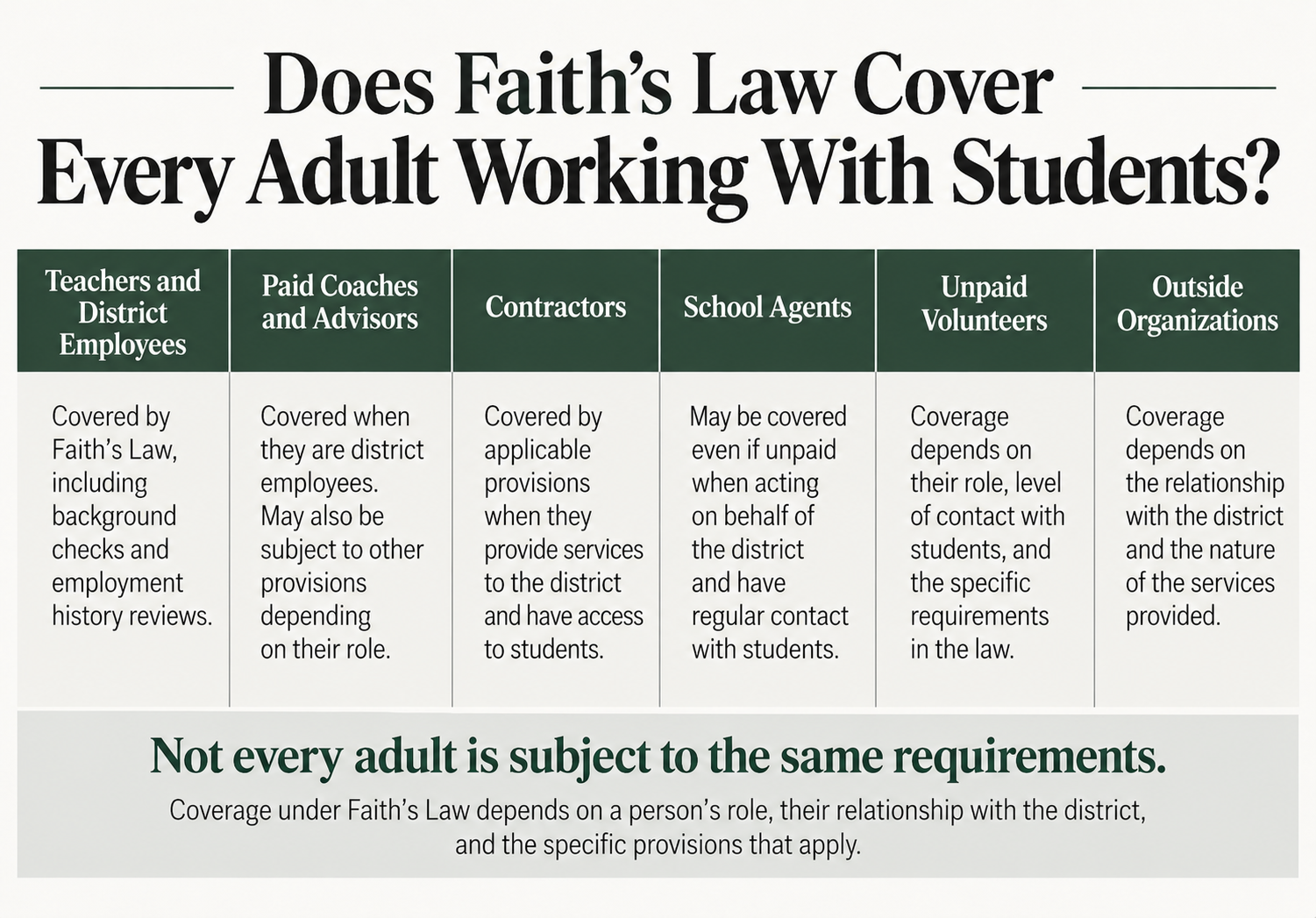
Faith’s Law expressly addresses school employees, agents, and contractors in certain provisions, but it does not automatically treat every volunteer or outside participant as a district employee.
For example, a teacher who serves as a club advisor is a district employee and is subject to the requirements applicable to that employment relationship. A paid coach employed by the district would generally fall into the same category. A coach or instructor working through a separate contractual arrangement may instead be covered by provisions addressing contractors.
Unpaid volunteers present a more complicated question. A parent volunteering at a school event, an unpaid athletic assistant, or a community member helping supervise an extracurricular activity may not be subject to every employment screening requirement established by Faith’s Law.
However, depending on the circumstances, an individual authorized to act on behalf of a school could qualify as a school agent for purposes of certain legal requirements. That distinction can be particularly important when determining whether an allegation involving a nonemployee triggers parental notification obligations.
Whether a particular volunteer qualifies as an agent depends on the relationship between the individual and the district, the authority granted to that person, and the activities being performed. A volunteer's lack of compensation does not necessarily eliminate the district's responsibilities.
Are Volunteers Required to Undergo Background Checks?
Faith’s Law expanded employment history review requirements for covered school positions, including certain positions involving direct contact with students.
Beginning July 1, 2023, covered schools were required to implement additional procedures for reviewing applicants' previous employment histories, including information concerning sexual misconduct allegations or findings. These requirements can also extend to covered contractor positions.
However, Faith’s Law does not automatically require every unpaid volunteer to undergo the same employment history review process as a prospective district employee.
School districts may separately establish volunteer screening requirements through board policies, administrative procedures, or other applicable laws.
As a result, parents should not assume that every adult permitted to supervise or work with students has undergone an identical screening process.
A useful question for families is whether their district distinguishes between occasional volunteers, regularly scheduled volunteers, athletic assistants, extracurricular advisors, and individuals permitted to supervise students without a district employee present.
What About Booster Clubs and Outside Organizations?
Booster clubs, youth organizations, community groups, and other outside entities sometimes organize activities involving students or support school-sponsored programs. Their involvement can create additional questions about responsibility and oversight.
For example, an adult assisting with an officially authorized school activity may have a different relationship with the district than someone independently organizing an event outside school supervision. Simply participating in a school-related activity does not automatically establish that a person is a district employee, agent, or contractor.
Similarly, membership in a booster organization does not necessarily mean an individual is acting on behalf of the district.
The relevant questions include whether the district authorized the activity, whether the individual was acting under district direction, what responsibilities the person was assigned, and whether the activity was school-sponsored.
These distinctions can affect which Faith’s Law provisions apply. They also highlight why districts should clearly communicate their expectations for adults who interact with students, regardless of whether those adults receive a paycheck.
What Is Grooming, and Why Does the Law Address It?
Grooming generally refers to behavior intended to establish trust, access, secrecy, or emotional dependence as part of preparing a child for sexual exploitation or abuse.
Concerning behaviors may include excessive personal attention, inappropriate private communication, requests to keep interactions secret, favoritism, or repeated violations of professional boundaries. Not every instance of favoritism, personal communication, or individual attention constitutes grooming. However, patterns of behavior that cross appropriate boundaries may warrant closer examination. Faith’s Law recognizes the importance of establishing professional standards before inappropriate conduct escalates into more serious misconduct.
Illinois law defines sexual misconduct for these purposes to include certain conduct involving sexual or romantic relationships between school employees and students, as well as specified acts of sexual abuse or exploitation.
Does Every Allegation Have to Be Made Public?
No. Faith’s Law distinguishes between notifying an affected family and publicly disclosing information to the entire school community.
The parental notification requirements focus on students directly involved in allegations of sexual misconduct and their parents or guardians. The law does not automatically require school districts to issue districtwide announcements identifying employees, volunteers, or other adults accused of misconduct.
Schools must also consider student privacy, investigative confidentiality, and applicable state and federal laws.
An allegation is not the same as a finding of misconduct. At the same time, the law's notification requirements do not necessarily depend on a completed criminal investigation or conviction.
What Should Parents Ask Their School District?
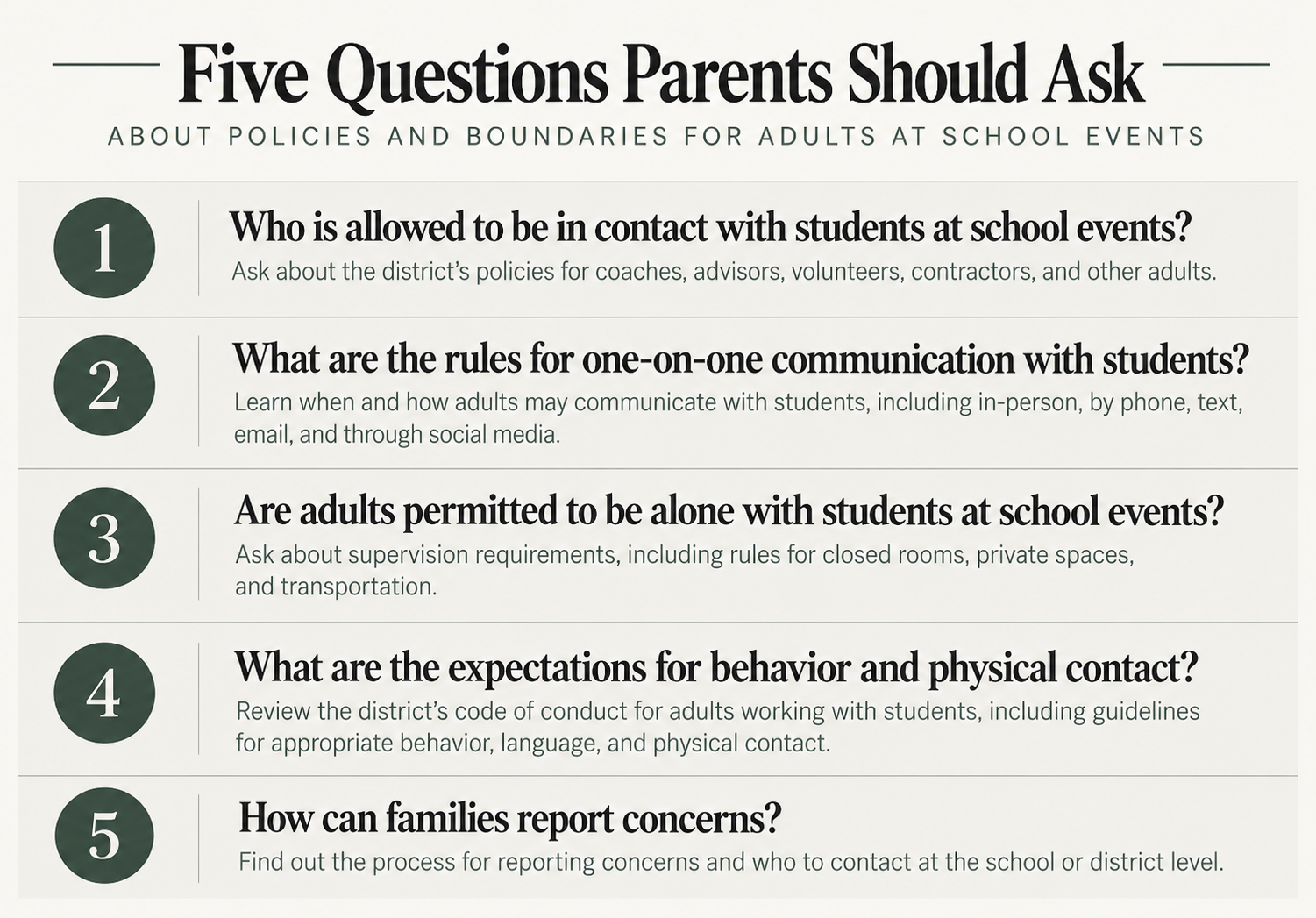
Parents seeking to understand how Faith’s Law is implemented locally can ask several questions:
Where can families access the district's employee code of professional conduct and sexual misconduct reporting procedures?
What background checks and employment history reviews are required for employees, contractors, volunteer coaches, and extracurricular advisors?
Are unpaid volunteers permitted to supervise students independently?
What policies govern private communication, transportation, and interactions outside school hours?
How does the district determine whether an unpaid volunteer or outside advisor is acting as a school agent?
What procedures are followed when an allegation involves someone who is not directly employed by the district?
How and when are affected parents notified?
Where Can Families Find More Information?
The Illinois State Board of Education maintains a Faith’s Law information page containing guidance, frequently asked questions, employment history review materials, and a sexual abuse response and prevention resource guide.
The state's guidance specifically clarifies that volunteers are not required to complete the employment history reviews established under Faith’s Law. Those reviews apply to covered permanent and temporary employment positions involving direct student contact. The guidance also explains that Faith’s Law does not eliminate other applicable background check requirements.
Parents can review the materials at www.isbe.net/faithslaw.
The statutory provisions are available through the Illinois General Assembly, including Sections 22-85.5, 22-85.10, and 22-94 of the Illinois School Code.
The Bottom Line for Illinois Families
Faith’s Law establishes important protections intended to prevent sexual misconduct, strengthen hiring practices, and improve communication with families. But those protections involve different legal requirements depending on whether an adult is a school employee, contractor, agent, or volunteer.
An unpaid volunteer may not be subject to the same employment history review requirements as a teacher or contracted coach. However, that does not necessarily mean the individual falls outside the district's responsibilities or the law's provisions.
The central question is not simply whether an adult receives a paycheck from the school district. It is what responsibilities that adult has been given, what safeguards apply to the role, and how the district responds when concerns are raised.