Hayshaker's Grill Brings Fresh Breakfast to the Geneseo Farmers Market


While North Street Treats has been a familiar part of the Geneseo Farmers Market for years, this season marks the debut of a new venture for husband-and-wife team Jill and Jarred Gephart: Hayshaker's Grill.
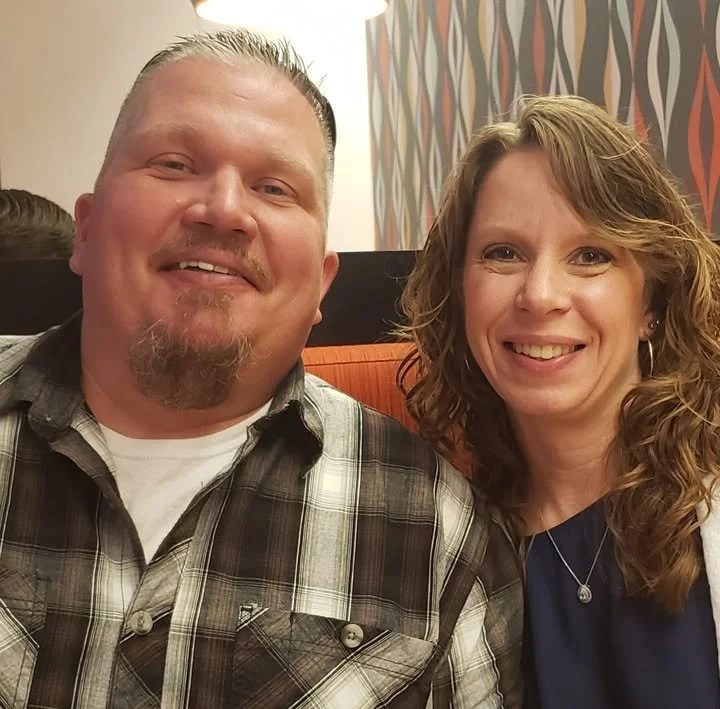
Jarred and Jill Gephart

The Gepharts met while working in the restaurant industry and had long talked about starting a business of their own after retirement.

"We met in the restaurant business & always talked about starting our own business after retirement," they said. "Passion for cooking and serving quality food. I felt there was a gap in the food truck industry that we could fill."

The opportunity to join the Geneseo Farmers Market came after organizer Jill Darin approached the couple about serving breakfast. The Gepharts said they believed it was "the perfect opportunity to introduce Hayshaker's Grill to the Geneseo community."

Each Saturday morning, Hayshaker's Grill prepares fresh breakfast scrambles to order before transitioning to its lunch menu. The business's top-selling item is its unbreaded pork tenderloin sandwich, followed closely by its smashburgers.

When asked what first-time customers should order, the answer was immediate: "The un breaded pork tenderloin sandwich, it is the best in the QC area."

According to the Gepharts, the business is built on quality and consistency.

"The quality of the food and the fact that it's cooked fresh over a charcoal grill set us apart," they said. "Consistency is what brings customers back. We strive to deliver a good, quality product every time."

Although Hayshaker's Grill is new to the market, the Gepharts are well known to many regular shoppers through North Street Treats, their gluten-free dessert business, which has been a longtime Farmers Market vendor. North Street Treats specializes in gluten-free desserts and continues to operate through farmers markets, events and custom orders. The Gepharts noted that, despite some community confusion, North Street Treats is not currently opening a bakery.

Looking ahead, the couple hopes to have Hayshaker's Grill operating from a food trailer by the start of next season, with the long-term goal of opening a brick-and-mortar restaurant within the next five years.

The response from the Geneseo community has been stronger than they anticipated.

"Amazingly overwhelming!!" they said. "The support so far has been beyond expected."

Visitors can find Hayshaker's Grill and North Street Treats each Saturday at the Geneseo Farmers Market in City Park, where the Gepharts continue serving fresh, made-to-order food alongside the gluten-free desserts that have become a longtime market favorite.



Inside Project Big River – Part 1: What Is Carbon Capture, and Why Does It Matter?

At first glance, a proposed carbon sequestration project near Galva might not seem like something Geneseo residents need to follow. After all, the project isn't located in Geneseo, and most of the activity would take place at Big River Resources' ethanol plant just outside Galva. But the decisions being made over the next year could affect all of Henry County.

The Henry County Board recently approved a one-year moratorium on new carbon sequestration projects while officials gather more information, review emergency preparedness, and determine whether additional local safeguards are needed. Those discussions involve countywide emergency planning, taxpayer-funded public safety resources, agriculture, economic development, and regulations that could shape future projects across the county.

That's why The Geneseo Current is launching a three-part series explaining what the Big River–Lapis project is, why it's being debated, and what it could mean for our region. In Part 1, we'll answer the most basic question: What exactly is this project?

What is carbon capture?

To understand the project, it helps to start with how ethanol is made.

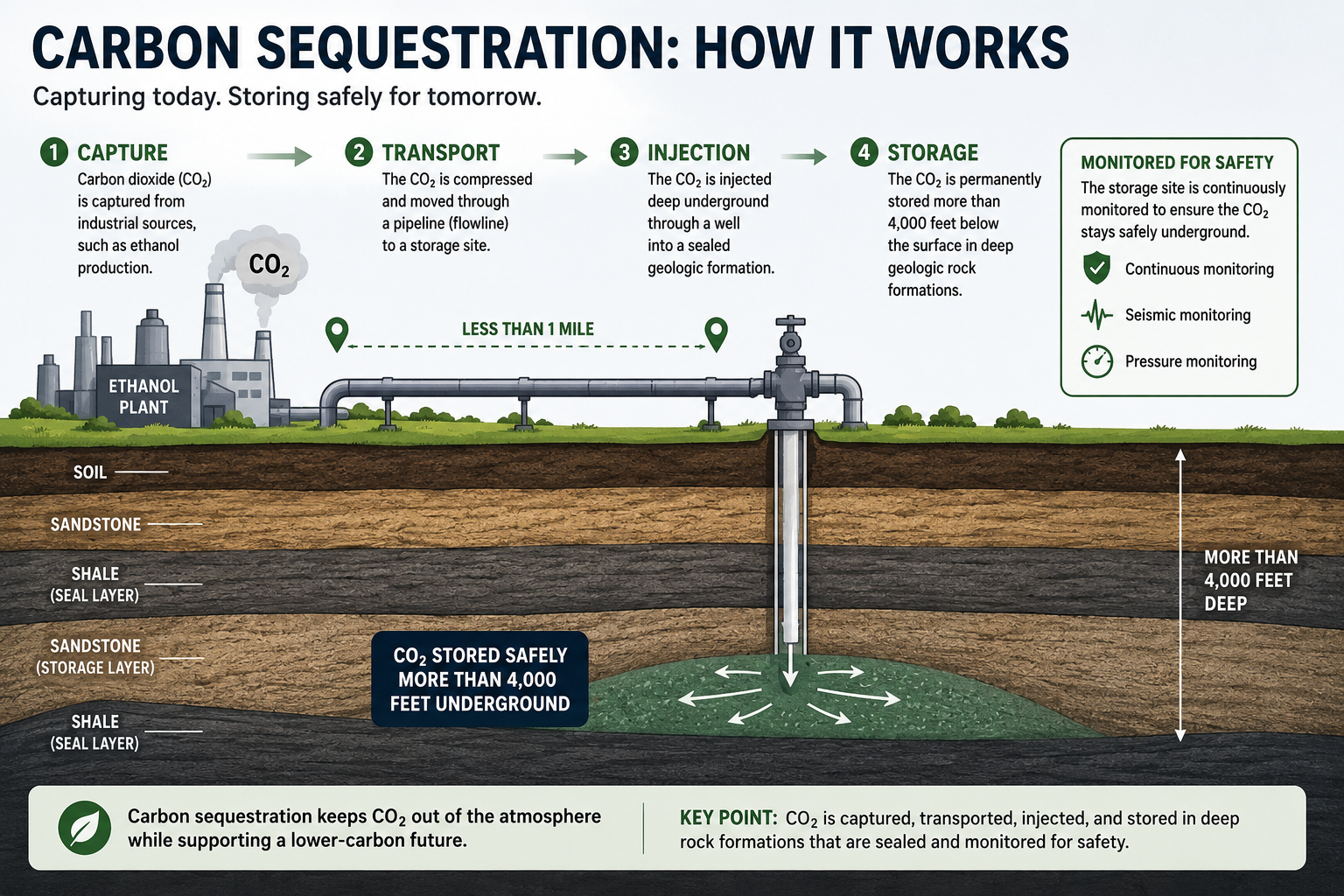
At the Big River Resources ethanol plant near Galva, corn is processed into ethanol fuel. During fermentation, yeast converts sugars into alcohol—and in the process, naturally produces carbon dioxide (CO₂).

Traditionally, that carbon dioxide is released into the atmosphere.

Carbon capture changes that.

Instead of venting the CO₂, specialized equipment captures it, removes impurities, compresses it into a dense fluid, and prepares it for transportation and storage.

The goal is to prevent those emissions from entering the atmosphere.

What is carbon sequestration?

Capturing carbon dioxide is only half of the process.

Carbon sequestration refers to permanently storing that captured CO₂ deep underground.

The compressed carbon dioxide is injected thousands of feet below the surface into porous rock formations capped by impermeable layers of rock that are intended to keep it trapped over the long term.

Supporters describe the process as similar to storing natural gas underground, while opponents raise questions about long-term monitoring and safety.

What is being proposed near Galva?

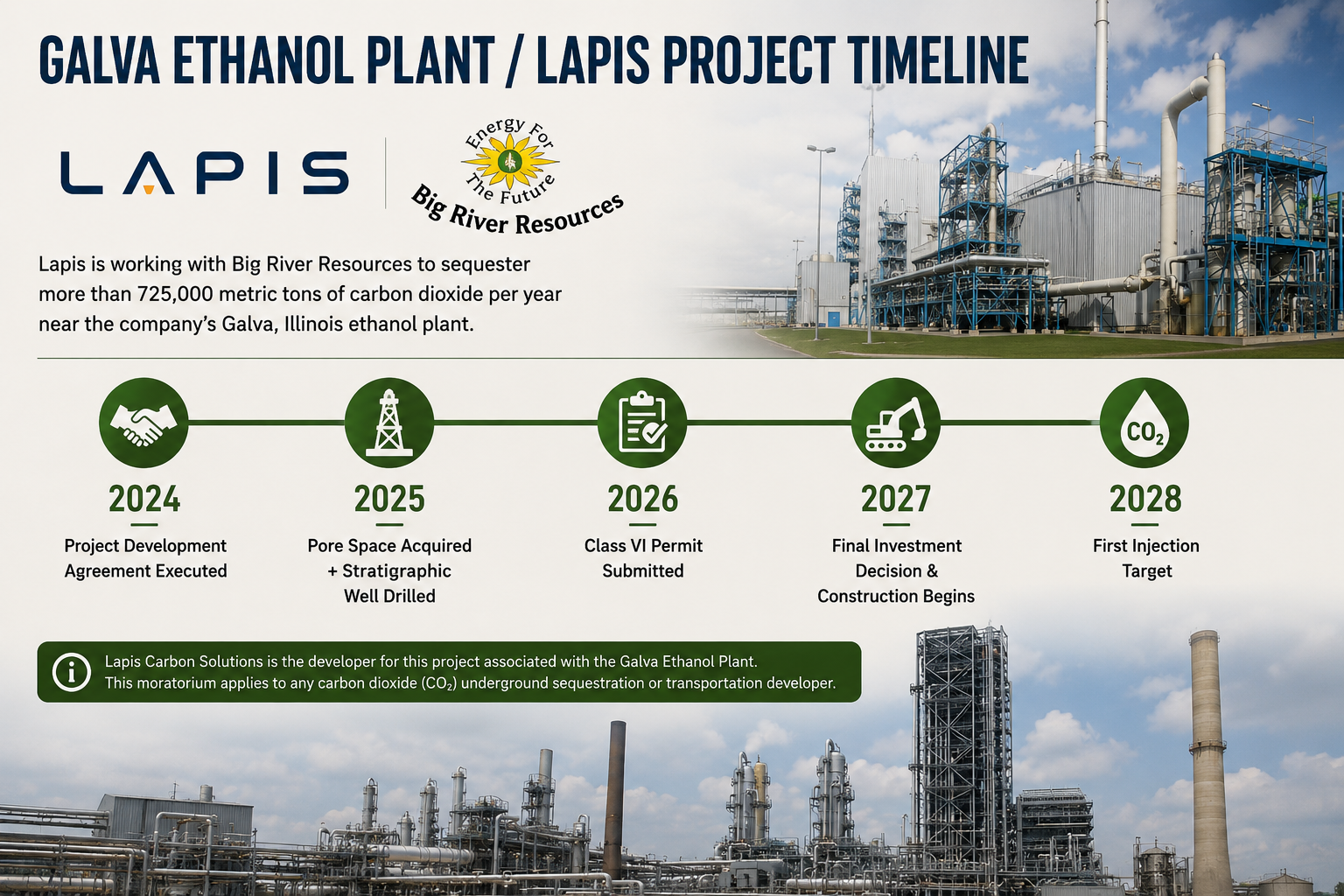
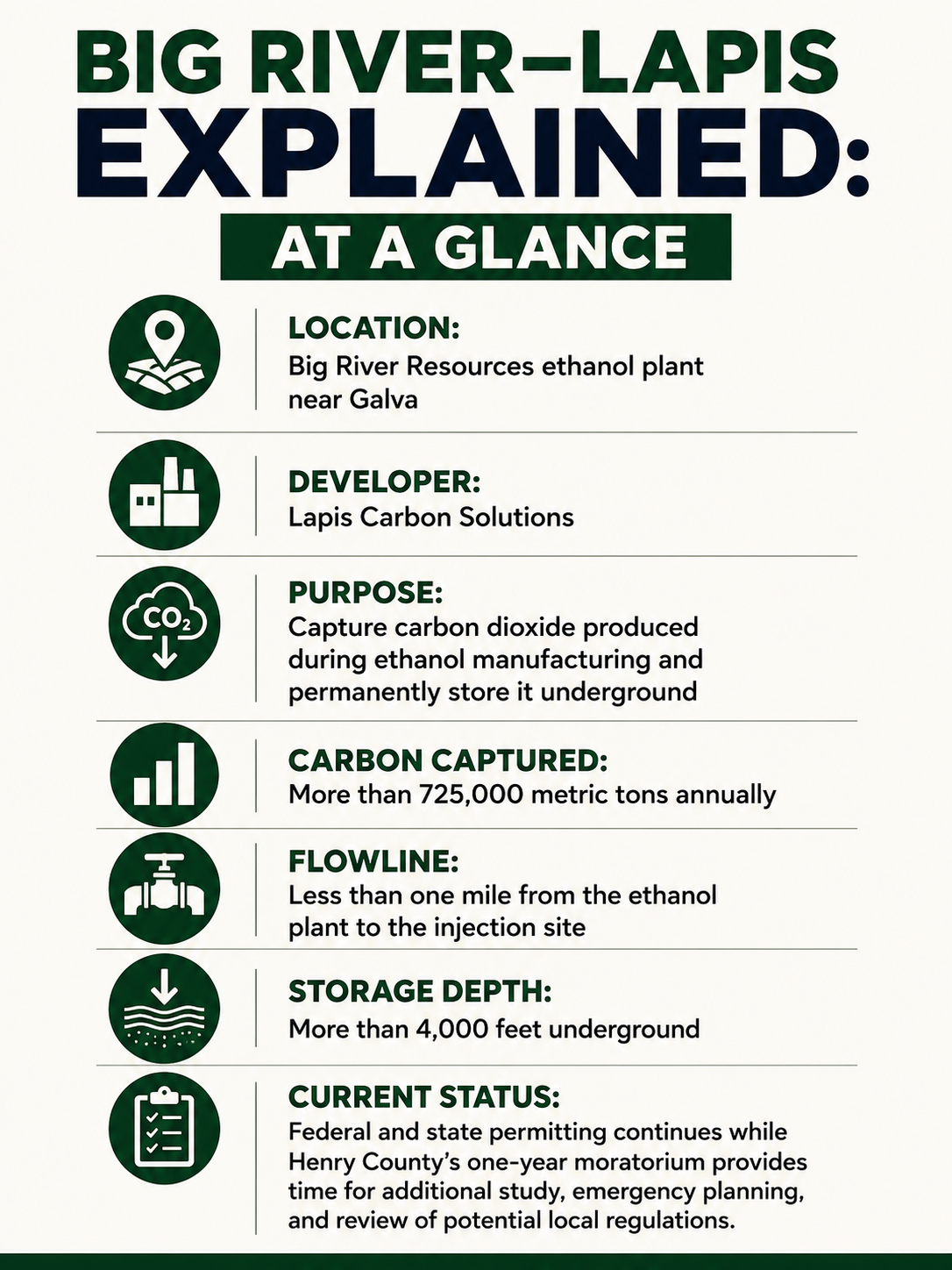
The proposed project is a partnership between Big River Resources, which operates the ethanol plant near Galva, and Lapis Carbon Solutions, a company that develops carbon capture and storage projects.

According to the companies, the project would:

  • Capture more than 725,000 metric tons of carbon dioxide each year from ethanol production.

  • Compress the CO₂ and transport it through a flowline less than one mile long.

  • Inject it more than 4,000 feet underground into geologic formations suitable for permanent storage.

  • Continuously monitor the storage site under federal and state regulations.

Unlike some carbon capture proposals that involve hundreds of miles of interstate pipeline, Project Big River is designed as a near-plant project, with the storage site located adjacent to the ethanol facility.

Lapis has also stated it does not anticipate using eminent domain for the project's short flowline.

Why build a project like this?

The primary reason is to reduce the carbon intensity of ethanol.

Many fuel markets and government programs place a value on fuels with lower greenhouse gas emissions. By capturing and storing carbon dioxide that would otherwise be released into the atmosphere, ethanol producers may qualify for incentives and improve the competitiveness of their product.

Supporters say projects like this can help Illinois ethanol plants remain competitive while supporting local jobs and markets for corn producers.

Where would the carbon dioxide go?

One of the most common misconceptions is that carbon dioxide would be stored in tanks or warehouses.

Instead, it would be injected into deep underground rock formations that have held fluids for millions of years.

These formations are located thousands of feet below drinking water aquifers and are selected based on extensive geologic studies.

Before injection can begin, the project must receive a federal Class VI Underground Injection Control permit, one of the most rigorous permitting processes overseen by the U.S. Environmental Protection Agency. Illinois also recently adopted additional state regulations governing carbon sequestration projects.

Why is Henry County talking about it now?

Although the project is located near Galva, it has become a countywide discussion because county officials want to better understand the technology before additional projects move forward.

Earlier this month, the Henry County Board approved a one-year moratorium on new carbon sequestration projects and new data center developments.

County leaders have said the temporary pause is intended to give officials time to:

  • Review technical information.

  • Develop emergency response plans.

  • Study public safety considerations.

  • Evaluate whether additional local regulations are needed.

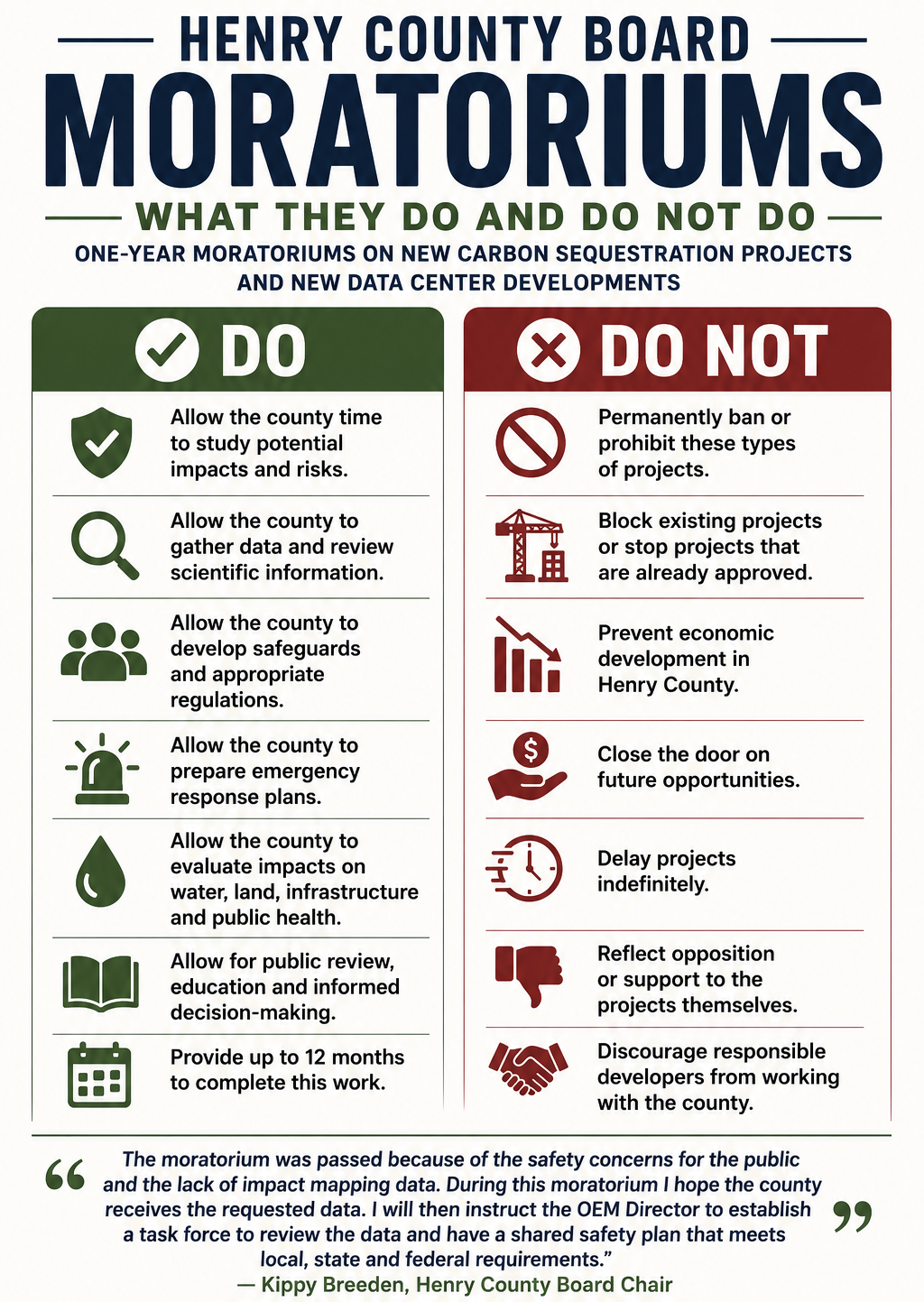
The moratorium is not a permanent ban on carbon sequestration, nor does it automatically stop the existing Big River–Lapis proposal. Instead, county officials describe it as an opportunity to gather information before making future decisions.

Why should Geneseo residents care?

Even though the project is centered near Galva, the discussions extend beyond one community.

County emergency planning, mutual aid between first responders, economic development, agriculture, and county regulations all have implications that reach across Henry County. Big River Resources is also an important regional purchaser of corn, meaning decisions affecting the plant can have ripple effects throughout the local agricultural economy.

Perhaps most importantly, these decisions are being made by elected officials who represent residents throughout Henry County—not just Galva.

Understanding the project helps residents better evaluate the conversations taking place at County Board meetings and the decisions their representatives will make over the coming months.

Coming Next: Part 2

In Part 2, we'll take a closer look at safety and emergency planning.

Editor's Note: This is the first installment in a three-part educational series designed to explain the proposed Big River–Lapis carbon sequestration project. The purpose of this series is to provide factual information about the proposal, the science behind carbon sequestration, and the issues being discussed by local officials so readers can better understand the ongoing public conversation.

After 18 Years of Waiting, Is Passenger Rail Really Coming to Geneseo?

For nearly 20 years, Geneseo has been promised the return of passenger rail. The city still has a planned station, land has been purchased, and Illinois continues to include Geneseo on its preferred route—but years of delays, missed deadlines and unfinished agreements leave one big question: Is Amtrak finally coming, or is the community still waiting? Here’s where the project stands today.

Read more

Back-to-School Q&A: Free & Reduced-Price School Meals in Geneseo

As the new school year approaches, many Geneseo families have questions about free and reduced-price school meals. Here's what you should know.

Who can apply?
Any family with a student enrolled in Geneseo Community Unit School District #228 may submit an application for free or reduced-price meals.

How do I apply?
Applications are available through Geneseo CUSD #228 before the school year begins and can also be requested through your child's school office.

Who qualifies?
Eligibility is based primarily on household size and household income using annual federal guidelines.

What if I don't think I'll qualify?
Consider applying anyway. Many families are surprised to learn they qualify for reduced-price meals or other educational benefits.

Can I apply if my financial situation changes during the school year?
Yes. If your household experiences a job loss, reduced work hours, or another significant income change, you may apply at any time during the school year.

Will my child's classmates know?
No. Student meal eligibility is confidential.

Do Geneseo students receive free meals automatically?
No. Geneseo schools do not provide free meals to all students. Families who believe they may qualify must complete an application unless they have already been notified that their child qualifies through another eligible program.

Why is it important to apply if I'm eligible?
Approved applications can:

  • Reduce your family's meal costs.

  • Help schools qualify for certain federal and state funding.

  • Support programs and services that benefit students throughout the district.

Where can I get help?
If you have questions or need assistance completing an application, contact your child's school office or the Geneseo CUSD #228 District Office.

Helpful Tip:
If you're unsure whether your family qualifies, apply anyway. The application is free, confidential, and may provide benefits for both your family and the school district.

Links:

What Is a Moratorium? Henry County Board Chair Explains Why Officials Hit Pause on Carbon Sequestration and Data Centers

When the Henry County Board voted to approve one-year moratoriums on new carbon dioxide (CO₂) sequestration projects and new data center developments, some residents questioned what a moratorium actually means—and whether it signals opposition to the projects themselves.

According to Henry County Board Chair Kippy Breeden, the answer is no.

Instead, she says the temporary pause is intended to give county officials time to gather additional information, develop emergency response plans and ensure appropriate safeguards are in place before any future proposals move forward.

What is a moratorium?

A moratorium is a temporary suspension of certain activities while additional study, planning or regulations are completed.

In Henry County's case, the resolutions temporarily pause the acceptance, approval, recommendation, endorsement or support of new carbon sequestration projects and new data center developments for up to 12 months—or until the County Board takes further action.

The moratoriums do not permanently prohibit either type of development.

The current discussion in Henry County has centered largely around a proposed carbon dioxide sequestration project associated with Big River Resources' ethanol plant in Galva. Lapis Carbon Solutions is the developer pursuing that project. However, Board Chair Kippy Breeden emphasized that the moratorium is not directed at Lapis specifically. Instead, it applies broadly to any future carbon dioxide underground sequestration or CO₂ transportation project proposed within Henry County during the moratorium period.

Why did the Board approve the moratorium?

Breeden said two primary concerns drove the Board's decision.

"The moratorium was passed because of the safety concerns for the public and the lack of impact mapping data."

During previous Planning & Development Committee meetings, officials cited concerns including emergency response preparedness, groundwater protection, infrastructure impacts, agricultural land preservation and the need to better understand the potential effects of both carbon sequestration projects and large-scale data centers.

What happens during the pause?

Breeden said county officials intend to use the next year to gather additional information and prepare for the possibility of future projects.

"During this moratorium I hope the county receives the requested data. I will then instruct the OEM (Office of Emergency Management) Director to establish a task force to review the data and have a shared safety plan that meets local, state and federal requirements."

She said the task force would work alongside the Henry County Planning & Development Committee to review technical information and help develop emergency response plans should future projects be proposed.

Does the moratorium stop economic development?

Some residents have expressed concern that temporarily pausing new projects could discourage investment in Henry County.

Breeden said she does not believe the one-year moratorium should have that effect.

"The County Board and County officials have had several meetings with the developer and they understood our process and the 12-month moratorium should not impede the perceived economic advantage."

What happens next?

Breeden said the county's focus during the moratorium will be education and planning.

"The next steps are that the OEM Director will work with his task force and the Planning and Development County Board Committee to inform and educate us all on the overall parameters of the project."

Any future decisions regarding carbon sequestration projects or data center developments would occur after the moratorium expires or if the County Board chooses to take action sooner.

For now, the temporary moratorium allows county officials additional time to evaluate scientific research, review technical data, consider emergency preparedness needs and determine whether additional local regulations should be adopted before new projects move forward.

Sources:

  • Henry County Planning & Development Committee Minutes, June 9, 2026.

  • Henry County Planning & Development Committee agenda packet, including draft moratorium resolutions.

  • Henry County Board meeting, June 18, 2026.

  • Email interview with Henry County Board Chair Kippy Breeden, July 16, 2026.

  • Lapis Carbon Solutions, “Project Big River”

More Than Fireworks: What It Takes to Put on Geneseo's Thrill on the Hill

For thousands of people, Thrill on the Hill is a few hours of live music, food, family activities and one of the region's largest fireworks displays.

For the City of Geneseo, it's months of planning, coordination and tens of thousands of dollars in expenses before the first firework ever leaves the ground.

City financial records show the City Council doubled the usual budget for this year’s “America 250 Celebration,” spending at least $43,650 on direct event costs this year, with the fireworks display accounting for the overwhelming majority of that expense.

Those identified costs included:

  • Fireworks display: $40,000

  • Live entertainment: $2,500

  • Face painting/ Henna/ Kids Activities: $950

  • Fireworks liability insurance: $200

The city's financial reports also show $18,950 in fireworks donations received, helping offset a significant portion of the event's cost.

More Than What Appears on Paper

Those figures, however, tell only part of the story.

Many of the costs associated with a community celebration like Thrill on the Hill never appear as a separate line item in the city’s financial reports.

In the weeks leading up to the event, city employees coordinate logistics, obtain permits, prepare the grounds, arrange electrical service, set up barricades and signage, coordinate vendors and entertainment, and work with emergency responders.

On the day of the event, police officers, Public Works crews, utility employees and other city staff help direct traffic, maintain safety, monitor utilities and clean up once the crowds leave.

Rather than being charged directly to the event, those labor and equipment costs are generally absorbed into each department's operating budget, making the true cost difficult to calculate from financial reports alone.

A Complex Fireworks Operation

The fireworks display itself also requires considerably more than simply hiring a pyrotechnics company.

Organizers must coordinate safety zones, insurance coverage, emergency access, weather monitoring and site preparation while working with state regulations and licensed fireworks professionals.

Behind the scenes, pulling off the annual Thrill on the Hill fireworks display requires a careful balancing act between safety, weather forecasting, and tight logistical deadlines.

By mid-morning on event day, city officials and the fireworks vendor must make a final go/no-go call based on the latest forecast. Although strong afternoon storms were expected, forecasts indicated conditions would improve by approximately 6 p.m.

Ultimately, the vendor's lead technician—who bears final responsibility for launch safety—determined conditions would allow the show to proceed.

To protect the city's investment while accounting for the uncertain forecast, officials elected to move forward with the main aerial display while taking a credit on the ground-level fireworks show. Ground displays rely on delicate electronic components that are far more difficult to protect or quickly dismantle if rain begins after setup has started.

Proceeding with the aerial show also carried an important commitment. Once both the City and the fireworks vendor authorized the launch, those fireworks were committed for that evening and could not simply be postponed.

In the end, the strategy paid off, preserving the main fireworks spectacle for the community while minimizing financial risk associated with the more weather-sensitive ground effects.

Community Support Helps Offset Costs

Although the city's direct spending exceeded $43,000, community support helped offset a substantial portion of that cost.

Donations from local businesses, organizations and residents contributed nearly $19,000 toward the fireworks fund, reducing the amount paid from city resources.

Months of Work for One Evening

Large community events such as Thrill on the Hill are often evaluated by their attendance or entertainment value, but behind the scenes they represent a significant investment of public resources, volunteer support and months of planning.

By the time spectators gather with lawn chairs and blankets to watch the fireworks, much of the work has already been completed by dozens of people—many of whom remain behind the scenes throughout the celebration to help ensure the event runs safely and smoothly.

Sources: City of Geneseo financial reports; City of Geneseo check register.


John Deere Settlement Expands Repair Options for Illinois Farmers

A new federal settlement could change the way many Illinois farmers repair their John Deere equipment, giving owners and independent repair shops access to software and diagnostic tools that were previously available only through authorized dealerships.

The agreement, announced this week by the Federal Trade Commission (FTC) and attorneys general from five states—including Illinois—resolves an antitrust lawsuit alleging Deere unfairly restricted repairs by limiting access to critical software and electronic repair resources. Deere has denied wrongdoing but agreed to the settlement.

For farmers, the biggest impact may be greater flexibility.

Under the 10-year agreement, Deere must make available to farmers and independent repair providers the same repair resources it provides to its authorized dealers. That includes the ability to:

  • Read, clear and reset electronic fault codes.

  • Reprogram electronic components after they're replaced.

  • Restart equipment following certain emissions-related shutdowns.

  • Access technical manuals, troubleshooting information and repair databases.

The settlement also requires Deere to provide future repair tools once they become widely available within its dealer network and prohibits the company from retaliating against customers or independent repair businesses that choose to perform their own repairs. The FTC and participating states will oversee compliance for at least 10 years.

Why It Matters

For many farmers, equipment downtime during planting or harvest can have significant financial consequences. Modern farm equipment often relies on proprietary software that has required dealership access for certain diagnostics and repairs.

Supporters of the settlement say expanding access to repair software could reduce delays, lower repair costs and give farmers more control over equipment they own. Independent repair shops may also be better positioned to compete with dealerships for certain repairs.

Henry County farmer Curt Jacobs said the ability to choose who repairs equipment—or perform repairs yourself when possible—is becoming increasingly important as dealership labor costs continue to rise.

"Having that ability to hire somebody to come out and do repairs—or do it yourself if you have the technical abilities—is huge because the dealership costs are so high anymore," Jacobs said. "There's definitely ways to save money if you're able to do it yourself or hire a private repairman."

The agreement applies specifically to John Deere agricultural equipment. While it does not require Deere to provide repair resources free of charge, it does require the company to make them available on fair and reasonable terms.

Local Impact

Agriculture plays a major role in Henry County's economy, and John Deere equipment is widely used throughout the region. The settlement could provide local producers with additional repair options while reducing the need to rely exclusively on authorized dealerships for certain electronic repairs.

Jacobs said minimizing equipment downtime remains one of the biggest priorities for farmers during planting and harvest.

"If we're in one of our main seasons—planting or harvest—a machine being down is huge," he said. "It can cost us days of production, and if weather moves in, those delays can have an even greater impact."

He also believes the issue is more nuanced than many people realize. Jacobs noted that John Deere has made diagnostic software available to farmers through a lease program for several years, though many producers may not have been aware it existed. He said the larger limitation has been access to software and firmware updates, which remain restricted and continue to require dealer involvement.

"The tools have been available," Jacobs said. "The bigger issue is that farmers and independent repair shops still can't perform software and firmware updates, so there are still limits on what can be repaired outside the dealership."

Looking Ahead

The settlement is viewed as one of the most significant developments in the national "Right to Repair" movement, which advocates for consumers' ability to repair the products they own. While the agreement currently applies only to Deere, many industry observers believe it could influence how other agricultural equipment manufacturers approach repair access in the future.

Sources: Federal Trade Commission; Associated Press; Reuters; Interview with Curt Jacobs, Henry County farmer; The Geneseo Current.


Fact Check: Chamber Director Did Not Introduce Downtown Music Fest Idea to Council

A social media post circulating Wednesday inaccurately described a discussion that took place during Tuesday's Geneseo City Council meeting, claiming Geneseo Chamber of Commerce Executive Director Lindsie Akers "pitched" moving Music Fest downtown.

A review of the meeting video shows the discussion unfolded differently.

During questions following Akers' Chamber report, Council member Brett Barnhart introduced the topic by asking whether the Chamber had considered rebranding Music Fest. Barnhart said he would personally like to see the event held more downtown and become more involved with downtown businesses.

Akers responded that the Chamber had held a post-event recap meeting after this year's Music Fest and had discussed a variety of ideas for the future.

Barnhart: "Have you guys thought about... rebranding it a little bit? ... I personally would love to see it more downtown and more involved with the businesses. Is that something that's being discussed? I mean, when we don’t talk about ideas we start to stagnate."

Akers: "Yeah, we had a big recap meeting after Music Fest about how we should do a big rebrand of it. So we tossed around ideas of bringing it downtown. We're leaning more into the actual music side of it and maybe bringing in some larger names and stuff. So we've got a lot of ideas in the works for next year."

The exchange begins at approximately the 4:00-minute mark of the City Council meeting video. Watch the exchange here.

The meeting record shows that Barnhart—not Akers—raised the idea during the council meeting. Akers' response confirmed that a possible downtown location was one of several ideas discussed during the Chamber's post-event recap, along with placing greater emphasis on the music portion of the festival and exploring the possibility of attracting larger musical acts.

No formal proposal to relocate Music Fest was presented during the meeting. The discussion was preliminary and centered on ideas that have been suggested as planning begins for future festivals.

Chamber responds

After learning of the social media post, Akers provided the following statement to The Current:

"The idea came up during questions after our Chamber report, and we confirmed it was one of several ideas that have been suggested. No proposal has been made and no decision has been made. The Chamber's purpose is to support local businesses, and that's the lens we bring to any idea we're part of. We also understand and respect how much Geneseo's traditions mean to this community."

The Current reviewed the full meeting recording before publishing this fact check. While opinions differ on whether Music Fest should evolve in the future, the meeting video shows the idea was introduced by Barnhart during council questions—not by Akers during the Chamber's report.


Geneseo City Council Discusses Construction Noise Ordinance, Infrastructure Projects

The Geneseo City Council reviewed updates on major infrastructure projects, discussed a proposed amendment to the city's noise ordinance, received reports from the Chamber of Commerce and city staff, and approved several routine items during its regular meeting Tuesday evening.

Chamber highlights upcoming events

Geneseo Chamber of Commerce Executive Director Lindsie Akers updated the council on recent and upcoming community events. Music Fest and the pageants were successful despite the cancellation of the Father's Day parade due to weather. Looking ahead, the Chamber is preparing for Downtown Sidewalk Sales on July 24-25, Trains, Planes & Automobiles Sept. 10-12, and its Annual Dinner on Nov. 5, which will feature an "Eras of Geneseo" theme. Business award nominations are now open, and planning has also begun for the Dec. 12 Christmas Walk.

Akers also announced the Chamber has implemented new member management software and is promoting its Chamber gift card program with a "Buy $100, Get $50" incentive to encourage shopping at participating local businesses. Council members also discussed the possibility of rebranding Music Fest in future years with more downtown involvement and a greater emphasis on live music.

Infrastructure projects continue

An IMEG engineering representative updated the council on several construction projects currently underway.

North State Street reconstruction continues with underground utility work complete and pavement installation underway. Mainline paving is expected to be completed by the end of July, followed by sidewalks and driveways. Work also continues on the Chicago Street sidewalk project, where most sidewalk installation has been completed.

Additional engineering updates included:

  • Continued work on Well 33 and required source water protection documentation.

  • No significant update on the proposed pedestrian bridge while the city awaits a response from the Illinois Department of Natural Resources.

  • Ongoing coordination regarding easements needed for the Ford Road sanitary sewer project.

Police staffing remains a concern

Mayor Sean Johnson, Police Chief Casey Disterhoft, and city officials discussed the challenges of recruiting and retaining police officers.

Officials said the department could face multiple retirements over the next year, while academy training and field training require several months before a new officer is ready for independent duty. To stay ahead of anticipated staffing needs, the city plans to continue moving qualified candidates through the hiring process whenever possible.

Utility and capital projects updated

City Administrator Brandon Maeglin presented updates on numerous utility and public works projects.

Highlights included:

  • Receipt of the city's first property tax levy distribution for the fiscal year.

  • Roof replacement at the municipal power plant is scheduled to begin in August.

  • Underground electrical improvements at Culver Court are nearing completion.

  • City officials continue evaluating options for Wind Turbine No. 1 following a generator failure, including repair, replacement, or decommissioning.

  • Painting of the North Water Tower is substantially complete.

  • Bidding for lead service line replacement projects is expected to begin soon.

  • Pickleball court resurfacing has been delayed due to weather.

  • A new wastewater jet truck has been delivered.

  • Annual street overlay work has been completed with only minor adjustments remaining.

Council advances proposed noise ordinance changes

One of the evening's primary discussions centered on a possible amendment to the city's loud and unnecessary noise ordinance.

City officials said complaints had been received regarding construction crews beginning work before 7 a.m. in a developing residential subdivision. Staff noted that contractors frequently request earlier start times during the hottest months of the year to reduce heat exposure for workers.

Council members discussed several approaches, including allowing earlier construction hours only during the summer months and tying the exception to projects requiring building permits. Members also debated whether the ordinance should include an objective seasonal standard or continue using a case-by-case variance process.

Ultimately, the council directed staff to draft revised ordinance language allowing qualifying construction projects to begin work at 6 a.m. during the months of June through September and bring the proposal back for consideration at a special City Council meeting on July 28. The motion passed unanimously.

Passenger rail discussion expected to continue

During council comments, aldermen discussed the long-delayed proposal to bring passenger rail service to Geneseo.

Officials expressed frustration over the lack of progress and said they hope to invite representatives from the Bi-State Regional Commission to a future Committee of the Whole meeting to review the project's history, discuss current funding uncertainty, and explore options for gathering updated community feedback on the proposal.

Henry County Board Approves One-Year Moratoriums on New Carbon Sequestration Projects and Data Centers

Henry County has approved 12-month moratoriums on new carbon dioxide sequestration projects and new data centers, temporarily pausing future proposals while county officials research potential impacts on public safety, farmland, water resources, infrastructure, and local regulations. The action follows public input and gives the county time to evaluate whether additional safeguards should be adopted before new projects move forward.

Read more

Former Hardee's Property in Geneseo Under Contract

By Sarah DeMaranville

The former Hardee's restaurant property on South Oakwood Avenue is officially under contract, marking the latest development for one of Geneseo's most recognizable commercial properties.

The property, located at 2163 S. Oakwood Ave., has been listed for sale since earlier this year and is currently identified in commercial real estate listings as contingent, indicating a purchase agreement has been signed but the sale has not yet closed. The 3,856-square-foot building sits on approximately 1.03 acres near Interstate 80 and Hy-Vee.

At this time, the identity of the prospective buyer has not been publicly disclosed.

The property was home to Hardee's for decades before the restaurant permanently closed in late 2025. Prior to becoming Hardee's, the location originally operated as Sandy's, making it a familiar landmark for generations of Geneseo residents.

Commercial real estate listings continue to show the property as contingent, meaning certain conditions must still be satisfied before the transaction can officially close. Those conditions can vary from deal to deal and may include inspections, financing, or other contractual requirements. Until the closing is complete and a deed is recorded, ownership remains unchanged.

No redevelopment plans, building permits, or public applications identifying the future use of the property have been announced by the City of Geneseo. Likewise, no national or regional business has publicly confirmed plans for the site.

The Geneseo Current is continuing to monitor public records, city agendas, and county filings. We will provide updates as additional information becomes available, including the identity of the buyer and any proposed plans for the property once those details become part of the public record.

View the commercial listing here.


Geneseo City Council to Meet Tuesday

The Geneseo City Council will meet Tuesday at City Hall.

The agenda includes discussion of a proposed amendment to the city's noise ordinance. Council members will consider revisions to Section 26-22 of the City Code, which addresses loud and unnecessary noise. The agenda also includes consideration of scheduling a Special City Council meeting on July 28.

Council members will receive the monthly engineering report from IMEG.

The agenda calls for Mayor Sean Johnson to provide comments regarding Police Department staffing. City Administrator Brandon Maeglin is scheduled to recognize those involved with the recent Thrill on the Hill event.

The council will review the Treasurer's Report, Capital Asset Report, and capital planning updates.

The consent agenda includes proposed revisions to the Oakwood Cemetery Rules and Regulations, approval of previous meeting minutes, and other routine business.

The meeting also includes approval of city and utility bills, followed by a public comment period.

The meeting is open to the public and will begin at 6 p.m. Tuesday in the City Council Chambers. Citizens can also watch the livestream of the meeting on the City’s YouTube channel.

Cyclospora Cases Reported in Illinois; No Henry County Cases Identified at This Time

As concerns grow over an increase in cyclospora cases across the United States, local health officials say there is currently no evidence of cases in Henry County.

The Geneseo Current contacted the Henry & Stark County Health Department to determine whether the recent increase in illnesses has had any local impact.

"We have yet to hear of any outbreaks in our area," said RaeAnn Tucker-Marshall of the Henry & Stark County Health Department. "If we do, we would put out an alert."

Tucker-Marshall said the best way to prevent infection is by following the same food safety practices already recommended for everyday meal preparation, including frequent handwashing and properly washing or cooking fresh produce. The Illinois Department of Public Health offers similar guidance in its public education materials and seasonal health advisory.

Illinois Cases Continue to Rise

Illinois is among 17 states reporting cases of cyclosporiasis this year, although the Centers for Disease Control and Prevention (CDC) has not released county-level case information.

According to the CDC, 145 people in 17 states contracted cyclosporiasis in the United States between May 1 and June 16, 2026. Another 45 travel-related cases have also been reported.

Twenty people have been hospitalized, but no deaths have been reported.

Health officials stress there is currently no evidence of a single nationwide outbreak linked to one food item or supplier. Instead, investigators are examining several smaller clusters while continuing to search for possible sources.

Because many people recover without seeking medical care—or are never specifically tested for Cyclospora—the actual number of illnesses is likely higher than reported.

What Is Cyclospora?

Cyclospora is an intestinal illness caused by the microscopic parasite Cyclospora cayetanensis. People typically become infected after consuming contaminated food or water.

Previous outbreaks in the United States have often been linked to imported fresh produce such as raspberries, basil, cilantro, lettuce and snow peas, although investigators have not identified a common source in the current investigations. The parasite does not typically spread directly from person to person.

Symptoms to Watch For

Symptoms usually begin about one week after exposure but may appear anywhere from two days to more than two weeks later.

Common symptoms include:

  • Frequent watery diarrhea

  • Stomach cramps

  • Bloating and gas

  • Nausea

  • Loss of appetite

  • Weight loss

  • Fatigue

Some people also experience vomiting, body aches or a low-grade fever.

Without treatment, symptoms can last several weeks and may disappear before returning. Most healthy people recover, although some require treatment with prescription antibiotics.

Older Adults Face Greater Risks

Older adults and people with weakened immune systems are at greater risk because prolonged diarrhea can lead to dehydration and other complications.

Potential complications include:

  • Kidney injury

  • Electrolyte imbalances

  • Weakness

  • Dizziness and falls

  • Worsening of existing medical conditions

People experiencing prolonged diarrhea, severe abdominal pain, persistent vomiting, blood in the stool or signs of dehydration should seek medical attention.

Because Cyclospora is not routinely included in all stool testing, patients with ongoing diarrhea should ask their healthcare provider whether specific Cyclospora testing is appropriate. Illinois health officials have also reminded providers that multiple stool samples may sometimes be needed because a single negative test does not necessarily rule out infection.

Simple Prevention Steps

Although investigators have not identified the source of the current illnesses, health officials emphasize that routine food safety practices remain the best defense.

The Illinois Department of Public Health recommends:

  • Wash your hands with soap and water before and after handling fresh produce and after using the restroom.

  • Wash fruits and vegetables thoroughly under running water.

  • Scrub firm produce such as melons with a produce brush.

  • Remove bruised or damaged portions before eating.

  • Refrigerate cut fruits and vegetables within two hours.

  • Store produce separately from raw meat and seafood.

The Henry & Stark County Health Department says it will continue monitoring for any local cases and would notify the public if an outbreak were identified.

The Geneseo Current will continue following updates from the Henry & Stark County Health Department, Hammond-Henry Hospital, the Illinois Department of Public Health and the CDC.

Sources: Centers for Disease Control and Prevention (CDC); Illinois Department of Public Health; Henry & Stark County Health Department; AARP; Mayo Clinic; local reporting by The Geneseo Current.

Letter to the Editor: When "Priority" Doesn't Mean Priority

This is my third and final installment on this topic.

My personal experience with the USPS has not been positive. I have observed a deterioration of service in the last six months.

I would like to share a recent example. It is a bit lengthy, but instructive.

BACKGROUND

In early February 2026, I sent two packages via Priority Mail to my grandson for his birthday. Priority Mail is advertised as a two- to three-day service, and included in the fee is "free" $100 insurance. One package was delivered three days late, and the other has never been delivered. Both obviously missed his birthday.

PROCESS

Since I mailed these items through the Geneseo Post Office, I started there. The employees were generally helpful and sympathetic to my problem, but ultimately impotent and ineffectual.

After waiting a few weeks, upon the advice of the local USPS supervisor, he ran a trace on the missing item. He said it was still at the USPS processing facility in Des Moines. After a month, he said the item had been lost and that I should file a claim.

CLAIM HISTORY

My view is I paid my money and had a contract with the USPS, and since they failed, I was entitled to reimbursement of the insured value. Interestingly, they do not reimburse a sender for the original shipping fees. Also, the claim that the item was "lost" is weak. Since matter can neither be created nor destroyed, my view is the USPS had this item in its custody while it was either stolen or damaged.

So these are the steps I followed and the result:

  1. I filed a claim, which was rejected.

  2. I appealed the rejection, which was also rejected.

  3. Once again, I filed an appeal, which was once again rejected.

The USPS argued I didn't provide proof the item was damaged and therefore could not reimburse me. I never said it was damaged; my point was they "lost" it. This fell on deaf ears. This is circular reasoning at its finest—they admit they lost the item, but since it was lost, I needed to prove it was damaged. My response was, "Just return the damaged item to me and we'll call it even." No reply.

At this point several months had passed, and I was getting tired of chasing a dead end. I had spent several dozen hours working on it to that point. I foolishly decided to file a complaint with the U.S. Postal Inspection Service and began calling various 1-800 phone numbers. After getting kicked around through several automated phone systems and talking to a couple of clerical employees, I was instructed to engage in a texting session with an AI bot. This resulted in the bot informing me its records indicated the item was in the system and pending delivery and that I needed to be patient. After four months, this was total hogwash. This was the final straw, and I gave up.

CONCLUSION

I learned the USPS is a failing institution because it does not provide the service that is paid for. There will probably always be a need for it to exist, but the business model it utilizes is broken, and it has priced itself out of a competitive position. Particularly disgusting is the customer service. Apparently, they feel that by implementing internet-based solutions and AI tricks, all will be well. With 600,000 employees, we all deserve better.

- Donald Crawford

Letter to the Editor: Before Another Piece of Geneseo's History Disappears

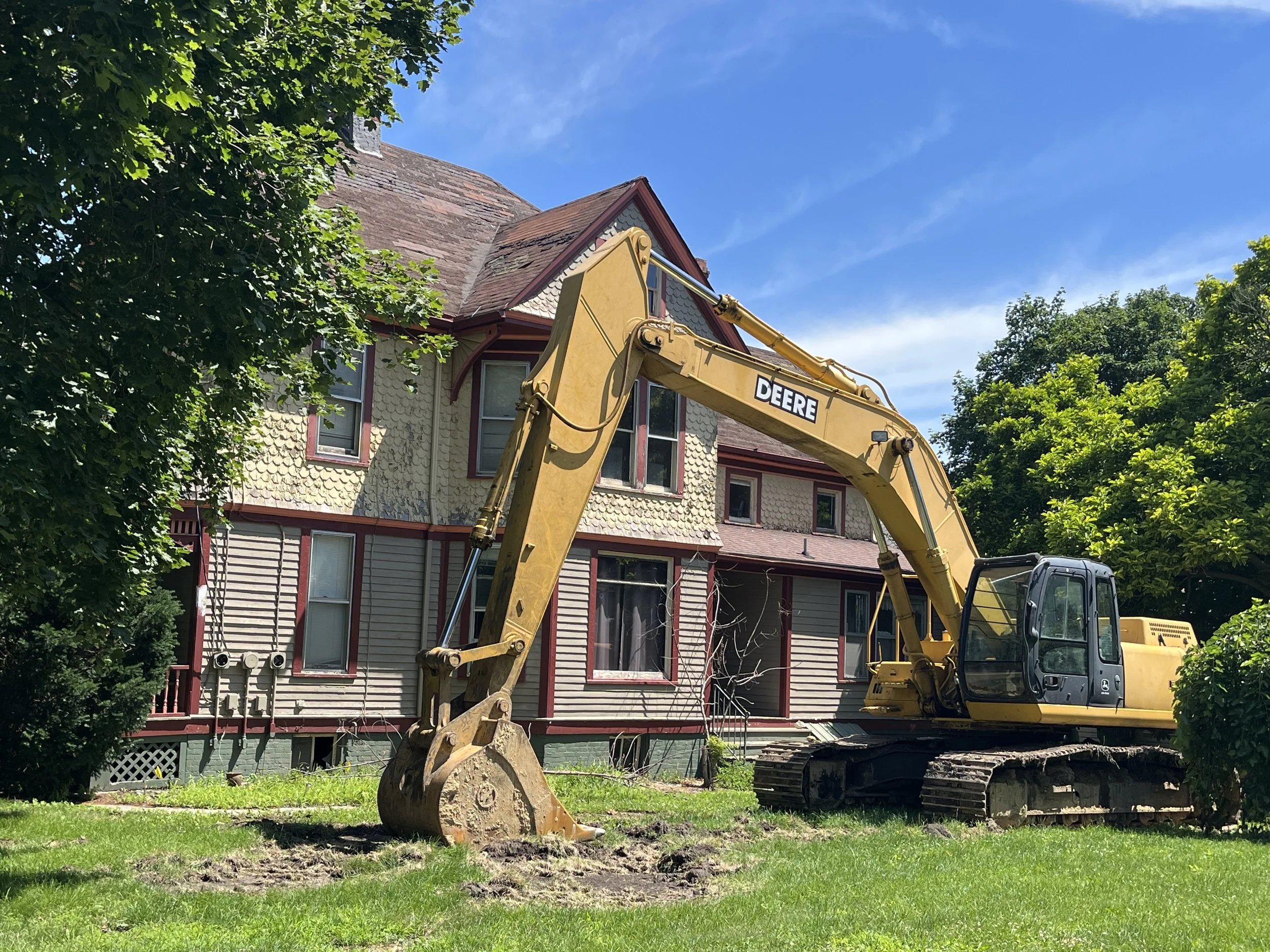
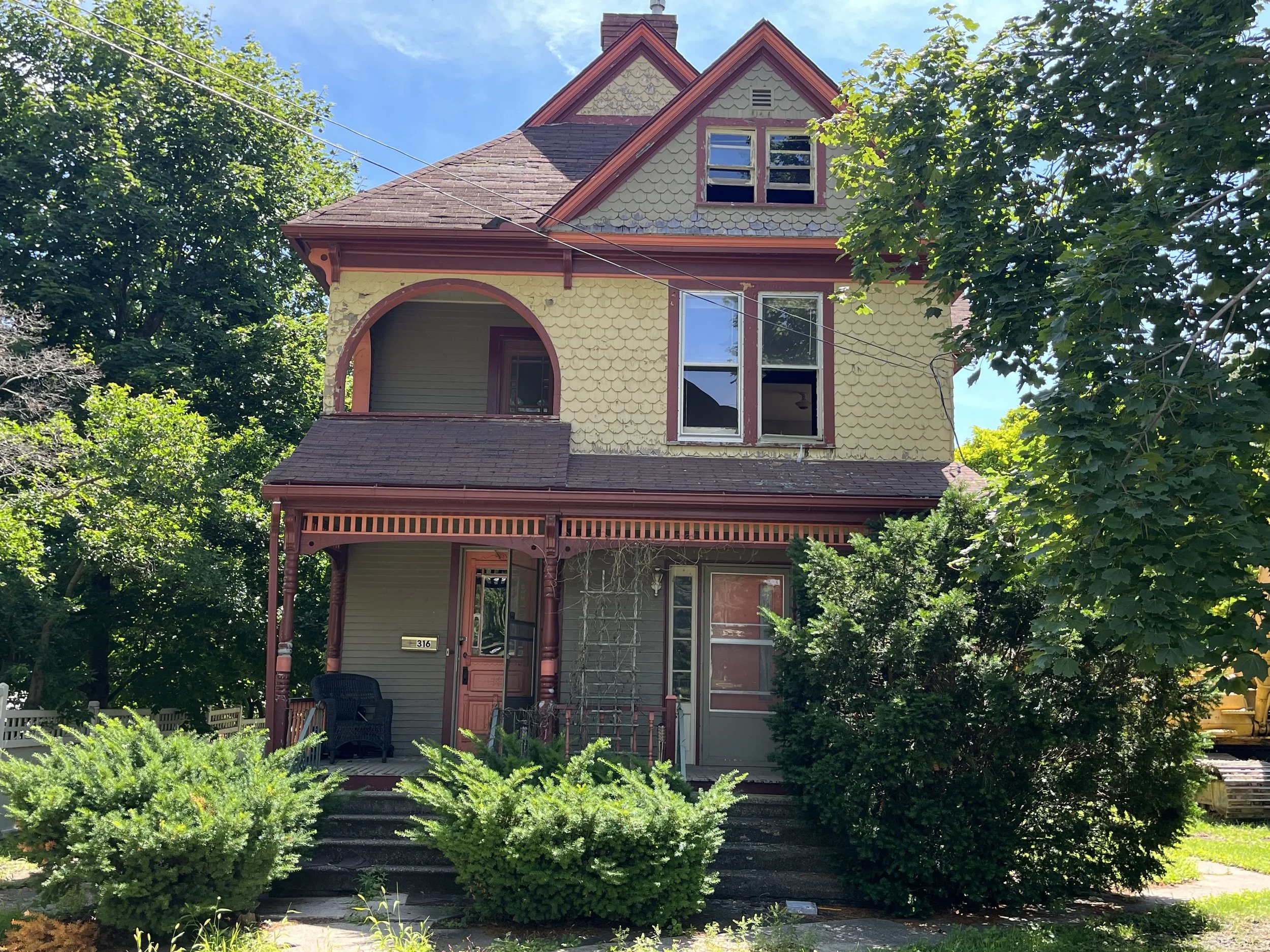
Three weeks ago, just before Geneseo’s music festival weekend, I drove down State Street—just past the city park, and I was shocked to see a large Deere excavating machine parked next to the Queen Anne Victorian home at 316 South State Street. After pulling over and observing more carefully, I saw the JULIE locater flags in the front yard, and I knew immediately what that meant. The house is going to be demolished. As of today, the house still stands.

It’s one of my favorite houses in Geneseo, situated adjacent from the city park and along the State Street boulevard in one of the most visible locations in town. It has unique architectural features, with an upstairs arched porch and Queen Anne details across the roofline of the downstairs porch, topped off with fish scale scallops on the upper levels of the home. For me, it’s very disappointing that one of the most iconic and historic Geneseo homes isn’t being restored. Does anyone else in Geneseo feel the same way?

I’m fully aware that the house has been neglected for many years. It was used as a duplex, and I know from the experience of once being a landlord that not all renters are good ones. It also needs a roof, new windows, and probably needs all new mechanicals, but the house doesn’t look hopeless. I don’t pretend to know all of the reasons why it is being demolished; there may be many. It looks structurally sound.

A quick search on Zillow has a description and pictures of the house from a 2019 listing. It has an intricate open stairway, a fireplace, original woodwork, hardwood floors, a pocket door, and stained glass. The description states that “It’s a rare opportunity to own a piece of preserved history.” The same Zillow listing also indicates that the home was sold in 2020.

Just a block south of the home is a sign on the boulevard that says, “Geneseo Historic District.” I don’t know exactly what that means in Geneseo, as several homes along State Street have been demolished in recent years, and this house is apparently going to be next. Geneseo used to proudly market itself as “Victorian Geneseo,” but I have not heard the town promoted in that way for a number of years.

Historic Preservation of our homes and downtown buildings draws residents and tourism to places like Geneseo. Restoring our older homes is an investment in our community and our future. It’s our architecture that often sets one community apart from another, especially in the Midwest. Instead of demolition, let’s respect the craftsmanship of those before us, and find solutions and the resources to help preserve these unique and historic homes.

-Marty Golby, Geneseo

Downtown Geneseo Sidewalk Sales Return July 24–25

Downtown Geneseo will transform into an open-air shopping destination July 24–25 as local businesses bring merchandise outdoors for two days of sidewalk sales, special promotions, pop-up vendors and live entertainment.

The annual event, organized by the Geneseo Chamber of Commerce, invites residents and visitors to spend the weekend exploring downtown while taking advantage of seasonal deals and discovering new businesses.

"Businesses around Geneseo are bringing their deals outside," said Chamber Executive Director Lindsie Akers. "Join us July 24 and 25 for sidewalk sales, special deals, pop-ups and more."

Several downtown businesses have already announced promotions for the weekend, including:

  • Pegasus Fine Gifts: Buy two sale items and get two free.

  • Four Seasons: Last Chance Consignment items for $5 each or three for $10.

  • Village Home Stores: Big Lighting Sale.

  • A Spotted Apron: 50% off clearance merchandise and 25% off storewide.

In addition to shopping, visitors can enjoy several special attractions throughout downtown. Anthology for Books will have its popular "Once Upon a Trailer" book trailer on site, while Gaslight Grocer & Wine Bar will host pop-up vendors Dragonfly Flower Farms and Leaf Livestock. Live patio music will also be offered at In-A-Godda-Da-Vida.

Additional participating businesses include Katsch Boutique, Village Florist, and Hayshaker's Grill & North Street Treats, along with other downtown merchants offering sidewalk displays and promotions throughout the weekend.

According to Akers, the event is designed to showcase everything that makes downtown Geneseo unique.

"Downtown Geneseo comes alive for a full weekend of sidewalk shopping, summer sales and community fun," she said. "Local businesses set up outside their storefronts with racks, tables and displays overflowing with deals—from clothing and gifts to home goods and seasonal finds."

She encourages shoppers to take their time exploring downtown.

"It is the perfect excuse to discover something new and support the small businesses that make Geneseo special," Akers said. "Grab a friend, bring the family and make a day of it."

The Sidewalk Sales will take place Friday and Saturday, July 24–25, throughout downtown Geneseo.