
State Street Newswire - August 31, 2026

Your Custom Text Here
Could the former Tyson Foods plant near Joslin find new life as a data center? A look at the site's acreage, industrial infrastructure, water use, power needs, taxes and redevelopment potential.
Read moreSee what Google and Facebook actually know about you, how they collect information from searches, websites, apps and advertisers, and how thousands of digital signals can build a detailed profile.
Read moreDolly Parton’s Imagination Library will continue following her passing, The Dollywood Foundation told community partners, reaffirming its commitment to providing free books to children and carrying forward Parton’s legacy of literacy and love of reading.
Read moreThe Geneseo Current is launching Breakfast with The Current, a casual community conversation Sept. 4 at Caffeine & Carbs in Geneseo.
Read moreAfter 24 years with the Geneseo Police Department, Jamison Weisser has been named deputy police chief. Learn about his career, policing priorities and new leadership role.
Read moreA preliminary plan for the proposed Seth Ernst Memorial Sports Complex provides a more detailed look at what could eventually be built on approximately 26 acres near Interstate 80 in Geneseo.
The concept, prepared by Hutchison Engineering and dated July 20, shows five irrigated soccer fields, pickleball courts, a playground, splash pad, concessions and restroom facilities, shelters and approximately 490 parking spaces.
The details follow Tuesday's presentation to the Geneseo City Council, when Dave and Betty Ernst discussed donating approximately 26 acres for the Seth Ernst Memorial Sports Complex. The property is located near I-80 and the city's wind turbines. No construction plan or city funding commitment was approved at that meeting.
The new details also provide an early estimate of the project's potential cost. Notes provided to The Current indicate the complex, as currently planned, is estimated at approximately $6 million to $7 million and is intended to be privately funded.
Soccer would occupy much of the proposed complex.
The preliminary plan shows three full-size, 74-by-120-yard soccer fields and two standard high-school-sized, 65-by-110-yard fields.
That aligns with the need organizers described to the council Tuesday. Ernst said 439 children are participating in Geneseo soccer this fall, and organizers have discussed the need for additional fields for close to a decade.
Richmond Hill currently provides park greenspace that is used for games, but organizers said space and parking can limit the size of tournaments Geneseo can accommodate. A larger complex near I-80 could potentially draw visiting teams and families while creating additional traffic for local restaurants, hotels, and businesses.
The preliminary plan goes beyond soccer.
It identifies pickleball courts near the west end of the property, along with a playground and splash pad farther into the complex.
Parking represents another substantial part of the concept.
Four parking areas shown on the preliminary plan contain a total of 490 spaces.
The concept includes a 50-by-110-foot concessions, restroom and equipment building, along with two 30-by-44-foot shelters with restrooms.
Developing the property would require significant infrastructure.
The preliminary plan includes the infrastructure needed to support the complex, including water service, stormwater drainage and septic systems.
Significant grading would also be required to prepare the property for development.
Plans also call for sidewalks, playing surfaces, maintained lawn areas and native grasses throughout the site.
One of the biggest issues still to be resolved is how vehicles would reach the complex.
The preliminary plan shows an access drive near the I-80/Illinois Route 82 area. Project notes identify the need for an Illinois Department of Transportation entrance from Route 82, with traffic analysis and additional studies among the next steps.
That expands on the access discussion at Tuesday's council meeting, when city officials said they would investigate right-of-way near the city's wind turbine property and determine whether an existing approach could potentially provide access.
Organizers plan to seek partnerships with local businesses and organizations as the project develops.
At Tuesday's meeting, organizers said contributions would be funneled through the nonprofit associated with the Seth Ernst Memorial Soccer Slam and used to pay project expenses.
The preliminary $6 million to $7 million figure is not an approved city expenditure, and the materials provided to The Current describe the project as privately funded in its current form.
For now, the concept provides a considerably clearer picture of the scale being considered: five soccer fields, nearly 500 parking spaces and several additional recreation amenities on a 26-acre site along the interstate — with access, infrastructure, private funding and community partnerships among the major pieces still to be worked out.
Credit and debit card fees aren't treated the same. Here's what consumers and businesses should know about surcharges, cash discounts and payment-network rules.
Read moreThe Tyson Foods plant in Joslin generated nearly $600,000 in property taxes for the 2025 tax year, with Riverdale schools receiving the largest share of the revenue.
Read moreHenry County has mental health resources, including counseling, medication management and crisis support, but residents needing specialized or inpatient psychiatric care often must leave the county. Local providers and law enforcement explain how the system works — and where gaps remain.
Read moreA proposed 26-acre sports complex near I-80, the Ford Road sanitary sewer project and the appointment of a new deputy police chief highlighted Geneseo City Council meetings Tuesday.
Read more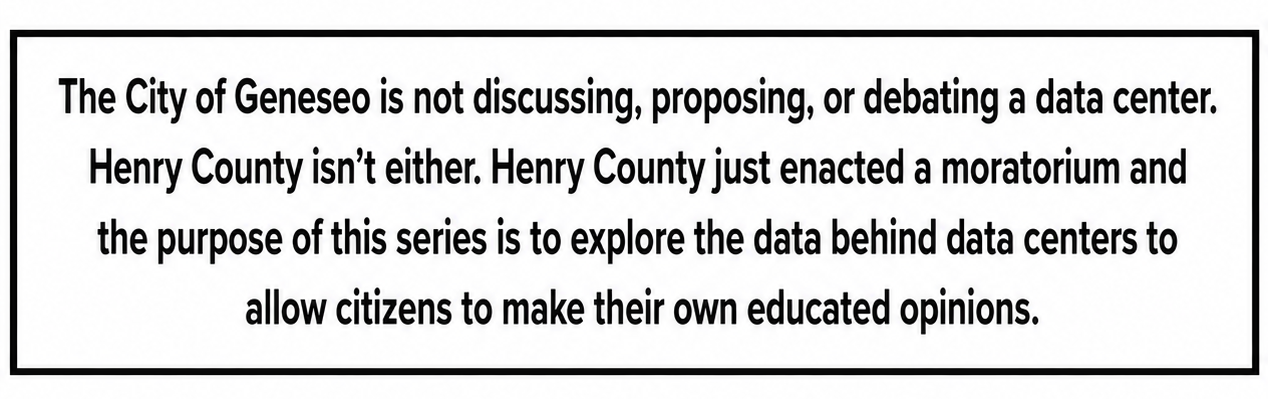
For the past two weeks, we've explored why data centers are being built at an unprecedented pace and examined the potential benefits and concerns they bring to the communities that host them.
Now the focus shifts to Henry County.
In June, the Henry County Board approved a 12-month moratorium on new data center projects. The decision wasn't intended to stop development permanently. Instead, county leaders chose to pause, gather information, and determine whether Henry County's current regulations are sufficient—or whether new rules should be in place before a proposal ever reaches the County Board.
Data centers are unlike most developments the county has considered in the past.
A new subdivision, manufacturing facility, or retail business each presents its own challenges. But modern data centers bring unique questions involving electricity, water, technology infrastructure, emergency response, and long-term land use.
Rather than waiting until an application arrives, county officials have opted to establish expectations in advance.
The goal is simple: create a fair, transparent process that protects the public while giving developers a clear understanding of the county's requirements.
One of the first decisions the county may need to make is where data centers could be built. Space needs range from 15-30 acres for a small facility, 30-150 acres for an average data center, and up to 150-500+ acres for “hyperscale” centers.
Throughout the Henry County moratorium, the board will be considering questions like:
Should they be limited to industrially zoned property?
Should they be located near existing electrical, utility, or stormwater infrastructure?
Should productive farmland receive additional protections?
Should minimum setbacks be required from homes, schools, parks, or other sensitive areas? Will any additional landscaping/ screening be required?
Are safeguards in place to protect farmland and our rural character?
The answers will shape not only whether a project is approved, but where one could realistically be proposed.
Modern data centers consume large amounts of power, and future facilities are expected to require even more as technology needs continues to expand.
Issues that are not properly addressed upfront can cause increased electricity bills:
need for new substations, transmission lines, or equipment
higher capacity requirements
stranded (abandoned) projects
increased wholesale prices due to increased demand
local grid updates
Addressing these issues prior to approval may involve:
an infrastructure payment agreement
a utility cost-impact study
separate utility rates so the data center pays its fair share (also known as a separate large-load rate treatment)
exit and stranded cost protections
agreed-upon expansion triggers
public reporting and accountability measures
third-party regulator reviews
While utilities ultimately determine whether power can be supplied, the county may require developers to document those plans before a project moves forward.
Not every data center uses the same cooling technology. Some rely primarily on outside air. Others use water-based cooling systems. Still others use hybrid designs that reduce water consumption while maintaining efficient operation. Water consumption ranges from as much as 5 million gallons daily to nearly zero, depending on the cooling system and the size of the facility.
Before considering a project, the county may want developers to identify:
Acceptable cooling systems
Estimated daily water use
The source of the water
Potential impacts on nearby water systems
Plans for drought conditions
Wastewater management
Maximum annual withdrawal and consumption caps
Water usage and monitoring measures
Unlike factories, data centers typically don't produce smoke or heavy truck traffic. They do, however, operate 24 hours a day. Cooling equipment, transformers, ventilation systems, and backup generators all create sound.
Many communities establish measurable noise standards instead of relying on subjective descriptions like "too loud."
Possible standards could address:
Maximum daytime noise
Maximum nighttime noise
Property-line measurements
Generator testing schedules
Required sound barriers or landscaping
Quieter equipment
Noise monitoring, complaint, and response plans
Clear standards provide certainty for both residents and developers.
Data centers contain sophisticated electrical equipment, backup power systems, batteries, and fire suppression systems.
Although these facilities are designed with multiple layers of safety, local emergency responders still need to have the tools and training to respond appropriately to potential emergencies.
County officials may ask:
What specialized training would responders need?
Would additional equipment be necessary?
How would emergency access be maintained?
What information should fire departments receive before construction?
These discussions often occur long before a building permit is issued.
A project of this size could affect roads, utilities, and other public infrastructure. Construction may require heavy equipment and frequent deliveries. Electrical service may require upgrades. Fiber-optic connections may need expansion.
One important question is who pays for those improvements. Many communities negotiate development agreements that clearly assign responsibility before construction begins.
County officials may formalize expectations regarding:
road repairs for wear and tear caused by construction traffic
upgrades to roads, bridges, and intersections
traffic control, signage, and safety measures
dust control and cleanup
construction hours
Data centers rely on backup generators to keep critical systems running during outages. When these generators run or are tested, they emit pollution, including:
nitrogen oxides
particulate matter
carbon monoxide
volatile organic compounds (VOCs)
carbon dioxide
other toxins including formaldehyde, benzene, and others
Limiting those pollutants or outlining expectations requires policies outlining:
generator testing schedules
generator maintenance runs
fuel used in generators
location relative to prevailing winds and nearby homes, schools, businesses
stack height and dispersion modeling
Data center generators are regulated as stationery engines under the Clean Air Act.
Supporters often point to the economic impact of data centers, while opponents often question whether those benefits justify the project's size and infrastructure needs.
Rather than relying on estimates or assumptions, the moratorium allows Henry County the opportunity to evaluate measurable information, including:
Expected property tax revenue
Potential tax incentives
Construction investment
Temporary construction jobs
Permanent employment
Local purchasing commitments
Infrastructure contributions
Long-term maintenance obligations
Looking beyond the headline investment number allows decision-makers to understand a project's overall impact on the community.
One of the biggest questions during the moratorium is whether the county's existing zoning regulations are enough.
Many communities have concluded that data centers deserve their own standards because of their unique infrastructure needs.
A future ordinance could address issues such as:
Appropriate zoning districts
Minimum lot size
Building height
Setbacks
Landscaping and screening
Noise limits
Water reporting
Utility documentation
Emergency response planning
Road-use agreements
Environmental requirements
Financial guarantees
Decommissioning plans if a facility eventually closes
The purpose of those standards wouldn't necessarily be to encourage or discourage development. Their purpose would be to ensure every proposal is evaluated using clear, consistent, and transparent criteria.
The decisions Henry County makes during this moratorium could shape how the county evaluates technology-related development for decades.
Strong regulations provide clarity for residents, developers, and elected officials alike. Poorly defined regulations can create uncertainty for everyone involved.
The coming months give Henry County an opportunity to ask difficult questions before difficult decisions have to be made.
Next in the series: How would a data center proposal actually move from concept to construction? In the final installment, we'll walk through the decision-making process, the roles of local, state, and utility partners, and how residents can participate as plans take shape.
Sources:
Illinois Department of Commerce & Economic Opportunity (DCEO)
U.S. Department of Energy – Powering America's AI Future: Data Center Resource Hub
JCE Co-op. Powering Growth, Keeping Members First. HI-LINES, August 2026.
JLL Research, North American Data Center Report 2024
Cushman & Wakefield- Data Center Landscape 2024
Uptime Institute- Data Center Industry Survey 2024
Five area license plate reader cameras remain in operation despite the Henry County Sheriff's Office decision to stop using its system. Here's who operates the cameras, where they're located and why the sheriff's decision doesn't affect them.
Read moreThe Rachel Clementz Memorial Scholarship Fund continues Rachel’s legacy of persistence through an Aug. 28 bowling fundraiser at Arcadia Family Fun Center.
Read moreStumphy’s Restaurant & Bar is preparing for a move, with plans to relocate from its current location at Sugar Maple Golf Club to a new space.
The restaurant hopes to have a new location selected by the end of this week. The Sugar Maple location will remain open until October.
The move does not mean Sugar Maple Golf Club is closing. The golf course will remain open and continue operating.
Stumphy’s currently employs 18 staff members, and minimizing the amount of time between locations is a priority as plans move forward.
A specific new location has not yet been announced. Though, The Current has confirmed that they will not be relocating within Geneseo.
The planned relocation marks a new chapter for Stumphy’s, which has operated from the clubhouse at Sugar Maple Golf Club outside Geneseo since April 2026. Once a location is finalized, additional information about the restaurant’s transition and reopening will be announced.
The Current will update this story as additional information becomes available.


The 2026 GHS Homecoming festivities will include a 60th anniversary celebration for the Maplettes, the high school dance team.
Read more