
The State Street construction project in Geneseo is nearing completion. The Ogden Avenue intersection is expected to reopen Aug. 12, with remaining work wrapping up by Aug. 21.
Read moreGeneseo Celebrates 20 Years of Trains, Planes & Automobiles
Three-day festival returns September 10–12 with classic cars, WWII aircraft, model trains, canal tours, food trucks and family fun
The Geneseo Chamber of Commerce is excited to announce the return of the 20th Annual Trains, Planes & Automobiles, taking place Thursday, September 10 through Saturday, September 12, 2026.
For twenty years, this unique festival has celebrated the machines that helped shape America's history while showcasing everything that makes Geneseo a great place to visit. From vintage aircraft and classic automobiles to operating model trains and historic canal tours, the three-day event offers something for visitors of every age.
The weekend culminates on Saturday with one of Illinois' premier classic car shows, hosted by the Maple City Cruisers, featuring hundreds of beautifully restored vehicles lining downtown Geneseo. Throughout the weekend, visitors can also enjoy food trucks, family activities, shopping, dining, and attractions throughout the community.
A longtime highlight of the festival is the VFW Salute to America on Saturday at noon. The patriotic ceremony features the VFW Color Guard, a tribute to our nation's veterans, and the crowd-favorite airplane flyover.
Event Highlights
Thursday, September 10
The festivities begin at Gen-Airpark with the annual Stearman Fly-In from 11:00 a.m. to 2:00 p.m. Visitors can experience the sights and sounds of authentic WWII-era Stearman biplanes as they arrive throughout the afternoon.
(No pets, please.)
Friday, September 11
Friday offers two unique experiences.
Guests can reserve a spot on the popular Cruise the Canal golf cart tours, exploring the history and engineering of the Hennepin Canal with guided tours departing at 9:00 a.m., 11:00 a.m., and 1:00 p.m. Reservations are required.
The Geneseo Model Railroaders will also host an Operating Model Train Display from 11:00 a.m. to 3:00 p.m. at 154 E. Exchange Street, giving visitors an up-close look at detailed model railroads in action.
The evening wraps up with the TPA Pre-Party, hosted by Erdman Construction, beginning at 5:00 p.m. It's the perfect opportunity to kick off the weekend with food, drinks, and great company before Saturday's festivities.
Saturday, September 12
Downtown Geneseo comes alive from 9:00 a.m. to 3:00 p.m. with the signature Trains, Planes & Automobiles celebration.
Highlights include:
Maple City Cruisers Car Show
Operating Model Train Display
Food Trucks
Youth Pedal Car Parade
VFW Salute to America with airplane flyover
Trophy presentations and Chamber 50/50 raffle drawing
Local shops, restaurants, and businesses will be open throughout the day, making it easy for visitors to spend the entire day exploring everything downtown Geneseo has to offer.
"The 20th anniversary is a special milestone for this event," said Lindsie Akers, Executive Director of the Geneseo Chamber of Commerce. "Trains, Planes & Automobiles brings together multiple community organizations, volunteers, and local businesses to create a weekend that's uniquely Geneseo. Whether you're a lifelong car enthusiast, fascinated by aviation or railroads, or simply looking for a fun family outing, there's something for everyone."
Admission to the festival is free, with the exception of the Cruise the Canal tours, which require advance registration and a ticket.
For a complete schedule of events and additional information, visit Geneseo.org/TPA or contact the Geneseo Chamber of Commerce at geneseo@geneseo.org
Video: State Street Newswire - August 4, 2026
Brought to you by:

McAvoy Couple Opens Gaslight Grocer and Wine Bar in Downtown Geneseo
Gaslight Grocer & Wine Bar in Geneseo has been a “labor of love” for Scott and Julia McAvoy.
Read moreVideo: State Street Newswire - August 3, 2026
Geneseo FFA Members Compete, Learn, and Lead Throughout July
Written by Hannah Wildemuth
VoAg Fair
On July 2, members had the opportunity to compete at the Section 3 Vocational Agriculture Fair at the Cambridge Fairgrounds. They competed in various livestock and crop areas.
Members showed their animals based on their conformation, overall balance, muscling, and the way they move. They also competed in showmanship classes where they were judged on their ability to handle, control, and present their animal. The crops were judged using a separate criteria of quality, cleanliness, maturity, and the condition of the crop. They had fun showing off their projects!
Horse Fair
Annabelle, Hannah, and Ashlynn competed at the Section 3 VoAg Horse Fair at Black Hawk East. They had the opportunity to show off how well they can execute patterns, the conformation of their horses, and how well they can perform different gaits.
They started the morning by showing their horses in halter classes, presenting their horse to be inspected by a judge on their conformation and the quality of their movement. Afterwards they competed in pattern classes where they performed different transitions, pivots, and the ability to effectively communicate with their horse. They were in pleasure classes where they had to smoothly transition from the walk, trot, and canter. They had a great day competing!
Leadership Camp
Henry, Lydia, and Ella had a fun week at the Illinois FFA Leadership Camp. They learned how to be an effective leader and how to better communicate with others.
They were put into groups for the week where they met FFA members from all around the state. They worked together in these groups to complete an obstacle course that taught them about how effective communication is essential when working in a team. These groups also competed in ag olympics that taught them how trust is important when working with others and how different leadership styles impact a team.
FFA coverage is proudly sponsored by Valley Insurance.

New to Podcasts? Here's How to Listen to The Geneseo Current
By Sarah DeMaranville
If you've never listened to a podcast before, you're not alone.
Many people hear the word "podcast" and assume it's complicated or that you have to pay for it. The good news? It's actually one of the easiest ways to stay informed—and it's completely free.
Whether you're driving to work, making breakfast, walking the dog, or mowing the lawn, you can listen to local news, community stories, and local history wherever you are.
Here's how to get started.
What Is a Podcast?
Think of a podcast as a radio show you can listen to whenever you want.
Instead of tuning in at a specific time, new episodes are automatically delivered to your phone.
The Geneseo Current offers several free podcasts, including:
State Street Newswire – A quick local news update each weekday morning.
Hidden History – Stories from Geneseo's fascinating past.
Sarah Says Things – A lighthearted look at everyday life.
If You Have an iPhone
Your iPhone already includes the Apple Podcasts app.
Open the Podcasts app.
Tap the Search icon.
Type Geneseo Current or the name of the show.
Tap the podcast.
Press Follow so new episodes automatically appear.
Tap any episode to start listening.
That's it!
If You Have an Android Phone
Most Android phones include a podcast app, but if yours doesn't, simply download Spotify from the Google Play Store.
Open Spotify.
Tap Search.
Type Geneseo Current or the name of the podcast.
Select the show.
Tap Follow.
Press Play on any episode.
You do not need a paid Spotify subscription to listen to podcasts.
Listening on Your Computer
You don't even need a phone.
Simply visit GeneseoCurrent.com, where podcast episodes are available directly on our website.
You can also visit Apple Podcasts or Spotify in your web browser and listen there.
Why Follow Instead of Just Listening?
Following a podcast means you'll never have to remember to look for new episodes.
Each new show automatically appears in your library.
It's free, takes just a few seconds, and you can stop following anytime.
Can I Listen in My Car?
Yes!
If your vehicle supports Apple CarPlay or Android Auto, your podcasts can play right through your vehicle's audio system.
Many newer vehicles also include Apple Podcasts or Spotify directly on the dashboard.
Do Podcasts Cost Anything?
No.
All Geneseo Current podcasts are completely free to listen to.
There are no subscriptions, no memberships, and no paywall.
Never Miss What's Happening
Whether you're interested in breaking local news, community events, local history, or cooking, podcasts make it easy to stay connected—even when you're too busy to read.
Simply open Apple Podcasts or Spotify, search for Geneseo Current, tap Follow, and we'll take it from there.
Pipe Organ Concert Planned in September
First Congregational United Church of Christ will host a public pipe organ concert titled "From Bach to Broadway!" featuring organist Freddy Allen on the "Mighty Moller" pipe organ.
Read moreInside Project Big River – Part 3: The Debate: Why Reasonable People Disagree About Carbon Sequestration
Over the past two installments of this series, we've explained how the proposed Big River–Lapis project would work and why Henry County officials are spending significant time discussing emergency planning and public safety.
That leaves one important question:
Why is carbon sequestration so controversial?
Unlike many public issues, this debate isn't simply between people who support economic development and people who oppose it.
Many of those involved—including elected officials, farmers, business leaders, emergency responders, environmental advocates, and nearby residents—agree on several basic goals: protecting public safety, supporting the local economy, and making informed decisions.
Where they differ is how they weigh the potential benefits against the potential risks.
Why supporters favor the project
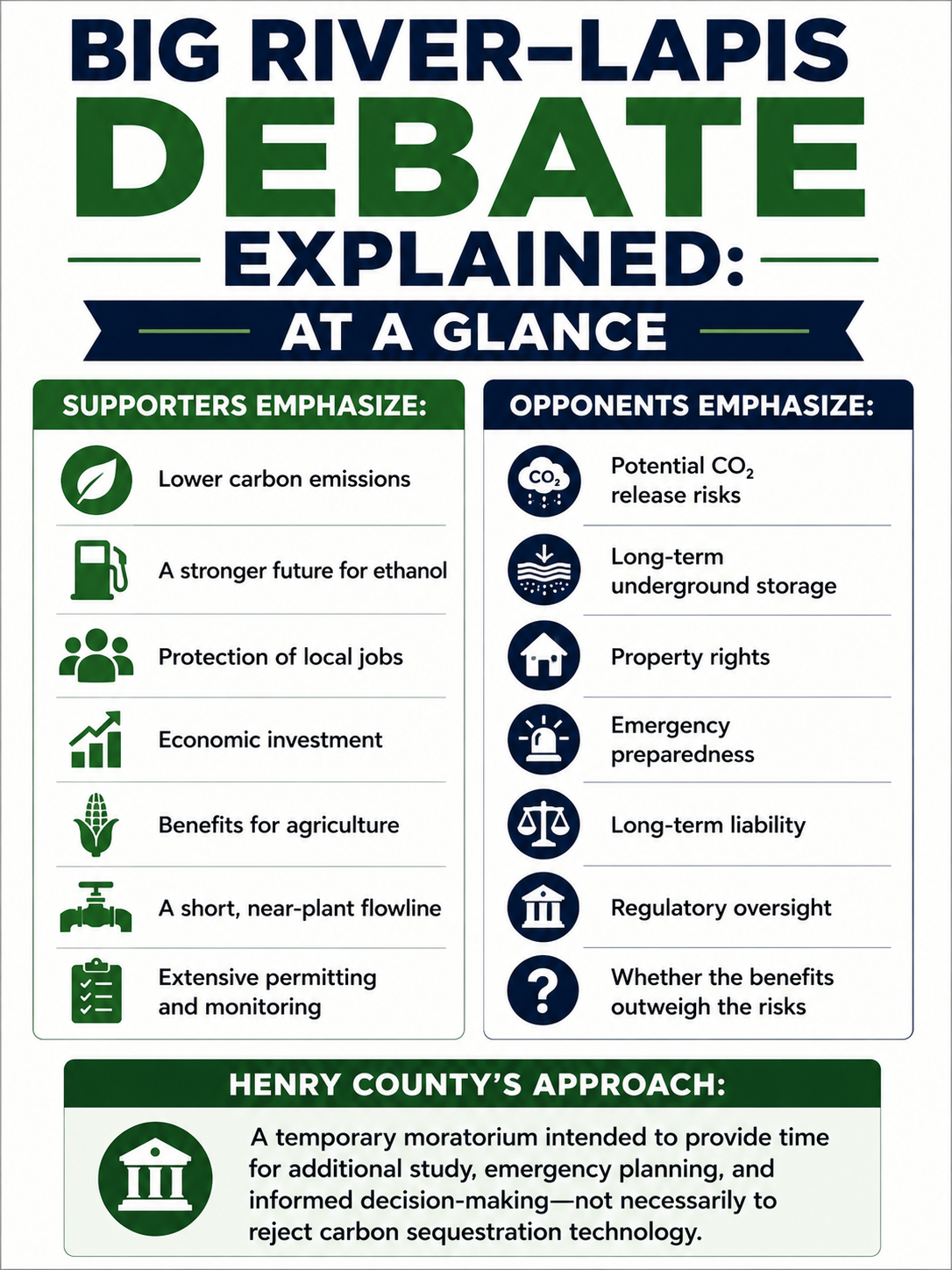
Supporters believe carbon sequestration can help both the local economy and the future of ethanol production.
Lower carbon emissions
Capturing carbon dioxide before it enters the atmosphere reduces the greenhouse gas emissions associated with ethanol production.
Supporters view carbon capture as one tool for lowering industrial emissions while allowing existing facilities to continue operating.
Keeping ethanol competitive
Fuel markets increasingly reward products with lower carbon intensity.
Supporters argue that reducing the carbon footprint of ethanol helps Illinois producers compete in those markets and positions the industry for long-term success.
Protecting local jobs
Big River Resources is a significant employer in the region.
Supporters say projects like this help ensure facilities remain economically viable, supporting both existing jobs and future employment opportunities.
Supporting agriculture
Illinois is one of the nation's leading corn-producing states.
A strong ethanol industry creates demand for locally grown corn, which supporters say benefits farmers, grain elevators, transportation companies, equipment dealers, and other agriculture-related businesses.
Attracting investment
Supporters believe carbon capture projects represent new private investment in rural communities.
Construction activity, engineering services, and long-term operation can generate additional economic activity.
A different type of project
Supporters also emphasize that Project Big River is not a long interstate pipeline.
Instead, it is designed as a near-plant project, with a flowline of less than one mile connecting the ethanol plant directly to the underground injection site.
They argue this substantially changes the project's risk profile compared to regional carbon dioxide pipeline networks.
Extensive permitting and monitoring
Before carbon injection could begin, the project must satisfy extensive federal and state permitting requirements.
Supporters point to ongoing geological studies, well construction standards, groundwater protections, pressure monitoring, financial assurance requirements, and long-term monitoring as evidence that multiple safeguards already exist.
Why opponents remain concerned
Opponents don't necessarily oppose every carbon capture project.
Many simply believe unanswered questions remain.
Carbon dioxide releases
The primary concern involves the possibility—however unlikely—of a significant carbon dioxide release.
Because CO₂ can displace oxygen, opponents want to better understand potential public safety impacts before projects move forward.
Long-term underground storage
Some residents question whether carbon dioxide can safely remain underground for decades or centuries.
While supporters point to extensive geological research, opponents say they would like more information about long-term monitoring and responsibility.
Property rights
Although Lapis has stated it does not anticipate using eminent domain for Project Big River's short flowline, some landowners remain concerned about how future carbon capture projects could affect property rights if additional infrastructure were proposed elsewhere.
Emergency preparedness
Many residents have asked whether local emergency responders have the training, equipment, and resources needed to respond to a carbon dioxide incident.
Those questions became more common following the 2020 Satartia, Mississippi pipeline rupture.
Long-term liability
Questions have also been raised about who would remain responsible for monitoring and maintaining underground storage sites years—or even decades—after injection ends.
Residents have asked who would bear responsibility if problems were ever identified in the future.
Government oversight
Some opponents believe additional local regulations may be necessary beyond existing federal and state permitting requirements.
Others believe current regulations are sufficient.
That difference of opinion has become one of the central questions facing county officials.
Do the benefits outweigh the risks?
Ultimately, much of the debate comes down to balancing potential economic benefits against potential public safety concerns.
Supporters believe the benefits justify moving forward under existing regulations.
Opponents believe additional study and local safeguards are appropriate before approving similar projects.
Why did Henry County approve a moratorium?
The County Board has repeatedly emphasized that the one-year moratorium should not be viewed as a permanent prohibition on carbon sequestration.
Instead, officials have described it as an opportunity to better understand the issue before additional projects move forward.
County leaders have said they want time to:
Gather additional technical information.
Develop comprehensive emergency response plans.
Review public safety considerations.
Study whether additional county regulations are appropriate.
Better understand how future projects could affect Henry County.
County Board Chair Kippy Breeden has said the Board's intent is to make informed decisions—not to reject the technology outright.
Whether additional county regulations are ultimately adopted remains to be seen.
What happens next?
The proposed Big River–Lapis project continues moving through the federal and state permitting process.
Meanwhile, Henry County officials are expected to continue reviewing technical information, coordinating with emergency management officials, and discussing whether additional local safeguards should be considered before the moratorium expires.
The conversations taking place over the next year may shape not only this project, but how Henry County approaches similar proposals in the future.
A final thought
Carbon sequestration is a complicated topic.
It combines agriculture, manufacturing, geology, engineering, environmental policy, emergency management, economics, and public safety.
Reasonable people can—and do—reach different conclusions about whether projects like Big River should move forward.
As the public discussion continues, understanding both the potential opportunities and the concerns allows residents to evaluate the project based on facts rather than assumptions.
That is ultimately the purpose of this series.
Geneseo Quilt Guild Ribbon Cutting at Smith Studio & Gallery
On Friday, August 7th at 4:30 there will be a ribbon cutting to honor this new creative gallery in Geneseo. This ribbon cutting will be conducted by the Geneseo Chamber of Commerce
Read moreThe Current Launches State Street Newswire, a New Daily Local News Briefing
Start your mornings informed with State Street Newswire, The Geneseo Current's new weekday local news briefing. Launching August 3, each episode delivers the top local headlines, events, and community updates in about three minutes and is available by 5:30 a.m. every weekday, making it the fastest way to catch up on what matters most in Geneseo.
Read more2026 Girl Scout Day at Cole Cabin
Geneseo Girl Scout Service Unit 886 held their 16th Girl Scout Day Camp at Cole Cabin, Geneseo, IL on June 22-26, 2026.
Read moreGeneseo Church League Tournament Set for Aug. 10–12 at Richmond Hill
The Geneseo Church League will conclude its season with a free, double-elimination softball tournament at Richmond Hill Park on Aug. 10–12. Featuring nine church teams from Geneseo, Erie, and Hampton, the community is invited to enjoy three evenings of softball, fellowship, and concessions while cheering on local players.
Read moreSmith Twins Both in Summer Baseball Internships
The Smith twins, Addison and Easton, have internships in sports this summer, Addison Smith at the Field of Dreams in Dyersville, Iowa, and her twin brother, Easton, is with the Waterloo Bucks.
Read moreFinancial Scams Targeting Seniors: How to Recognize and Avoid Them
Learn how to recognize and avoid financial scams targeting seniors, including Medicare, romance, impersonation, and investment fraud, with expert tips and local resources.
Read moreSchool Transportation Costs Continue to Rise as State Aid Covers Only Half the Bill
by Sarah DeMaranville
Every school day, Geneseo CUSD #228 buses travel hundreds of miles transporting students to and from school, athletic events and extracurricular activities. While the State of Illinois helps pay for those services, district financial records show that state funding covers only about half of the district's transportation costs—leaving local taxpayers to make up the difference.
A review of Geneseo's recent Annual Financial Reports and budget documents shows that transportation expenses have continued to rise in recent years, while the state's contribution has remained relatively flat as a share of total costs.
State aid covers about half of transportation expenses
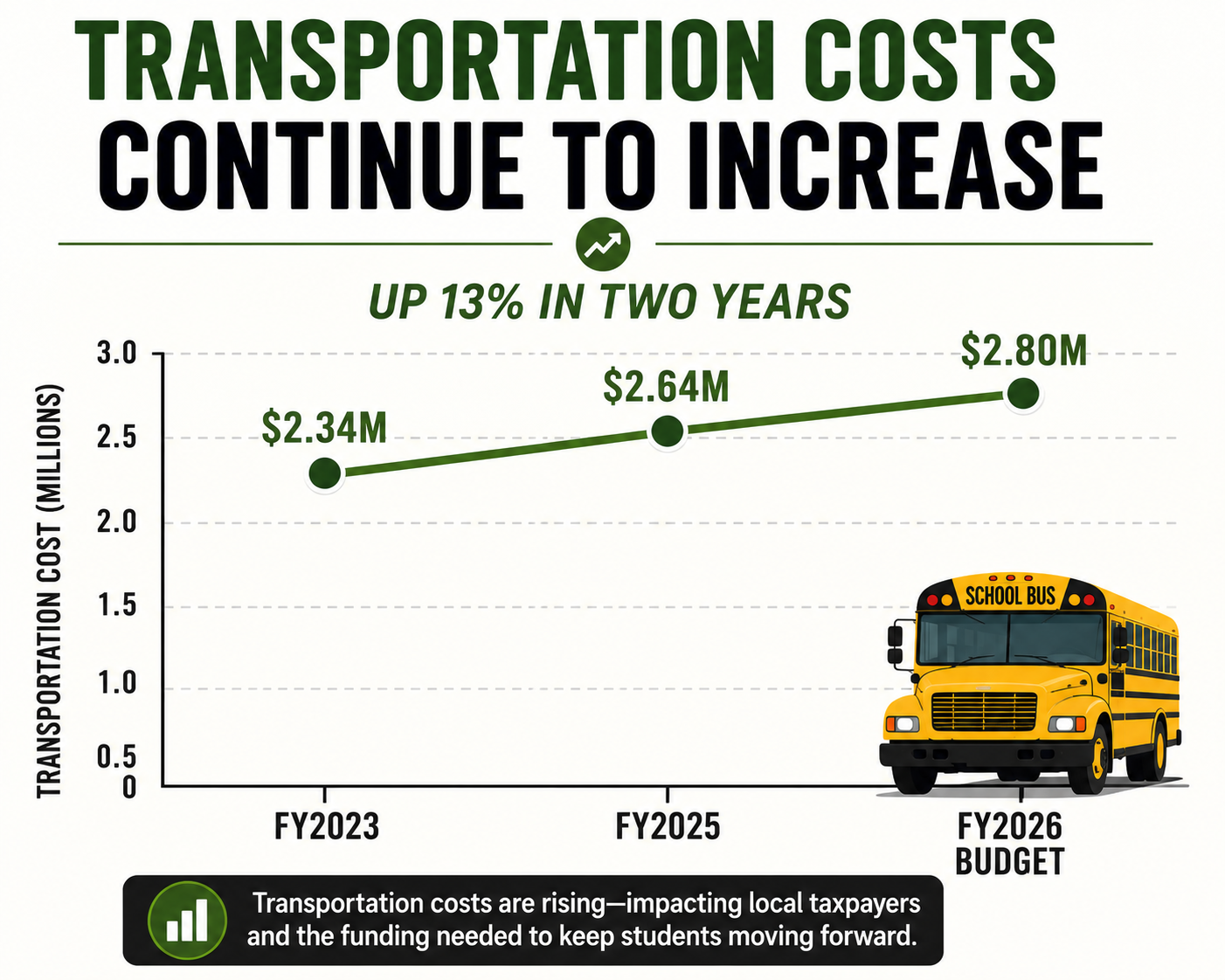
According to the district's FY2025 Annual Financial Report, Geneseo received approximately $1.37 million in state transportation aid while spending nearly $2.64 million operating its Transportation Fund.
That means state transportation aid covered approximately 51.7% of transportation expenditures.
The previous year tells a similar story.
In FY2023, the district received about $1.21 million in transportation aid while spending $2.34 million, with state funding covering approximately 51.9% of transportation costs.
While state funding increased in dollar amounts between FY2023 and FY2025, transportation expenses increased at nearly the same pace. As a result, the state's share of overall transportation costs remained essentially unchanged.
Costs continue to rise
Transportation has become one of the district's steadily growing operational expenses.
Between FY2023 and FY2025:
Transportation expenditures increased from $2.34 million to $2.64 million, an increase of approximately 13.2%.
State transportation aid increased from $1.21 million to $1.37 million, an increase of approximately 12.7%.
The district has also approved higher transportation contract costs for the current school year, citing increases in route costs, mileage and extracurricular transportation.
For FY2026, the district projects approximately $2.8 million in transportation expenditures.
Transportation fund projected to operate at a deficit
Budget projections show the Transportation Fund is expected to continue facing financial pressure.
For FY2026, the district projects:
Transportation Fund revenue: approximately $2.36 million
Transportation expenditures: approximately $2.80 million
That leaves a projected operating deficit of approximately $437,000.
Even when accounting for all Transportation Fund revenue—including state aid, local property taxes and other revenue—the district expects expenditures to exceed available revenue.
The Transportation Fund also operated at deficits in previous years, including approximately $255,000 in FY2023 and $243,000 in FY2025.
A long-standing concern
District officials have warned about transportation funding for years.
In its FY2017 budget document, Geneseo noted that Illinois was reimbursing districts for only about 71 to 72 percent of their calculated transportation entitlement, estimating that the district was losing roughly $300,000 annually because state appropriations did not fully fund the statutory formula.
The district cautioned at the time that Transportation Fund balances were expected to continue declining because of the reduced reimbursement.
Although today's funding calculations differ from that earlier entitlement measure, the district's financial records continue to show that transportation remains a significant local budget challenge.
Why it matters
Unlike many other budget areas, student transportation is largely unavoidable.
School buses must continue operating regardless of fluctuations in diesel fuel prices, labor costs, vehicle maintenance expenses or bus replacement costs.
When transportation costs rise faster than available revenue, districts must rely more heavily on local resources or existing fund balances to continue providing the same level of service.
For Geneseo taxpayers, the district's financial reports illustrate an ongoing reality: while the State of Illinois remains an important funding partner, local revenue continues to play a substantial role in ensuring students can safely travel to and from school each day.
Sources
Geneseo CUSD #228 FY2025 Annual Financial Report
Geneseo CUSD #228 FY2023 Annual Financial Report — Full Version
Geneseo CUSD #228 FY2026 Budget Cash Summary
Geneseo CUSD #228 2024 Tax Levy and Financial Projections Presentation
Geneseo CUSD #228 FY2017 Budget Document
Pinks’ Bus Service Transportation Contract Proposal for the 2026–27 School Year
Geneseo CUSD #228 May 2026 Board Materials
Henry County Democrats Ice Cream Social is Aug. 11
The Henry County Democrats ice cream social from 5 to 7 p.m. on Tuesday, Aug. 11, in Geneseo City Park.
Read moreGeneseo Weighs Future of Aging Wind Turbine After Generator Failure
A failed generator on one of Geneseo's two municipal wind turbines has prompted city officials to begin what could become one of the most significant energy infrastructure decisions the City has faced in years.
Rather than asking the City Council to choose a course of action immediately, Electric Director Eric Rowold used Tuesday night's Committee of the Whole meeting to outline the condition of Wind Turbine No. 1, explain the financial implications of several possible paths forward, and begin framing what will likely be months of analysis before a final recommendation is made.
The discussion centered on a question that extends well beyond replacing a broken generator: Should the City invest in extending the life of a 17-year-old turbine, retire it altogether, or pursue an entirely different approach to local power generation?
Generator Failure Raises Bigger Questions
Wind Turbine No. 1 is approximately 17 years old and was originally designed with a 20-year life expectancy, although Rowold said it may be possible to extend that lifespan to 25 or even 30 years.
Doing so, however, would require much more than simply replacing the failed generator.
"We need to look at the structural concerns," Rowold said.
That includes evaluating:
the foundation and tower,
the blades,
the main bearing,
the pitch system,
the yaw system,
the electrical system,
the braking system, and
numerous other components that have experienced nearly two decades of wear.
Rowold noted that replacing only the generator could expose the City to another expensive repair if another major component fails shortly afterward.
"You could change a generator today and have blade bearing failure tomorrow," he said.
Aging Equipment Creates New Challenges
One of the largest concerns discussed Tuesday wasn't simply age—it was parts availability.
Rowold explained that although the manufacturer still supports the turbine model, newer versions have replaced Geneseo's equipment.
As a result:
replacement parts are becoming harder to source,
fewer technicians specialize in older models,
European parts must meet U.S. certification requirements before installation,
and international shipping, tariffs and customs delays have increased uncertainty.
"The longer that we go with the wind turbine, the more we're going to have troubles sourcing some of those parts," Rowold said.
What the Turbine Produces
Despite its age, Wind Turbine No. 1 remains an important part of the City's electric system.
According to Rowold, the turbine produces roughly:
3 million kilowatt-hours annually
about $420,000 worth of electricity each year
approximately 5 to 6 percent of the City's total energy needs.
If the turbine remains offline, purchasing that same electricity from MISO would increase annual costs by roughly $150,000, although Rowold noted market prices fluctuate significantly.
He also emphasized another benefit of locally generated power.
"When you're looking at $420,000, that energy is produced locally, there's no fuel being burnt and we're not paying transmission," he said.
Insurance Covers Much—But Not Everything
Replacing the generator is expected to cost approximately $955,161, according to estimates from Vestas USA and West Engineering.
The City's insurance carrier has already approved approximately $855,161, leaving the City responsible for a $100,000 deductible.
Officials are also awaiting a separate business interruption claim worth approximately $50,000 for lost electrical production while the turbine remains offline.
Even if the City proceeds, replacement won't happen quickly.
Rowold said delivery of a new generator is currently estimated at eight to ten months, with supply chain disruptions continuing to affect availability. The replacement generator would carry a three-year warranty.
Could Solar Replace It?
Council members asked whether expanding the City's solar array might eliminate the need to repair the turbine.
Rowold said replacing the turbine's production with solar would be difficult.
The City currently operates roughly one megawatt of solar generation on about five acres.
Replacing the turbine's output would require roughly three additional megawatts.
"You would have to cover every inch of that ground," Rowold said, noting the site's rolling terrain and reduced winter sunlight also limit production.
While additional solar could be added, he said it would not fully replace the turbine's output by itself.
"Do You Revive the Dead Duck?"
Council members spent much of the discussion weighing the long-term value of investing additional money into aging equipment.
Councilmember Martin Rothschild summarized the dilemma with a memorable analogy.
"The biggest thing is that we have a dead duck sitting there," Rothschild said. "Do you revive the dead duck or do you just put him to rest? That's the ultimate question."
Rowold stressed that he is not advocating for either outcome.
Instead, he said staff is trying to understand the full condition of the turbine before recommending whether replacing the generator makes financial sense.
"I am not," Rowold replied when asked if he wanted to abandon the turbine. "I am only showing you what the concerns are."
Decommissioning Remains an Option
If the City decides not to repair the turbine, removing it would also come with significant costs.
Rowold said preliminary estimates place decommissioning at approximately $214,000.
That proposal would involve cutting the tower down rather than dismantling it piece by piece.
The estimate includes:
removing and recycling the tower,
removing the generator,
disposing of the blades,
site cleanup,
but does not include removing the concrete foundation, which would remain underground.
Wind Turbine No. 2 Also Nearing End of Design Life
The discussion also highlighted that Wind Turbine No. 2 will soon face many of the same questions.
Although it continues operating, Rowold said both turbines are approaching the end of their original design life.
Earlier this year, the City hired consultants to begin evaluating long-term options, including:
extending turbine life,
repowering with newer equipment,
decommissioning,
and broader electric system planning.
That planning effort originally focused on the City's electric plant and distribution system but has expanded following the unexpected generator failure.
No Decision Yet
No action was requested Tuesday.
Instead, council members directed staff to continue gathering information, including updated repair estimates and long-term financial projections comparing the costs of repairing, replacing or retiring the turbine.
Rowold said those future presentations will examine projected revenues, maintenance costs and purchased power expenses over roughly the next 25 years before any recommendation is brought forward for council consideration.
Passenger Rail Project Gains Momentum
"It's not if, it's when."
That was the message Denise Bulat, executive director of the Bi-State Regional Commission, shared with the Geneseo City Council Tuesday evening as she updated members on the long-discussed Chicago-to-Quad Cities passenger rail project.
Closing her presentation, Bulat told council members she believes "there's a light at the end of the train tunnel," pointing to recent state funding commitments and renewed regional collaboration as signs the project is moving closer to reality.
Bulat's presentation before the Committee of the Whole was intended to provide historical context and an update on where the project stands today. No action was requested from the Council.
More Than Two Decades in the Making
Bulat reminded council members that major transportation projects often require decades of planning, engineering, environmental review, and funding before construction begins.
She said the Amtrak feasibility study alone took about 10 years to complete after work began in the late 1990s. Drawing on her own experience, Bulat compared the project to the new Interstate 74 bridge between Moline and Bettendorf.
"I was working on the I-74 bridge project since 1994," she said, noting that construction was not completed until 2021.
"Transportation takes a long time," Bulat said.
Funding Picture Has Improved
While acknowledging that one hurdle remains, Bulat said the project's financial outlook is significantly stronger than it was just a year ago.
She explained that the Illinois General Assembly approved more than $400 million in gap funding during last year's veto session, providing the money needed for the project to continue moving forward.
The remaining issue is an extension of approximately $78 million in federal funding through the Federal Railroad Administration. Illinois Department of Transportation officials are seeking that extension, and Bulat said indications remain positive.
"They now have the money they need to continue to proceed on this project," she told council members.
According to the meeting packet, IDOT officials were unable to attend Tuesday's meeting because the federal funding request is still pending but plan to present to the Council once the process is complete.
Questions About Local Benefits
Councilmember Craig Arnold asked whether studies have examined how passenger rail affects smaller communities.
Bulat said she was not aware of research specific to communities like Geneseo but pointed to several potential benefits.
She said the proposed station would provide Henry County residents with a convenient place to park and travel to Chicago without driving downtown. She also suggested passenger rail could make Geneseo more attractive to professionals who work in Chicago but prefer living in a smaller community.
Bulat noted that officials in Moline have discussed similar possibilities, including retaining Illinois residents whose work requires frequent trips to Chicago.
She also emphasized that reliable service is key, noting current planning calls for two daily round trips between the Quad Cities and Chicago with a travel time of roughly three hours and 15 minutes.
That schedule, she said, would allow business travelers to work on the train instead of spending hours behind the wheel or searching for parking in downtown Chicago.
Council Reflects on Years of Planning
Councilmember Keith Kennett, who has been involved with the project since Geneseo first pursued a station, reflected on the City's early participation.
Kennett recalled traveling with former City Administrator Tracy Koteki to meetings with Amtrak and the Illinois Department of Transportation, where they met officials from communities that either had passenger rail service or were working to obtain it.
He also described taking the train from Princeton to Chicago several times and meeting commuters who lived in Princeton while working in Chicago.
"I don't think it's going to double our population," Kennett said, "but I think it is something to be aware of. That's kind of an intangible asset of having that."
Kennett also said he believes the project lost several years of momentum after state funding was withdrawn during a previous administration before eventually being restored. He acknowledged residents' frustration with the lengthy timeline but said he believes the project is now closer than it has been in years.
"The game isn't over," Kennett said. "We're in the late innings."
Questions About the City's Commitment
Councilmember Brett Barnhart questioned how long Geneseo should continue reserving land for a station if the project experiences additional delays.
Bulat responded that she expects IDOT and project leaders, including former Illinois Deputy Secretary of Transportation Doug House, to provide updated timelines once the federal funding issue is resolved. She said communities would be informed if circumstances changed significantly but emphasized that project leaders remain focused on moving forward.
"Moline already built their station," Bulat said. "Everyone is working really hard toward getting this."
"It's not if, it's when," she said. "There's a light at the end of the train tunnel."
Mayor Sean Johnson thanked Bulat for the presentation, saying council members regularly receive questions from residents about passenger rail.
"We're just a hungry community for answers," Johnson said. He added that the historical overview, resolutions, and planning milestones discussed during the presentation would help council members better answer those questions in the future.
City Council Discusses Passenger Rail, Wind Turbines, Noise Ordinance During Busy Meeting
Passenger rail, the future of the City's aging wind turbines, proposed changes to the construction noise ordinance, and downtown façade improvements were among the topics discussed during Tuesday's Committee of the Whole and Special City Council meetings.
The Committee of the Whole opened with a historical overview of the proposed Chicago-to-Quad Cities passenger rail project and the potential Geneseo station. Denise Bulat, executive director of the Bi-State Regional Commission, reviewed the project's history, current federal funding status, and next steps while answering questions from council members about the project's future and the City's continued commitment to the proposed station location. No action was taken.
See more about Bulat’s presentation and the Council discussion here.
Council members then received an update on Wind Turbine No. 1 after the failure of one of its generators. Electric Director Chris Rowold outlined the turbine's current condition, expected remaining lifespan, replacement costs, insurance considerations, and repair challenges. The discussion served as the beginning of what officials described as a broader conversation about the City's long-term options for its wind energy infrastructure.
See more about the wind turbine discussion here.
The Committee also unanimously recommended approval of a façade improvement grant for Katsch Boutique, 113 N. State St. The project includes exterior repairs, repainting, a new awning, and updated storefront improvements. The recommendation now moves to the City Council for final approval.
During public comment, Hammond-Henry Hospital CEO Wyatt Brieser invited City officials to participate in the hospital's strategic planning process as the organization prepares to celebrate its 125th anniversary.
Following the Committee of the Whole meeting, the City Council convened a Special Meeting to vote on an amendment to the City's noise ordinance. The change allows construction projects with City-issued building permits to begin work at 6 a.m. between June 1 and Sept. 30 while maintaining the existing 7 a.m. start time during the remainder of the year. The proposal was introduced in response to recent resident complaints while recognizing the challenges contractors face working during extreme summer heat.
Council members discussed several aspects of the proposal, including weather-related exceptions, enforcement, and how the ordinance would apply to different types of construction projects. The Council voted to approve the amendment, with only Councilman Barnhart voting against the change.
The meeting concluded with the Council entering executive session to discuss pending or probable litigation.
