Geneseo CUSD #228 reviewed its tentative FY27 budget, including a $975,805 Education Fund deficit, rising healthcare costs, declining enrollment and long-term plans to strengthen the district’s financial position.
Read moreFrom Geneseo to the Big Ten Network: Zach Mackey Takes Next Step in Broadcasting Career
Geneseo native Zach Mackey is joining the Big Ten Network in a full-time play-by-play role, bringing his broadcasting career back to the conference where it began.
Read moreThe Future of Data Centers in Henry County, Part 1
Why Does the World Suddenly Need So Many Data Centers?
If you've followed recent discussions at the Henry County Board, you've probably heard the term data center more times in the past few months than ever before.
Communities across Illinois—and across the country—are being approached about the possibility of hosting large data centers. Though there is no proposed project at the moment, Henry County will be no exception. County leaders recently approved a temporary moratorium to give themselves time to study the issue, learn more about the industry, and determine what regulations, if any, should be in place before considering future projects.
But before asking whether a data center belongs in Henry County, there's an even more basic question worth answering:
Why does the world suddenly need so many of them?
The Internet Has to Live Somewhere
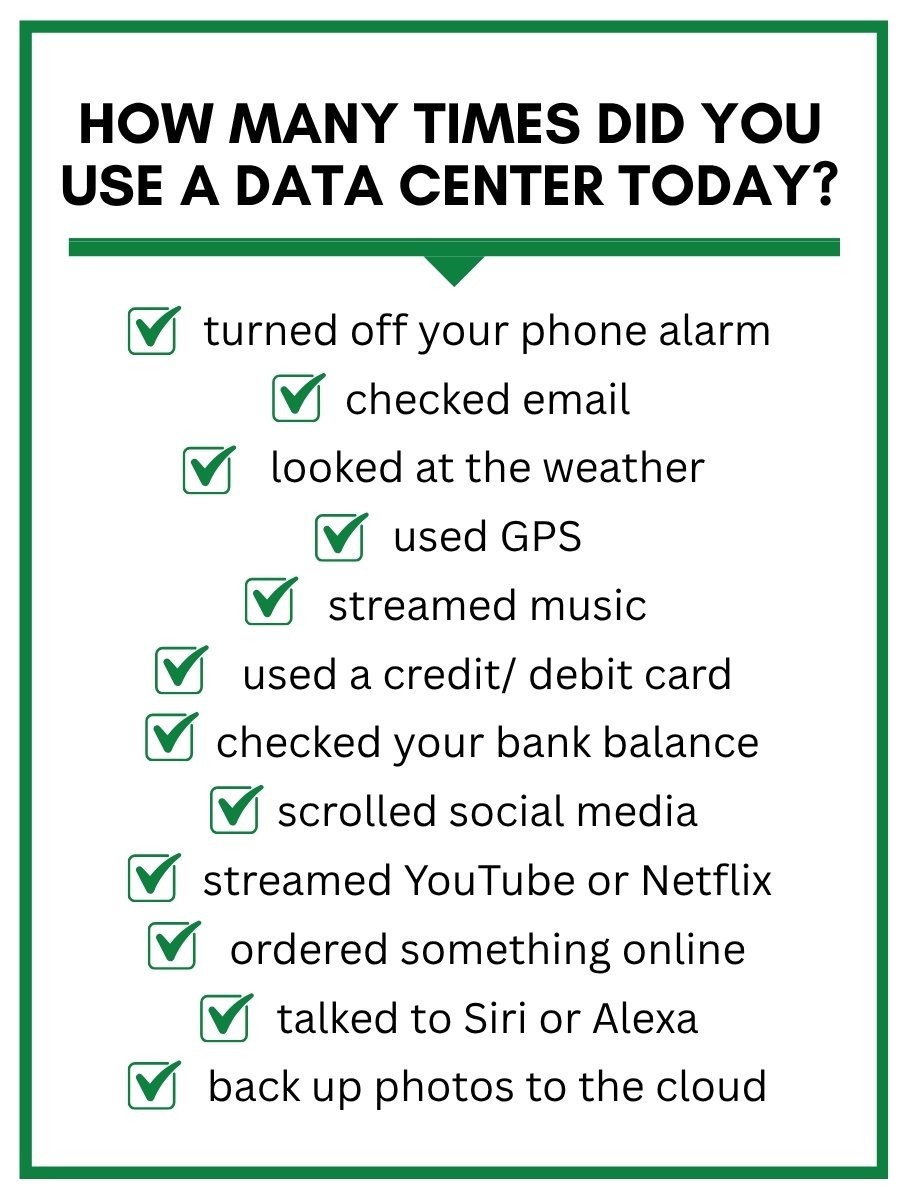
It's easy to think of the internet as something that exists "in the cloud." In reality, every email, every online purchase, every Netflix movie, every Google search, every Facebook photo, and every AI conversation is processed by physical computers located inside secure buildings known as data centers. The fact that you’re reading this right now is due to data centers.
Imagine a warehouse—but instead of storing boxes, it stores thousands upon thousands of powerful computers. Those computers work around the clock to store information, process requests, and keep the digital services we rely on running every second of every day.
Most of us interact with data centers dozens—if not hundreds—of times each day without realizing it.
That description isn't just theoretical. In its August 2026 member newsletter, JCE Co-op described data centers as "the physical backbone of many services we use every day," citing online banking, medical records, school systems, farm technology, local business software, weather tools, emergency communications, streaming services and artificial intelligence as examples of services that depend on them.
Why Are We Building More Now?
Data centers aren't new. The internet has depended on them for decades.
What has changed is how much computing power the modern world demands.
Twenty years ago, most people used the internet to browse websites and send email.
Then came smartphones.
Then streaming movies and music.
Then cloud computing, where businesses began storing files and running software online instead of on office computers.
Then remote work and virtual meetings.
Now comes artificial intelligence.
Each wave has dramatically increased the amount of information that must be stored, transmitted, and processed. AI is the latest jump.
Why AI Is Different
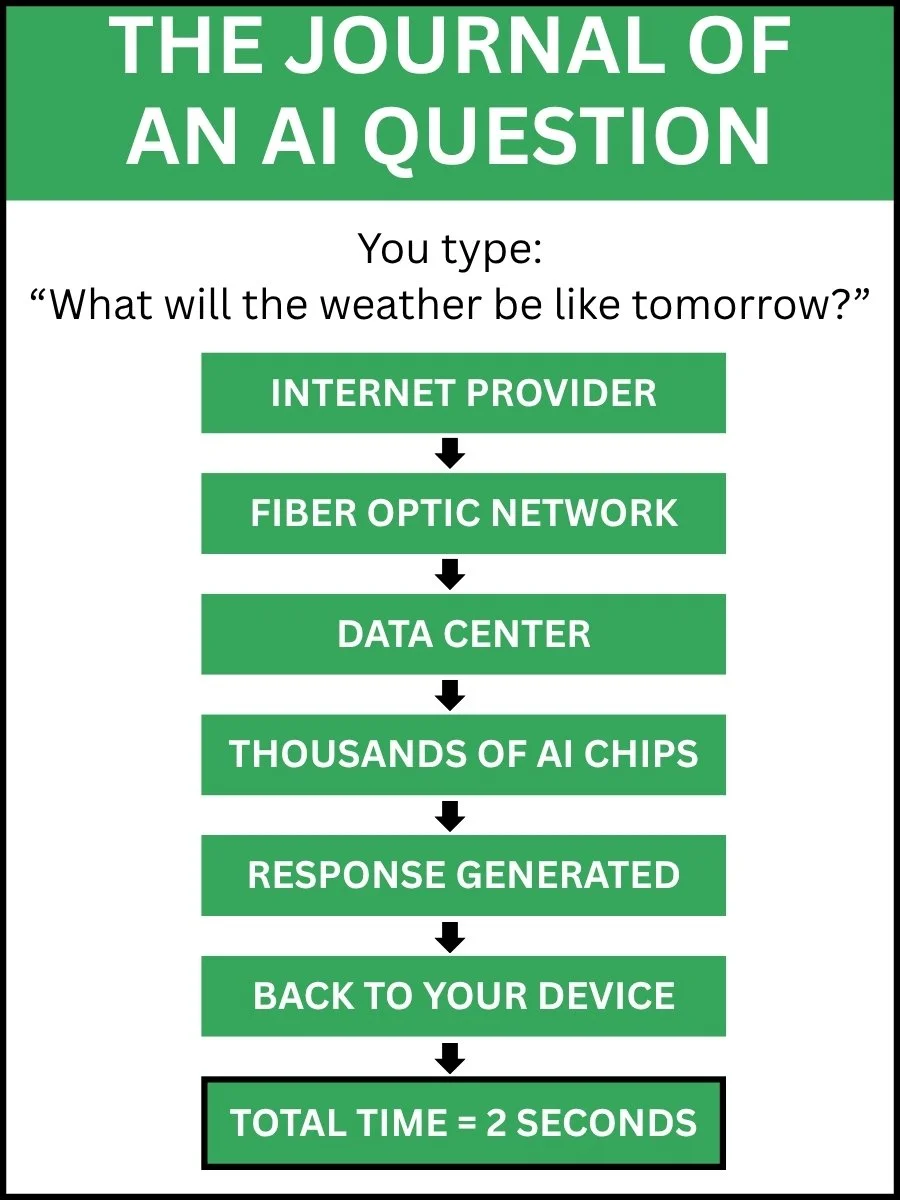
Traditional internet activity is relatively straightforward. You search for a restaurant. You stream a song. You check your bank balance. It’s a simple match of your query to indexed keywords or transmission of data.
Artificial intelligence works differently.
Instead of simply retrieving existing information, AI systems analyze enormous amounts of data to generate text, create images, write computer code, summarize documents, answer questions, and perform increasingly complex multi-step tasks in real time.
That requires enormous computing power.
While the exact amount varies depending on the task and the technology involved, AI workloads can require substantially more computing resources than many traditional internet searches. Multiply that by millions of users around the world, and the need for additional computing capacity grows quickly.
Why Not Use the Data Centers We Already Have?
Many existing facilities were designed years ago for different kinds of workloads.
Today's AI servers consume more electricity, generate more heat, and require more advanced cooling systems than many previous generations of computer equipment.
Some existing facilities can be upgraded. Others cannot.
In many cases, companies find it more practical to build entirely new facilities designed specifically for modern computing needs.
Why Are Companies Looking Beyond Major Cities?
If demand is growing so quickly, why not simply build more facilities in Chicago or other major metropolitan areas?
The answer often comes down to infrastructure.
Large data centers require vast amounts of electricity, extensive fiber-optic connectivity, hundreds of acres of land, and room to expand over time. In some areas, suitable sites are increasingly difficult or expensive to develop.
As a result, companies are looking beyond traditional technology hubs and evaluating communities that have the land, infrastructure, and long-term potential to support these projects.
That has placed more rural communities—including some in Illinois—into conversations that would have seemed unlikely just a few years ago.
Why Henry County?
That naturally leads to the next question.
What characteristics make Henry County attractive—or not attractive—for a project like this?
Does the county have the electrical infrastructure?
Is there enough available land?
How important are fiber-optic networks?
What role do local zoning regulations play?
And perhaps most importantly, what would a data center actually mean for the people who live here?
Those are the questions we'll begin exploring in the next installment of this series.
Next in the series: Data centers promise jobs, tax revenue, and economic investment—but they also require land, power, and infrastructure. In Part 2, we'll examine the potential benefits and challenges communities consider before approving a data center.
The goal of this series isn't to persuade readers that data centers are good or bad. It's to provide the information needed to have an informed conversation.
Sources:
U.S. Department of Energy – Data Centers and Servers
Uptime Institute – Data Center Fundamentals
Uptime Institute – Research & Reports
U.S. General Services Administration – Cloud Basics (NIST-based)
JCE Co-op, "Powering Growth, Keeping Members First," HI-LINES, August 2026.
Geneseo Council Weighs Wind Turbine Repairs, Flock Camera Concerns as City Projects Move Forward
Geneseo City Council discusses wind turbine repairs and potential electric cost impacts, Flock camera privacy concerns, infrastructure projects and other city updates from its Aug. 11 meeting.
Read moreGeneseo Couple Hopes Hometown Support Can Carry Them to ‘America’s Favorite Couple’ Quarterfinals
For Miranda and Kyle, home has rarely been tied to one place.
The professional actors and musicians have spent much of their 11-year relationship traveling the country for theater work, living in cities including Denver and Chicago and, for a time, taking their home with them while traveling full-time in a converted Ford Transit van.
Now, their travels have brought them somewhere Miranda knows especially well: back to Geneseo and into the house where she grew up.
And this week, the couple is hoping their hometown will help carry them a little farther in another journey — the nationwide America’s Favorite Couple competition.
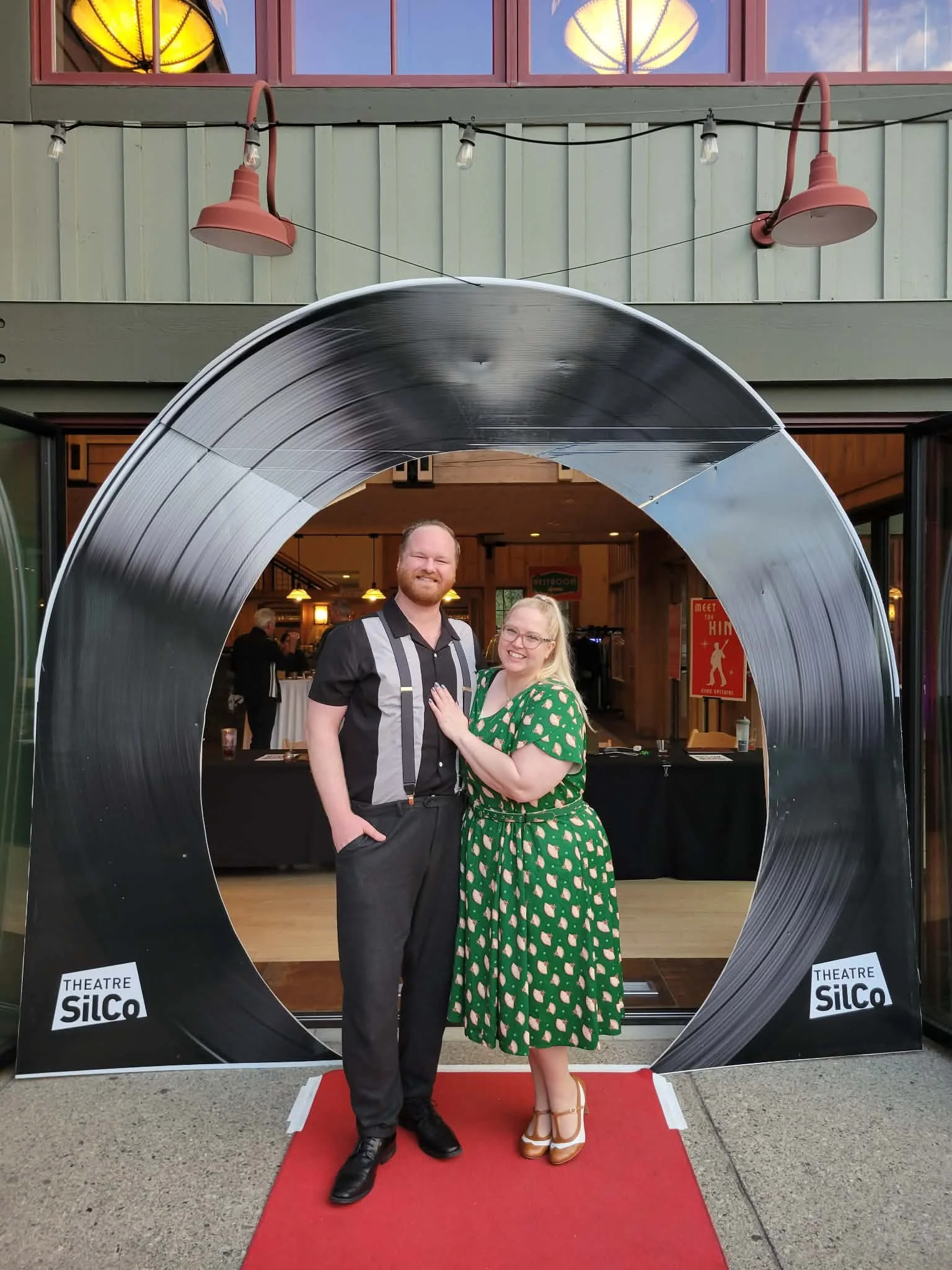
Miranda Lipes and Kyle Lahr
As of Tuesday evening, Miranda and Kyle were ranked third in their competition group. Only the first-place couple automatically advances from the Group Finals to the Quarterfinals, with voting in the current round ending Thursday, Aug. 13, at 9 p.m. Central.
For Miranda, returning to Geneseo wasn't necessarily part of the plan.
After living in Denver beginning in 2017, the couple briefly moved to Moline in 2021 before embracing full-time travel. Kyle's work eventually brought them back to Illinois and Chicago in 2024.
Then, as they considered settling down again, a longtime Geneseo family friend contacted Miranda with some unexpected news: her childhood home was for sale.
“How many chances do you get to buy back your childhood home?” Miranda said.
They decided to take the opportunity.
Returning has allowed Miranda to see the community differently than she did growing up.
“When I was younger, I wanted to see what else the world had to offer,” she said. “I felt like I needed to get out, take some risks, and try some new things.”
She still wants to follow those dreams, she said, but now appreciates having Geneseo as the place they return to — particularly knowing the house will remain in her family lineage.
“The traditions, the friendliness, the camaraderie,” Miranda said. “It literally feels magical to live here, sometimes.”
A Love Story Built on Music — and the Road
Miranda and Kyle's story began in 2015 while both were working at a summer stock theater in Meredith, New Hampshire.
Miranda was splitting her time between stage management and playing trumpet in the pit orchestra. Kyle was playing electric and upright bass.
The musical connection helped bring them together, although Kyle remembers another moment particularly well: watching Miranda show off her hula-hooping skills in a Dollar General.
They spent the summer together before their contracts sent them in different directions. A few months later, Miranda traveled to Maryland to meet Kyle, and following a date at the National Zoo, they officially became a couple.
They've been navigating the unpredictable life of working performers together ever since.
Their careers have included periods of long-distance work, frequent travel and the constant process of auditioning and searching for the next job.
More recently, they've increasingly found opportunities to perform together.
Among their favorite shared experiences have been productions centered on Buddy Holly, with Miranda acting and performing keyboard and trumpet while Kyle played bass as one of Buddy Holly's Crickets.
They have also begun working together on camera, including a commercial filmed in St. Louis and advertisements recorded as a duo.
For Kyle, life in regional theater can mean rehearsing from 10 a.m. to 6 p.m. for nearly two weeks, followed by 12-hour technical rehearsals and then performances several days each week.
“And part of every job is looking for the next job,” he said.
A Second Shot at the Competition
This isn't Miranda and Kyle's first attempt at becoming America's Favorite Couple.
They entered the competition during its inaugural year in 2025, when they were placed in a group of approximately 75 couples. They reached the Top 10 in their group before being eliminated prior to the Top Five.
They decided to try again in 2026 — and this time they've made it farther.
“I think what's surprised me the most about the experience is how kind everyone has been,” Miranda said. “The other competitors are very humble, very sweet, and really just want to shout their love story from the rooftops.”
America's Favorite Couple is operated by Colossal Management as a fundraising campaign on behalf of Action Initiative Team, a 501(c)(3) public charity. Donations generated through the competition benefit the Los Angeles Regional Food Bank and ocean conservation organization Oceana. Voters may cast one free vote every 24 hours, while additional votes can be obtained through donations.
The competition raised nearly $4 million during its 2025 campaign, according to Colossal. The Los Angeles Regional Food Bank reported receiving more than $1.9 million from that campaign for hunger-relief efforts.
The Push to Thursday
For Miranda and Kyle, the immediate goal is simple: get from third place to first.
The Group Finals conclude Thursday. First-place finishers advance to the Quarterfinals, scheduled for Aug. 17-27. Couples finishing second receive another opportunity through a Wildcard Round Aug. 14-16. The Semifinals follow Aug. 28-Sept. 3, with the Finals scheduled for Sept. 4-10.
The eventual winning couple will receive $20,000, a photoshoot and advertorial telling their story in Variety, and a Hollywood dinner experience with Jeff and Emilie Goldblum and Charlie Day and Mary Elizabeth Ellis.
For two working actors and musicians, the Hollywood experience has obvious appeal.
But the $20,000 would serve a considerably more practical purpose back in Geneseo.
Their childhood-home-turned-new-home needs work.
“We have to install new floors and windows and it would make a world of difference,” the couple wrote on their competition profile.
And should their story eventually make it into the pages of Variety, Miranda said they'd be happy to bring a little piece of Geneseo along for the ride.
For now, however, they're focused on Thursday.
“Thanks for those who have already been voting,” Kyle said. “We can see your names pop up when you submit a vote — we really appreciate you for that.”
Voting for the Group Finals ends Thursday, Aug. 13, at 9 p.m. Central.
Readers can view Miranda and Kyle's story and vote through their official competition profile:
What Do School Registration Fees Actually Pay For?
What do Geneseo school registration fees actually pay for? A look at District 228’s 2026–27 fees, how the money is used, and the $11,880 cost of non-resident tuition.
Read moreHow is the Park District Funded?
See how the Geneseo Park District is funded, where its money goes, and how property taxes, memberships, fees, grants and donations support local parks, facilities and recreation.
Read moreState of Geneseo: Cost of Living
By Sarah DeMaranville
Whether you're buying your first home, relocating for work, or deciding where to raise a family, one question usually comes first:
Can I afford to live there?
The answer is more complicated than looking at home prices alone.
Housing is often the largest household expense, but it's only one piece of the financial picture. Household income, mortgage costs, rent, utilities, transportation, taxes, and employment opportunities all influence what it actually costs to live in a community.
To better understand how Geneseo compares with neighboring communities, The Geneseo Current examined data from the U.S. Census Bureau's 2020–2024 American Community Survey.
Housing: Geneseo Costs More Up Front
The biggest difference between Geneseo, Princeton and Kewanee is housing.
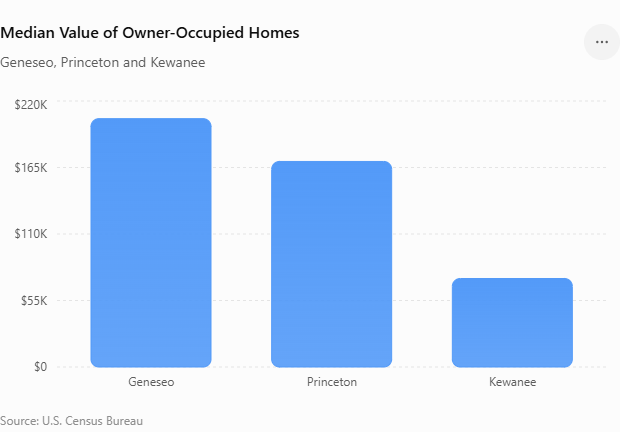
According to the Census Bureau, the median value of an owner-occupied home is:
Geneseo $205,400
Princeton $170,000
Kewanee $73,200
A home in Geneseo is worth nearly three times as much as the typical owner-occupied home in Kewanee.
At first glance, that may make Geneseo seem significantly less affordable.
But economists often view home values as a reflection of something else: demand.
Communities with strong schools, stable employment, desirable neighborhoods, and healthy local economies generally command higher home prices because more people want to live there.
Monthly Mortgage Costs
The Census also estimates what homeowners spend each month.
For homes with a mortgage, the median monthly owner cost is:
Geneseo: $1,688
Kewanee: $1,089
For homeowners without a mortgage, the median monthly housing cost is:
Geneseo: $685
Kewanee: $477
Those figures include expenses such as property taxes, insurance and utilities that are typically included in the Census definition of owner costs.
Renting
Rent follows a similar pattern.
Median monthly gross rent is:
Geneseo: $1,015
Kewanee: $797
That's a difference of more than $2,600 per year for the typical renter.
Princeton generally falls between the two communities on both home values and rental costs.
Higher Costs—But Higher Incomes
Housing tells only half the story.
The other half is income.
Median household income is:
Geneseo $70,147
Princeton $61,900
Kewanee $50,900
In other words, Geneseo households earn roughly 38% more than Kewanee households on average.
Higher incomes help offset higher housing costs.
That's why economists generally evaluate housing affordability rather than simply asking whether homes are expensive.
Homeownership
Another indicator of community stability is homeownership.
According to the Census:
76.3% of Geneseo homes are owner-occupied.
69.2% of Kewanee homes are owner-occupied.
Higher homeownership often corresponds with longer-term residency, greater neighborhood investment, and increased civic participation, although it isn't a measure of quality by itself.
Electricity Costs
Electricity is one area where Geneseo residents appear to have a cost advantage compared with state and national averages.
Geneseo operates its own municipal electric utility. Under the city's 2026 residential rate schedule, customers pay 10.829¢ per kilowatt-hour for the first 500 kWh and 10.294¢ for usage above 500 kWh, plus a $25 monthly basic charge.
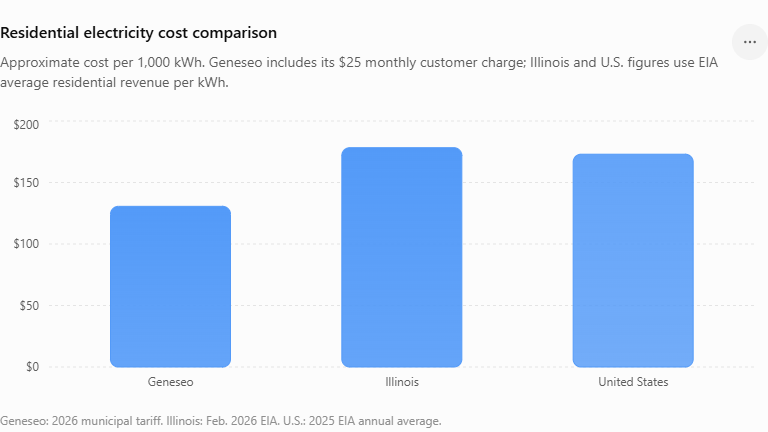
For a household using 1,000 kWh in a month, that translates to approximately $130.62 before applicable taxes, or an effective rate of about 13.06 cents per kWh when the monthly basic charge is included.
For comparison, the most recent finalized annual data from the U.S. Energy Information Administration puts Illinois' 2024 residential average at 15.87¢ per kWh. The national residential average increased to 17.30¢ per kWh in 2025.
More recent monthly data show Illinois residential electricity averaging 17.83¢ per kWh in February 2026, although monthly rates fluctuate and shouldn't be directly compared with a full-year national average.
The comparison isn't perfectly apples-to-apples. Geneseo's figure is calculated from its published rate schedule, while EIA averages represent total residential utility revenue divided by electricity sold and therefore incorporate the various costs customers actually pay. Still, the figures indicate that electricity is one household expense where Geneseo residents generally pay less than broader Illinois and national benchmarks.
It's About More Than Price
If affordability were based solely on home prices, Kewanee would clearly have the advantage.
But lower housing costs don't necessarily mean a community is less expensive overall.
Communities with lower home values often also have lower household incomes, fewer employment opportunities, or slower housing demand.
Geneseo's higher housing costs are accompanied by:
Higher household incomes
Higher educational attainment
Lower poverty
Higher homeownership
Stable population
Those characteristics generally increase demand for housing, which in turn pushes home values higher.
So, Is Geneseo More Expensive?
Yes—but the answer deserves context.
Buying or renting a home in Geneseo will generally cost more than in Kewanee and somewhat more than in Princeton.
However, residents also tend to earn more, and the community has historically maintained stronger home values.
For some buyers, Kewanee's lower home prices may make homeownership easier to achieve.
Others may find Geneseo's combination of schools, employment opportunities, healthcare, and community amenities worth paying more for.
Ultimately, "affordable" isn't just about the purchase price of a house.
It's about what residents earn, what they receive in return, and whether a community offers the quality of life they're looking for.
Sources:
U.S. Census Bureau — American Community Survey —
U.S. Census Bureau QuickFactsU.S. Energy Information Administration (EIA) —
U.S. Energy Information Administration — Electricity DataCity of Geneseo Public Records
Council for Community and Economic Research (C2ER) — C2ER Cost of Living Index
U.S. Bureau of Labor Statistics (BLS) — U.S. Bureau of Labor Statistics
About the State of Geneseo Series
State of Geneseo is an ongoing Geneseo Current series examining the data behind our community. Each installment explores a different aspect of life in Geneseo—from housing and affordability to schools, healthcare, infrastructure, business growth, parks, volunteerism, and local government—to better understand what makes a healthy small town thrive and where opportunities for improvement may exist.
Red Barn Harvest Fest Aims to Become Geneseo's Newest Fall Tradition
By Sarah DeMaranville
There's something about harvest season that feels like home.
The changing leaves. Crisp autumn air. Pumpkins and mums lining front porches. Warm drinks in hand. Time spent with family.
For Ashley Marshall, those memories stretch back to her childhood growing up on a family farm, where autumn meant riding in the combine with her dad, helping drive grain carts, and watching another harvest come to life.
Now, she's turning those memories into a brand-new community tradition.
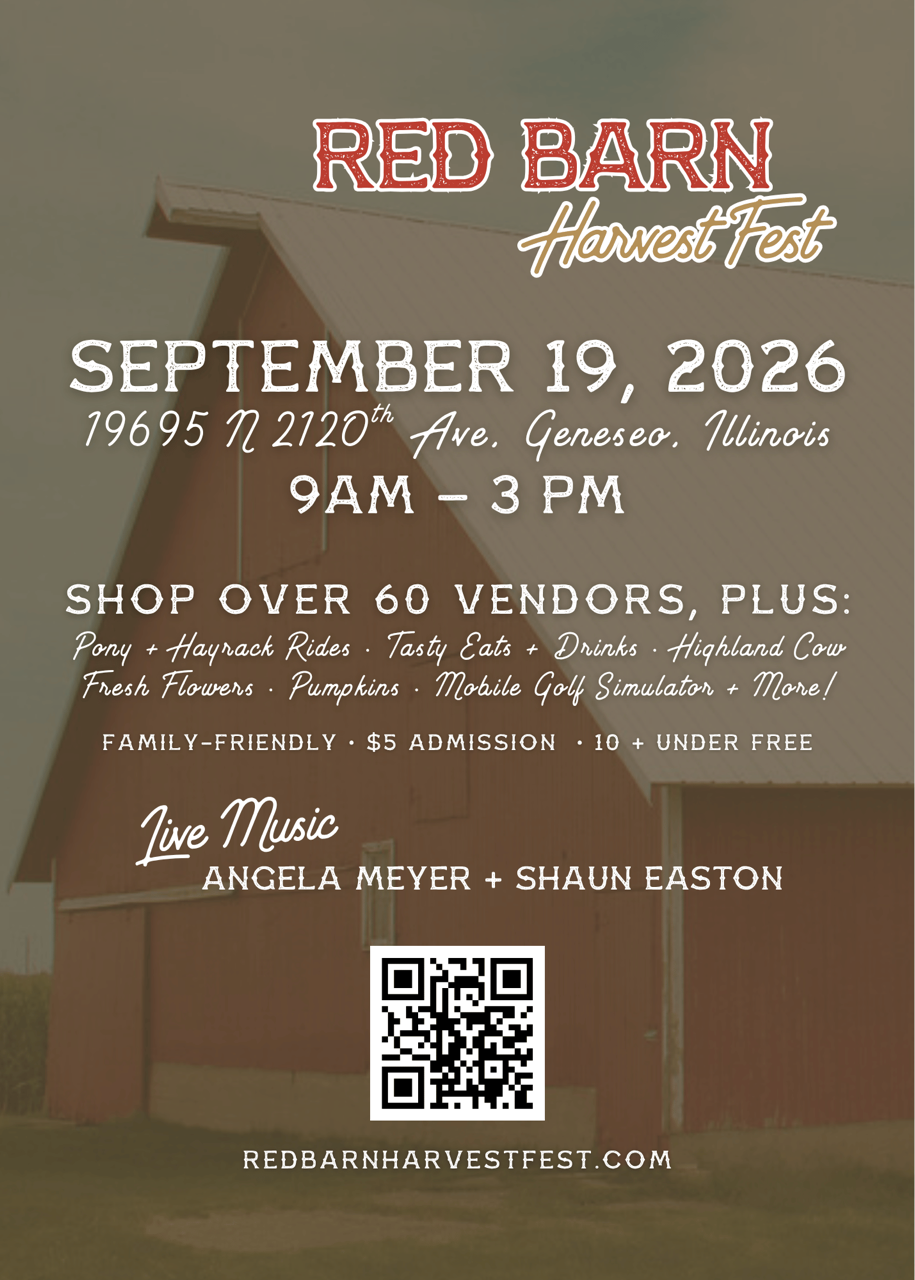
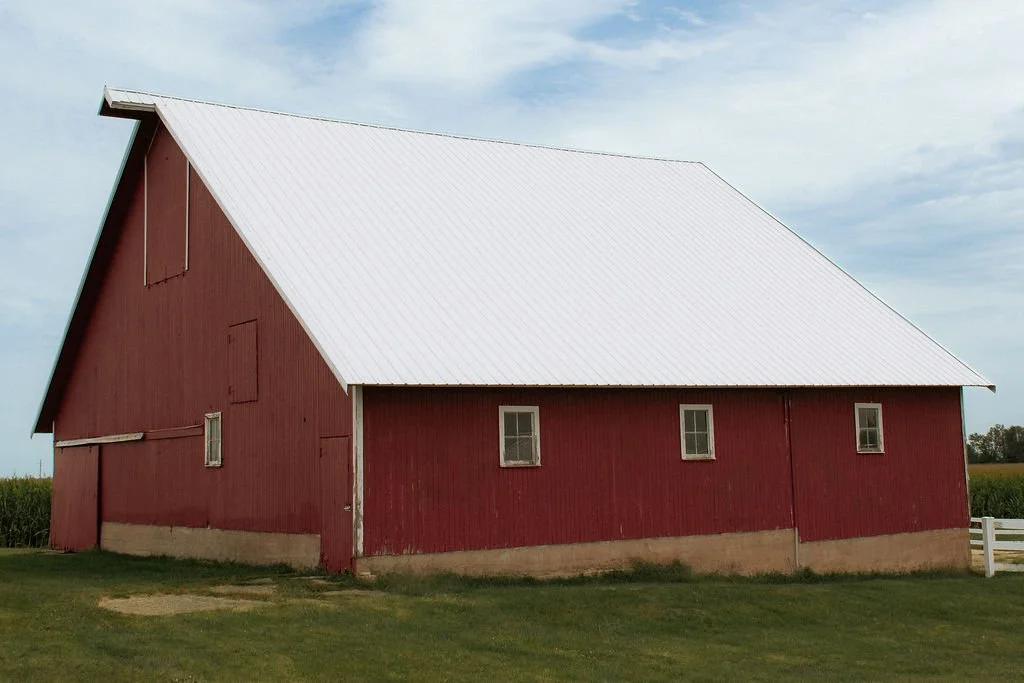
The inaugural Red Barn Harvest Fest will invite visitors to spend a day on the farm surrounded by local makers, live music, great food, family activities, and everything people love about fall in the Midwest.
The festival will be held at 19695 N 2120th Ave., Geneseo, located east of Geneseo along the Hennepin Canal heading toward Atkinson.
"It's really the combination of two passions," Ashley said. "I've always loved harvest season, and as a small business owner myself, I know how important opportunities like this are for makers and entrepreneurs. I wanted to create an event where people could celebrate the season while discovering and supporting amazing local businesses."
A Labor of Love
Although this is the festival's first year, months of preparation have gone into transforming the property into a destination designed for families to spend an entire day.
One of the biggest priorities, Ashley said, was carefully selecting vendors.
Rather than simply filling available spaces, organizers intentionally curated the event to feature a wide variety of businesses, ensuring shoppers will find unique products throughout the festival.
More than 60 makers and small businesses are expected to participate, offering everything from handmade goods and boutique clothing to home décor, fresh flowers, baked treats, and specialty gifts.
Behind the scenes, however, creating the festival has been very much a family effort.
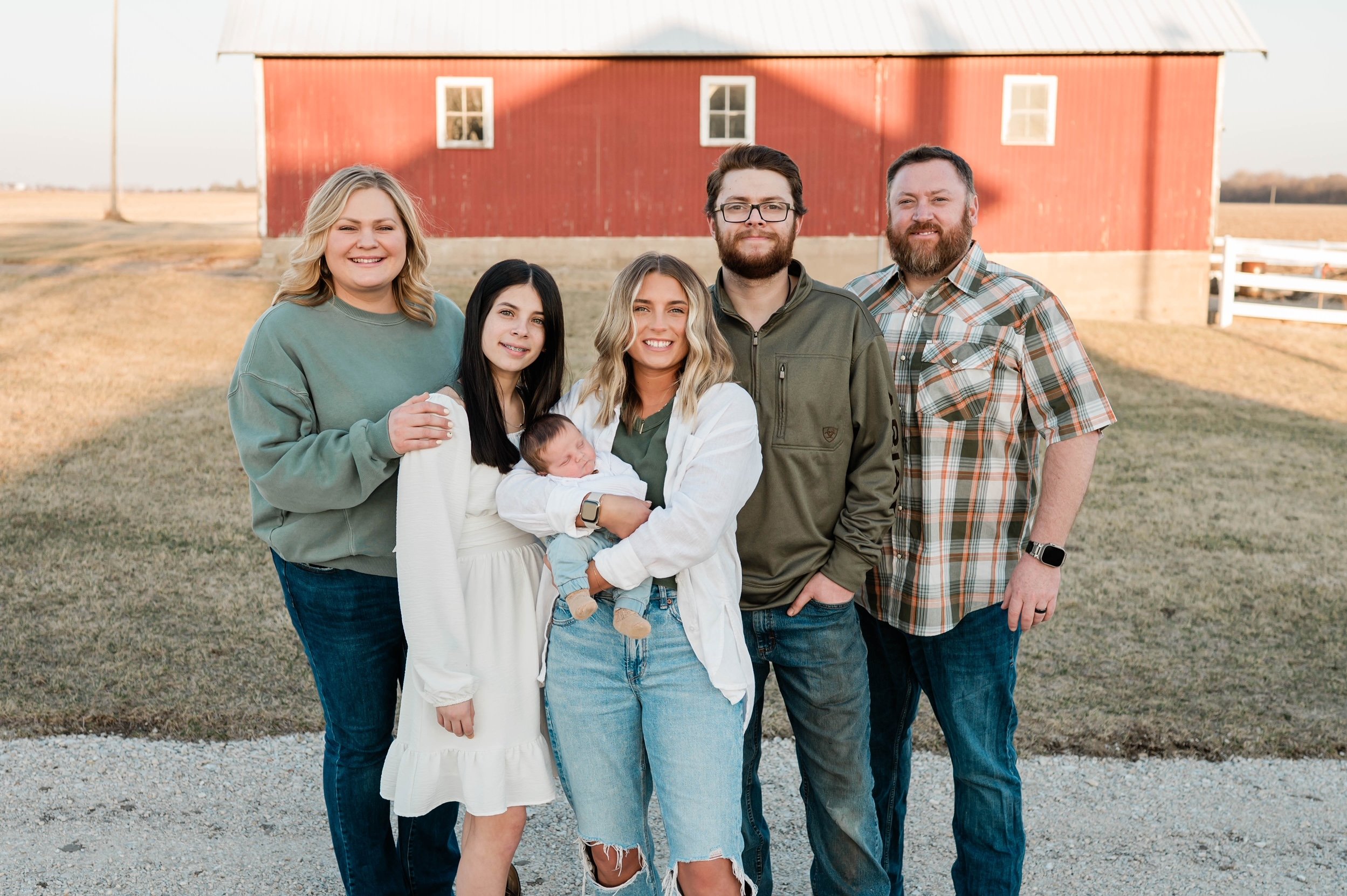
Organizer Ashley Marshall poses with husband Joe and kids Evan, Liliana, Landon and Lanie.
"None of this would be possible without my husband, Joe," Ashley said. "This may have started as my dream, but it's definitely become ours."
She credits Joe with spending countless hours helping prepare the farm, tackling projects, supporting new ideas, and helping bring the vision to life.
Family members, friends, and fellow small business owners have also stepped in to lend advice and help wherever needed.
As opening day approaches, preparations continue with vendor spotlights on social media, finalizing the event layout, and making sure every detail is ready for visitors.
"Our biggest goal is making sure our vendors have an amazing day," Ashley said. "They're what make this market so special."
More Than a Vendor Market
While shopping will certainly be a major attraction, organizers say visitors can expect far more than rows of booths.
Live music will fill the farm throughout the day with performances by Angela Meyer and Shaun Easton, two musicians well known throughout the region.
And visitors should probably come hungry.
Food & Drinks
The festival's food and beverage lineup includes:
Shadow Lake's "Can Stand" serving its signature mixed drinks, along with beer from Geneseo Brewing Company
Geneseo Trap Team fundraiser
Cynful Smokers BBQ
Reap & Sow
The Bean Field Coffee House
The Main Squeeze Trailer, serving lemonade and apple cider drinks
Just Us & Treats ice cream truck
Plus baked goods and other packaged food vendors
Families will also find plenty of activities designed to keep everyone entertained.
Guests can enjoy:
Pony rides
Hayrack rides
A mobile golf simulator
Plenty of seating to relax and enjoy the scenery
A chance to meet—and even snuggle—a Highland cow named Roy, who Ashley jokingly describes as one of the festival's biggest attractions.
"Shopping and eating... those two things paired with being outdoors—you really can't beat that," she said. "And, of course, snuggles with Roy."
Built for Families
As the mother of a one-year-old, Ashley says creating a family-friendly atmosphere wasn't just important—it was essential.
"This is definitely something I would want to take my own family to," she said.
Rather than rushing from one activity to the next, organizers hope families will slow down, spend time together, and simply enjoy a beautiful fall day on the farm.
"It's a place where people can spend the day together while enjoying everything that makes fall in the Midwest so special."
Supporting Small Businesses
At its heart, Red Barn Harvest Fest is also about strengthening local businesses.
Ashley hopes visitors discover new favorite makers and continue supporting them long after the festival ends.
She also hopes the event encourages visitors from outside the area to spend time exploring Geneseo after they leave the farm.
"I'd love to see people head into town afterward and support the amazing businesses we have here," she said.
For someone who has spent years building her own small business, creating opportunities for others carries special meaning.
"I can't wait for our vendors to have a successful day because supporting small businesses has always been so near and dear to my heart."
Hoping to Build a New Tradition
Ashley isn't just planning a one-time event.
From the beginning, the goal has been to establish Red Barn Harvest Fest as an annual tradition.
The festival is intentionally scheduled for the third Saturday in September, allowing families to know exactly when to mark their calendars each year.
"I hope someday people simply say, 'It's Red Barn Harvest Fest weekend,' and make plans around it the same way they do other annual traditions," she said.
A Fall Day Worth the Drive
For anyone still deciding whether to attend, Ashley has one final sales pitch.
"Did you see I mentioned a Highland cow?" she laughed. "Need I say more?"
Then she added:
"If you're looking for something fun to do this fall, this is it. It checks all the boxes—supporting small businesses, shopping, delicious food and drinks, live music, beautiful scenery, and activities for the whole family. It's the perfect opportunity to slow down, enjoy the season, go for a little drive, and experience everything that makes fall in the Midwest so special."
If the inaugural event lives up to Ashley's vision, Red Barn Harvest Fest won't simply be another stop on the fall calendar. It could become one of those traditions families circle every September—a place where local businesses thrive, friends gather, children make memories, and the harvest season is celebrated the way she has loved since childhood.
Follow the Red Barn Harvest Fest Facebook page for vendor features and updates.
Geneseo City Council to Consider Downtown Façade Grant, Police Board Appointments Tuesday
Deputy chief selection update and several major infrastructure projects are also on the agenda
The Geneseo City Council will meet Tuesday, August 11, with a downtown façade improvement grant, police board appointments and an update on the selection of a new deputy police chief among the items scheduled for consideration.
The regular meeting begins at 6 p.m. in the Council Chambers.
Katsch Boutique Façade Grant
Council members are scheduled to consider final approval of a façade improvement grant for Katsch Boutique, 113 N. State St.
The project carries an estimated total cost of $10,937.75 and is intended to address deteriorating façade boards, peeling paint and a torn awning. Plans include exterior painting, wood repairs and replacement of the awning.
The Committee of the Whole unanimously recommended the application at its July 28 meeting, with the City providing up to $5,468.88 through its 50/50 matching façade improvement program. The application now appears on Tuesday's consent agenda.
Deputy Police Chief Selection
Police Chief Casey Disterhoft is also scheduled to provide an update on the City's deputy chief selection process.
The update comes as the Police Department continues to work through staffing and recruitment efforts. At the July 14 meeting, Disterhoft and Mayor Sean Johnson discussed the nationwide shortage of law enforcement officers and the City's efforts to recruit qualified candidates.
Police Board Reappointments
Council will also consider Resolution R-26-15, which would reappoint two members to City police-related boards.
Jeffrey Lang is proposed for a three-year term on the Police Commission, running through August 11, 2029. Dan Schaaf is proposed for a two-year term on the Police Pension Board, running through August 11, 2028.
Two Wind Turbines Now Have Generator Problems
The City's regular project report contains a notable new development: both of Geneseo's wind turbines are now dealing with generator issues.
Wind Turbine #1 has been out of service since a generator failure April 30. The City submitted an insurance claim, and according to the latest report, Chubb has issued $855,151 toward generator replacement along with another $50,000 for lost revenue. The City has also received a quote to decommission the tower.
At the July 28 meeting, council members discussed whether to repair or decommission the 17-year-old turbine.
Since that discussion, Wind Turbine #2 experienced a generator failure July 30. City power plant staff testing indicated a short in the generator windings, with results sent to Vensys for analysis. An insurance claim is expected once those findings are verified.
No formal decision on either turbine appears on Tuesday's agenda.
Other City Projects Moving Forward
Council will receive updates on a number of ongoing infrastructure projects.
Among them, the City's North State Street reconstruction has reached another milestone. Road pavement is complete, while seven driveways, the remaining half of the sidewalks and landscaping were still outstanding as of August 7.
Work is also approaching on several other projects, including resurfacing of the City's pickleball courts during the week of August 17 and Chicago Street concrete patching, which has been delayed by weather.
The Ford Road sanitary sewer extension and lift station is moving toward construction as well. Bid documents have been released, with bids scheduled to open August 19 and council consideration of a contract anticipated at a special meeting August 25.
The City also continues to await Illinois Department of Natural Resources approval for the proposed pedestrian bridge at Oakwood Landing. The project is designed to provide a pedestrian crossing over Geneseo Creek near State Street and Oakwood Avenue.
Water System Planning Continues
Planning for Geneseo's future water supply also remains underway.
IMEG is developing three alternatives for a preliminary engineering report associated with the City's proposed sixth well and future water treatment facilities. Meanwhile, documents for Well #33 — the City's fifth well — are complete, with the project awaiting an Illinois Environmental Protection Agency permit.
Meeting Information
The Geneseo City Council meets at 6 p.m. Tuesday, August 11, in the Council Chambers at 115 S. Oakwood Ave.
The meeting includes two opportunities for public comment. Under City ordinance, speakers may provide comments for up to three minutes, although the comment periods are not interactive question-and-answer sessions with council members or staff.
Also on the agenda: the Chamber of Commerce and engineering reports, election packet information from the City Clerk, the Treasurer's Report, Budget Book and capital asset presentations, and approval of approximately $561,335 in City and utility bills.
Geneseo School Board to Review FY27 Tentative Budget Thursday
Geneseo CUSD #228 will review its FY27 tentative budget Thursday, including a projected Education Fund deficit, rising benefit costs, transportation funding pressures and long-term financial planning.
Read moreHammond-Henry Navigates a Difficult Reality Facing Rural Hospitals
For many people, a hospital's finances seem simple: either it's making money or it isn't. The reality—especially for rural hospitals—is far more complicated.
Read moreWhat Makes a Healthy Small Town? Here's What the Data Says—and How Geneseo Compares
Ask ten people and you'll likely get ten different answers. Some will point to great schools. Others will say low crime, good jobs, a thriving downtown, or friendly neighbors.
Read moreOakwood Pedestrian Bridge Project Advances
The City of Geneseo continues to move forward with plans for a pedestrian bridge at Oakwood Landing, although the project is still awaiting approval from the Illinois Department of Natural Resources
Read moreFormer Rexall Building Could Soon Welcome New Business
Wayne Peterson has purchased the historic former Rexall Drug building at 201–205 N. State Street in downtown Geneseo and plans to lease the space to new tenants.
Read moreState Street Project Nears Completion
The State Street construction project in Geneseo is nearing completion. The Ogden Avenue intersection is expected to reopen Aug. 12, with remaining work wrapping up by Aug. 21.
Read moreGeneseo Celebrates 20 Years of Trains, Planes & Automobiles
Three-day festival returns September 10–12 with classic cars, WWII aircraft, model trains, canal tours, food trucks and family fun
The Geneseo Chamber of Commerce is excited to announce the return of the 20th Annual Trains, Planes & Automobiles, taking place Thursday, September 10 through Saturday, September 12, 2026.
For twenty years, this unique festival has celebrated the machines that helped shape America's history while showcasing everything that makes Geneseo a great place to visit. From vintage aircraft and classic automobiles to operating model trains and historic canal tours, the three-day event offers something for visitors of every age.
The weekend culminates on Saturday with one of Illinois' premier classic car shows, hosted by the Maple City Cruisers, featuring hundreds of beautifully restored vehicles lining downtown Geneseo. Throughout the weekend, visitors can also enjoy food trucks, family activities, shopping, dining, and attractions throughout the community.
A longtime highlight of the festival is the VFW Salute to America on Saturday at noon. The patriotic ceremony features the VFW Color Guard, a tribute to our nation's veterans, and the crowd-favorite airplane flyover.
Event Highlights
Thursday, September 10
The festivities begin at Gen-Airpark with the annual Stearman Fly-In from 11:00 a.m. to 2:00 p.m. Visitors can experience the sights and sounds of authentic WWII-era Stearman biplanes as they arrive throughout the afternoon.
(No pets, please.)
Friday, September 11
Friday offers two unique experiences.
Guests can reserve a spot on the popular Cruise the Canal golf cart tours, exploring the history and engineering of the Hennepin Canal with guided tours departing at 9:00 a.m., 11:00 a.m., and 1:00 p.m. Reservations are required.
The Geneseo Model Railroaders will also host an Operating Model Train Display from 11:00 a.m. to 3:00 p.m. at 154 E. Exchange Street, giving visitors an up-close look at detailed model railroads in action.
The evening wraps up with the TPA Pre-Party, hosted by Erdman Construction, beginning at 5:00 p.m. It's the perfect opportunity to kick off the weekend with food, drinks, and great company before Saturday's festivities.
Saturday, September 12
Downtown Geneseo comes alive from 9:00 a.m. to 3:00 p.m. with the signature Trains, Planes & Automobiles celebration.
Highlights include:
Maple City Cruisers Car Show
Operating Model Train Display
Food Trucks
Youth Pedal Car Parade
VFW Salute to America with airplane flyover
Trophy presentations and Chamber 50/50 raffle drawing
Local shops, restaurants, and businesses will be open throughout the day, making it easy for visitors to spend the entire day exploring everything downtown Geneseo has to offer.
"The 20th anniversary is a special milestone for this event," said Lindsie Akers, Executive Director of the Geneseo Chamber of Commerce. "Trains, Planes & Automobiles brings together multiple community organizations, volunteers, and local businesses to create a weekend that's uniquely Geneseo. Whether you're a lifelong car enthusiast, fascinated by aviation or railroads, or simply looking for a fun family outing, there's something for everyone."
Admission to the festival is free, with the exception of the Cruise the Canal tours, which require advance registration and a ticket.
For a complete schedule of events and additional information, visit Geneseo.org/TPA or contact the Geneseo Chamber of Commerce at geneseo@geneseo.org
New to Podcasts? Here's How to Listen to The Geneseo Current
By Sarah DeMaranville
If you've never listened to a podcast before, you're not alone.
Many people hear the word "podcast" and assume it's complicated or that you have to pay for it. The good news? It's actually one of the easiest ways to stay informed—and it's completely free.
Whether you're driving to work, making breakfast, walking the dog, or mowing the lawn, you can listen to local news, community stories, and local history wherever you are.
Here's how to get started.
What Is a Podcast?
Think of a podcast as a radio show you can listen to whenever you want.
Instead of tuning in at a specific time, new episodes are automatically delivered to your phone.
The Geneseo Current offers several free podcasts, including:
State Street Newswire – A quick local news update each weekday morning.
Hidden History – Stories from Geneseo's fascinating past.
Sarah Says Things – A lighthearted look at everyday life.
If You Have an iPhone
Your iPhone already includes the Apple Podcasts app.
Open the Podcasts app.
Tap the Search icon.
Type Geneseo Current or the name of the show.
Tap the podcast.
Press Follow so new episodes automatically appear.
Tap any episode to start listening.
That's it!
If You Have an Android Phone
Most Android phones include a podcast app, but if yours doesn't, simply download Spotify from the Google Play Store.
Open Spotify.
Tap Search.
Type Geneseo Current or the name of the podcast.
Select the show.
Tap Follow.
Press Play on any episode.
You do not need a paid Spotify subscription to listen to podcasts.
Listening on Your Computer
You don't even need a phone.
Simply visit GeneseoCurrent.com, where podcast episodes are available directly on our website.
You can also visit Apple Podcasts or Spotify in your web browser and listen there.
Why Follow Instead of Just Listening?
Following a podcast means you'll never have to remember to look for new episodes.
Each new show automatically appears in your library.
It's free, takes just a few seconds, and you can stop following anytime.
Can I Listen in My Car?
Yes!
If your vehicle supports Apple CarPlay or Android Auto, your podcasts can play right through your vehicle's audio system.
Many newer vehicles also include Apple Podcasts or Spotify directly on the dashboard.
Do Podcasts Cost Anything?
No.
All Geneseo Current podcasts are completely free to listen to.
There are no subscriptions, no memberships, and no paywall.
Never Miss What's Happening
Whether you're interested in breaking local news, community events, local history, or cooking, podcasts make it easy to stay connected—even when you're too busy to read.
Simply open Apple Podcasts or Spotify, search for Geneseo Current, tap Follow, and we'll take it from there.
Inside Project Big River – Part 3: The Debate: Why Reasonable People Disagree About Carbon Sequestration
Over the past two installments of this series, we've explained how the proposed Big River–Lapis project would work and why Henry County officials are spending significant time discussing emergency planning and public safety.
That leaves one important question:
Why is carbon sequestration so controversial?
Unlike many public issues, this debate isn't simply between people who support economic development and people who oppose it.
Many of those involved—including elected officials, farmers, business leaders, emergency responders, environmental advocates, and nearby residents—agree on several basic goals: protecting public safety, supporting the local economy, and making informed decisions.
Where they differ is how they weigh the potential benefits against the potential risks.
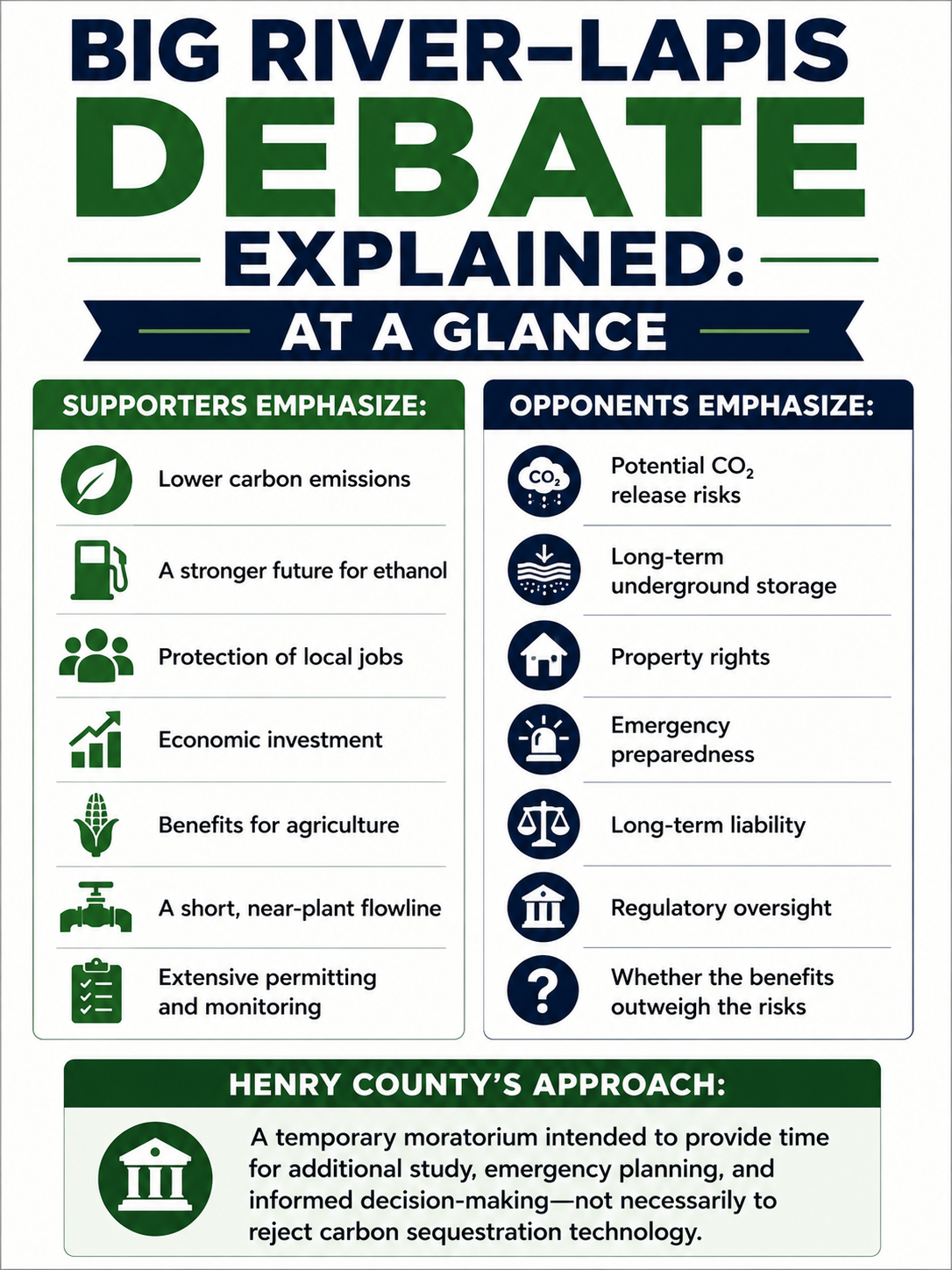
Why supporters favor the project
Supporters believe carbon sequestration can help both the local economy and the future of ethanol production.
Lower carbon emissions
Capturing carbon dioxide before it enters the atmosphere reduces the greenhouse gas emissions associated with ethanol production.
Supporters view carbon capture as one tool for lowering industrial emissions while allowing existing facilities to continue operating.
Keeping ethanol competitive
Fuel markets increasingly reward products with lower carbon intensity.
Supporters argue that reducing the carbon footprint of ethanol helps Illinois producers compete in those markets and positions the industry for long-term success.
Protecting local jobs
Big River Resources is a significant employer in the region.
Supporters say projects like this help ensure facilities remain economically viable, supporting both existing jobs and future employment opportunities.
Supporting agriculture
Illinois is one of the nation's leading corn-producing states.
A strong ethanol industry creates demand for locally grown corn, which supporters say benefits farmers, grain elevators, transportation companies, equipment dealers, and other agriculture-related businesses.
Attracting investment
Supporters believe carbon capture projects represent new private investment in rural communities.
Construction activity, engineering services, and long-term operation can generate additional economic activity.
A different type of project
Supporters also emphasize that Project Big River is not a long interstate pipeline.
Instead, it is designed as a near-plant project, with a flowline of less than one mile connecting the ethanol plant directly to the underground injection site.
They argue this substantially changes the project's risk profile compared to regional carbon dioxide pipeline networks.
Extensive permitting and monitoring
Before carbon injection could begin, the project must satisfy extensive federal and state permitting requirements.
Supporters point to ongoing geological studies, well construction standards, groundwater protections, pressure monitoring, financial assurance requirements, and long-term monitoring as evidence that multiple safeguards already exist.
Why opponents remain concerned
Opponents don't necessarily oppose every carbon capture project.
Many simply believe unanswered questions remain.
Carbon dioxide releases
The primary concern involves the possibility—however unlikely—of a significant carbon dioxide release.
Because CO₂ can displace oxygen, opponents want to better understand potential public safety impacts before projects move forward.
Long-term underground storage
Some residents question whether carbon dioxide can safely remain underground for decades or centuries.
While supporters point to extensive geological research, opponents say they would like more information about long-term monitoring and responsibility.
Property rights
Although Lapis has stated it does not anticipate using eminent domain for Project Big River's short flowline, some landowners remain concerned about how future carbon capture projects could affect property rights if additional infrastructure were proposed elsewhere.
Emergency preparedness
Many residents have asked whether local emergency responders have the training, equipment, and resources needed to respond to a carbon dioxide incident.
Those questions became more common following the 2020 Satartia, Mississippi pipeline rupture.
Long-term liability
Questions have also been raised about who would remain responsible for monitoring and maintaining underground storage sites years—or even decades—after injection ends.
Residents have asked who would bear responsibility if problems were ever identified in the future.
Government oversight
Some opponents believe additional local regulations may be necessary beyond existing federal and state permitting requirements.
Others believe current regulations are sufficient.
That difference of opinion has become one of the central questions facing county officials.
Do the benefits outweigh the risks?
Ultimately, much of the debate comes down to balancing potential economic benefits against potential public safety concerns.
Supporters believe the benefits justify moving forward under existing regulations.
Opponents believe additional study and local safeguards are appropriate before approving similar projects.
Why did Henry County approve a moratorium?
The County Board has repeatedly emphasized that the one-year moratorium should not be viewed as a permanent prohibition on carbon sequestration.
Instead, officials have described it as an opportunity to better understand the issue before additional projects move forward.
County leaders have said they want time to:
Gather additional technical information.
Develop comprehensive emergency response plans.
Review public safety considerations.
Study whether additional county regulations are appropriate.
Better understand how future projects could affect Henry County.
County Board Chair Kippy Breeden has said the Board's intent is to make informed decisions—not to reject the technology outright.
Whether additional county regulations are ultimately adopted remains to be seen.
What happens next?
The proposed Big River–Lapis project continues moving through the federal and state permitting process.
Meanwhile, Henry County officials are expected to continue reviewing technical information, coordinating with emergency management officials, and discussing whether additional local safeguards should be considered before the moratorium expires.
The conversations taking place over the next year may shape not only this project, but how Henry County approaches similar proposals in the future.
A final thought
Carbon sequestration is a complicated topic.
It combines agriculture, manufacturing, geology, engineering, environmental policy, emergency management, economics, and public safety.
Reasonable people can—and do—reach different conclusions about whether projects like Big River should move forward.
As the public discussion continues, understanding both the potential opportunities and the concerns allows residents to evaluate the project based on facts rather than assumptions.
That is ultimately the purpose of this series.
The Current Launches State Street Newswire, a New Daily Local News Briefing
Start your mornings informed with State Street Newswire, The Geneseo Current's new weekday local news briefing. Launching August 3, each episode delivers the top local headlines, events, and community updates in about three minutes and is available by 5:30 a.m. every weekday, making it the fastest way to catch up on what matters most in Geneseo.
Read more