
Residents attending a Monday informational meeting expressed support for the proposed pedestrian crossing, as Geneseo prepares another attempt at state funding that could reduce the city's share of the $392,010 project to about $71,000.
Read moreTerminally Ill Illinoisans Have a New End-of-Life Option — But Access May Vary Locally
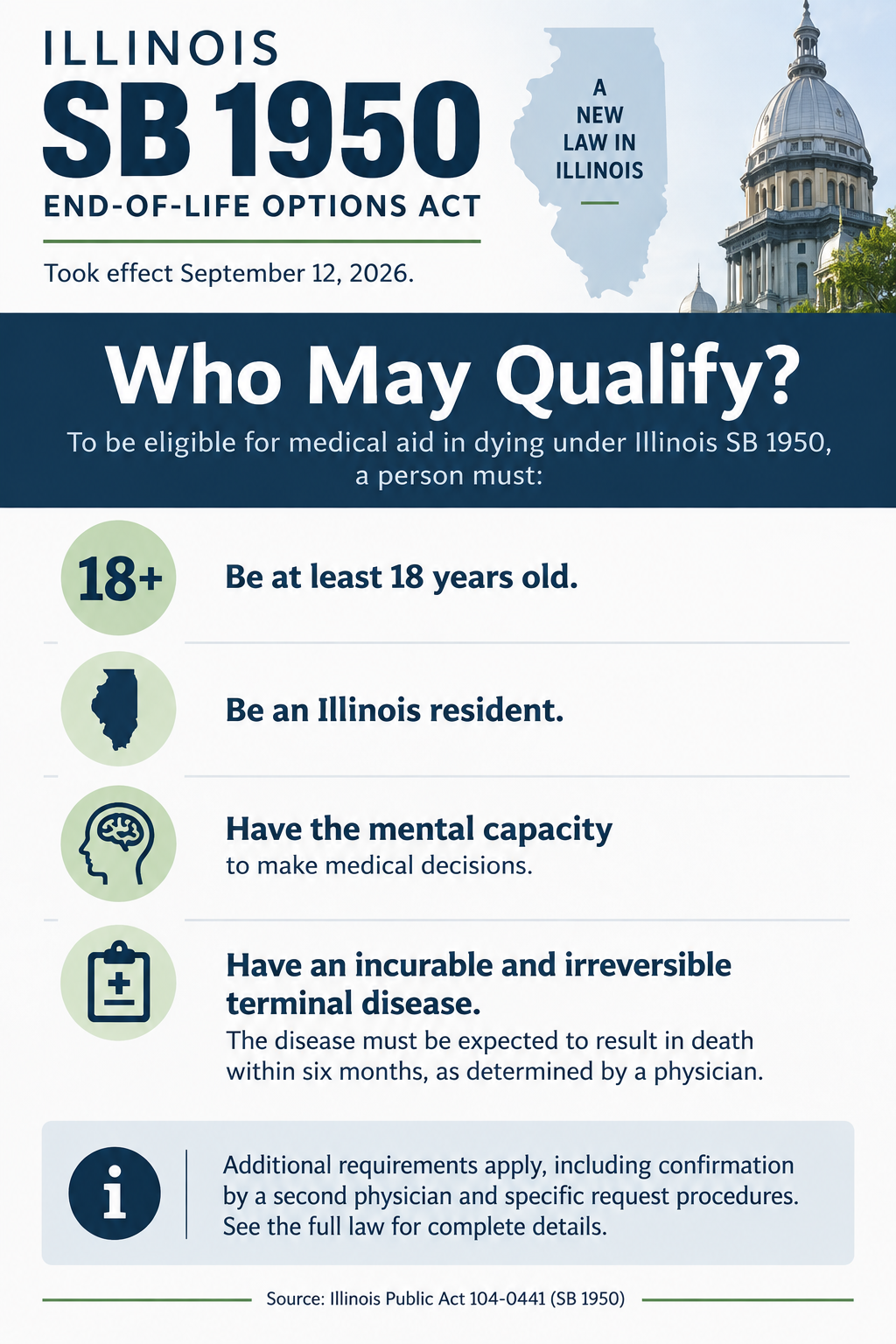
A new Illinois law allowing some terminally ill adults to obtain medication to end their lives took effect Sept. 12.
But whether Geneseo-area patients can access that option through their current health care provider may vary.
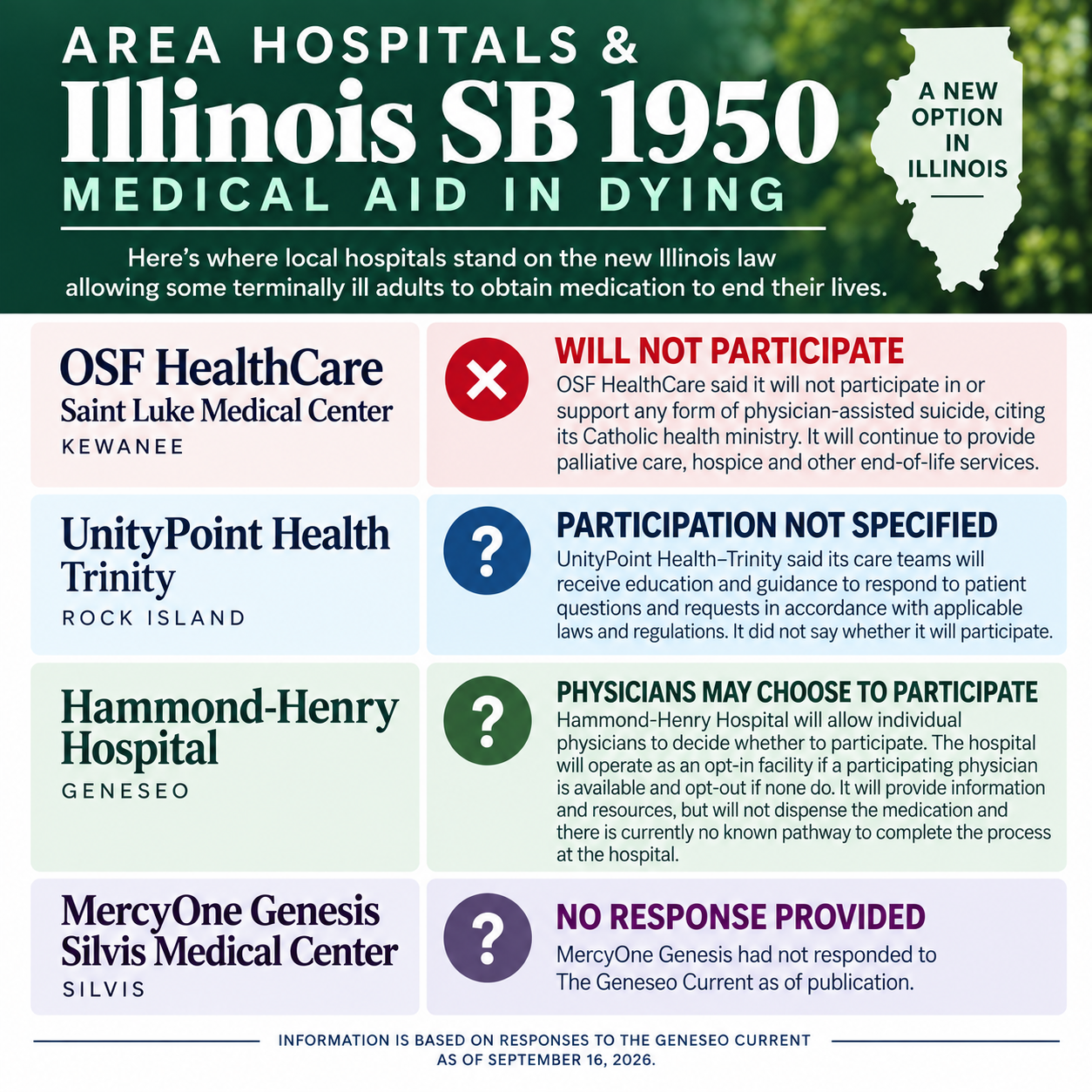
Hammond-Henry Hospital says it will allow individual physicians to decide whether to participate in medical aid in dying and will operate as an “opt-in” facility if it has a participating physician.
OSF HealthCare told The Geneseo Current it will not participate, citing its Catholic health ministry. UnityPoint Health–Trinity did not say whether it will participate, but said its care teams will receive guidance on responding to patient questions and requests.
The End-of-Life Options for Terminally Ill Patients Act, also known as Deb’s Law, applies to mentally capable adult Illinois residents with a terminal illness and a prognosis of less than six months to live.
The diagnosis and prognosis must be confirmed by an attending and consulting physician. Patients must make two oral requests and a written request, and the request cannot be made by a family member, guardian, health care proxy or other surrogate decision-maker. The patient must be able to self-administer the medication.
Hammond-Henry will allow physicians to choose whether to participate
Hammond-Henry Hospital CEO Wyatt Brieser told The Geneseo Current that the hospital's participation will depend on whether any of its physicians choose to participate.
“The Board of Directors and Administration recognize that Medical Aid In Dying (MAID) is a deeply personal issue involving ethical, professional, and community considerations,” Brieser said.
Under Hammond-Henry's policy, individual physicians may choose to participate or abstain, consistent with the law, hospital policy and their professional judgment. No physician will be required to participate.
“The hospital will operate as an opt-in facility only if a physician plans to participate and opt-out if there are no participating physicians,” Brieser said.
That means Hammond-Henry's participation status could change over time depending on whether it has a physician willing to participate.
Regardless of that status, Brieser said the hospital will provide information to patients, families, clinicians and staff.
Hammond-Henry will not dispense the medication
Even if Hammond-Henry has a participating physician, the hospital's role would be limited.
According to Brieser, patients could meet with a participating attending or consulting physician to discuss and consider medical aid in dying.
Hammond-Henry does not operate an outpatient pharmacy and will not stock or dispense the medications used in the process, Brieser said.
If the hospital does not have a participating physician, patients would be directed to resources through the Illinois Department of Public Health.
“At this time, Hammond-Henry Hospital is not aware of any pharmacies that are participating in stocking or dispensing the medications necessary for MAID,” Brieser said. “Therefore, there is currently no known pathway to complete this option at the time of this response.”
That distinction is important: Hammond-Henry is not categorically opting out of medical aid in dying, but its policy does not mean a patient can currently complete the entire process through the hospital.
Brieser said education, resources and auditing processes are in place to help the hospital comply with the new law and its own policies.
OSF will not participate
OSF HealthCare, which operates OSF HealthCare Saint Luke Medical Center in Kewanee and other facilities in the region, said its Catholic identity prevents it from participating.
“OSF HealthCare is saddened that SB 1950 is now law in Illinois. As a Catholic health ministry, OSF is guided by honoring the dignity of every human person and we will not participate in or support any form of physician-assisted suicide,” OSF said in a statement provided to The Current.
OSF said it will continue providing palliative care, hospice, pain management, emotional support and spiritual care. Patients who want to pursue medical aid in dying can transfer their records and seek care elsewhere.
“We will continue to provide robust palliative care, hospice care, pain management, emotional support, and spiritual care to patients and families, ensuring that no one feels alone or without options during their most vulnerable moments,” OSF said. “As is current process, decisional patients can transfer their records and seek interventions elsewhere and are able to self-refer outside of OSF.”
UnityPoint does not specify whether it will participate
UnityPoint Health–Trinity did not say whether medical aid in dying will be available through its physicians or facilities.
“UnityPoint Health is committed to ensuring our care teams have the education and guidance needed to respond to patients and their caregivers when they have questions and requests, in accordance with applicable laws and regulations,” a UnityPoint Health–Trinity spokesperson said.
The health system added that its focus remains on “delivering compassionate, patient-centered care and supporting patients and families throughout their health care journey.”
The Geneseo Current also contacted Genesis but had not received a response as of publication.
What happens if a provider doesn't participate?
Illinois law does not require physicians or health care organizations to participate in medical aid in dying. The law specifically states that a health care entity has no duty to participate and allows organizations to prohibit aid-in-dying care while their professionals are working for the organization.
IDPH also says physicians are not required to provide aid-in-dying care. If a patient transfers to another provider, however, the patient's medical records must be provided in a timely manner.
Hammond-Henry said patients who ask about medical aid in dying will receive information about their end-of-life options. If the hospital has no participating physician, it can direct patients to IDPH and other outside resources.
For Geneseo-area patients, the responses from the three health systems illustrate how differently the new law may work from one provider to another: OSF has chosen not to participate; Hammond-Henry has established a framework that allows individual physicians to participate but says there is currently no known pathway to complete the process; and UnityPoint has not publicly specified whether it will participate.
The practical availability of medical aid in dying locally may therefore depend not only on whether a patient qualifies under state law, but also on whether participating physicians and pharmacies are available.

Stumphy’s Returning to Its Roots with Move to Former Captain’s Table in Moline
Stumphy’s Restaurant & Bar is returning to its roots with plans to move into the former Captain’s Table location in Moline, bringing the restaurant back to the Quad Cities.
Read moreHarvest Fest Weekend Brings Music, Raffles and Family Activities to Geneseo
Geneseo’s Harvest Fest weekend features student band and choir performances, the Maple Leaf Classic, raffles, a silent auction, food and family activities.
Read moreIgnite Begins Oct. 7 at Kingswood Geneseo Church
Kingswood Geneseo Church’s Ignite program begins Oct. 7, offering Wednesday afternoon programming for children in kindergarten through fifth grade.
Read moreKingswood Hosts Garage Sale Silent Auction to Benefit Operation Christmas Child
Kingswood Church will host a garage sale and silent auction Oct. 2–3 to benefit Operation Christmas Child, supporting its annual shoebox gift ministry.
Read more$8 Million US 6 Project, E-Bike Rules and Oakwood Bridge on Geneseo Council Agenda
Tuesday’s meetings will include a new grant application for the Oakwood pedestrian bridge, a first look at proposed rules for e-bikes and e-scooters, and planning for a major 2027 IDOT project along West Main Street.
Geneseo City Council members will have a full slate of infrastructure and planning issues before them Tuesday, Sept. 22, with discussions ranging from the city's long-term capital needs to new regulations for electric bicycles and scooters.
The Committee of the Whole meeting begins at 6 p.m. in Council Chambers at City Hall. A Special City Council meeting is also scheduled Tuesday and includes action on the Oakwood Landing pedestrian bridge grant application and the sale of surplus Electric Department equipment.
Oakwood pedestrian bridge returns to council
The city is preparing to make another attempt at securing Illinois Transportation Enhancement Program (ITEP) funding for the proposed pedestrian bridge over Geneseo Creek near Oakwood Avenue.
The Historic Landing Area and Pedestrian Crossing Project was introduced in 2022. Geneseo previously applied for ITEP funding during the 2022 and 2024 application cycles but was not selected. The beautification and historical landing portion of the project was completed in March 2024 with local grant support, while the pedestrian bridge remained unfinished.
Since the previous applications, the city authorized preliminary engineering for the bridge. Plans have also undergone revisions requested by the Illinois Department of Natural Resources, including raising the structure completely out of the floodway. According to the meeting materials, those modifications have been made and final IDNR approval is pending.
IMEG Engineering now estimates the project at $392,010. Plans call for a 90-foot-long, six-foot-wide pedestrian bridge over Geneseo Creek.
The city is working with Bi-State Regional Commission on another ITEP application, due in early October. According to city documents, an award could cover between 50% and 80% of eligible construction costs, with award announcements expected in April 2027. The Geneseo Foundation has also confirmed that its previously pledged $125,000 grant remains available for the project.
The Special City Council agenda calls for a vote on Resolution R-26-17 supporting the city's grant application. If the city does not receive ITEP funding, council members would be asked in 2027 to decide whether to proceed using local funding along with the Foundation contribution.
Council gets look at 2027 capital planning
Council members will also review the city's capital planning and Waterworth modeling for 2027.
The extensive capital improvement plan looks several years into the future and covers needs across city departments. The documents are planning materials rather than authorization Tuesday night for every individual project listed.
Among the items identified for 2027 are $200,000 for miscellaneous City Hall building repairs and $40,000 for other administration equipment and IT work.
The Parks Department plan includes $60,000 for City Park band shelter and bathroom improvements. Proposed work includes a new roof, LED lighting, bathroom renovations, interior painting, and an epoxy floor. The city notes that the bathrooms have not been operational for many years and indicates that grant funding would be pursued.
Street projects identified for 2027 include $150,000 for the annual street overlay program and $135,000 for concrete patching on Chicago Street between Main and Exchange streets. A $225,000 equipment replacement is also included.
The capital plan extends well beyond those examples and includes projects and equipment needs across city operations.
New rules proposed for e-bikes and e-scooters
One of Tuesday's discussions could eventually affect residents who use e-bikes, electric scooters, electric skateboards, and similar devices.
The city is considering changes to Chapter 36 of its municipal code in response to new Illinois regulations scheduled to take effect Jan. 1, 2027. No ordinance is scheduled for passage Tuesday. The draft is being presented for council review and discussion and is expected to be refined with the city attorney.
The proposal divides low-speed electric bicycles into three classes. Class 1 and Class 2 e-bikes would have maximum assisted speeds of 20 mph, while Class 3 bikes could provide pedal assistance up to 28 mph. Electric scooters, electric skateboards and electric unicycles are included under electric micromobility devices. Higher-powered devices exceeding 750 watts or 28 mph would be treated as motor-driven cycles and subject to licensing, registration, titling and insurance requirements.
The draft also includes age restrictions. Operators of Class 1 and Class 2 e-bikes would need to be at least 15 to use them on public streets, paths or trails. Class 3 e-bike and electric micromobility device operators would need to be at least 16. Children's battery-powered electric toys would be exempt from those age provisions.
Another significant provision would prohibit Class 1, 2 and 3 e-bikes, electric scooters and other covered micromobility devices from being operated on public sidewalks within Geneseo.
Lower-speed devices could instead operate on public roads with posted speed limits of 35 mph or less, designated bicycle lanes and multi-use trails, subject to rules including yielding to pedestrians. Higher-powered motor-driven cycles would not be permitted on sidewalks, bike paths, multi-use trails or bike lanes.
The proposed ordinance also contains fines, potential police impoundment, and provisions addressing parental responsibility when minors violate the rules.
Major US 6 project planned for 2027
Council members will also review an agreement with the Illinois Department of Transportation for a substantial improvement project along US 6/West Main Street.
The project would extend from approximately 0.1 mile west of Dilenbeck Drive east to South Oakwood Avenue and include pavement patching, milling and hot-mix asphalt resurfacing, ADA sidewalk improvements, traffic signal upgrades, parking improvements and utility adjustments.
IDOT would serve as the lead agency, handling surveying, necessary land acquisition, engineering design, bidding, and construction inspection.
The project is currently scheduled for the November letting, with construction expected to span the 2027 construction season. The documents list a Nov. 24, 2027 completion date, plus 10 days the following spring for remaining landscaping and punch-list work.
The estimated overall project cost is $8.05 million, including engineering. Federal funding is estimated at approximately $6.35 million, the state's share at approximately $1.56 million, and Geneseo's share at approximately $134,637.
The city's share includes costs associated with traffic signals, utility adjustments, and parking improvements. The project also includes resurfacing two parking lanes along the south side of West Main Street between Main and Center streets and resurfacing the parking lot at Geneseo City Park.
The Committee of the Whole agenda calls for moving the IDOT agreement and associated resolutions forward for final City Council review and approval.
Four transformers could be sold
The Special City Council will also consider declaring four Electric Department transformers surplus property.
According to the resolution, the transformers are no longer needed by Geneseo's electric utility following its voltage conversion project. The city proposes selling them to the City of Mascoutah for $20 per KVA.
Residents have two opportunities for public comment
Residents who want to address council members can do so during designated public-comment periods.
Near the beginning of the Committee of the Whole meeting, the council accepts comments specifically concerning items on the night's agenda. Each speaker may provide input for up to three minutes. City rules specify that the period is intended for council members to listen to public feedback and is not an interactive question-and-answer session.
A second public-comment period is scheduled near the end of the meeting for all other items, with the same three-minute limit.
The Committee of the Whole meeting begins at 6 p.m. Tuesday, Sept. 22, in Council Chambers at Geneseo City Hall. The meeting can also be watched through the City's YouTube livestream.


Geneseo Home Sales Up Nearly 15% This Year as Median Price Climbs
More homes are selling in Geneseo in 2026, while the year-to-date median sale price has increased 23%.
Geneseo's housing market has recorded more home sales through the first eight months of 2026 than during the same period last year, even as prices have moved considerably higher.
Through August, 78 single-family detached homes had closed in Geneseo, up 14.7% from 68 during the first eight months of 2025, according to an August Local Market Update provided by the Quad City Area Board of Realtors using data from Midwest Real Estate Data LLC.
The year-to-date median sale price reached $239,950, compared with $194,750 at the same point last year — an increase of 23.2%.
The average sale price increased 19.2%, from $231,696 to $276,201.
More homes are entering the Geneseo market
The increase in sales has been accompanied by an increase in homes coming onto the market.
Geneseo recorded 102 new single-family detached listings through August, up 17.2% from 87 during the same period last year.
Pending sales increased even faster, rising 18.8% from 69 to 82.
Inventory was also higher at the end of August. There were 22 single-family detached homes for sale, compared with 18 in August 2025, an increase of 22.2%.
The combination is notable: Geneseo has had more homes listed for sale this year, but it has also recorded more pending and completed sales.
August alone tells a different price story
The year-to-date numbers are particularly useful because a single month's results can fluctuate significantly in a relatively small housing market.
That can be seen in August.
Ten detached homes closed in Geneseo during the month, compared with nine in August 2025. But the median sale price was $251,450 — down 19.5% from the unusually high $312,500 median recorded in August 2025.
At the same time, the average August sale price jumped 65.7%, from $257,144 to $425,990.
Having the median fall sharply while the average rises sharply is a good example of why small-market monthly statistics need context. A relatively small number of unusually expensive sales can pull an average higher without representing what happened to the price of a typical home.
Year-to-date figures therefore provide a broader picture: Geneseo's detached-home median is up 23.2%, while its average price is up 19.2%.
Homes sold quickly in August
Homes that closed during August also moved considerably faster than those that closed during the same month last year.
Cumulative days on market until sale fell from 27 days in August 2025 to 15 days this August, a 44.4% decline.
Year to date, however, the pattern is reversed. Homes sold through August had spent 36 days on the market compared with 24 days through August 2025.
August sellers also received 100% of their original listing price, compared with 96% in August 2025.
Year to date, sellers have received 97.4% of their original asking price, virtually unchanged from 97.5% last year. Those calculations do not account for seller concessions.
Henry County shows higher prices but fewer sales
The broader Henry County market has followed a somewhat different trajectory.
Through August, 263 detached homes had closed countywide, down 9.3% from 290 during the first eight months of 2025.
Pending sales were down 7%, while new listings were nearly flat, increasing from 348 to 351.
Prices, however, were higher.
The countywide year-to-date median sale price increased 14.1%, from $157,750 to $180,000, while the average increased 14.3% to $193,726.
Inventory also expanded. Henry County had 82 detached homes for sale in August, up 28.1% from 64 a year earlier. Months of inventory increased from 1.7 to 2.3.
August itself was slower than a year ago, with 37 closed sales compared with 41 in August 2025. The month's median price, however, increased 17.1% to $202,500.
Geneseo outperforming county sales trend
The contrast between Geneseo and Henry County is one of the clearest findings.
Through the first eight months of the year, Geneseo detached-home sales increased 14.7%, while Henry County sales overall declined 9.3%. Geneseo's year-to-date median price increased 23.2%, compared with a 14.1% increase countywide.
Both markets have also accumulated more homes for sale.
For buyers, that means there are more properties available than there were last August. For sellers, the numbers show that higher inventory has not prevented Geneseo from recording more sales or higher year-to-date prices.
The August reports were provided to The Geneseo Current by LuAnn Lavine of RE/MAX Concepts and originate from the Quad City Area Board of Realtors' Local Market Update using Midwest Real Estate Data LLC data. The reports were current as of Sept. 14.
Geneseo Chamber Lunch & Learn to introduce businesses to EOS tools
The Geneseo Chamber of Commerce will host an Oct. 15 Lunch & Learn introducing local business leaders to practical EOS tools for setting priorities, aligning teams and improving execution.
Read moreA First Look at the October Current Scene

The October issue of Current Scene is coming soon, with 48 pages of local stories, fall ideas, Geneseo history and practical seasonal reads.
Our feature story looks at more than 100 years of retail through “Katie Kutsunis Carries on a Geneseo Family Legacy.” We’ll also tell the story of “The Little Building That Did a Little Bit of Everything” and remember longtime Geneseo standout Barry Pearson, whose remarkable football career took him all the way to the NFL.
There’s plenty for fall, too: 10 things to do with a pumpkin without cutting it, winterizing your home and car, fall superstitions explained, seasonal recipes and kids’ crafts.
And as the holidays approach, we’re getting an early start with historic Christmas ads from Geneseo newspapers, holiday hosting with NOSH and our Geneseo Holiday Bucket List.
You’ll also find thoughtful features on rediscovering Geneseo after raising kids, raising independent kids at every age, and saying one last Midwestern goodbye to summer.
🍁 History. Home. Family. Football. Fall. And the holidays just around the corner.
The October Current Scene is coming soon.
Geneseo Rotary Joins Regional Effort to Raise $10,000 for Polio Eradication
Geneseo Rotary will join a regional World Polio Day walk Oct. 24, helping the Quad Cities raise $10,000 to support global polio eradication efforts.
Read moreRichmond Hill Players Receives Illinois Theatre Association Award of Excellence
Richmond Hill Players has received the Illinois Theatre Association’s 2026 Award of Excellence in Community Theatre, recognizing its contributions to theatre in Illinois.
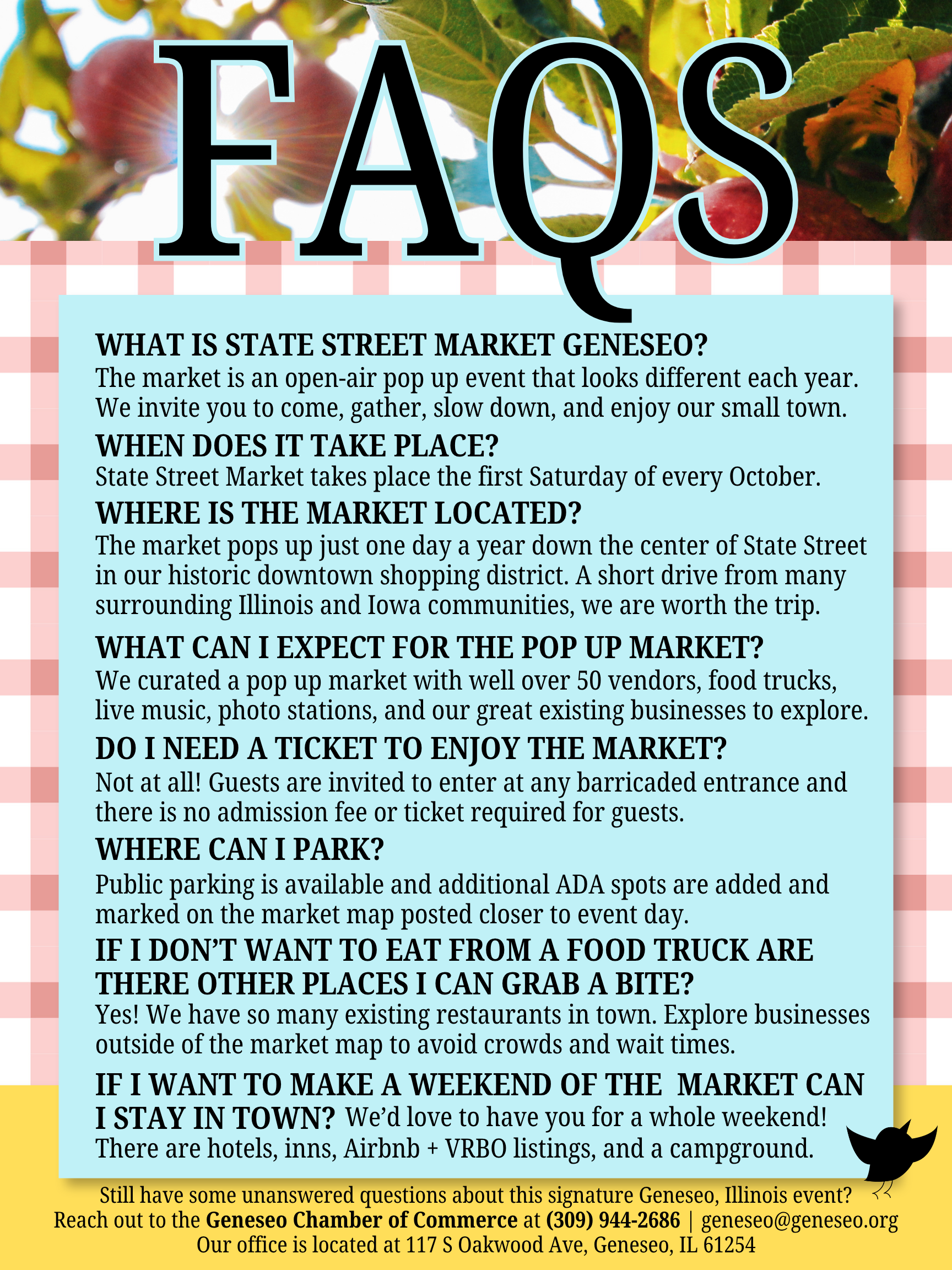
Read moreState Street Market Returns to Downtown Geneseo October 3
One of Geneseo’s favorite fall traditions returns Saturday, October 3, as State Street Market takes over historic Downtown Geneseo for a full day of shopping, food, music and fall fun.
The free, open-air market will run from 10 a.m. to 4 p.m. along State Street and will feature a curated collection of vendors from Geneseo and throughout the Midwest offering vintage finds, handmade goods, home décor, clothing, accessories and other unique items.
More than just a market, the event is an opportunity to spend the day experiencing Geneseo. Visitors are encouraged to shop the market, explore Geneseo’s locally owned stores, grab lunch or drinks at downtown restaurants and enjoy live entertainment throughout the day.
“State Street Market is one of those days that really shows off what makes Geneseo special,” said Lindsie Akers, Executive Director of the Geneseo Chamber of Commerce. “You have a great outdoor market right in the middle of our historic downtown, but you also have all of our local shops, restaurants and businesses to explore. It’s a perfect excuse to make a day of Geneseo.”
Food trucks and vendors will be located downtown throughout the event, with seating available for visitors to stop, eat and enjoy the atmosphere. Live music and entertainment will also take place throughout the market.
State Street Market has grown into a regional fall destination, welcoming shoppers and vendors from throughout Illinois and the surrounding Midwest. Geneseo is conveniently located just off Interstate 80 at Exit 19, making the market an easy day trip from the Quad Cities, Peoria, Chicagoland and surrounding communities.
State Street Market Geneseo
Saturday, October 3, 2026
10 a.m.–4 p.m.
Downtown Geneseo, Illinois
Admission is free.
Additional vendor, food and entertainment announcements will be shared leading up to the event.
For updates, follow State Street Market Geneseo on Instagram at @statestreetmarketgeneseo.
For more information, contact the Geneseo Chamber of Commerce at 309-944-2686 or geneseo@geneseo.org.
GIFT Opens Fall Grant Cycle for Geneseo Nonprofits
Geneseo nonprofits can apply for up to $1,500 through the GIFT Community Foundation’s fall grant cycle. Applications are due Oct. 15, with awards announced Oct. 31.
Read moreHow Expensive Is Geneseo City Government? A Look at Three Similar Illinois Communities
When residents see a city budget totaling tens of millions of dollars, it can be difficult to tell whether local government is actually expensive.
One problem is that Geneseo's total budget includes its electric, water and sewer utilities. Comparing that total with cities that operate different services can be misleading.
A more useful comparison comes from the Illinois Comptroller's Fiscal Responsibility Report Cards, which provide standardized financial information for municipalities across the state.
Using fiscal year 2024 data, The Geneseo Current compared Geneseo with Princeton, Mendota and Monmouth — three Illinois communities of similar size.
The results show Geneseo spending less on general government services than all three.
Spending per resident
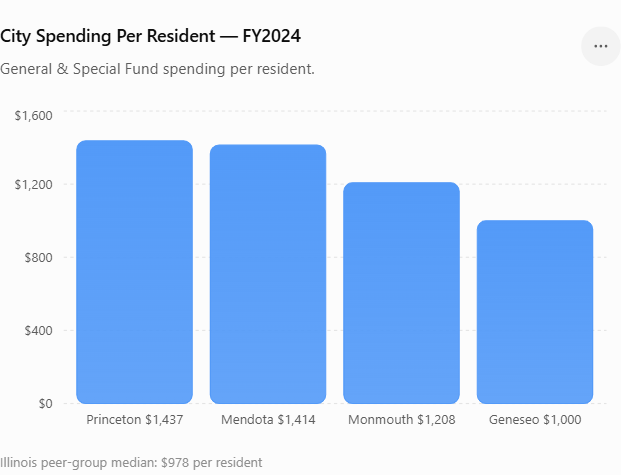
Geneseo's $1,000 per resident was approximately 17% below Monmouth, 29% below Mendota and 30% below Princeton.
The Illinois Comptroller reports an average of $1,191 per resident and a median of $978 among municipalities in the same broad population category.
That puts Geneseo about 16% below the statewide group average but very close to the median.
But among these three regional comparison communities, its governmental spending is clearly the lowest.
Geneseo also finished with substantial reserves
Spending tells only part of the story.
Geneseo began fiscal 2024 with approximately $10.89 million in General and Special Fund balances and ended with approximately $12.23 million.
That equals $1,870 per resident.
The city's ending fund balance represented approximately 187% of annual General and Special Fund expenditures.
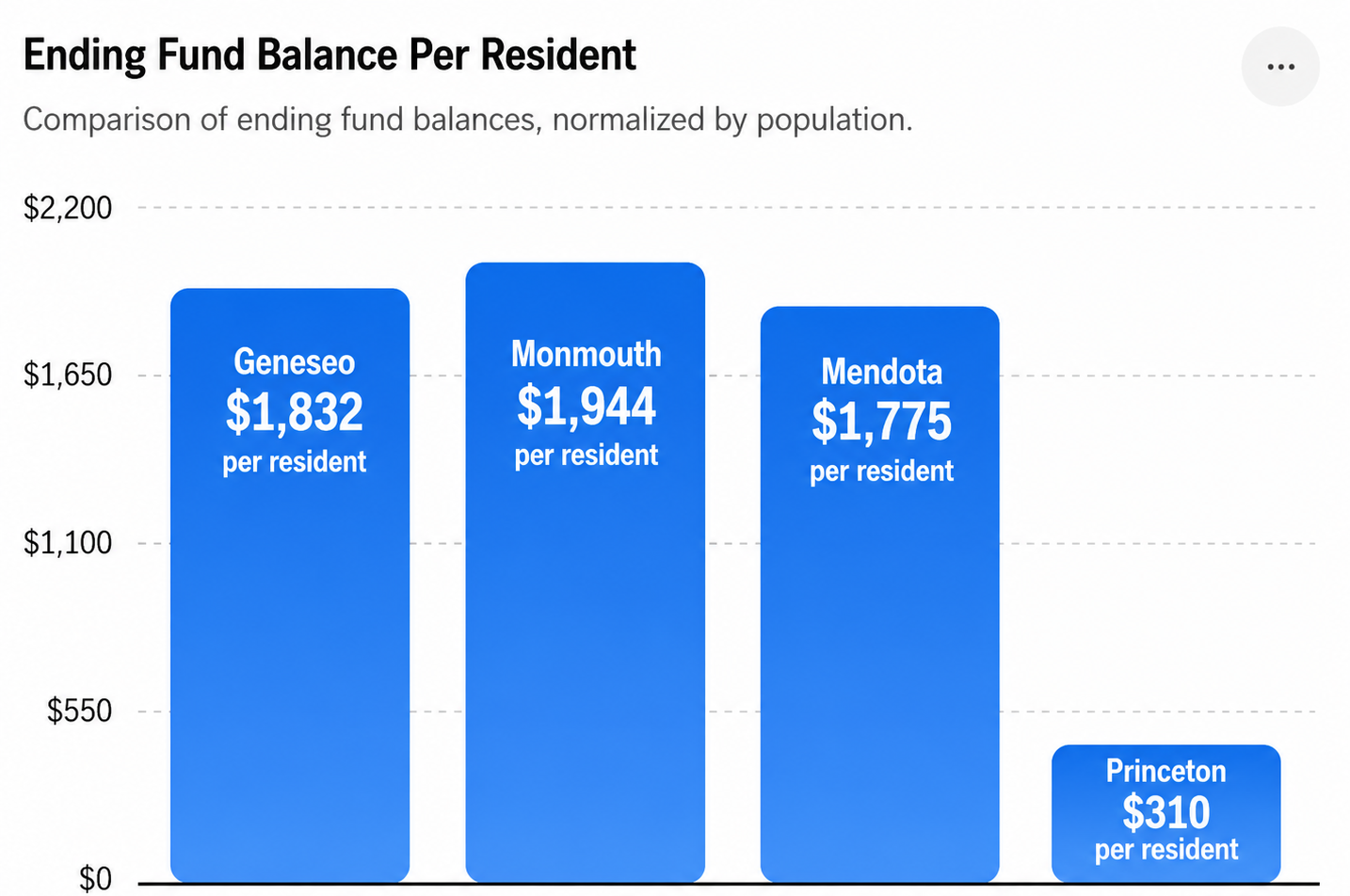
Fund balances aren't necessarily money available for immediate spending. They can include restricted or committed funds, reserves and money intended for future expenses.
Geneseo doesn’t simply have fewer employees
Geneseo reported 60 full-time and 24 part-time employees, with approximately $4.98 million in salaries paid.
That's about 9.2 full-time employees for every 1,000 residents.
Princeton had a nearly identical ratio, with 70 full-time employees serving a larger population.
That suggests Geneseo's lower General and Special Fund spending isn't simply the result of maintaining a smaller workforce.
Utilities make the overall budget look much larger
This is where municipal comparisons become complicated.
In addition to its General and Special Funds, Geneseo reported approximately $12.10 million in enterprise-fund expenses.
These funds include business-like operations such as municipal utilities, which are largely supported by charges for services.
Geneseo's enterprise operations generated approximately $13.05 million in revenue during FY2024.
Because cities don't all own and operate the same utilities, comparing their total budgets can create a distorted picture of how much ordinary city government costs.
Debt tells a different story
Geneseo reported approximately $22.66 million in outstanding debt, or about $3,465 per resident.
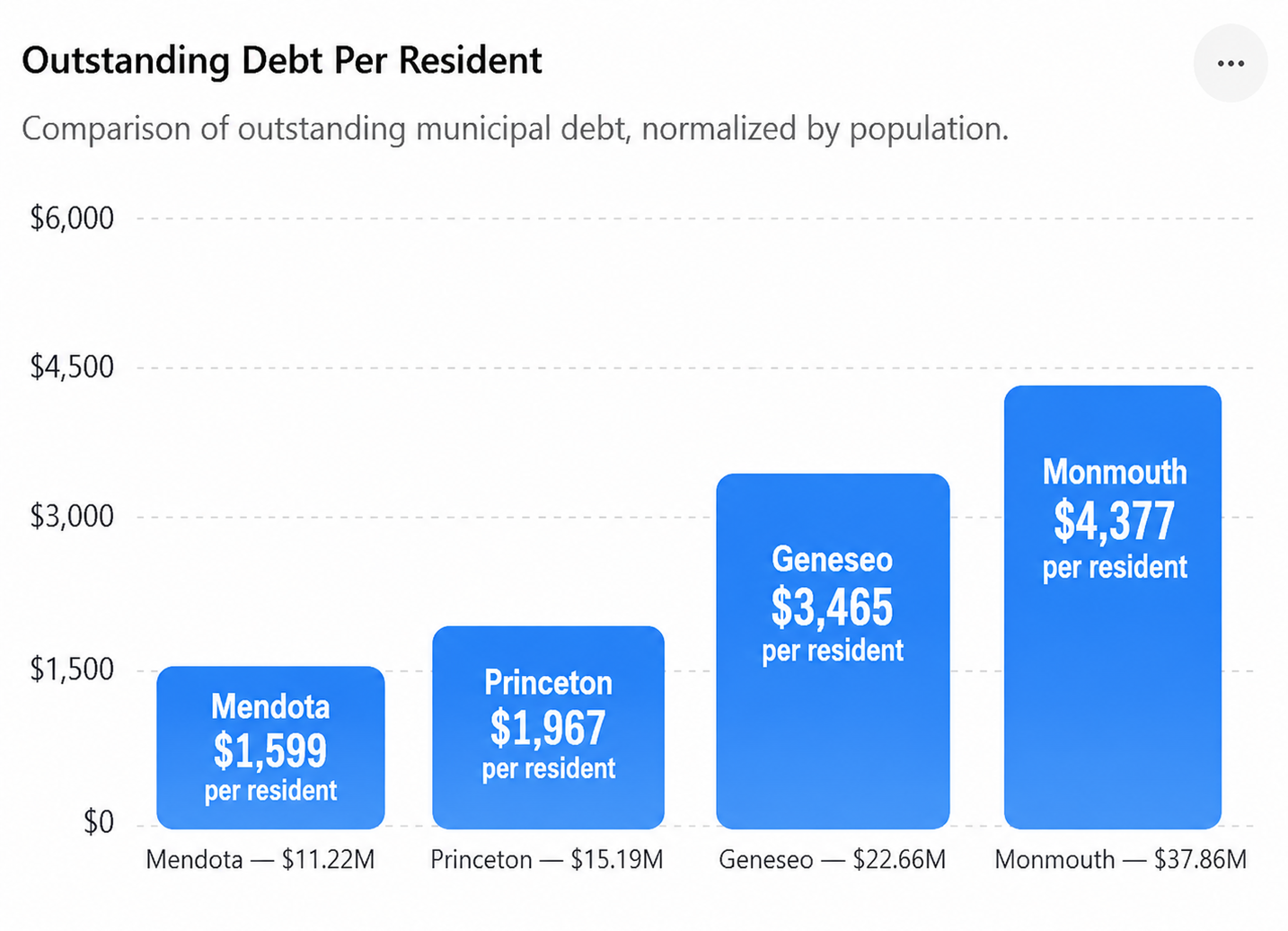
That was more per resident than Princeton or Mendota, but less than Monmouth.
However, the state's debt figure includes debt associated with both governmental and proprietary activities. In Geneseo's case, that means debt connected with municipal utility infrastructure can be included.
The number therefore shouldn't be interpreted as General Fund debt alone.
So, is Geneseo city government expensive?
The FY2024 numbers don't produce a simple yes-or-no answer.
On one of the best standardized measures available, Geneseo spent about $1,000 per resident through its General and Special Funds. That was close to the statewide median and lower than Princeton, Mendota and Monmouth.
At the same time, Geneseo maintained substantial fund balances, operated a sizable municipal workforce and utility system, and carried significant infrastructure-related debt.
Taken together, the numbers show a city with moderate governmental spending, substantial reserves and significant municipal infrastructure to operate and maintain.
That provides a more useful picture than Geneseo's total city budget alone.
Beyond the Books: What You Might Not Know the Geneseo Library Offers
From streaming movies and genealogy research to children's programs, computer help, voter registration and even puzzle swaps, the Geneseo Public Library offers considerably more than shelves of books.
For generations, the public library has been a place to find something to read.
That is still a big part of what happens at the Geneseo Public Library District — but it is far from the whole story.
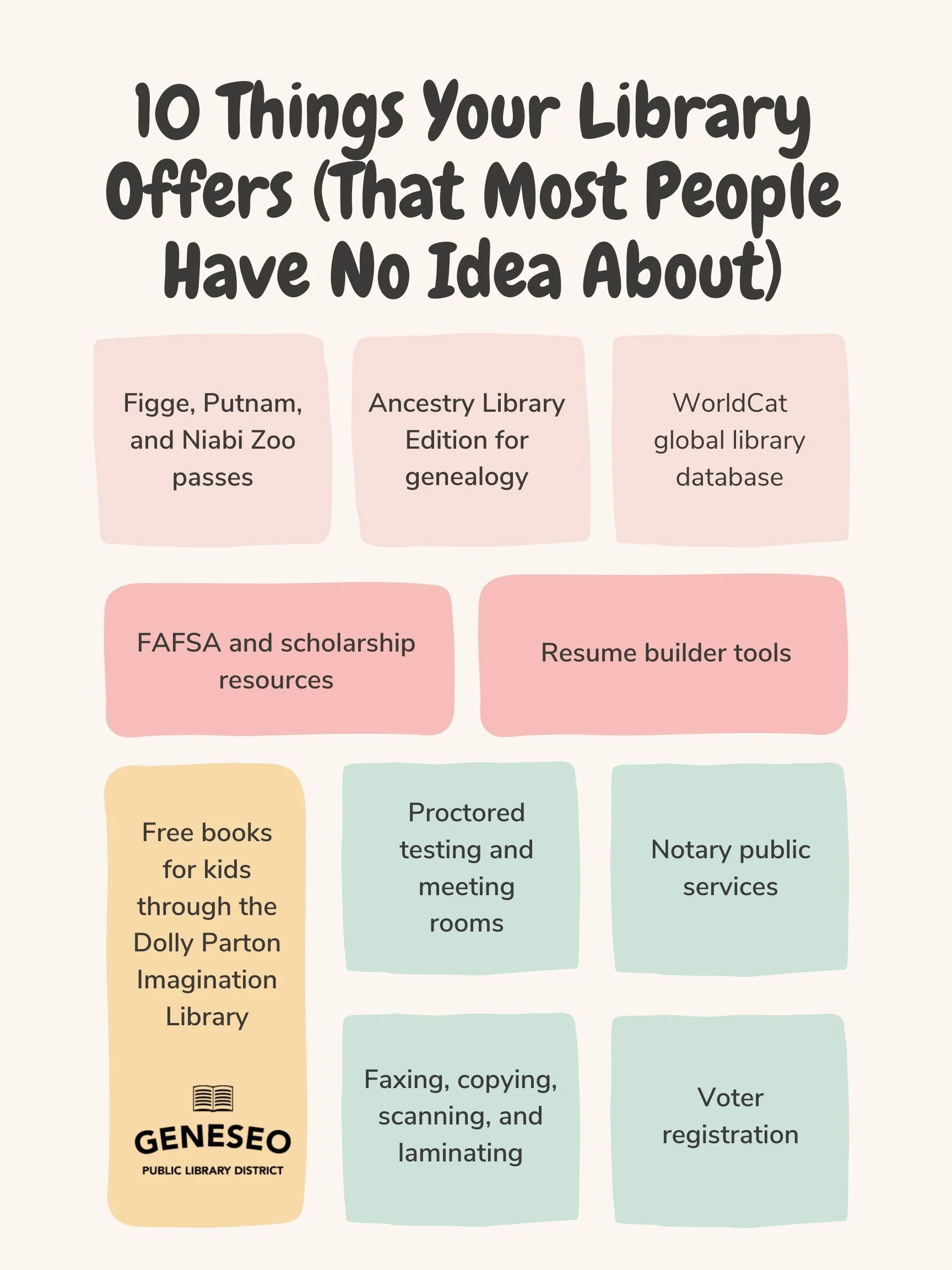
A look through the library's programs and services shows an institution that also functions as a technology center, meeting place, children's activity space, local-history resource, entertainment provider and, occasionally, the place to go when you need something laminated, notarized or faxed.
For residents who haven't looked closely at what their library card — or simply a visit to the building — provides, there may be a few surprises.
Movies, Audiobooks and Digital Reading From Home
A trip to the library does not necessarily require leaving the house.
Geneseo library patrons have access to several digital services through their library cards.
Libby provides ebooks and audiobooks that can be borrowed digitally and enjoyed on a phone, tablet or other compatible device.
The library also provides access to Kanopy, a streaming service offering movies and other video programming, as well as Hoopla, which gives Geneseo patrons access to additional digital content.
Those services extend the library's collection well beyond what can physically fit inside the building.
Computers, Wi-Fi and Help When Technology Doesn't Cooperate
Free wireless internet is available throughout the library.
The library also maintains eight public internet stations at no charge. The computers include Microsoft Word, Publisher and Excel, and patrons can scan documents to the public computers.
Two additional computers are available for homework and personal projects that do not require internet access. A large-screen computer with larger buttons is also available for patrons with visual impairments.
For children, three computers in the children's room include games and learning activities without internet access.
The library also recognizes that simply providing a computer doesn't always solve the problem.
Staff can provide limited computer assistance for specific issues. Patrons who need additional help can arrange a 30-minute one-on-one computer assistance appointment.
The library may also offer basic computer instruction based on community interest and can help patrons locate more extensive training opportunities.
Printing, Scanning, Faxing and Lamination
Some of the library's most practical services have little to do with reading.
A public copier is available for letter- and legal-size copies, including double-sided copying and enlargement or reduction. Black-and-white and color copying are available.
The library can also scan documents and email them or save them to a patron's flash drive. A public-use scanner is available as well.
Need to send an old-fashioned fax? The library can do that, too. Both sending and receiving fax services are available.
Lamination is another service offered for smaller documents and standard letter-size pages.
Fees apply to some of these services.
Need Something Notarized? The Library May Be Able to Help
Several library staff members are notaries public.
Patrons are encouraged to call before visiting to make sure a notary is working at that time.
The library can also register Henry County residents to vote. Residents need to bring two forms of identification showing their current address.
Those offerings make the library a place residents can turn for routine civic and administrative needs as well as recreation.
Researching Geneseo — or Your Own Family
For anyone curious about local history or genealogy, the library maintains dedicated resources.
Two computers in the Genealogy/Local History room provide access to Ancestry Library Edition for public use.
A separate computer is available for reading microfilm.
The genealogy and local-history resources give residents a way to trace family histories, research former residents and explore Geneseo's past using resources that may not be readily available from home.
Starting Young — Very Young
Some of the library's programming begins before children are old enough to read for themselves.
The Rubber Ducky Club is designed for children from birth through age 3 and their caregivers, combining simple stories, songs, movement and rhymes.
Story Time gives older preschool children an opportunity to enjoy stories and a craft.
The library also offers Music Time with Miss Tina, led by an early childhood music education specialist, with separate sessions designed for different age groups.
Art from a Cart gives children an opportunity to get creative with provided art supplies, while visits from therapy dogs give young readers a particularly patient audience as they practice reading aloud.
For older children and teens, programming has included Dungeons & Dragons Adventures, designed to be beginner-friendly with materials provided.
1,000 Books Before Kindergarten
The library encourages families to make reading part of everyday life long before a child enters a classroom.
Through 1,000 Books Before Kindergarten, families can sign up at the library and receive a reading log.
Parents and caregivers record the books they read with their children. The same favorite book can count again when a child inevitably asks to hear it for the 47th time.
Completed logs are returned to the library as families work toward the 1,000-book goal.
The idea is simple: build a habit of reading together before formal schooling begins.
They'll Help You Sign Up for Dolly Parton's Imagination Library
Families with young children can also get help enrolling in Dolly Parton's Imagination Library.
The well-known early literacy program sends participating children free, age-appropriate books in the mail, helping families build a home library during a child's earliest years.
Library staff can help families with the enrollment process, making the public library a starting point for getting books into children's hands both inside the library and at home.
Community Art, Quilts and Collections
The library also provides space for local residents to show what they create and collect.
Local quilters regularly display their work near the library entrance, while works from area artists are featured elsewhere in the building. Exhibits rotate throughout the year.
Collectors can get involved, too.
The library invites residents to share their own collections in display cases, giving everything from childhood collections to adult hobbies a temporary place in the spotlight.
It's another way the building serves as a showcase for the interests, creativity and history of people who live here.
Speakers, Clubs and Programs for Adults
Adult programming extends well beyond traditional book discussions.
The library brings in speakers and presenters covering entertainment, history, food, culture and other subjects.
Programs have included presentations exploring television history, American cookbooks, and beekeeping.
The library also hosts book discussions and other activities throughout the year, with offerings changing as new programs are scheduled.
There's Even a Book Sale
For people who prefer owning their books, the library maintains an ongoing book sale area.
Books, magazines and DVDs are added regularly.
The library accepts some donations of saleable materials during regular operating hours, provided items are in good condition. There are restrictions on some types of donated materials, so residents with larger donations or questions may want to check with the library first.
More Than a Place to Check Something Out
Taken together, the offerings paint a much broader picture of what a modern public library does.
One person might walk through the doors looking for a novel.
Someone else may be there to research a great-grandparent, use a computer, register to vote, get a document notarized, laminate a page, entertain a toddler, learn a new skill, work on a puzzle or get help signing a child up to receive free books through Dolly Parton's Imagination Library.
Others may never enter the building at all that day, instead using their library card to download an audiobook or stream something from home.
The Geneseo Public Library District's mission includes meeting residents' personal, educational, recreational and cultural needs while encouraging lifelong learning and reading.
Sometimes that involves a book. Sometimes it doesn't.
What Illinois Schools Are Required to Teach — And Who Makes Sure They Do
Learn what Illinois public schools are required to teach, which curriculum decisions remain local, and how the state monitors compliance and performance.
Read moreThe Current Launches ‘Ask Geneseo,’ Putting Your Questions to Local Leaders
There are plenty of questions people in Geneseo would like to ask the people making decisions, running organizations and leading our community.

Sometimes the answer is easy to find. Sometimes it requires more explanation than a meeting agenda, social media post or short news story can provide.
That’s the idea behind Ask Geneseo, a new program from The Geneseo Current designed to create a direct line between community members and local leaders.
The concept is simple: You submit the questions. We take them to the people who can answer them.
We’ll invite local leaders and others with firsthand knowledge into the studio for recorded conversations built around questions submitted by Geneseo-area residents. Those conversations will be edited into podcast-style episodes and made available through The Current.
This isn’t intended to be a press conference or a debate. It’s an opportunity to slow things down, ask questions people are actually wondering about and give guests enough time to explain their answers.
What can you ask?
Questions can cover the issues, projects and decisions affecting life in and around Geneseo.
Some questions may be straightforward: When will this project be finished?
Others may require more explanation: Why was this decision made? How much will it cost? Who is paying for it? What happens next?
Ask Geneseo gives us room for both.
Will every submitted question be asked?
No.
We expect some topics may generate many questions, including several asking essentially the same thing. We may combine similar submissions or select the question that most clearly represents the broader issue.
Questions selected for the program should generally be:
Timely — connected to a current issue, decision, project or community conversation.
Widely applicable — something whose answer would be useful or interesting to more than one individual.
Relevant — connected to the guest's role, responsibilities or firsthand knowledge.
We will not select questions simply because they are provocative, and Ask Geneseo isn't intended to resolve individual disputes, complaints or highly personal situations through a public podcast.
At the same time, difficult questions aren't automatically off limits. If something is timely, relevant and matters to the broader community, it can be worth asking even when the answer may be complicated or uncomfortable.
The Current will make the final editorial decisions about which submitted questions are included.
What happens after you submit a question?
We'll review submissions and look for recurring themes and questions with broad community relevance.
When we schedule a guest who can address those topics, we'll use selected questions to help shape the conversation. We may also ask follow-up questions during the interview when an answer needs clarification or raises another relevant issue.
The finished conversation will then be edited for clarity, length and listening experience before publication.
Editing will not be used to change the meaning of a guest's answer.
Why are we doing this?
Local news shouldn't only tell you what happened. When possible, it should also help you understand why it happened, how it affects you and what comes next.
And sometimes the best question isn't the one we thought to ask.
You live here. You drive the roads, pay the taxes, send kids to school, use local services, attend community events and watch decisions being made. You have questions.
Ask Geneseo gives you a place to ask them.
We can't promise we'll ask every question submitted.
We can promise we'll be listening.
Ask Geneseo
You ask. We ask. Geneseo answers.
Geneseo School Board Approves FY27 Budget, Working Cash Transfer
Geneseo CUSD 228 approved its FY27 budget along with a military-connected student resolution, permanent working cash transfer, diesel fuel bid and consent agenda items.
Read moreGHS Homecoming Court 2026 Named at Pep Rally
Geneseo High School named its full 2026 Homecoming Court, with Connor Runty and Alex Bagby selected king and queen and attendants representing all four classes as part of the school’s Mardi Gras-themed festivities.
Read more