
Richmond Hill Players has received the Illinois Theatre Association’s 2026 Award of Excellence in Community Theatre, recognizing its contributions to theatre in Illinois.
Read moreState Street Market Returns to Downtown Geneseo October 3
One of Geneseo’s favorite fall traditions returns Saturday, October 3, as State Street Market takes over historic Downtown Geneseo for a full day of shopping, food, music and fall fun.
The free, open-air market will run from 10 a.m. to 4 p.m. along State Street and will feature a curated collection of vendors from Geneseo and throughout the Midwest offering vintage finds, handmade goods, home décor, clothing, accessories and other unique items.
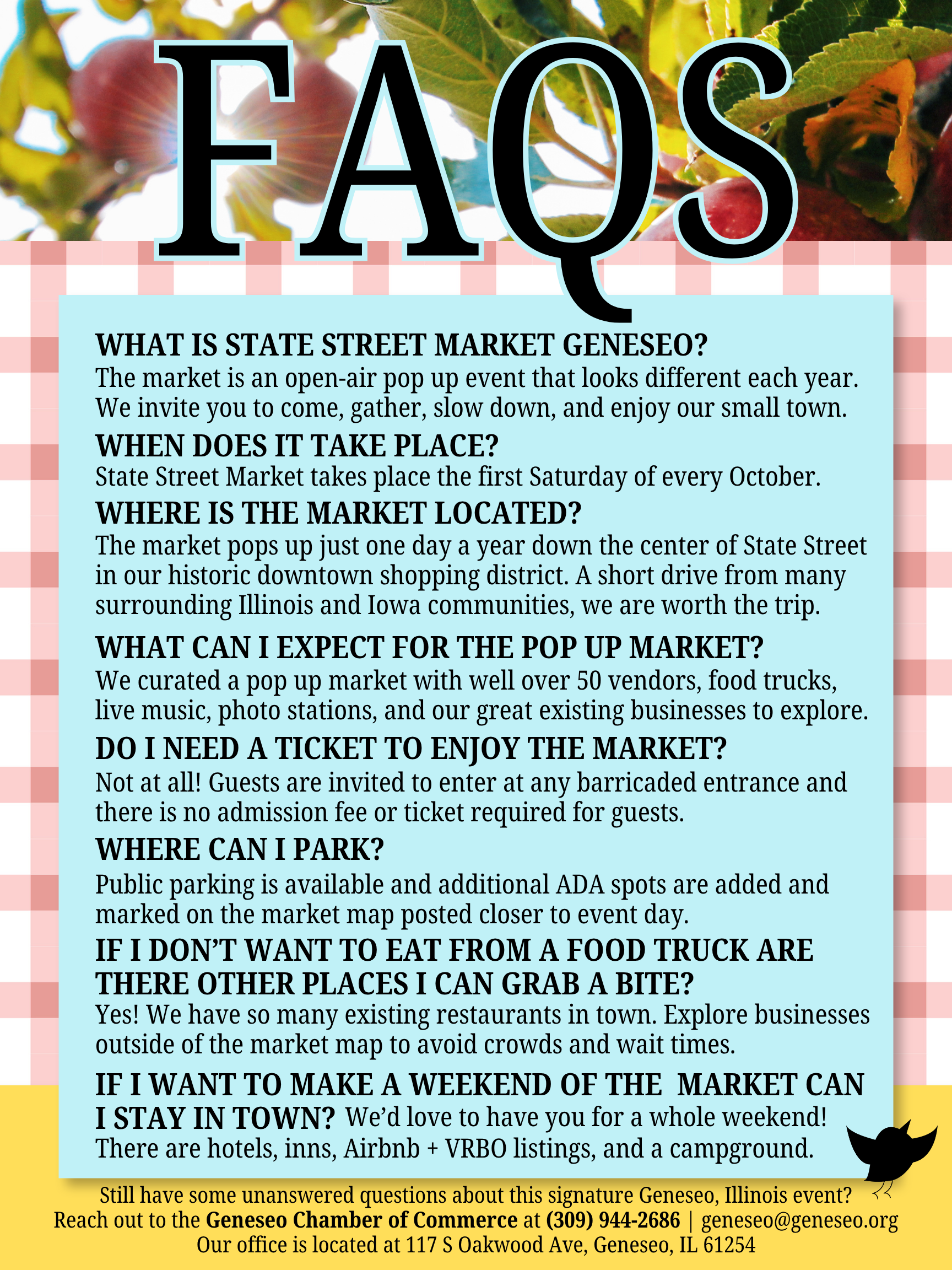
More than just a market, the event is an opportunity to spend the day experiencing Geneseo. Visitors are encouraged to shop the market, explore Geneseo’s locally owned stores, grab lunch or drinks at downtown restaurants and enjoy live entertainment throughout the day.
“State Street Market is one of those days that really shows off what makes Geneseo special,” said Lindsie Akers, Executive Director of the Geneseo Chamber of Commerce. “You have a great outdoor market right in the middle of our historic downtown, but you also have all of our local shops, restaurants and businesses to explore. It’s a perfect excuse to make a day of Geneseo.”
Food trucks and vendors will be located downtown throughout the event, with seating available for visitors to stop, eat and enjoy the atmosphere. Live music and entertainment will also take place throughout the market.
State Street Market has grown into a regional fall destination, welcoming shoppers and vendors from throughout Illinois and the surrounding Midwest. Geneseo is conveniently located just off Interstate 80 at Exit 19, making the market an easy day trip from the Quad Cities, Peoria, Chicagoland and surrounding communities.
State Street Market Geneseo
Saturday, October 3, 2026
10 a.m.–4 p.m.
Downtown Geneseo, Illinois
Admission is free.
Additional vendor, food and entertainment announcements will be shared leading up to the event.
For updates, follow State Street Market Geneseo on Instagram at @statestreetmarketgeneseo.
For more information, contact the Geneseo Chamber of Commerce at 309-944-2686 or geneseo@geneseo.org.
GIFT Opens Fall Grant Cycle for Geneseo Nonprofits
Geneseo nonprofits can apply for up to $1,500 through the GIFT Community Foundation’s fall grant cycle. Applications are due Oct. 15, with awards announced Oct. 31.
Read moreHow Expensive Is Geneseo City Government? A Look at Three Similar Illinois Communities
When residents see a city budget totaling tens of millions of dollars, it can be difficult to tell whether local government is actually expensive.
One problem is that Geneseo's total budget includes its electric, water and sewer utilities. Comparing that total with cities that operate different services can be misleading.
A more useful comparison comes from the Illinois Comptroller's Fiscal Responsibility Report Cards, which provide standardized financial information for municipalities across the state.
Using fiscal year 2024 data, The Geneseo Current compared Geneseo with Princeton, Mendota and Monmouth — three Illinois communities of similar size.
The results show Geneseo spending less on general government services than all three.
Spending per resident
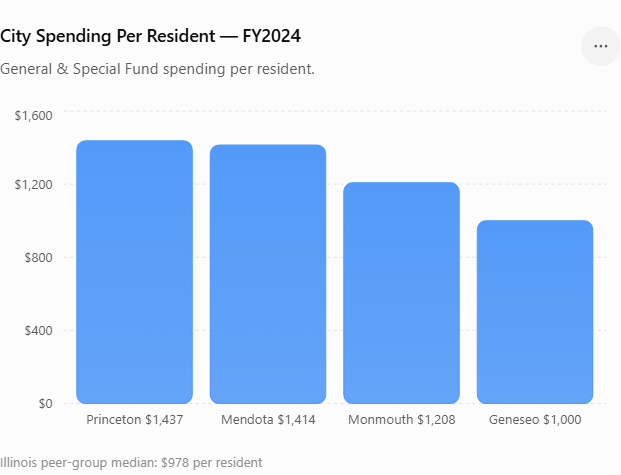
Geneseo's $1,000 per resident was approximately 17% below Monmouth, 29% below Mendota and 30% below Princeton.
The Illinois Comptroller reports an average of $1,191 per resident and a median of $978 among municipalities in the same broad population category.
That puts Geneseo about 16% below the statewide group average but very close to the median.
But among these three regional comparison communities, its governmental spending is clearly the lowest.
Geneseo also finished with substantial reserves
Spending tells only part of the story.
Geneseo began fiscal 2024 with approximately $10.89 million in General and Special Fund balances and ended with approximately $12.23 million.
That equals $1,870 per resident.
The city's ending fund balance represented approximately 187% of annual General and Special Fund expenditures.
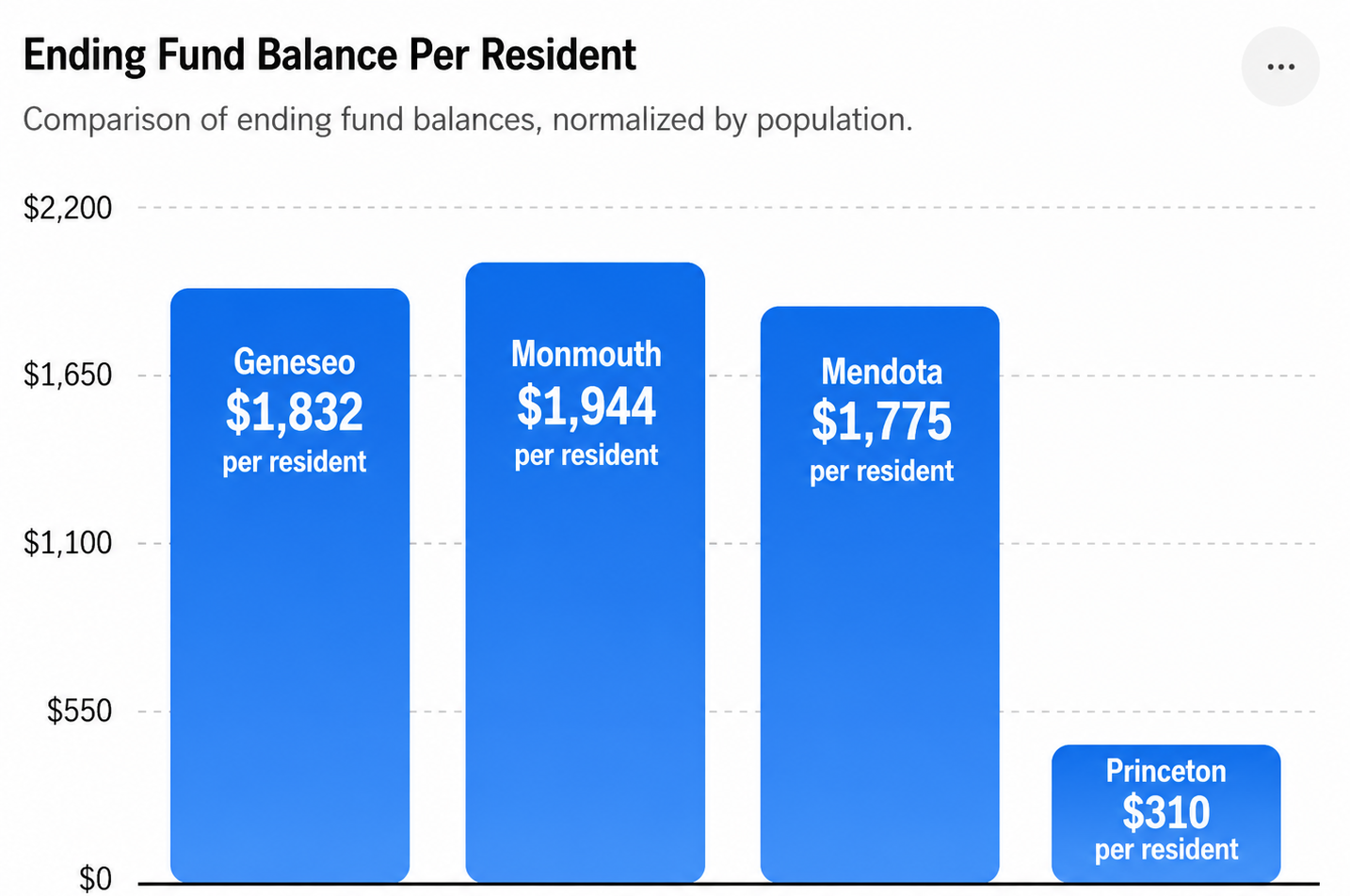
Fund balances aren't necessarily money available for immediate spending. They can include restricted or committed funds, reserves and money intended for future expenses.
Geneseo doesn’t simply have fewer employees
Geneseo reported 60 full-time and 24 part-time employees, with approximately $4.98 million in salaries paid.
That's about 9.2 full-time employees for every 1,000 residents.
Princeton had a nearly identical ratio, with 70 full-time employees serving a larger population.
That suggests Geneseo's lower General and Special Fund spending isn't simply the result of maintaining a smaller workforce.
Utilities make the overall budget look much larger
This is where municipal comparisons become complicated.
In addition to its General and Special Funds, Geneseo reported approximately $12.10 million in enterprise-fund expenses.
These funds include business-like operations such as municipal utilities, which are largely supported by charges for services.
Geneseo's enterprise operations generated approximately $13.05 million in revenue during FY2024.
Because cities don't all own and operate the same utilities, comparing their total budgets can create a distorted picture of how much ordinary city government costs.
Debt tells a different story
Geneseo reported approximately $22.66 million in outstanding debt, or about $3,465 per resident.
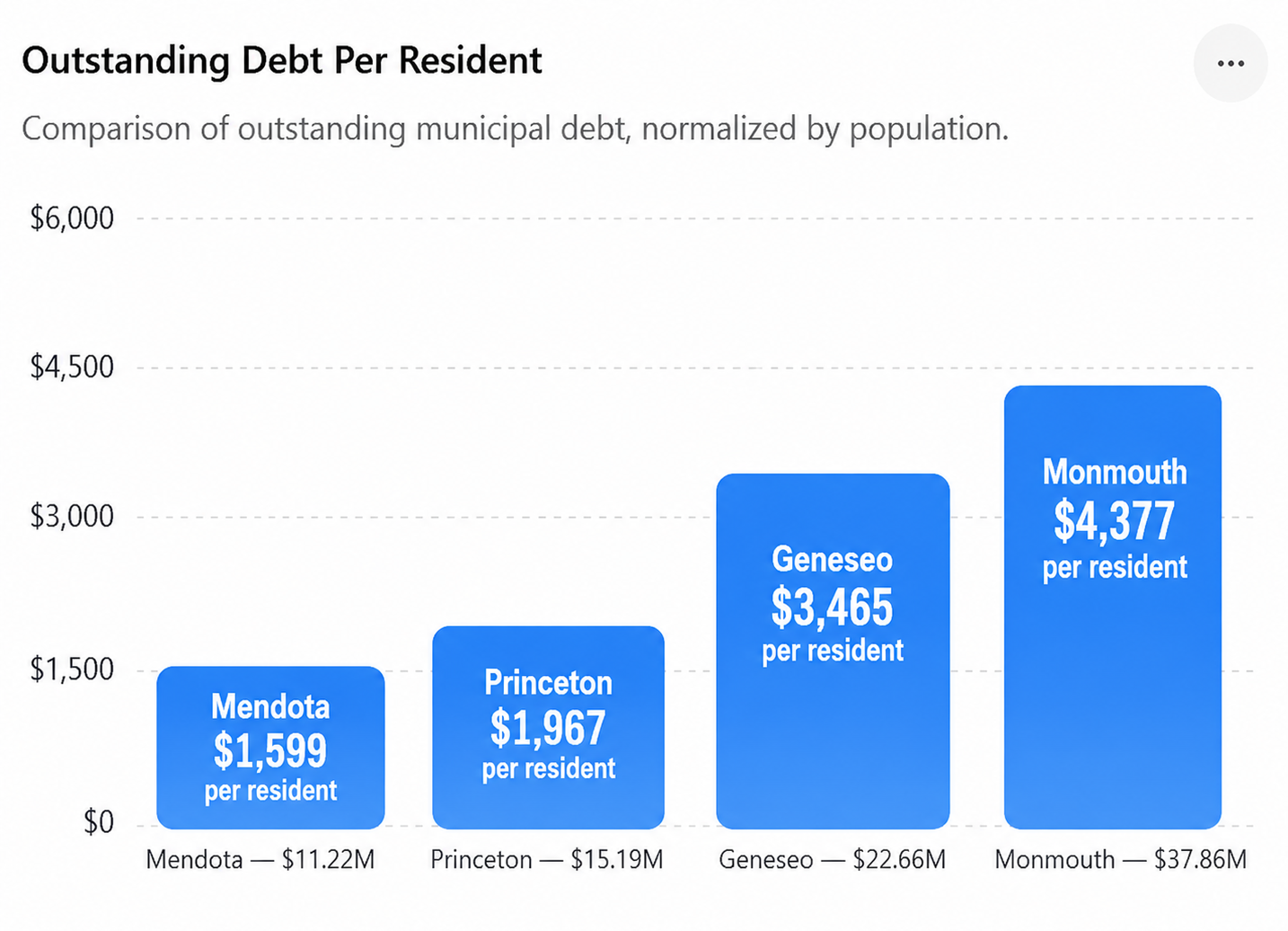
That was more per resident than Princeton or Mendota, but less than Monmouth.
However, the state's debt figure includes debt associated with both governmental and proprietary activities. In Geneseo's case, that means debt connected with municipal utility infrastructure can be included.
The number therefore shouldn't be interpreted as General Fund debt alone.
So, is Geneseo city government expensive?
The FY2024 numbers don't produce a simple yes-or-no answer.
On one of the best standardized measures available, Geneseo spent about $1,000 per resident through its General and Special Funds. That was close to the statewide median and lower than Princeton, Mendota and Monmouth.
At the same time, Geneseo maintained substantial fund balances, operated a sizable municipal workforce and utility system, and carried significant infrastructure-related debt.
Taken together, the numbers show a city with moderate governmental spending, substantial reserves and significant municipal infrastructure to operate and maintain.
That provides a more useful picture than Geneseo's total city budget alone.
Beyond the Books: What You Might Not Know the Geneseo Library Offers
From streaming movies and genealogy research to children's programs, computer help, voter registration and even puzzle swaps, the Geneseo Public Library offers considerably more than shelves of books.
For generations, the public library has been a place to find something to read.
That is still a big part of what happens at the Geneseo Public Library District — but it is far from the whole story.
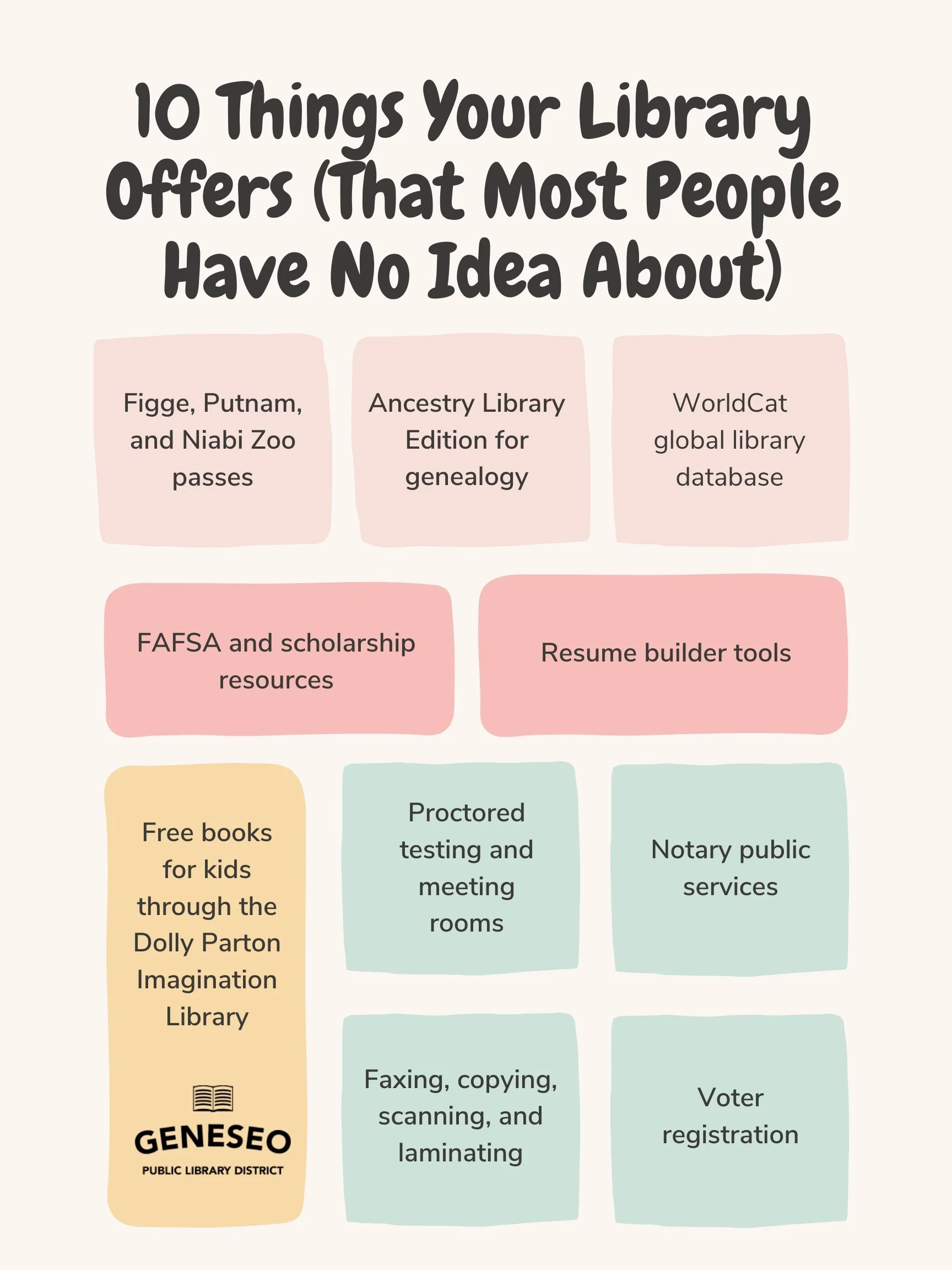
A look through the library's programs and services shows an institution that also functions as a technology center, meeting place, children's activity space, local-history resource, entertainment provider and, occasionally, the place to go when you need something laminated, notarized or faxed.
For residents who haven't looked closely at what their library card — or simply a visit to the building — provides, there may be a few surprises.
Movies, Audiobooks and Digital Reading From Home
A trip to the library does not necessarily require leaving the house.
Geneseo library patrons have access to several digital services through their library cards.
Libby provides ebooks and audiobooks that can be borrowed digitally and enjoyed on a phone, tablet or other compatible device.
The library also provides access to Kanopy, a streaming service offering movies and other video programming, as well as Hoopla, which gives Geneseo patrons access to additional digital content.
Those services extend the library's collection well beyond what can physically fit inside the building.
Computers, Wi-Fi and Help When Technology Doesn't Cooperate
Free wireless internet is available throughout the library.
The library also maintains eight public internet stations at no charge. The computers include Microsoft Word, Publisher and Excel, and patrons can scan documents to the public computers.
Two additional computers are available for homework and personal projects that do not require internet access. A large-screen computer with larger buttons is also available for patrons with visual impairments.
For children, three computers in the children's room include games and learning activities without internet access.
The library also recognizes that simply providing a computer doesn't always solve the problem.
Staff can provide limited computer assistance for specific issues. Patrons who need additional help can arrange a 30-minute one-on-one computer assistance appointment.
The library may also offer basic computer instruction based on community interest and can help patrons locate more extensive training opportunities.
Printing, Scanning, Faxing and Lamination
Some of the library's most practical services have little to do with reading.
A public copier is available for letter- and legal-size copies, including double-sided copying and enlargement or reduction. Black-and-white and color copying are available.
The library can also scan documents and email them or save them to a patron's flash drive. A public-use scanner is available as well.
Need to send an old-fashioned fax? The library can do that, too. Both sending and receiving fax services are available.
Lamination is another service offered for smaller documents and standard letter-size pages.
Fees apply to some of these services.
Need Something Notarized? The Library May Be Able to Help
Several library staff members are notaries public.
Patrons are encouraged to call before visiting to make sure a notary is working at that time.
The library can also register Henry County residents to vote. Residents need to bring two forms of identification showing their current address.
Those offerings make the library a place residents can turn for routine civic and administrative needs as well as recreation.
Researching Geneseo — or Your Own Family
For anyone curious about local history or genealogy, the library maintains dedicated resources.
Two computers in the Genealogy/Local History room provide access to Ancestry Library Edition for public use.
A separate computer is available for reading microfilm.
The genealogy and local-history resources give residents a way to trace family histories, research former residents and explore Geneseo's past using resources that may not be readily available from home.
Starting Young — Very Young
Some of the library's programming begins before children are old enough to read for themselves.
The Rubber Ducky Club is designed for children from birth through age 3 and their caregivers, combining simple stories, songs, movement and rhymes.
Story Time gives older preschool children an opportunity to enjoy stories and a craft.
The library also offers Music Time with Miss Tina, led by an early childhood music education specialist, with separate sessions designed for different age groups.
Art from a Cart gives children an opportunity to get creative with provided art supplies, while visits from therapy dogs give young readers a particularly patient audience as they practice reading aloud.
For older children and teens, programming has included Dungeons & Dragons Adventures, designed to be beginner-friendly with materials provided.
1,000 Books Before Kindergarten
The library encourages families to make reading part of everyday life long before a child enters a classroom.
Through 1,000 Books Before Kindergarten, families can sign up at the library and receive a reading log.
Parents and caregivers record the books they read with their children. The same favorite book can count again when a child inevitably asks to hear it for the 47th time.
Completed logs are returned to the library as families work toward the 1,000-book goal.
The idea is simple: build a habit of reading together before formal schooling begins.
They'll Help You Sign Up for Dolly Parton's Imagination Library
Families with young children can also get help enrolling in Dolly Parton's Imagination Library.
The well-known early literacy program sends participating children free, age-appropriate books in the mail, helping families build a home library during a child's earliest years.
Library staff can help families with the enrollment process, making the public library a starting point for getting books into children's hands both inside the library and at home.
Community Art, Quilts and Collections
The library also provides space for local residents to show what they create and collect.
Local quilters regularly display their work near the library entrance, while works from area artists are featured elsewhere in the building. Exhibits rotate throughout the year.
Collectors can get involved, too.
The library invites residents to share their own collections in display cases, giving everything from childhood collections to adult hobbies a temporary place in the spotlight.
It's another way the building serves as a showcase for the interests, creativity and history of people who live here.
Speakers, Clubs and Programs for Adults
Adult programming extends well beyond traditional book discussions.
The library brings in speakers and presenters covering entertainment, history, food, culture and other subjects.
Programs have included presentations exploring television history, American cookbooks, and beekeeping.
The library also hosts book discussions and other activities throughout the year, with offerings changing as new programs are scheduled.
There's Even a Book Sale
For people who prefer owning their books, the library maintains an ongoing book sale area.
Books, magazines and DVDs are added regularly.
The library accepts some donations of saleable materials during regular operating hours, provided items are in good condition. There are restrictions on some types of donated materials, so residents with larger donations or questions may want to check with the library first.
More Than a Place to Check Something Out
Taken together, the offerings paint a much broader picture of what a modern public library does.
One person might walk through the doors looking for a novel.
Someone else may be there to research a great-grandparent, use a computer, register to vote, get a document notarized, laminate a page, entertain a toddler, learn a new skill, work on a puzzle or get help signing a child up to receive free books through Dolly Parton's Imagination Library.
Others may never enter the building at all that day, instead using their library card to download an audiobook or stream something from home.
The Geneseo Public Library District's mission includes meeting residents' personal, educational, recreational and cultural needs while encouraging lifelong learning and reading.
Sometimes that involves a book. Sometimes it doesn't.
What Illinois Schools Are Required to Teach — And Who Makes Sure They Do
Learn what Illinois public schools are required to teach, which curriculum decisions remain local, and how the state monitors compliance and performance.
Read moreThe Current Launches ‘Ask Geneseo,’ Putting Your Questions to Local Leaders
There are plenty of questions people in Geneseo would like to ask the people making decisions, running organizations and leading our community.
Sometimes the answer is easy to find. Sometimes it requires more explanation than a meeting agenda, social media post or short news story can provide.
That’s the idea behind Ask Geneseo, a new program from The Geneseo Current designed to create a direct line between community members and local leaders.
The concept is simple: You submit the questions. We take them to the people who can answer them.
We’ll invite local leaders and others with firsthand knowledge into the studio for recorded conversations built around questions submitted by Geneseo-area residents. Those conversations will be edited into podcast-style episodes and made available through The Current.
This isn’t intended to be a press conference or a debate. It’s an opportunity to slow things down, ask questions people are actually wondering about and give guests enough time to explain their answers.
What can you ask?
Questions can cover the issues, projects and decisions affecting life in and around Geneseo.
Some questions may be straightforward: When will this project be finished?
Others may require more explanation: Why was this decision made? How much will it cost? Who is paying for it? What happens next?
Ask Geneseo gives us room for both.
Will every submitted question be asked?
No.
We expect some topics may generate many questions, including several asking essentially the same thing. We may combine similar submissions or select the question that most clearly represents the broader issue.
Questions selected for the program should generally be:
Timely — connected to a current issue, decision, project or community conversation.
Widely applicable — something whose answer would be useful or interesting to more than one individual.
Relevant — connected to the guest's role, responsibilities or firsthand knowledge.
We will not select questions simply because they are provocative, and Ask Geneseo isn't intended to resolve individual disputes, complaints or highly personal situations through a public podcast.
At the same time, difficult questions aren't automatically off limits. If something is timely, relevant and matters to the broader community, it can be worth asking even when the answer may be complicated or uncomfortable.
The Current will make the final editorial decisions about which submitted questions are included.
What happens after you submit a question?
We'll review submissions and look for recurring themes and questions with broad community relevance.
When we schedule a guest who can address those topics, we'll use selected questions to help shape the conversation. We may also ask follow-up questions during the interview when an answer needs clarification or raises another relevant issue.
The finished conversation will then be edited for clarity, length and listening experience before publication.
Editing will not be used to change the meaning of a guest's answer.
Why are we doing this?
Local news shouldn't only tell you what happened. When possible, it should also help you understand why it happened, how it affects you and what comes next.
And sometimes the best question isn't the one we thought to ask.
You live here. You drive the roads, pay the taxes, send kids to school, use local services, attend community events and watch decisions being made. You have questions.
Ask Geneseo gives you a place to ask them.
We can't promise we'll ask every question submitted.
We can promise we'll be listening.
Ask Geneseo
You ask. We ask. Geneseo answers.
Geneseo School Board Approves FY27 Budget, Working Cash Transfer
Geneseo CUSD 228 approved its FY27 budget along with a military-connected student resolution, permanent working cash transfer, diesel fuel bid and consent agenda items.
Read moreGHS Homecoming Court 2026 Named at Pep Rally
Geneseo High School named its full 2026 Homecoming Court, with Connor Runty and Alex Bagby selected king and queen and attendants representing all four classes as part of the school’s Mardi Gras-themed festivities.
Read moreTV50 to Replay Sept. 11, 2001 Local News Coverage in Real Time Friday Morning
TV50 will mark the 25th anniversary of Sept. 11 by replaying local television news coverage from Sept. 11, 2001, in real time Friday morning, beginning at 7:45 a.m.
Read moreGeneseo Council Approves Route 82 Traffic Study for Proposed Sports Complex
Geneseo City Council advanced several community projects Tuesday, approving a Route 82 study for the proposed sports complex while discussing the pedestrian bridge, wind turbines, completed city projects and the success of Richmond Hill Rocks.
Read moreTheme Dress Days to Celebrate Homecoming Week at GHS
The homecoming court will be announced at a pep rally at 7 p.m. on Thursday, Sept. 10, at Bob Reade Football Field, and will include a king and queen, duke and duchess and lord and lady from the senior class, and two attendants from each of the freshman, sophomore and junior classes.
Read moreTrains, Planes & Automobiles Marks 20 Years in Geneseo
Trains, Planes & Automobiles celebrates its 20th year in Geneseo Sept. 10–12, bringing a weekend of transportation-themed events, activities and entertainment to the community.
Read moreTour of the Heartland Returns to Geneseo Sept. 19 with Rides Up to 100 Miles
The Tour of the Heartland returns to Geneseo Sept. 19, offering cyclists 25-, 50-, 75- and 100-mile routes through the rural countryside.
Read moreWomen’s Health Series Luncheons Begin Sept. 24
Hammond-Henry Hospital’s Women’s Health Series returns Sept. 24, offering luncheon programs focused on women’s health, wellness and education throughout the coming months.
Read moreNew Illinois AI Guidance Puts Local Schools in the Driver’s Seat
Illinois has released new guidance for AI in schools, leaving local districts to decide how the technology fits into classrooms, policies, privacy and student learning.
Read moreInside the Rules Communities Are Using to Rein In Data Center Impacts
As Henry County studies data centers during its temporary moratorium, it is not the only local government examining how existing zoning rules apply to a type of development that can bring unusually large demands for electricity, water and supporting infrastructure.
Communities in Illinois, Iowa, Virginia, Georgia and elsewhere have adopted data-center-specific ordinances or revised existing zoning codes. Their approaches differ, but the ordinances provide examples of the issues local governments have chosen to address before or during the approval of a project.
Henry County's Planning and Development Committee considered a resolution for a temporary moratorium on new data centers in June. The moratorium gives the county time to study the issue before new projects move through the zoning process.
No single ordinance provides a standard model. Local authority also varies by state. However, existing ordinances show several recurring areas of regulation: where data centers may locate, water use, noise, setbacks, utilities, roads, emergency planning, environmental studies and what happens when a facility eventually closes.
Linn County Requires Water Study and Agreements
One of the closest regional examples is Linn County, Iowa.
In February 2026, the Linn County Board of Supervisors approved an ordinance establishing separate zoning rules for small and large data centers in unincorporated portions of the county.
The ordinance addresses building setbacks, noise, traffic and road impacts, emergency planning and site-plan review. Large-scale projects face additional requirements.
Before a large data center can proceed, the developer must complete a water study describing the project's water source, anticipated consumption, cooling method, efficiency measures, reliability and potential effects on existing groundwater and surface-water users.
The developer must also enter into a water-use agreement with Linn County. That agreement addresses monitoring, reporting, information sharing and procedures that could apply during droughts, emergencies or other periods of constrained water supply.
Linn County also requires an economic development agreement for a large-scale data center. The agreement establishes any incentives the project will receive and contributions associated with the development. County documents state that it must include a community fund that can support infrastructure, public services, environmental protection and workforce development. It may also include measures addressing nearby property values.
The county subsequently placed an 18-month moratorium on new applications to rezone property for large-scale data centers beginning July 1, 2026.
County officials said the additional review would consider cumulative effects involving public infrastructure, water, electrical infrastructure, emergency response, transportation and long-range land-use planning.
An Illinois Community Requires Special-Use Approval
Troy, Illinois, provides an example from within the state.
Under Troy's ordinance, data centers are permitted only in the city's I-2 General Industry zoning district and require a special-use permit.
The review includes the project's relationship to surrounding and planned land uses, building design, parking, traffic, road capacity, utility demand, site access, signage and environmental effects. The applicant must provide confirmation from utility providers that adequate facilities are available and submit a noise study.
Troy also establishes specific operating noise limits.
Stationary noise adjacent to residential land uses cannot exceed 60 decibels during the day or 55 decibels at night. The limit adjacent to nonresidential uses is 70 decibels.
The ordinance further reduces permissible levels when sound contains discrete tones or impulsive characteristics. It requires an existing ambient-noise study and allows post-construction testing to determine whether an operating facility complies with the limits.
Those provisions demonstrate one distinction found in some data-center ordinances: rather than relying entirely on a general noise ordinance, the regulations establish standards specifically for the facility.
Albemarle County Uses Setbacks and Cooling Requirements
Albemarle County, Virginia, regulates the physical location and operation of data centers through measurable standards.
Existing regulations require data-center buildings and associated equipment — including generators, HVAC systems and battery backup equipment — to be at least 200 feet from property lines and 500 feet from the county's Rural Areas zoning district.
Data centers must use public water and sewer. If water is used for cooling, the system must be closed-loop or use recycled water.
Generator testing is another regulated activity.
Routine generator maintenance is limited to weekdays between 10 a.m. and 4 p.m. Generators must use enclosures that limit sound to 70 dBA measured 23 feet from the generator, while the facility remains subject to the county's overall property-line noise requirements.
The county has also studied additional requirements involving landscaping, equipment screening, building appearance and post-construction noise testing. Its draft standards included three staggered rows of evergreen trees in certain locations and requirements intended to break up the appearance of large building facades.
Albemarle's experience also illustrates that local regulatory authority differs by state. The county states that Virginia law allows it to regulate matters such as zoning districts, setbacks, building size, height, noise and landscaping, but does not give it zoning authority to regulate a data center based on factors such as energy consumption or customers served.
Jones County Requires 100 Acres and a Decommissioning Bond
Jones County, Georgia, adopted detailed data-center regulations in January 2026.
A data center is not permitted as a matter of right in any zoning district. It requires conditional-use approval in the county's M-2 district.
The regulations establish a minimum site size of 100 acres. Buildings and equipment generally must be at least 200 feet from property lines, while structures generating noise are subject to a 400-foot setback.
The county establishes noise limits of 55 dBA during the day and 45 dBA at night at property lines. Generator testing is restricted to one weekday test period per week between 11 a.m. and 1 p.m.
Applications must include sound modeling.
Water requirements are also specific.
Jones County requires closed-loop cooling or equivalent technology designed to minimize water consumption. Non-closed-loop and evaporative cooling systems are prohibited.
Data centers must use a public water supply, and wells cannot be drilled or operated to supply the facility.
Applicants must also submit a traffic-impact study and a baseline environmental-impact study addressing potential effects involving air quality, water, energy generation, noise, lighting, traffic, natural resources and archaeological or cultural resources.
Planning for the End of a Facility
Jones County's ordinance addresses an issue that occurs potentially decades after a zoning application is approved: decommissioning.
A building-permit application must contain a decommissioning plan describing how electronic equipment and other materials will be managed, recycled or disposed of.
The requirement applies not only when the entire facility closes but also to electronic waste generated through future equipment replacement and technological upgrades.
The developer must provide financial security, such as a bond or letter of credit, sufficient to cover the county's estimated cost of decommissioning the facility.
Wastewater is addressed separately. Data centers must connect to a publicly owned sewer system. Where public sewer is unavailable, the ordinance prohibits on-site wastewater treatment and disposal systems.
Applicants must estimate wastewater volumes and explain the treatment and disposal of process wastewater, including flows associated with cooling and water-treatment systems.
Different Ordinances Address Different Stages of Development
The ordinances reviewed do not regulate data centers identically.
Some focus heavily on the initial land-use decision. Troy requires special-use approval and evaluates compatibility, traffic, utilities and noise before a project is approved.
Others establish detailed operating standards. Albemarle regulates setbacks, cooling systems and generator testing, while Jones County establishes property-line noise limits and cooling requirements.
Linn County adds another layer by requiring agreements governing water use and economic development in addition to ordinary zoning requirements.
Jones County extends regulation to the end of the facility's useful life through a decommissioning plan and financial surety requirement.
Together, the ordinances identify several questions local governments have addressed when developing data-center regulations:
Where can a data center be located?
Is it permitted by right or does each project require discretionary approval?
How far must buildings, generators and cooling equipment be located from neighboring properties?
What noise levels are allowed during daytime and nighttime hours?
Is sound modeling required before construction and testing required afterward?
Where can the facility obtain water?
What cooling technologies are permitted?
How is water consumption measured and reported?
Can groundwater be used?
What utility-capacity information must be supplied before approval?
What road and traffic studies are required?
What emergency planning is required?
What environmental information must an applicant provide?
What landscaping or screening is required?
Are development incentives and community contributions addressed through a separate agreement?
What happens when equipment is replaced or a facility permanently closes?
Is the developer required to provide financial security for eventual decommissioning?
For Henry County, the examples provide a record of the subjects other local governments have chosen to address as they developed regulations for a land use that may not have been specifically contemplated when their existing zoning codes were written.
Source Documents

Geneseo Sports Complex Could Take Another Step Forward Tuesday
Geneseo City Council will consider a key Route 82 access study Tuesday that could help determine the next steps for the proposed Seth Ernst Memorial Sports Complex.
Read moreGeneseo Model Railroaders to Display Operating Layouts During Trains, Planes, & Automobiles
The Geneseo Model Railroaders Club, invite the public to see their display of operating layouts during the 20th anniversary of the Trains, Planes & Automobiles festivities.
Read moreErnie Haase & Signature Sound Bringing ‘Then & Now’ Tour to Geneseo
One of Southern Gospel music's best-known quartets will bring a special reunion-style performance to Geneseo this fall.
Ernie Haase & Signature Sound will present its Then & Now concert at 6 p.m. Sunday, Oct. 4, at Kingswood Church, 302 N. State St., Geneseo.
Admission is free, and no tickets are required.
Rather than featuring only the group's current lineup, Then & Now brings together musicians from different eras of Signature Sound for a concert built around more than two decades of the group's music.
The current quartet of Ernie Haase, Doug Anderson, Dustin Doyle and Christopher Taylor will be joined by former members Ryan Seaton, Tim Duncan and Roy Webb during the limited-date tour.
The concept is exactly what the name suggests: part look back, part presentation of where the group is today.
Audiences can expect newer Signature Sound material alongside songs associated with earlier versions of the group, creating what promoters describe as a greatest-hits celebration combining harmony, humor and the high-energy performance style that has become a Signature Sound trademark.
More than two decades of Signature Sound
Haase formed Ernie Haase & Signature Sound in 2003, following a career that had already made him a recognizable name in Southern Gospel.
He spent approximately a decade singing tenor with the legendary Cathedral Quartet, a group he had admired since he was young. After The Cathedrals retired, Haase eventually formed Signature Sound and developed the quartet into an act with an international following.
The group's profile grew substantially through its appearances with the Gaither Homecoming series. Its 2007 release Get Away Jordan became an important breakout project, reaching No. 1 on sales charts and helping establish the quartet's energetic visual performance style with a much wider audience.
Since then, the group has performed at venues ranging from churches to Carnegie Hall and the Grand Ole Opry, while also appearing internationally in countries including South Africa, New Zealand, Romania and the Netherlands.
Ernie Haase & Signature Sound has received four collective Grammy nominations and six GMA Dove Awards, along with multiple Gold and Platinum-certified long-form video releases.
Bringing the earlier lineup back
The reunion component is what makes the Then & Now tour unusual.
Former bass singer Tim Duncan, former lead singer Ryan Seaton and longtime pianist and arranger Roy Webb were part of the era that helped establish Signature Sound nationally. They will share the stage with Haase, Anderson and members of today's group during the tour.
Promotional information for the tour notes that it has been more than 20 years since the original lineup performed together, giving longtime listeners an opportunity to hear some of the voices associated with the group's early years alongside its current sound.
The tour itself is relatively limited. Current listings show Then & Now performances in September and October, including stops in South Dakota, Kentucky, Bloomington, Geneseo and Michigan.
That makes the Geneseo appearance somewhat unusual for a community of this size.
Still recording new music
Then & Now isn't simply a nostalgia tour.
Signature Sound remains an active recording and touring group. Its recent projects have pushed beyond traditional Southern Gospel while retaining the quartet's four-part harmony.
The group's A Jazzy Little Christmas reached the Top 10 on Billboard's Jazz Albums chart, while the 29-song Decades of Love applied the Signature Sound treatment to standards including music associated with several generations of popular music.
More recently, the group released America: Land of Hopes and Dreams, built around patriotic, gospel and familiar American songs as the nation marked its 250th anniversary year.
Signature Sound's official biography describes the quartet's approach as one centered on four-part harmony and songs of hope — but with a willingness to stretch the boundaries of what audiences might expect from a Southern Gospel quartet.
The Then & Now concert brings those two sides of the group together: the music that built its following and the performers continuing that tradition today.
