
TV50 will mark the 25th anniversary of Sept. 11 by replaying local television news coverage from Sept. 11, 2001, in real time Friday morning, beginning at 7:45 a.m.
Read moreGeneseo Council Approves Route 82 Traffic Study for Proposed Sports Complex
Geneseo City Council advanced several community projects Tuesday, approving a Route 82 study for the proposed sports complex while discussing the pedestrian bridge, wind turbines, completed city projects and the success of Richmond Hill Rocks.
Read moreTheme Dress Days to Celebrate Homecoming Week at GHS
The homecoming court will be announced at a pep rally at 7 p.m. on Thursday, Sept. 10, at Bob Reade Football Field, and will include a king and queen, duke and duchess and lord and lady from the senior class, and two attendants from each of the freshman, sophomore and junior classes.
Read moreTrains, Planes & Automobiles Marks 20 Years in Geneseo
Trains, Planes & Automobiles celebrates its 20th year in Geneseo Sept. 10–12, bringing a weekend of transportation-themed events, activities and entertainment to the community.
Read moreTour of the Heartland Returns to Geneseo Sept. 19 with Rides Up to 100 Miles
The Tour of the Heartland returns to Geneseo Sept. 19, offering cyclists 25-, 50-, 75- and 100-mile routes through the rural countryside.
Read moreWomen’s Health Series Luncheons Begin Sept. 24
Hammond-Henry Hospital’s Women’s Health Series returns Sept. 24, offering luncheon programs focused on women’s health, wellness and education throughout the coming months.
Read moreNew Illinois AI Guidance Puts Local Schools in the Driver’s Seat
Illinois has released new guidance for AI in schools, leaving local districts to decide how the technology fits into classrooms, policies, privacy and student learning.
Read moreInside the Rules Communities Are Using to Rein In Data Center Impacts
As Henry County studies data centers during its temporary moratorium, it is not the only local government examining how existing zoning rules apply to a type of development that can bring unusually large demands for electricity, water and supporting infrastructure.
Communities in Illinois, Iowa, Virginia, Georgia and elsewhere have adopted data-center-specific ordinances or revised existing zoning codes. Their approaches differ, but the ordinances provide examples of the issues local governments have chosen to address before or during the approval of a project.
Henry County's Planning and Development Committee considered a resolution for a temporary moratorium on new data centers in June. The moratorium gives the county time to study the issue before new projects move through the zoning process.

No single ordinance provides a standard model. Local authority also varies by state. However, existing ordinances show several recurring areas of regulation: where data centers may locate, water use, noise, setbacks, utilities, roads, emergency planning, environmental studies and what happens when a facility eventually closes.
Linn County Requires Water Study and Agreements
One of the closest regional examples is Linn County, Iowa.
In February 2026, the Linn County Board of Supervisors approved an ordinance establishing separate zoning rules for small and large data centers in unincorporated portions of the county.
The ordinance addresses building setbacks, noise, traffic and road impacts, emergency planning and site-plan review. Large-scale projects face additional requirements.
Before a large data center can proceed, the developer must complete a water study describing the project's water source, anticipated consumption, cooling method, efficiency measures, reliability and potential effects on existing groundwater and surface-water users.
The developer must also enter into a water-use agreement with Linn County. That agreement addresses monitoring, reporting, information sharing and procedures that could apply during droughts, emergencies or other periods of constrained water supply.
Linn County also requires an economic development agreement for a large-scale data center. The agreement establishes any incentives the project will receive and contributions associated with the development. County documents state that it must include a community fund that can support infrastructure, public services, environmental protection and workforce development. It may also include measures addressing nearby property values.
The county subsequently placed an 18-month moratorium on new applications to rezone property for large-scale data centers beginning July 1, 2026.
County officials said the additional review would consider cumulative effects involving public infrastructure, water, electrical infrastructure, emergency response, transportation and long-range land-use planning.
An Illinois Community Requires Special-Use Approval
Troy, Illinois, provides an example from within the state.
Under Troy's ordinance, data centers are permitted only in the city's I-2 General Industry zoning district and require a special-use permit.
The review includes the project's relationship to surrounding and planned land uses, building design, parking, traffic, road capacity, utility demand, site access, signage and environmental effects. The applicant must provide confirmation from utility providers that adequate facilities are available and submit a noise study.
Troy also establishes specific operating noise limits.
Stationary noise adjacent to residential land uses cannot exceed 60 decibels during the day or 55 decibels at night. The limit adjacent to nonresidential uses is 70 decibels.
The ordinance further reduces permissible levels when sound contains discrete tones or impulsive characteristics. It requires an existing ambient-noise study and allows post-construction testing to determine whether an operating facility complies with the limits.
Those provisions demonstrate one distinction found in some data-center ordinances: rather than relying entirely on a general noise ordinance, the regulations establish standards specifically for the facility.
Albemarle County Uses Setbacks and Cooling Requirements
Albemarle County, Virginia, regulates the physical location and operation of data centers through measurable standards.
Existing regulations require data-center buildings and associated equipment — including generators, HVAC systems and battery backup equipment — to be at least 200 feet from property lines and 500 feet from the county's Rural Areas zoning district.
Data centers must use public water and sewer. If water is used for cooling, the system must be closed-loop or use recycled water.
Generator testing is another regulated activity.
Routine generator maintenance is limited to weekdays between 10 a.m. and 4 p.m. Generators must use enclosures that limit sound to 70 dBA measured 23 feet from the generator, while the facility remains subject to the county's overall property-line noise requirements.
The county has also studied additional requirements involving landscaping, equipment screening, building appearance and post-construction noise testing. Its draft standards included three staggered rows of evergreen trees in certain locations and requirements intended to break up the appearance of large building facades.
Albemarle's experience also illustrates that local regulatory authority differs by state. The county states that Virginia law allows it to regulate matters such as zoning districts, setbacks, building size, height, noise and landscaping, but does not give it zoning authority to regulate a data center based on factors such as energy consumption or customers served.
Jones County Requires 100 Acres and a Decommissioning Bond
Jones County, Georgia, adopted detailed data-center regulations in January 2026.
A data center is not permitted as a matter of right in any zoning district. It requires conditional-use approval in the county's M-2 district.
The regulations establish a minimum site size of 100 acres. Buildings and equipment generally must be at least 200 feet from property lines, while structures generating noise are subject to a 400-foot setback.
The county establishes noise limits of 55 dBA during the day and 45 dBA at night at property lines. Generator testing is restricted to one weekday test period per week between 11 a.m. and 1 p.m.
Applications must include sound modeling.
Water requirements are also specific.
Jones County requires closed-loop cooling or equivalent technology designed to minimize water consumption. Non-closed-loop and evaporative cooling systems are prohibited.
Data centers must use a public water supply, and wells cannot be drilled or operated to supply the facility.
Applicants must also submit a traffic-impact study and a baseline environmental-impact study addressing potential effects involving air quality, water, energy generation, noise, lighting, traffic, natural resources and archaeological or cultural resources.
Planning for the End of a Facility
Jones County's ordinance addresses an issue that occurs potentially decades after a zoning application is approved: decommissioning.
A building-permit application must contain a decommissioning plan describing how electronic equipment and other materials will be managed, recycled or disposed of.
The requirement applies not only when the entire facility closes but also to electronic waste generated through future equipment replacement and technological upgrades.
The developer must provide financial security, such as a bond or letter of credit, sufficient to cover the county's estimated cost of decommissioning the facility.
Wastewater is addressed separately. Data centers must connect to a publicly owned sewer system. Where public sewer is unavailable, the ordinance prohibits on-site wastewater treatment and disposal systems.
Applicants must estimate wastewater volumes and explain the treatment and disposal of process wastewater, including flows associated with cooling and water-treatment systems.
Different Ordinances Address Different Stages of Development
The ordinances reviewed do not regulate data centers identically.
Some focus heavily on the initial land-use decision. Troy requires special-use approval and evaluates compatibility, traffic, utilities and noise before a project is approved.
Others establish detailed operating standards. Albemarle regulates setbacks, cooling systems and generator testing, while Jones County establishes property-line noise limits and cooling requirements.
Linn County adds another layer by requiring agreements governing water use and economic development in addition to ordinary zoning requirements.
Jones County extends regulation to the end of the facility's useful life through a decommissioning plan and financial surety requirement.
Together, the ordinances identify several questions local governments have addressed when developing data-center regulations:
Where can a data center be located?
Is it permitted by right or does each project require discretionary approval?
How far must buildings, generators and cooling equipment be located from neighboring properties?
What noise levels are allowed during daytime and nighttime hours?
Is sound modeling required before construction and testing required afterward?
Where can the facility obtain water?
What cooling technologies are permitted?
How is water consumption measured and reported?
Can groundwater be used?
What utility-capacity information must be supplied before approval?
What road and traffic studies are required?
What emergency planning is required?
What environmental information must an applicant provide?
What landscaping or screening is required?
Are development incentives and community contributions addressed through a separate agreement?
What happens when equipment is replaced or a facility permanently closes?
Is the developer required to provide financial security for eventual decommissioning?
For Henry County, the examples provide a record of the subjects other local governments have chosen to address as they developed regulations for a land use that may not have been specifically contemplated when their existing zoning codes were written.
Source Documents

Geneseo Sports Complex Could Take Another Step Forward Tuesday
Geneseo City Council will consider a key Route 82 access study Tuesday that could help determine the next steps for the proposed Seth Ernst Memorial Sports Complex.
Read moreGeneseo Model Railroaders to Display Operating Layouts During Trains, Planes, & Automobiles
The Geneseo Model Railroaders Club, invite the public to see their display of operating layouts during the 20th anniversary of the Trains, Planes & Automobiles festivities.
Read moreErnie Haase & Signature Sound Bringing ‘Then & Now’ Tour to Geneseo
One of Southern Gospel music's best-known quartets will bring a special reunion-style performance to Geneseo this fall.
Ernie Haase & Signature Sound will present its Then & Now concert at 6 p.m. Sunday, Oct. 4, at Kingswood Church, 302 N. State St., Geneseo.
Admission is free, and no tickets are required.
Rather than featuring only the group's current lineup, Then & Now brings together musicians from different eras of Signature Sound for a concert built around more than two decades of the group's music.
The current quartet of Ernie Haase, Doug Anderson, Dustin Doyle and Christopher Taylor will be joined by former members Ryan Seaton, Tim Duncan and Roy Webb during the limited-date tour.
The concept is exactly what the name suggests: part look back, part presentation of where the group is today.
Audiences can expect newer Signature Sound material alongside songs associated with earlier versions of the group, creating what promoters describe as a greatest-hits celebration combining harmony, humor and the high-energy performance style that has become a Signature Sound trademark.
More than two decades of Signature Sound
Haase formed Ernie Haase & Signature Sound in 2003, following a career that had already made him a recognizable name in Southern Gospel.
He spent approximately a decade singing tenor with the legendary Cathedral Quartet, a group he had admired since he was young. After The Cathedrals retired, Haase eventually formed Signature Sound and developed the quartet into an act with an international following.
The group's profile grew substantially through its appearances with the Gaither Homecoming series. Its 2007 release Get Away Jordan became an important breakout project, reaching No. 1 on sales charts and helping establish the quartet's energetic visual performance style with a much wider audience.
Since then, the group has performed at venues ranging from churches to Carnegie Hall and the Grand Ole Opry, while also appearing internationally in countries including South Africa, New Zealand, Romania and the Netherlands.
Ernie Haase & Signature Sound has received four collective Grammy nominations and six GMA Dove Awards, along with multiple Gold and Platinum-certified long-form video releases.
Bringing the earlier lineup back
The reunion component is what makes the Then & Now tour unusual.
Former bass singer Tim Duncan, former lead singer Ryan Seaton and longtime pianist and arranger Roy Webb were part of the era that helped establish Signature Sound nationally. They will share the stage with Haase, Anderson and members of today's group during the tour.
Promotional information for the tour notes that it has been more than 20 years since the original lineup performed together, giving longtime listeners an opportunity to hear some of the voices associated with the group's early years alongside its current sound.
The tour itself is relatively limited. Current listings show Then & Now performances in September and October, including stops in South Dakota, Kentucky, Bloomington, Geneseo and Michigan.
That makes the Geneseo appearance somewhat unusual for a community of this size.
Still recording new music
Then & Now isn't simply a nostalgia tour.
Signature Sound remains an active recording and touring group. Its recent projects have pushed beyond traditional Southern Gospel while retaining the quartet's four-part harmony.
The group's A Jazzy Little Christmas reached the Top 10 on Billboard's Jazz Albums chart, while the 29-song Decades of Love applied the Signature Sound treatment to standards including music associated with several generations of popular music.
More recently, the group released America: Land of Hopes and Dreams, built around patriotic, gospel and familiar American songs as the nation marked its 250th anniversary year.
Signature Sound's official biography describes the quartet's approach as one centered on four-part harmony and songs of hope — but with a willingness to stretch the boundaries of what audiences might expect from a Southern Gospel quartet.
The Then & Now concert brings those two sides of the group together: the music that built its following and the performers continuing that tradition today.
Geneseo School Board to Consider FY27 Budget, Enrollment Decline at September Meeting
Geneseo CUSD 228 will consider its proposed FY27 budget at the Sept. 10 school board meeting, along with declining enrollment, district finances, personnel changes and strategic goals.
Read moreThe Current Launches Election 2026 Guide for Henry County Voters
The Geneseo Current launches its Election 2026 Guide, bringing Henry County voters important dates, voting information, offices on the ballot, candidate coverage and election results in one place.
Read moreGeneseo City Hall Fountain Part of Larger Landscaping, Security Project
Geneseo’s City Hall landscaping project included a new fountain, updated landscaping and a vehicle security barrier. Here’s how the project moved from capital planning to construction.
Read moreFederal Extension Keeps Chicago–Quad Cities Passenger Rail Project Moving Forward
A federal grant extension keeps the long-delayed Chicago–Quad Cities passenger rail project moving forward, preserving funding for the proposed route through Geneseo to Moline.
Read moreGeneseo Seniors Have More Than Bingo: 11 Free Ways to Get Out This Fall
Geneseo seniors can enjoy 11 free activities this fall at the Geneseo Community Center, including fitness, games, social events, educational programs and more.
Read more‘Tis the Season’: Geneseo Marching Band Brings Christmas to Bob Reade Field
Geneseo High School’s marching band brings Christmas to Bob Reade Field with its 2026 show, “‘Tis the Season,” featuring holiday favorites, Pentatonix arrangements and festive surprises
Read moreGrace United Methodist GUMDROPS Program Resumes in October
Grace United Methodist Church’s GUMDROPS program returns to Geneseo this October, offering weekly play, stories, activities, snacks and crafts for children ages 2–5 and their caregivers.
Read moreGeneseo Road Cart Now at Home in Museum Carriage House
The Geneseo Road Cart, once considered one of the finest horse-drawn vehicles of its time, has made its way from its long-time home at Klavine Motor Co., across Center St., to its new destination in the Geneseo Historical Museum Carriage House
Read moreThe Future of Data Centers in Henry County, Part 4
How Will Henry County Decide?
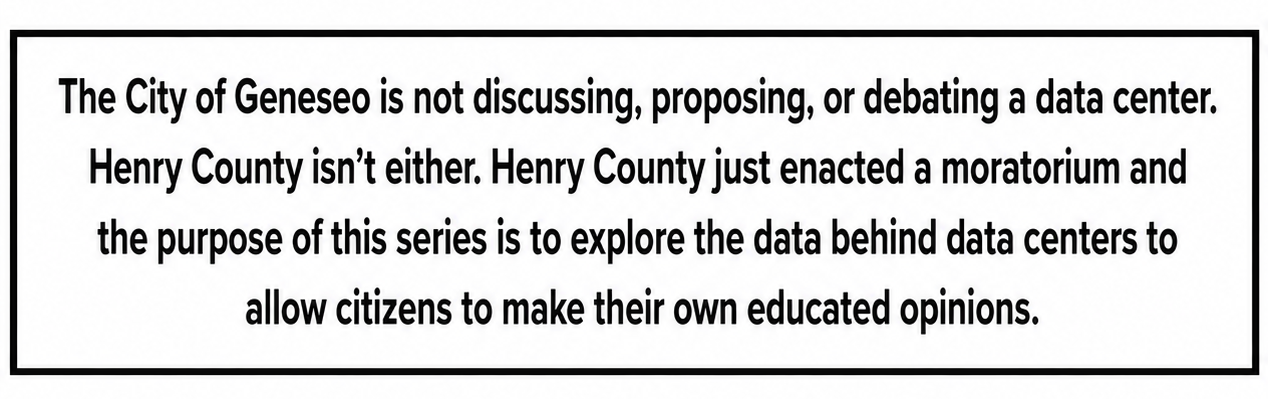
Over the past three weeks, we've explored why the demand for data centers has grown so rapidly, examined the potential benefits and concerns they present, and looked at the questions Henry County hopes to answer during its one-year moratorium.
If a company eventually proposes building a data center in Henry County, one question will remain:
How will the decision actually be made?
The answer is through a public process involving multiple boards, agencies, technical experts, utility providers and, ultimately, the residents of Henry County.
A project of this size would not be approved in a single meeting, nor would it be decided by one elected official.
Instead, it would likely move through months of review, public discussion, and technical evaluation.
Public Input Starts Before the Vote
One of the biggest misconceptions about local government is that public participation happens only after a decision has already been made. In reality, public input is most valuable before elected officials cast their votes.
Residents often know local conditions better than anyone else. They understand traffic patterns, drainage issues, nearby neighborhoods, agricultural concerns, emergency response capabilities, and the history of previous developments.
Just as importantly, they often ask questions government officials or developers may not have considered.
A strong public process doesn't guarantee everyone will agree with the outcome. It does help ensure decisions are made with the best available information.
The Role of the Planning & Development Committee
The Henry County Planning & Development Committee would likely be one of the first groups to review a proposed project. Its responsibility isn't simply to decide whether members personally support or oppose a development.
Instead, the committee examines whether the proposal complies with county ordinances and whether additional conditions or recommendations should be considered before forwarding the project to the full County Board.
Committee members may review issues such as:
Zoning compatibility
Site location
Land use
Infrastructure
Utility availability
Environmental considerations
Public comments
Proposed conditions of approval
The committee's recommendation helps shape the discussion but does not necessarily determine the final outcome.
The Role of the County Board
Ultimately, significant land-use decisions rest with the Henry County Board.
Board members must balance many competing priorities, including:
Economic development
Property rights
Agriculture
Infrastructure
Public safety
Long-term planning
Fiscal responsibility
Community concerns
Board members are responsible not only for today's residents but also for decisions that may affect the county for decades.
Their vote represents the final local policy decision after technical reviews and public input have been considered.
Who Else May Be Involved?
A project of this size would likely involve far more than county government.
Depending on the proposal, reviews or approvals could involve:
Electric Utility Providers
Determining whether sufficient electrical capacity exists.
Evaluating substations and transmission needs.
Planning infrastructure improvements.
Water Providers
Reviewing water availability.
Determining service capacity.
Evaluating impacts on existing customers.
Henry County Office of Emergency Management
Reviewing emergency response plans.
Coordinating with fire protection districts.
Identifying specialized training needs.
Fire Protection Districts
Evaluating fire suppression systems.
Reviewing emergency access.
Planning response procedures.
Illinois Environmental Protection Agency (if applicable)
Reviewing permits related to environmental regulations.
Evaluating wastewater or other regulated activities when required.
Illinois Department of Transportation (if applicable)
Reviewing access to state highways if necessary.
Other state or federal agencies may also become involved depending on the size, location and specific features of a proposed project.
What Does a Zoning Hearing Look Like?
For many residents, a zoning hearing may be unfamiliar.
While every hearing is different, the process generally follows a structured format.
It often includes:
Staff presentation summarizing the proposal.
The developer presents the project.
Questions from committee or commission members.
Public comments from supporters, opponents, and neighboring property owners.
Additional questions from officials.
Deliberation.
A recommendation or vote.
The purpose of the hearing is not simply to count supporters and opponents.
It is to create a public record, gather facts and allow decision-makers to evaluate testimony before making a recommendation.
Questions Worth Asking
Public meetings are often most productive when residents focus on information rather than positions.
Instead of asking only, "Should we allow a data center?" residents may find it more helpful to ask:
About Infrastructure
Can the electrical grid support the project?
Will roads require improvements?
Who pays for those improvements?
About Water
How much water will be used?
What type of cooling system is proposed?
Could nearby users be affected?
About the Economy
How many permanent jobs are expected?
What tax revenue is projected?
Are tax incentives being requested?
What local businesses could benefit?
About Community Impact
How will noise be measured?
What landscaping or screening is planned?
How will neighboring properties be protected?
About the Future
What happens if ownership changes?
What happens if the facility closes?
Who is responsible for removing equipment or restoring the property?
Questions like these move the conversation beyond opinions and toward informed decision-making.
If a Proposal Is Approved
Approval would not necessarily mean construction begins the next day.
Developers may still need to:
Finalize engineering plans.
Obtain permits.
Complete utility agreements.
Meet conditions established by the county.
Coordinate with contractors.
Begin infrastructure improvements.
Construction itself could take months or even years, depending on the project's size.
Throughout that process, developers would generally remain responsible for complying with local ordinances, permit requirements and any conditions attached to the approval.
If a Proposal Is Denied
A denial does not necessarily end the conversation forever.
Depending on the circumstances, a developer might:
Revise the proposal.
Select another location.
Wait until county regulations change.
Appeal through legal processes if permitted under applicable law.
Likewise, the county could continue refining its ordinances as technology and community priorities evolve.
Local land-use planning is an ongoing process, not a one-time decision.
An Informed Community Makes Better Decisions
Throughout this series, one message has remained consistent.
The discussion about data centers should not begin with "yes" or "no."
It should begin with information.
Henry County's moratorium provides time to understand an industry that is expanding rapidly across the country, to develop thoughtful local regulations and to ensure that if a proposal ever arrives, it will be evaluated through a transparent public process.
Whether Henry County eventually welcomes a data center or decides another path is best, residents deserve a process that is open, informed and grounded in facts.
Editor's Note
This four-part series was created to explain one of the fastest-growing industries in the world and how it could intersect with Henry County in the years ahead. It was not intended to advocate for or against data centers, but to provide readers with the background needed to participate in an informed public conversation if a proposal is ever brought before the county.
Additional resources on both sides of the issues
Lawrence Berkeley National Laboratory- Center of Expertise for Data Center Energy
Roosevelt Institute- AI’s Physical Footprint: The Environmental Consequences of Super Data Centers
Coalition for Responsible Data Center Development- Data Center Opposition Report
US Department of Energy- Cooling Water Efficiency Opportunities for Federal Data Centers
